Desk Setup Procrastination: Three Rough Lines Before More Tweaks

The 8:47 PM Desk Setup Procrastination Loop
“If you are an early-career UX writer in London who can spend twenty minutes aligning a keyboard before opening the Google Doc that matters, you may recognize perfectionism procrastination in a very tidy disguise.” I said this to Jordan as they settled into the chair across from me.
At 8:47 PM on a Tuesday in their small second-floor flat in Hackney, Jordan had squared the keyboard with the desk edge, coiled the charging cable, and wiped one faint mark beside an open Google Doc. I could still smell the citrus cleaner in the room. The radiator clicked behind us, and Jordan's phone felt warm in their palm as they looked at the blank page.
“I am not procrastinating,” they told me. “I am getting ready. Once the desk is right, the work will feel easier.” But the work that mattered was a UX writing brief due for review, and the planned work block had already begun without one new line in the document. Their jaw tightened whenever they looked at the cursor. Their hands found another cable whenever the tension became too noticeable.
I saw performance anxiety not as an abstract label, but as a small metal clamp around the mouth, restless fingers searching for a harmless object to fix, and a brief release in the chest whenever the surface looked orderly. Shame and frustration arrived a few minutes later, usually carrying the same promise: tomorrow, the setup would be even better.
A tidy desk can be a very convincing form of avoidance. I did not say that as an accusation. I said it because I have spent twenty years listening to people try to make one visible part of life perfect when another part feels personally exposed. “I do not think you are lazy,” I told Jordan. “I think the desk has become a place where you can feel in control. Let us make a map through that pattern and see what your own judgment has been trying to protect.”

Choosing a Ladder Instead of a Verdict
I asked Jordan to put both feet on the floor, take one slow breath, and hold the question without trying to improve it. Then I shuffled the cards slowly, using the movement as a practical transition from arranging the room to examining the problem. I was not asking the deck to predict a career outcome. I was giving Jordan a focused surface on which to notice a pattern already present in daily life.
For this reading, I chose the Four-Layer Insight Ladder - Context Edition. I explain the choice because it shows how tarot works here: the cards are reflective symbols, and the spread is a structure for moving from an observable behavior to the belief beneath it, then toward agency and a small experiment.
This was an F5 Inner Excavation case. The visible issue was a perfectionism-procrastination loop maintained by control and fear of judgment, so a Celtic Cross would have added broad life areas that Jordan had not asked about. A shadow-focused spread might have named the hidden fear, but it would not have made the practical integration step as clear. Four positions were enough to examine the presenting behavior, the root mechanism, the transformational lever, and the next workable action without turning the reading into a verdict.
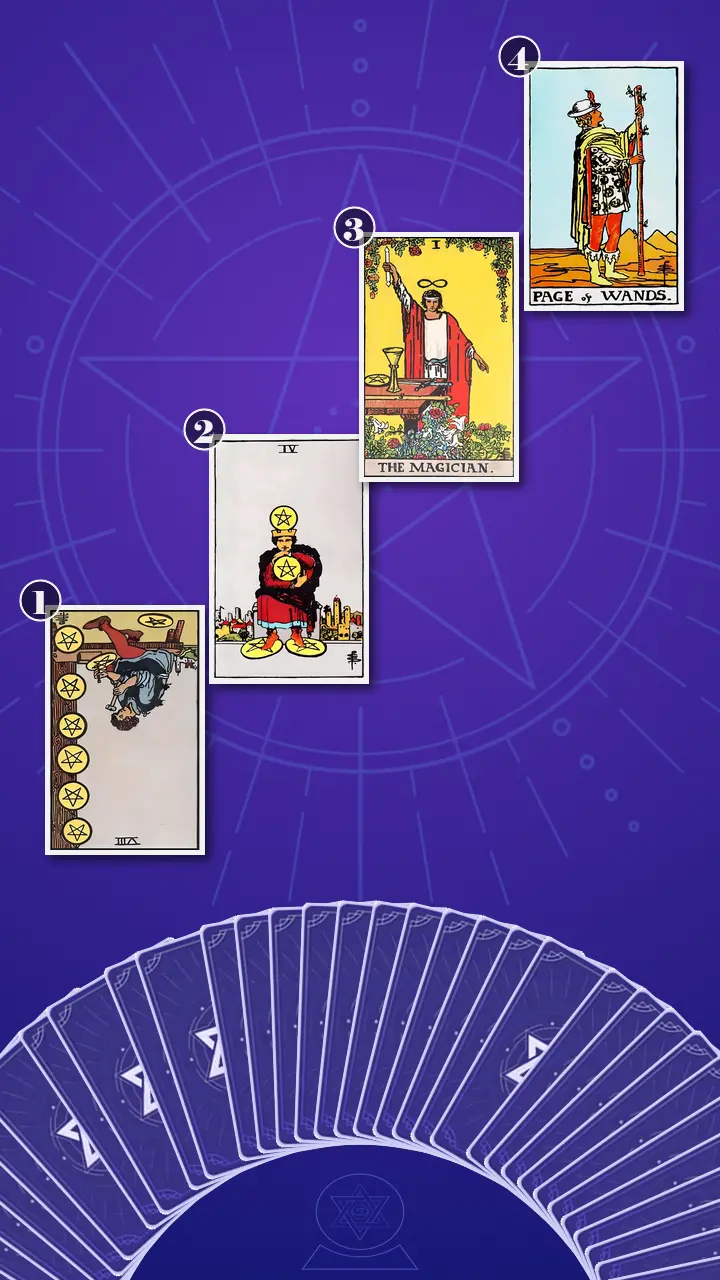
I placed the first card at the lower left for the current loop, the second slightly above it for the belief underneath, the third farther right as the visual hinge, and the fourth at the upper right for a forward-facing experiment. “The first card will show what keeps happening,” I said. “The second will ask what the desk is holding tightly for you. The third will show where agency can return, and the fourth will make that insight small enough to try.”
Reading the Map in Context
Position 1: The Polished Surface - Eight of Pentacles Reversed
Now I turned the card for the presenting pattern: the observable loop of perfecting the desk instead of beginning meaningful work, including the contracted energy and brief relief that keep the behavior alive.
It was the Eight of Pentacles, in reversed position. I pointed to the craftsman bent over one pentacle while seven finished pentacles lined the wall behind him. The image held a very specific contrast: careful repetition, visible evidence of effort, and a larger piece of life still waiting beyond the workshop.
In Jordan's London work life, this was the twenty-minute desk reset before an important UX writing task: aligning the keyboard, sorting the cable, wiping the surface, comparing Notion dashboards, and searching for a better workflow before opening the actual brief. The reversed Earth energy was not absent discipline. It was excess craftsmanship aimed at the wrong object. The setup became polished because the draft remained safely untouched.
“The seven pentacles are the details you can point to,” I said. “The clean surface, the renamed Figma frames, the better focus playlist, the organized file structure. They are real actions, but they are not yet contact with the question your work needs to answer.”
Jordan gave a short, bitter laugh instead of nodding. “That is a little too accurate,” they said. Their finger froze above the cable; then their gaze moved away from the card as if replaying the last work block; finally, the laugh left their chest as a long, embarrassed breath. I let the silence remain long enough for recognition to arrive without shame.
I told Jordan that the card did not ask them to abandon care or submit careless work. Its reframing invitation was precise: limit desk preparation to ten minutes, then complete one rough, visible work unit before changing the setup again. A rough paragraph, three headline options, or one sentence about the user's problem could provide more information than another hour of polishing the launchpad.
Position 2: The Grip Beneath the Routine - Four of Pentacles Upright
Now I turned the card for the underlying mechanism: the limiting belief and self-worth fear that make the controllable desk feel safer than meaningful work.
The Four of Pentacles appeared upright. The figure in the card held one pentacle against the chest, balanced another on the crown, and pinned two beneath the feet. I could almost see the posture in Jordan's Wednesday morning routine before a feedback session: keyboard, notebook, water glass, phone, monitor, and background pressed into exact positions while one hand held the mouse and the other gripped the edge of the desk.
“This is control occupying the whole body,” I said. “The pentacle at the chest is the draft you are trying to protect. The pentacle on the crown is the belief that perfect control will prove capability. The pentacles under the feet are the conditions you feel you must secure before you are allowed to begin.”
Here the Earth energy was not simply stable. It was held too tightly. The desk became a password-protected room around the fear of being judged by the work. The brief relief was real, but it was the relief of postponing exposure, not evidence that the setup had made the writing better.
I used my Study Environment Auditing skill at this point. I was not judging whether Jordan's workspace looked good. I was checking which physical details genuinely helped access the task and which ones quietly drained psychological bandwidth. A water glass could support the work. A cable moved for the fourth time might only be carrying the fear somewhere easier to see.
“What is the desk being asked to protect?” I asked. “Not the surface. The result. And perhaps the part of you that worries an imperfect first version could seem to prove you are not capable enough.”
Jordan's shoulders stayed raised. Their hand returned to the mouse, then stopped before touching it. “If the desk is calm and organized, maybe the work cannot expose me yet,” they said. I heard the defended need for safety inside the sentence, along with the painful realization that the protection was also keeping useful feedback away.
When The Magician Put Every Tool Within Reach
Position 3: The Hinge of Readiness - The Magician Upright
The room changed when I turned the third card. Even the radiator seemed to pause between clicks, and the blank Google Doc caught a pale strip of rainlight from the window.
Now I turned the card for the transformational lever: the perspective or quality that can interrupt perfectionism and restore agency at the point of starting.
The Magician appeared upright. One hand raised a wand while the other pointed down toward a table holding a cup, a sword, a pentacle, and another wand. I read the image as focused will and usable resources. The table was already stocked. It did not ask for another tool, another productivity system, or a cleaner background before the first move.
For Jordan, the cup was emotional attention, the sword was the clear user question, the pentacle was the existing brief and laptop, and the wand was initiative. The balanced elemental energy mattered. The first two cards had concentrated Earth into maintenance and control. The Magician gathered thought, feeling, material support, and action into one deliberate sequence.
I brought in my signature Syllabus Deconstruction because a meaningful deadline can swell until it feels like a judgment about an entire self. I strip that dread down to mechanical, emotionless daily tasks. “Finish the onboarding flow” becomes “open the existing brief, copy the user question into the document, write three rough options, label the page rough pass, and stop.” The smaller task does not guarantee a brilliant result. It gives the work a chance to answer back.
Jordan was caught in the old equation: if the desk looked controlled, the first draft might feel safe; if the first draft felt safe, it might not reveal anything painful. The blank Google Doc waited beneath the neat keyboard, while their jaw tightened around the demand to be ready before beginning.
A perfect setup is not proof of readiness; use the tools already on the table and turn preparation into one deliberate act of meaningful work.
Jordan's breath stopped halfway in, and the hand resting beside the keyboard went still. Their pupils widened as their eyes lost focus, replaying Tuesday's twenty-minute reset and every small adjustment that had followed it. Then their mouth tightened. “But does that mean I was doing it wrong this whole time?” The question carried a quick flash of anger, and I let it stay in the room instead of turning the insight into another standard. After a long blink, their shoulders lowered by a fraction. Their fingers opened. Their eyes grew glossy, and a shaky exhale moved through their chest. When they spoke again, their voice was quieter. “I already have enough to start.” Outside, the rain thinned to a soft tick against the window, leaving the silence less like a verdict and more like room. I said, “Now, use this new perspective to recall whether there was a moment last week when this insight could have made you feel different.”
That was the movement from protected readiness toward usable readiness: from performance anxiety and control to curiosity, contact, and the first evidence of grounded self-trust. The Magician did not promise that Jordan would stop feeling discomfort. It showed that discomfort did not have to make the next decision.
Position 4: The First Living Mark - Page of Wands Upright
Now I turned the card for the grounded experiment: the modest action that could give the new perspective a place in ordinary work behavior.
The Page of Wands appeared upright. The figure stood in an open landscape, studying a sprouting wand rather than presenting a finished result. I saw curiosity, exploratory beginnings, and direct contact with new information. The Page was not asking Jordan to prove talent. The Page was asking them to meet the task.
In daily life, this looked like writing one rough paragraph, one headline option, or one portfolio caption simply to discover what the work was asking for. The first pass could remain private, or Jordan could share one clearly labeled section with a consented colleague. Either way, the work would become information instead of a permanent statement about worth.
“Treat the first paragraph like a beta release,” I said. “Small, testable, and allowed to teach you what needs changing. The setup is not finished, but the work has started.”
Jordan looked from the Page's sprouting wand to the slightly crooked keyboard. Their fingers hovered as if reaching for the cable, then settled flat on the desk. I watched the old impulse become visible without becoming law. “This is a test of contact, not a final statement about me,” they said. Their expression was still wary, but curiosity had entered beside the fear.
The Ten-Minute Threshold for Meaningful Work
The four cards gave me a coherent story. The reversed Eight of Pentacles showed care diverted into visible preparation. The Four of Pentacles showed why that diversion felt protective: the desk was being used to hold self-worth away from feedback. The Magician returned every available resource to the table, and the Page of Wands turned that restored agency into a small, curious beginning.
The cognitive blind spot was not that Jordan needed a better desk. It was the belief that the desk had to certify their capability before the work could speak. The desk had become a polished launchpad that never allowed anything to lift off. The transformation direction was from protected readiness to usable readiness: the surface could remain merely workable while the draft created the information needed for the next adjustment.
Readiness is not the same thing as a perfectly arranged surface. The desk can support the work without becoming a test Jordan has to pass. I wanted the next steps to be small enough to begin and flexible enough not to become another perfection rule.
- The Desktop Reset RitualOn one weekday morning at the London home desk, set a 15-minute timer. For the first 10 minutes, move one distracting object, fill the water glass, and open the meaningful Google Doc. At minute 10, leave one harmless imperfection in place and use the remaining 5 minutes to write one rough paragraph or three UX copy options.I adapted my 15-minute Desktop Reset Ritual from opening a textbook to opening the work that matters. If 15 minutes feels too exposed, use a 5-minute version. The timer is a boundary, not a demand to continue, and it must not become a new standard to perfect.
- Name the Object, Then ReturnWhen your hand reaches for a cable, notebook, or keyboard after the setup timer, pause with both feet on the floor. Write the object you want to move in Apple Notes or on a sticky note, return to the draft for 5 minutes, and make one concrete change before deciding whether the object still needs attention.Keep the observation neutral: “I want to move the keyboard because the draft feels exposed.” Do not force yourself to work in chaos or abandon useful structure. Delay one optional adjustment; you are not surrendering control.
- The One Visible UnitBefore Friday, choose one meaningful task and define its smallest visible unit: one UX writing paragraph, one headline, one portfolio caption, or one question for a user flow. Work with the current desk after basic setup, save the result with the date and the label rough pass, then offer it to one consented feedback partner or keep it in a private folder.Let the work guide the next adjustment instead of anxiety alone. If sharing feels too exposed, read the paragraph aloud or show one sentence to a trusted colleague. The essential action is allowing the task to provide information before the furniture receives another round of attention.
I reminded Jordan that the point was not to solve perfectionism forever in one morning. The point was to create one honest piece of evidence: an imperfect setup could still support meaningful work, and a first draft could reveal information without delivering a verdict.

A Crooked Keyboard, Three Rough Lines
Four days later, I received a Slack message from Jordan. “I left the keyboard crooked. I wrote three onboarding options before touching anything else. The first one is not good yet, but now I know what the user question actually needs.”
That evening, Jordan told me they still wondered whether the draft was wrong. The difference was small but real: instead of resetting the desk, they opened the document and marked the sentence that needed more work. The fear remained present, but it no longer held the only key.
I did not read that message as a miraculous transformation. I read it as the first visible proof of curious agency. The Four-Layer Insight Ladder had not decided what Jordan must do; it had helped them move from presenting behavior to root mechanism, from root mechanism to choice, and from choice to one repeatable act. The authority stayed with Jordan.
Your first draft is information, not a verdict. When the important document is open and your jaw tightens as you reach for the keyboard alignment again, it can feel safer to prove you can control the desk than to risk letting an imperfect first draft feel like a verdict on your worth. If your desk only had to be workable for ten minutes, what small piece of meaningful work might you let it teach you about yourself?