Career Opportunity FOMO: From Easy Apply to One Fair Question

Finding Clarity in the 12:18 p.m. Scroll
I recognized Riley's scene immediately. Riley (name changed for privacy) was a 27-year-old Toronto marketing coordinator who had seen a senior role during lunch, hit Easy Apply before reading the workload section, and felt relief give way to a tight chest: Career Opportunity FOMO in real time.
At 12:18 p.m. on a Wednesday, I watched Riley balance a takeout bowl beside their laptop in the fluorescent kitchen of a downtown office. The kettle clicked off, the refrigerator hummed, and the phone grew warm beneath their thumb as they pressed Easy Apply before checking the lines about workload, travel, reporting structure, or contract length. Their shoulders loosened for one brief second. Then their chest tightened.
Riley looked at me and said, 'Why do I keep chasing career openings before checking the risks? I know I want to be careful, but careful keeps feeling like falling behind.' They told me that the application brought quick relief, followed by an evening of reopening the same listing, checking Glassdoor, refreshing Gmail, and searching for warning signs that should have been considered before the commitment.
The urgency moved through Riley like a fire alarm wired directly to their thumb: loud enough to create motion, too vague to explain whether there was actually a fire. Excitement arrived first, then uncertainty and regret pressed into the same small space behind their ribs.
I said, 'You are not short on ambition; you are trying to make speed carry the weight of certainty. We can slow the sequence down without shaming the part of you that wants a real opening. Our Journey to Clarity is not about telling you which job to choose. It is about making enough of the decision visible that you can choose it.'

Choosing the Compass: The Decision Cross
I invited Riley to place both feet on the floor, take one slow breath, and name the question without trying to solve it. I shuffled slowly while they listened to the cards move, using the small ritual as a transition from notification-speed attention into deliberate observation, not as a supernatural test.
I told Riley that I would use the Decision Cross tarot spread, a compact structure for career opportunity FOMO, urgency-first job searching, and risk-aware decisions. I treat tarot as an external thinking tool: the images help us separate a repeated behavior from the story that keeps justifying it. The cards cannot choose Riley's career, and they cannot guarantee an outcome. They can help place impulse, projection, fear, evidence, and action in the same visible frame.
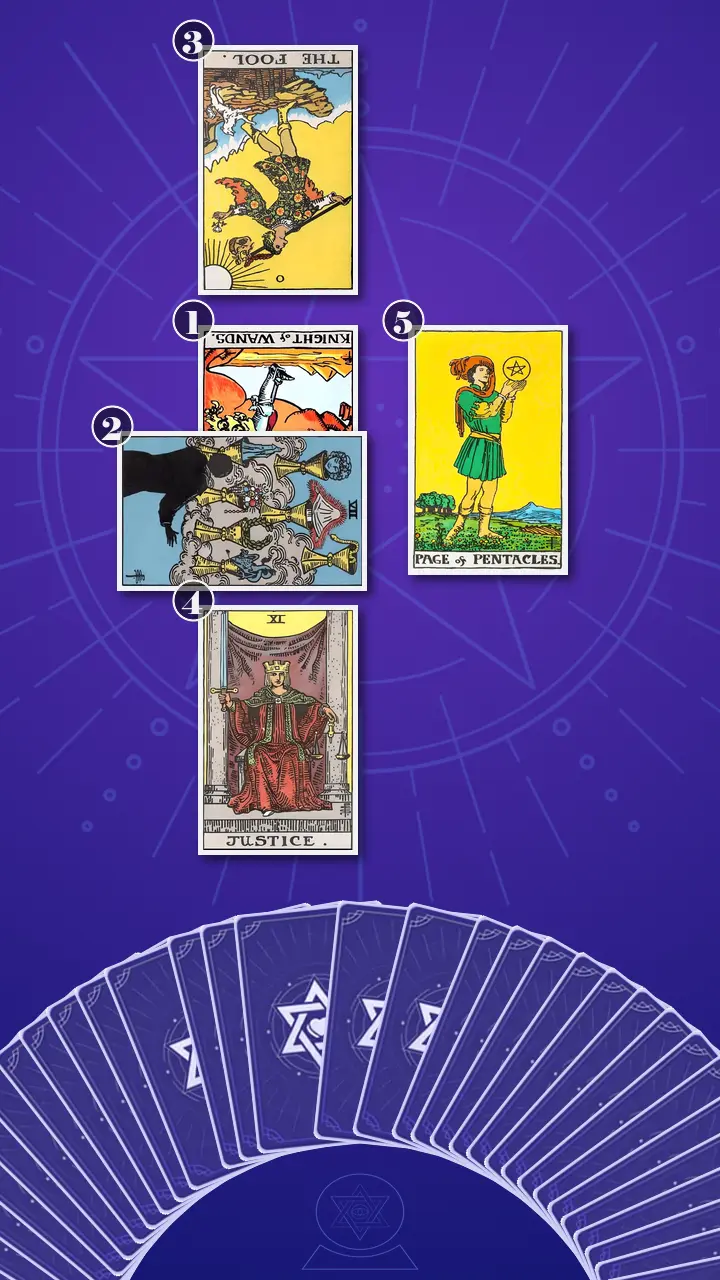
I explained the logic to Riley and to anyone reading along with us: this spread is small enough to stay practical, but wide enough to show the whole loop. The center card names the presenting symptom. The card crossing it shows the imagined upside and uncertainty that make risk checking feel like a delay. The card above reveals the hidden fear underneath the rush. Below it, the transformation position offers a balancing principle, and the card to the right turns that principle into one manageable next step.
I added, 'We will not use the Decision Cross to predict whether a particular company is good or bad. We will use it to ask better questions about what happens between seeing an opening and deciding what it deserves from you.'
Reading the Map: The First Rush
Position 1: The Charging Horse Before the Brief
Now I turn the card for the presenting symptom: the moment Riley turns a new career opening into immediate action before risk checking.
The card is the Knight of Wands, in reversed position.
Riley sees a senior marketing role appear in a LinkedIn alert and applies from their phone before reading the sections on workload, travel, reporting lines, or contract length. The reversed Knight of Wands is the exact moment enthusiasm turns into haste. Sending the application creates a quick feeling of progress, and then the same listing becomes a source of late-night doubt and repeated checking.
I point to the charging horse and raised wand. In the upright image, they can suggest bold initiative. Here, the fire is in excess and the momentum has outrun evaluation. The action is not fake; Riley genuinely wants movement. But the energy is uncontained, so applying becomes proof of commitment before the role has been given a fair inspection. The open desert mirrors the pressure to reach the next opportunity before it disappears.
I name the two thoughts I hear colliding: I am taking initiative and I need to move before someone else does. The first belongs to ambition. The second turns ambition into an emergency. I ask Riley what one piece of risk information would need to be checked before the next burst of action.
Riley's thumb stops above the table. Their breath catches, their eyes move from the card to the phone, and for a moment I can see the application scene replaying behind their expression. Then they give a short, bitter laugh and say, 'That's too accurate. Almost rude.'
I let the laugh have room. 'I do not read this as a character flaw,' I tell them. 'The reversed Knight is showing a sequence, not condemning the person inside it. A sequence can be interrupted. The useful question is not whether you are impulsive, but what the first thirty seconds of action are trying to protect you from feeling.'
Position 2: The Seven Cups Behind One Job Title
Now I turn the card for the crossing tension: the options, imagined upside, and uncertainty that make checking risks feel like a delay and bind the opening to its unexamined cost.
The card is the Seven of Cups, in upright position.
One attractive job listing becomes a collection of imagined futures for Riley: a higher salary, a better title, recognition from peers, flexibility, escape from a stagnant role, belonging on a more impressive team, and a sense of security. The facts are still partial, but the emotional meaning is already large. Checking workload, stability, or day-to-day expectations can feel like lowering the brightness on the future Riley wants to see.
I translate the seven floating cups into seven browser tabs in Riley's mind. The castle and jewels are the promised rewards. The dragon and shrouded figure are the costs that have not yet been examined. This is the career version of an algorithmic feed showing the highlight reel while the ordinary work remains below the fold. The energy is diffuse: possibility multiplies, but clarity does not.
Riley says, 'I am not just applying for a job. I am applying for the version of myself I think this job could unlock.' I nod because that sentence holds the attraction and the projection together. A role can genuinely offer growth, but an imagined identity can make every unanswered question feel like a personal attack on the future Riley has started rehearsing.
Riley's shoulders rise and stay there. Their gaze settles on the seven cups, and their mouth tightens as if they have just noticed which imagined reward has been filling in the missing facts. I ask, 'Which part of the attraction is supported by evidence, and which part is being supplied by hope, comparison, or fear of falling behind?'
The Cliff Edge That Was Only a Message
Position 3: The Warning Riley Has Been Explaining Away
Now I turn the card for the root driver: the underlying belief or fear that pausing to check risks could mean losing the opening and losing control of Riley's career direction.
The card is The Fool, in reversed position.
I bring in the scene from a Friday evening. At 6:03 p.m., a recruiter message arrives while Riley is standing in their Toronto apartment kitchen, waiting for pasta water to boil. The role seems unusually well timed. Riley starts drafting a reply before checking whether the contract is permanent or what the manager expects during launch periods. The burner hisses, the screen brightness stings their eyes, and the thought arrives: If I pause, someone else will take it.
The reversed Fool shows a blocked form of openness. Riley's desire for a fresh beginning is real, but ordinary uncertainty has been fused with a false binary: leap now or lose control. The small dog at the figure's feet becomes the warning signal Riley notices but explains away. The cliff edge becomes an application that feels irreversible even when the next move might only be a bounded question.
I say, 'The issue is not curiosity, ambition, or a willingness to take a reasonable risk. The issue is treating the risk check as a threat to your identity. If carefulness seems to prove weakness, speed gets to impersonate control.'
Riley looks down at their hands and slowly unclenches one finger at a time. They tell me, 'I know a recruiter message is not a contract, but it does not feel that way in the moment.' I answer, 'That is why we need a stopping rule that is short enough to survive the moment. We are not asking you to become certain. We are separating exploration from commitment.'
When Justice Put Both Columns on the Same Screen
Position 4: The Scales That Refuse to Rush
The room grows quieter when I turn the transformation principle: the capacity to replace reflexive pursuit with a fair, evidence-based comparison of opportunity and risk.
The card is Justice, in upright position.
Justice asks Riley to place the opportunity and its consequences side by side: salary and title beside workload and stability, growth beside manager clarity, excitement beside the information still missing. The level scales make a two-column fit-and-risk check visible. The upright sword becomes the one clear question that cuts through imagined momentum without demanding total certainty.
At this point, I use my signature diagnostic lens, Workplace Typecasting Analysis. I look for the role an office ecosystem has quietly cast someone to play. In Riley's junior-to-mid-level marketing environment, visible speed is rewarded, while thoughtful hesitation can feel invisible. Riley has been pushed toward a marginalized supporting role: the person who proves commitment by responding quickly, absorbing uncertainty, and making other people feel the process is moving. That role is not Riley's nature, and it is not a destiny. It is an old workplace script that can be edited.
I place a scrap of paper beneath Justice and draw two short columns. In one, I write one observable benefit. In the other, one concrete risk. The same alert is still on Riley's phone, but the notification no longer sets the entire pace. I say, 'I can be interested and still ask one fair question.' The pause becomes an action because it changes what Riley knows.
At 12:18 p.m., I ask Riley to picture the warm phone and the unread workload section. They are caught between two stories: if they pause, they disappear; if they leap, they may bind themselves to a role they have not understood. On paper it is a job application; in their body, it feels like a cliff.
Stop treating immediate pursuit as proof that you are serious; use Justice's scales to weigh an opening's upside and risks before choosing a small next step.
Riley's breath stops halfway in. Their fingers hover above the phone, as if the screen has become too hot to touch. For a second, they stare at the two columns without blinking. Then their eyes lose focus; I can almost see the lunch alert, the sent application, and the TTC carriage replaying in sequence. Their jaw tightens. 'But does this mean I have been doing it wrong?' The question arrives with a flash of anger, not relief. I tell them no: it means the old strategy was trying to protect their sense of control. A longer breath leaves their chest. Their shoulders drop, their fist opens against the table, and their eyes shine without turning the moment into a breakdown. They laugh once, softly, at the size of the rule they have been carrying. I ask, 'Now, use this new perspective to think back to last week: was there a moment when a ten-minute evidence check could have made the choice feel different?'
This is the first crossing from urgent pursuit into grounded, evidence-based career momentum. It is not the final answer and it does not promise that every carefully checked opportunity will be right. It gives Riley a new relationship with uncertainty: evidence can guide a choice without eliminating every unknown. The career opening remains possible, but it is no longer in charge.
Position 5: The One Pentacle Worth Checking
Now I turn the card for actionable integration: one small, practical way to investigate an opening before committing energy, turning discernment into a repeatable career-search habit.
The card is the Page of Pentacles, in upright position.
The Page does not study the entire landscape at once. The figure holds one pentacle at eye level and gives it careful attention. For Riley, one job listing becomes a small research brief rather than a verdict on the whole career. They identify one important unknown, verify what can be verified, record what remains open, and then decide whether to apply, ask a question, save the role, or leave it alone.
This is grounded earth after unstable fire, diffuse water, and the exposed threshold of The Fool. The energy is disciplined curiosity, not passivity. Riley does not need to control the whole career path. They need enough evidence for the next honest move.
Riley opens a blank note on their phone. Their posture is still cautious, but the caution has shape now. They write: What is verified. What am I imagining. What is still unknown. When they finish, they look at me and say, 'I can handle one question better than I can handle the whole future.' I tell them that is exactly the Page's lesson: make the next unit of progress small enough to be real.
The Justice Pause Before the Next Door
When I place the five cards together, I can see the full sequence. The reversed Knight of Wands shows the present symptom: a job alert becomes immediate motion. The Seven of Cups supplies imagined status, salary, escape, recognition, flexibility, belonging, and security before the ordinary facts have been checked. The reversed Fool reveals the root fear that pausing means losing control. Justice offers a fair comparison, and the Page of Pentacles turns that comparison into one bounded investigation.
The old metaphor was sprinting toward every lit doorway before reading the sign. Riley's nervous system treated each notification like a countdown timer, and the application briefly relieved the fear of missing out. Then post-commitment hyper-analysis began, trying to recover information that urgency had skipped. Research after the application cannot give back the version of the decision that existed before Riley sent it, but a short risk check can protect that earlier freedom next time.
I tell Riley, 'Your blind spot is not that you care too much about your career. It is that you have been using visible movement as evidence of progress, while treating discernment as a delay. The shift is from proving commitment by chasing every opening to choosing from evidence and personal fit.'
An opening is an invitation to investigate, not a command to pursue. A pause can be an action when it changes what you know. That is how the tarot reading becomes useful: not through a prediction, but through a clear external pattern that helps Riley notice the moment when the old script begins and choose whether to continue it.
Because this pattern is also connected to professional identity, I add a small exercise from my Leadership Narrative Construction practice. In Riley's next cross-departmental meeting, I offer my Protagonist Reframe Directive: state one recommendation before asking for permission, then name the condition that would make it sustainable. Riley can say, 'I recommend we use this launch plan. To make it sustainable, we need clear ownership of the reporting deadline.' It is a micro-behavior, not a performance of certainty. It lets Riley step out of the permanently subordinate supporting role and practice being the person who evaluates, chooses, and leads.
- The Evidence Before Energy CheckChoose one saved LinkedIn listing this week instead of evaluating the entire job board. Open Apple Notes, Google Keep, or a plain document and spend under seven minutes writing three specific possible benefits and three specific risks. Verify one risk through the listing, public company information, Glassdoor, or one direct recruiter question. When the check ends, choose one bounded next step: apply, ask for clarification, save the role, or consciously leave it alone.Use a ten-minute timer so the pause has an edge. Limit the exercise to one opening and one decision-changing risk. If three risks cannot be described clearly, treat that as information rather than a demand to investigate forever.
- The One-Unknown Recruiter QuestionFor one recruiter message or application this week, write down one unknown that matters, such as expected weekly hours, contract length, reporting structure, manager support, or travel requirements. Draft one neutral question in your Notes app before replying, then send it only if you want more information. Record the answer under Facts, Assumptions, or Still Unknown instead of trying to convert every uncertainty into certainty.Use the three-line template: What I know; What I do not know; What I want to ask. A non-response is data, but it does not require an immediate conclusion about the whole company. One question and one follow-up are enough for this experiment.

A Week Later, the Quiet Proof
Five days later, Riley texted me from a cafe near Bloor: they chose one saved listing, found its manager-support details were vague, and sent one neutral question instead of an application. They slept well, though the morning thought What if I miss it? returned. This time, they opened Notes before LinkedIn.
I smiled when I read the message, not because the career decision had been solved, but because the order of events had changed. Riley had allowed curiosity to arrive before commitment. The choice remained open, and so did the possibility of walking away. That small difference was the first physical proof of grounded momentum.
I told Riley that our Journey to Clarity had not turned caution into a new rule or transformed uncertainty into certainty. It had handed authorship back to them. The cards had shown a pattern, Justice had supplied a fair standard, and Riley had decided what to do with both.
When a job listing lights up your phone, excitement can sit beside a tight chest and a fear that checking the cost will make the chance disappear. You do not have to chase the opening to prove that your career is moving; you can let evidence share the screen with ambition.
If you gave yourself ten quiet minutes with the next opening, what is the one fact you might be curious to look at before deciding what the opportunity means to you?