From a Spiritual Lesson Draft to a 32-Word Boundary Text in Six Days

The Tuesday-Night Lesson That Would Not Let Her Breathe
I met Jordan, a twenty-seven-year-old communications coordinator at a Toronto nonprofit, on the Tuesday night when an apparently gentle text had made her small apartment feel even smaller. At 10:46 p.m., a relative had asked her to “pray about” a personal decision she had already made. The radiator clicked beside her desk, streetcar light slid across the bedroom wall, and her phone stayed warm in her palm as she opened Notes and titled a new page, “What is this teaching me?”
She had written three thoughtful paragraphs about patience, humility, and staying open. Behind that note sat an unsent message containing the sentence she had deleted twice: “I do not want to discuss this decision.” Her throat looked as if it were holding a door shut while someone leaned against it from the other side. Beneath the unease, I could hear guilt asking whether a boundary would make her faithless, and guarded anger asking why the lesson always seemed to arrive in someone else's voice.
“Maybe the pressure is a lesson,” Jordan said, rubbing her thumb along the edge of her phone. “But if I call it pressure, I have to admit I want to say no. What if I say no before I understand what I am supposed to learn?”
I told her I would not use tarot to decide what she should believe, whether the relationship should continue, or how the other person would respond. I would use it as a mirror for the pattern already visible in her body, drafts, and choices. “A lesson can be meaningful without becoming a command,” I said. “Let us make a map of the fog and see where meaning ends and consent begins.”

Choosing a Staircase Out of the Cloud
I invited Jordan to place both feet on the floor and take one slower breath if that felt comfortable. I shuffled while she held one precise question in mind: “What am I avoiding by calling religious pressure a lesson?” The pause was not a mystical test. It was simply a transition from reacting to observing.
I chose a six-card layout called The Shadow Spread. I use this spread when the visible explanation for a problem may be protecting a feeling, fear, judgment, or capacity underneath it. It suited Jordan's question because the central issue was not predicting another person's behaviour. It was uncovering how spiritual meaning-making had begun to postpone her own answer.
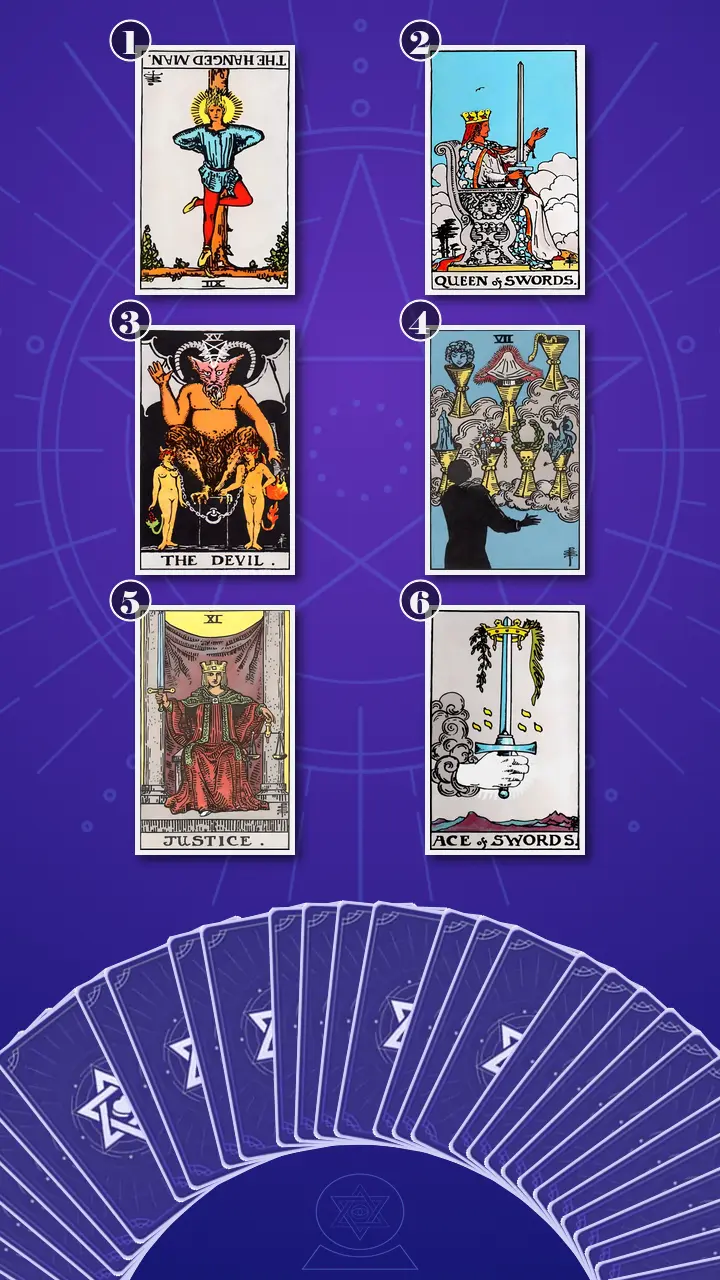
I arranged the cards in a two-column grid, three rows deep, like a staircase out of cloud. The first position would show the presenting frame, what Jordan consciously called a lesson. Beside it, the second would reveal the hidden judgment or boundary kept out of view. The middle row would pair the underlying fear with the protective story that made the fear easier to manage. The final row would move from liberating discernment into one grounded boundary. This is how tarot works at its most useful for me: card meanings in context become prompts for clearer observation, not instructions handed down by fate.
The Draft Held Between Stations
Position 1: The Presenting Frame
I began with the card representing what Jordan was consciously calling a lesson when religious pressure appeared. I turned over The Hanged Man, in reversed position.
The inverted figure, crossed legs, and halo showed a posture associated with surrender becoming an indefinite suspension. I brought Jordan back to 10:46 p.m.: she had produced a thoughtful page about humility and growth, but she had not recorded the exact request or admitted that she did not want it. The beautifully reasoned journal entry carried the halo. The unsent text was the single foot keeping her attached to the interaction.
“It is like a subway train held between stations,” I said. “A pause can offer perspective. But once the train remains there without a chosen end, the pause stops serving the journey.” The Hanged Man's reflective energy was blocked. Jordan's thought, I am still reflecting, so I cannot be avoiding anything, gave the delay a meaningful appearance while the original request and her answer remained untouched.
Jordan gave a short laugh that carried more bitterness than amusement. “That is so accurate it is almost rude,” she said. Then she looked toward the Notes window still open on her phone. Her fingers stopped moving, her eyes narrowed as if rereading an old pattern, and finally her shoulders lowered by a fraction. The card was not accusing her of reflection. It was asking when reflection had stopped producing perspective and started suspending consent.
I asked, “After the last pressured message, which exact reply did you postpone while you searched for a lesson?”
“I do not want advice about this decision,” she answered immediately. The speed of the answer mattered. Her body had not needed another podcast to locate it.
Position 2: The Boundary Hidden in Plain Language
I turned to the position representing the feeling, judgment, or boundary that the lesson framing kept out of view. The card was the Queen of Swords, upright.
I pointed to the raised sword and the open left hand. One hand discerned and spoke; the other remained receptive. Together they described a form of directness that did not require hostility. In Jordan's life, this looked like the sentence she might write before adding context: “I care about our relationship, and I am not available to discuss my beliefs today.” No accusation. No verdict on anyone's faith. Just an accurate statement of availability.
The Queen's energy was balanced, but Jordan's trust in that energy was underused. At work, in family texts, and even with friends, she could write a clean sentence and then bury it beneath two paragraphs proving that she was thoughtful, grateful, and open-minded. She had quietly made the other person's comfort the approval process for her clarity.
“Understanding their belief does not give that belief access to your decision,” I said. “The Queen is clear but not cruel, open but not available for pressure.”
Jordan exhaled through her nose and sat back. Her hand opened on the desk instead of gripping the phone. “I can understand where they are coming from without giving them access to my decisions,” she said, slowly enough to test each word. I watched the sentence land not as rebellion, but as a capacity she already possessed.
The Chain That Looked Like Moral Proof
Position 3: The Fear Beneath Belonging
The next card occupied the position of what Jordan feared would happen to her worth or belonging if she named the religious pressure directly. I turned over The Devil, upright.
I kept the interpretation precise. I was not calling religion, faith, or the relationship itself harmful. I was examining the specific bargain visible in the card: the belief that belonging required Jordan to surrender her judgment. The chains around the human figures were loose, but that did not make removing them emotionally simple. It meant the terms could be inspected rather than accepted as destiny.
I asked Jordan to recall a recent Line 1 commute. She described replaying a voice note that said people who cared about their spiritual lives should welcome correction. The train brakes had squealed, wet coats had filled the carriage with the smell of rain, and her fingers had tightened around the phone. The internal rule had arrived immediately: “If I set this boundary, I am selfish, faithless, and at risk of losing my place with them.”
The Devil showed an excess of shame-conditioned authority. Guilt flashed like an app notification designed to look urgent, and Jordan treated the alert as if it automatically represented her own values. “Guilt can mark a threatened belonging; it does not automatically prove a broken value,” I told her. “The feeling is real. The verdict is not automatic.”
Her breathing paused. Her gaze moved away from the card, unfocused, as if an old conversation were replaying behind her eyes. Then her lips parted around a quiet “Oh.” She pressed a palm to the centre of her chest and said, “I have been using the guilt as evidence.”
“Yes,” I replied. “And Justice will later ask us to examine evidence more carefully. For now, I only want to know whose voice wrote the rule that disappointment means you have done something morally wrong.”
Position 4: Seven Explanations and One Buried Answer
I turned to the position representing the protective story through which spiritual bypassing and existential drift kept the fear manageable while delaying a concrete response. The card was the Seven of Cups, upright.
The seven floating cups mirrored Jordan's late-night arrangement almost too neatly: a prayer journal, three browser tabs, a podcast queue, imagined family consequences, and several charitable explanations surrounding one hidden draft. Maybe the relative was worried. Maybe the discomfort was growth. Maybe patience was required. Maybe conflict would damage the family. Each possibility was plausible enough to postpone a choice.
The card showed imaginative energy in excess and grounding in deficiency. Jordan's sensitivity and spiritual curiosity were not faults, but every click had trained an internal algorithm to recommend another interpretation because interpretation felt safer than decision. It was like opening twelve browser tabs to avoid answering the one message beneath them.
“More meaning is not always more clarity,” I said. “Before asking what the interaction means, ask two grounded questions: What was actually asked? What do I consent to?”
Jordan nodded once, then winced. Her jaw tightened, her eyes moved toward the closed laptop beside her, and a rueful smile appeared. “I can tell you seven reasons they might have meant well,” she said. “I have never written down the exact thing they keep asking me to do.”
I told her empathy could explain another person's motives without granting ongoing access. The Seven of Cups did not demand that she reject meaning. It asked her to stop treating every possible meaning as an obligation.
When Justice Separated the Lesson from Consent
Position 5: The Liberating Discernment
I reached the position representing the truth or inner capacity that could separate a possible lesson from an obligation and interrupt the pressure cycle. The room seemed to quiet around us. Even the radiator stopped clicking as I turned over the reading's key card: Justice, upright.
Justice held balanced scales in one hand and an upright sword in the other. The scales asked for observable facts, impact, values, consent, and proportion. The sword separated categories that guilt had fused together. Jordan had been caught in the belief that she needed to make the spiritually correct decision before she could set any limit at all. Justice offered no cosmic verdict. It returned judgment to her.
It was nearly midnight. Her tea had gone cold, and the same boundary text remained hidden behind a prayer journal, three browser tabs, and a podcast queue. Every new interpretation sounded thoughtful, but her throat was still holding the answer.
You do not have to turn religious pressure into a sacred lesson to make the experience meaningful; weigh what is actually being asked and use Justice's sword and scales to choose a boundary that fits your values.
I let the sentence remain between us without rushing to soften it.
A difficult interaction may contain a lesson, but the lesson does not get to answer the consent question for you.
Jordan did not relax at first. Her breath stopped halfway in, and her fingers froze above the phone. Her pupils widened; then her eyes lost focus as if she were replaying every time she had said, “I will think about it,” while meaning, “Please stop asking.” Colour rose into her face. Her shoulders stayed rigid even as her fist slowly opened against the desk. When her eyes returned to mine, they were bright with anger as well as relief.
“But does that mean I have been wrong this whole time?” she asked. Her voice began sharply, then thinned at the end. “Have I just been letting this happen?”
I did not turn the insight into another judgment. “No,” I said. “It means interpretation helped you preserve belonging when a direct answer felt costly. That strategy deserves understanding. Now you can decide whether it still serves you.” Her jaw loosened. A long breath left her chest, followed by a smaller, unsteady one. Relief had arrived, but so had the exposed feeling of realising that the next choice belonged to her.
I asked, “Now, with this new perspective, think back to last week. Was there a moment when this insight could have made you feel different?”
Jordan remembered a Sunday conversation outside a community gathering. Someone had urged her to reconsider a private decision. Burnt coffee had hung in the tiled lobby, winter air had entered whenever the door opened, and she had smiled and said, “I will think about it.” She now saw that she might still have reflected on the encounter while answering the request separately: “I am not open to more advice about that decision.”
Justice also brought forward the diagnostic language I have developed through a lifetime of watching seasons. I call it Seasonal Trajectory Alignment. A winter field is not failing because it does not produce a spring harvest on demand. It is protecting roots, gathering resources, and waiting for conditions in which growth belongs to the organism rather than to the weather shouting at it.
I told Jordan that she had been treating someone else's urgency as proof that her inner season was late. She was trying to harvest spiritual certainty before she had enough quiet, privacy, or trust to know what she believed. Through Environmental Friction Sensing, I could see that the contraction in her throat was not evidence of deficient faith. It was information about the mismatch between her inward pace and an environment demanding access to an answer.
“Winter is not a command to disappear,” I said. “It is permission to stop forcing a conclusion while still protecting the ground. You may say, ‘Not now,’ before you know what the whole season means.”
I asked Jordan to open a fresh note and make two columns: “Possible lesson” and “Consent.” Under the first, she wrote, “I notice how quickly I abandon my answer when someone sounds certain.” Under the second, she wrote, “I am not available for repeated advice about this decision.” The scales were no longer abstract symbols. They had become two questions that could no longer impersonate each other.
I named the shift clearly: this was a first movement from belonging-driven guilt and interpretive suspension toward self-authored discernment and clear consent. It did not settle her faith, family, or future. It gave her back the authority to decide what she was available for now.
Position 6: The First Clear Sentence
I turned over the final card, representing the grounded, self-directed expression of clarity that could respond to religious pressure without deciding for anyone else. It was the Ace of Swords, upright.
A hand emerged from cloud holding a crowned blade. In Jordan's life, the image became one sentence on a stable blank page after the extra tabs were closed: “I am open to discussing my beliefs when I choose, but I am not available for pressure or repeated advice.”
The Ace carried balanced clarity, but its practical expression had not yet become automatic. There were no Wands or Pentacles in the spread, so insight and language were present while spontaneous action and bodily grounding still needed to be added deliberately. The sword was not a weapon for winning a theological argument. It was a tool for cutting a twenty-tab thought process down to one accurate description of availability.
“Write the boundary before you write the defence,” I said. “You can decide later whether to add context, whether to send it, and which channel feels safest. The first draft only needs to tell the truth.”
Jordan read the sentence aloud. Her voice caught on the word “pressure,” so she tried it again without apologising for the pause. On the second reading, the word came out at normal volume. She did not look triumphant. She looked startled by the sound of her own judgment occupying the room.
The Justice Columns and the Winter Pause
I gathered the cards into one coherent story. The Hanged Man showed how a once-useful habit of reflection had become suspension. The Devil revealed why suspension felt safer: Jordan feared that directness could cost goodness, faith, or belonging. The Seven of Cups protected her from that fear by multiplying explanations until no response felt certain enough. Yet the Queen of Swords had been present all along as her ability to be humane and exact. Justice separated learning from compliance, and the Ace of Swords gave that distinction a usable sentence.
The central blind spot was not that Jordan cared too much about meaning. It was that she had allowed another person's comfort to become the test of whether her boundary was morally valid. She had also confused understanding with permission and guilt with proof. The direction of change was therefore proportionate, not dramatic: name what was asked, decide what she consented to, and communicate one limit without requiring herself to settle anyone's beliefs.
I gave her three pieces of actionable advice. Each was deliberately small because clarity becomes trustworthy through observable practice, not through one perfect act of courage.
- Make the Justice ColumnsWithin ten minutes of the next pressured text or call, open a fresh note with only two headings: “What was asked of me?” and “What do I consent to?” Write one factual sentence under each before opening a journal, podcast, search result, or advice thread.If two sentences feel too exposing, use one phrase per column and keep the note private. Factual clarity does not judge anyone else's beliefs.
- Draft the Open-Hand BoundaryAt home on Wednesday evening, write no more than forty words using: “I am open to ___ when I choose, and I am not available for ___.” Ask one trusted friend, “Can you read this for clarity without debating whether my boundary is valid?”Save any longer explanation in a separate private note. The minimum version is “Not now,” and sending remains Jordan's choice.
- Use the Winter Dormancy ProtocolBefore responding, place both feet on the floor, read the boundary aloud once, and set a twenty-minute response window. When the timer ends, choose one action: send it, revise it once, or intentionally postpone it until a named date.Dormancy is a deliberate pause, not indefinite disappearance. If direct contact could affect housing, finances, privacy, or safety, keep the draft private and seek support before responding.
These next steps did not require Jordan to become certain about her spiritual identity. They only required her to stop making perfect certainty the entry fee for consent. She retained control over the wording, timing, channel, level of contact, and any consequence she was genuinely willing to carry out.

A Week Later, the Quiet Proof
Six days later, I received a message from Jordan. She had made the two columns after another request to reconsider her decision. Then she sent thirty-two words: “I care about our relationship. I am not available for repeated advice about this choice. If I want to discuss it later, I will bring it up.”
The relative replied with disappointment. Jordan did not pretend that the response felt good, and she did not turn one boundary into proof that the whole relationship was fixed. She put the phone face down, made tea while the radiator clicked, and let the message remain unanswered for the evening.
She slept through the night. Her first thought in the morning was, “What if I was wrong?” This time she gave a small, tired smile. The question was still present, but it was no longer a command.
I saw the value of the reading in that modest change. Tarot had not granted Jordan authority or predicted peace. It had reflected the authority she already possessed and helped her give it a structure: one fact, one consent decision, one proportionate sentence. Her journey to clarity remained in progress, but she had moved from borrowed certainty toward self-trust.
I know how easily someone else's certainty can fill a room until a simple no catches in the throat. Many of us start searching for a lesson because clarity feels dangerously close to losing our goodness or our place with someone we love. I would remember, however, that noticing this reflex already changes the season: a boundary can protect the ground while meaning continues to grow at its own pace.
If learning and consent were allowed to sit in separate Justice columns for one quiet moment, what small truth about your availability would you be curious to put into words?