The 9:40 p.m. Open Tab
If you are the reliable operations person everyone Slacks at 4:47 p.m., but your own course tabs survive unopened for months, your career drift may be hiding inside the phrase "quick favour."
I met Alex at a small kitchen table in a west-end Toronto apartment. It was 9:40 p.m.; the laptop fan warmed their wrist, the kettle clicked in the quiet, and three chat windows glowed beside an unread course outline. I watched Alex close that tab after editing a friend's cover letter and cleaning a coworker's spreadsheet, while the room still held the faint smell of detergent and the blue-white light made their shoulders rise toward their ears.
I asked what had brought them in. Alex looked at the closed laptop and said, "I am busy all the time, but none of it feels like movement. People know what to ask me for, but I do not know what I am asking from my own life." The question underneath was simple and painful: why were they staying useful to everyone while their own career direction and meaningful projects remained indefinitely postponed?
I heard the disorientation in the way Alex kept rubbing one thumb over the edge of the mug. It was not an absence of ambition. It was like running a phone as a communal power bank: every other device received a charge, while the person carrying the battery ignored the low-power warning until the whole evening became a heavy ache behind the sternum, followed by restless fatigue.
I told Alex that we did not need to frame care as the enemy of self-direction. The real contradiction was more precise: they wanted a direction of their own, but feared that becoming less useful would cost them closeness. "We can look at that pattern without judging your generosity," I said. "Our Journey to Clarity today is about finding where your direction keeps getting interrupted, then identifying one next step that belongs to you."

The Grid That Gives the Drift a Shape
I invited Alex to place both feet on the floor, take three unhurried breaths, and hold the question without trying to solve it. I shuffled slowly, treating the movement as a practical transition from reacting to observing, not as a supernatural test.
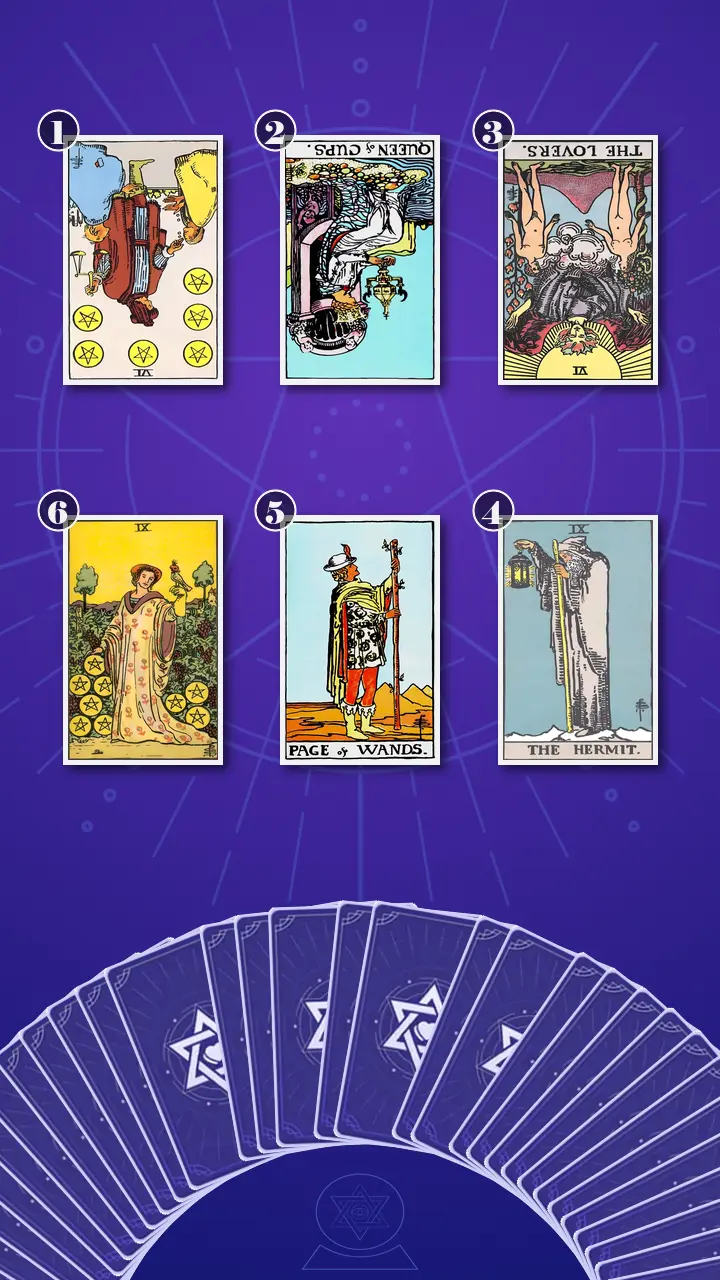
For this reading, I chose the Transformation Path Grid · Context Edition, a six-card tarot spread for tracing a behavioral loop from its visible expression to a sustainable alternative. This is one way of understanding how tarot works as an objective cognitive tool: the images give us stable symbols, while the details of a real calendar, message thread, budget, and body provide the evidence. I read card meanings in context, so no card becomes a verdict or a prediction.
I explained why this spread fitted the question. Alex's pattern was not one isolated decision but a cycle: a request activated the belief that usefulness protected closeness, a rapid yes created relief and appreciation, personal time disappeared, resentment grew, and the resulting lack of progress sent Alex back toward being needed. The top row would show the behavior, the emotional blockage, and the root belief. The lower row would reveal the leverage point, the first experiment, and the integrated way forward.
I told Alex to pay particular attention to the first three positions and then to The Hermit beneath the root. The first card would show how the drift appeared in ordinary life; the second would identify where care became overresponsibility; the third would expose the belief dividing connection from self-direction. The Hermit would show what could interrupt the loop, while the Page of Wands and the Nine of Pentacles would turn insight into actionable advice and realistic next steps.
The Calendar's Uneven Scales
The Yes That Arrived Before Capacity
I said, "Now I am turning over the card for the position that reveals the diagnosis-level behavior through which you stay useful while drifting: automatic giving, rapid agreement, and the repeated transfer of time away from your personal direction." I turned the card. It was the Six of Pentacles, in reversed position.
I connected the image to Alex's Tuesday at 4:47 p.m. A Slack notification had appeared just as they opened a data-visualization course outline. The request was non-urgent: could Alex clean up a shared spreadsheet before tomorrow? Alex had typed "Yep, no problem" before checking the calendar, then turned a shared task into a polished solo rescue mission. By 7:18 p.m., the office HVAC had gone quiet, the spreadsheet was perfect, and the course tab was closed again on the TTC ride home.
The scales in the giver's hand made the card's question difficult to avoid: who was consciously directing Alex's time, attention, and competence? Reversed, the Earth energy was excessive in one direction and deficient in another. Resources were being distributed quickly to whoever asked most clearly, while Alex's own priority was treated as the recipient who could always wait. The problem was not that helping was bad. The problem was that giving had become automatic, under-resourced, and quietly tied to the hope of remaining valued.
I let the 4:47 scene become an inner monologue. "It will only take a minute," Alex had thought. Then, "I am the easiest person to ask." Later, with the cleaned spreadsheet sent and the course outline still unread, the thought became, "Why did my evening disappear again?" I named the difference plainly: "A fast yes can be relief wearing the clothes of generosity. Chosen generosity checks capacity first; usefulness as an admission fee for closeness does not."
Alex did not nod. First, their breath stalled and their fingers hovered above the mug. Then their eyes lost focus, as if replaying the Slack notification, the warm thanks, and the closed course tab in sequence. Finally, a short laugh escaped with a bitter edge. "That is too accurate," Alex said. "Almost rude."
I did not soften the observation into a slogan, and I did not push Alex toward refusing every request. I asked, "What would change if your first answer to a non-urgent request were not yes or no, but a capacity check?" The reversed Six cautioned against the opposite extreme too: keeping a private score of favors, punishing ordinary relationships, or withdrawing to prove independence. A limit could be a way of making generosity more freely chosen.
The Mood That Became a Support Ticket
I said, "Now I am turning over the card for the position that identifies the immediate blockage that turns care into overresponsibility: the difficulty separating emotional attunement from an obligation to intervene." The card was the Queen of Cups, in reversed position.
I brought the sealed, ornate cup and the throne at the water's edge into Alex's Thursday evening. While making dinner, Alex had received a friend's reply: "all good." instead of the usual "all good!" I watched Alex inspect the punctuation, feel their jaw tighten, and offer a call before the friend had asked for anything. Their planned walk was cancelled so a possible discomfort could be managed.
The Queen of Cups reversed showed Water crossing its own boundary. Alex noticed emotional weather with remarkable speed, but awareness became ownership before consent, capacity, or an actual request entered the picture. Another person's mild uncertainty arrived like a high-priority support ticket. "They seem off" became "Maybe I did something," which became "I should fix this before I can relax." Sensitivity was not the flaw. The missing container was the distinction between witnessing a feeling and becoming responsible for the entire emotional outcome.
I said, "Usefulness can create a role without creating intimacy." I saw Alex's thumb stop moving over the phone. A moment later, their chest tightened and their gaze dropped to the table. I asked, "In the most recent chat where someone's tone seemed off, were you directly asked to help, or did you assign yourself the job before the other person named a need?"
Alex was quiet for a long moment. I could see care and fatigue occupying the same expression. I reminded them that the overcorrection would not be to mute every group chat, stop returning calls, or perform a rigidly detached version of themselves. The useful boundary question was smaller: can I remain connected without taking responsibility for fixing this feeling right now?
The Saturday That Pointed Away
I said, "Now I am turning over the card for the position that exposes the psychological root of the intimacy-competence fusion: the belief that self-directed choice and secure connection cannot coexist." I turned over The Lovers, in reversed position.
I asked Alex to picture the Saturday calendar they had described. Two free hours were marked "portfolio idea." A friend then asked whether Alex could help compare apartments, adding, "No worries if you're busy." Alex heard the espresso machine hiss in the cafe, felt a heavy drop behind the sternum, and agreed. By evening, the personal idea had been downgraded as too vague to count, while resentment appeared and guilt followed because the friend had been grateful.
The Lovers reversed did not predict a breakup, and I made that clear. In this position, the two exposed figures represented two equally vulnerable needs: closeness and a self-directed life. Reversed, they kept facing away from each other in Alex's calendar. Connection won whenever discomfort appeared, not because Alex consciously valued it more, but because approval felt immediate and personal direction still felt tentative.
I placed each reasonable yes beside the whole week. "I chose them because I care," Alex said softly. I answered, "And you keep choosing against the life you say you want." The recognition landed in the gap between those two statements. Every individual favor could look loving in isolation; the combined pattern still moved Alex away from their stated values. The card asked what Alex might choose if closeness did not have to be continually earned through competence.
Alex's mouth tightened, then loosened. Their eyes moved from the Saturday calendar in their phone to the three cards on the table. "I keep earning a place in rooms I am not sure I want to stay in," they said. I asked them to consider one pending personal decision and write a single sentence beginning, "I choose this because it matters to me," before asking anyone else what would be sensible.
When The Hermit's Lantern Showed One Turn
The Quiet That Belonged to Alex
The room grew noticeably still as I reached the card beneath The Lovers. I said, "Now I am turning over the card for the position that shows the leverage point that interrupts the self-reinforcing cycle: protected reflection in which you can hear a preference before responding to external needs." The card was The Hermit, in upright position, the bridge of this reading and the catalytic shift in awareness.
I connected the lantern to a scene Alex had not yet tried but could imagine: a phone-free half hour at a neighborhood library, a quiet cafe, or on a walk beside Lake Ontario. The phone would be on Do Not Disturb. The question would be, "What stays interesting when nobody needs it from me?" The lantern did not illuminate an entire career route. It made one next turn visible.
At Cambridge and on archaeological digs, I have learned to distrust the idea that a collapse means nothing was there. A fallen wall can hide the foundation line; a temporary fracture can expose the structure that deserves rebuilding. I used my Historical Epoch Analogies as a way to give Alex context, not drama: their old trajectory had rewarded constant availability, but the failure of that arrangement did not prove that Alex had no direction. It showed that an old social economy had reached its limit.
Then I used my Core Artifact Excavation. I asked what should survive the collapse of the old trajectory: curiosity, reciprocal care, practical competence, and the wish to belong without purchasing closeness through permanent availability. Those were not instructions from the card. They were values Alex recognized when I held the image up to their actual life.
It was 9:40 p.m.: the course page was still open, three chats were handled, the laptop was warm, and Alex's shoulders were tight. They had been useful all evening, but the one life no one had assigned them to build had not moved. The demand for a complete answer had turned every private preference into a test they could postpone by solving something else.
Your usefulness is not proof of intimacy; protect enough quiet to hear a desire that serves no one else, and let The Hermit's lantern reveal the next step instead of demanding the whole route.
I made the practical meaning explicit: "Your direction is not missing; it is being interrupted. The Hermit's lantern asks for enough unassigned quiet to see one step that belongs to you, not a complete map you can justify to everyone else." I stopped speaking and let the library light, the imagined lake wind, and the silence around the card do their quiet work.
For several seconds, Alex did not move. First, their breath paused halfway in and their fingers tightened around the phone, as if even permission required an immediate response. Then their gaze went unfocused, replaying the course tab, the unanswered personal notes, and every evening that had been handed away before desire could finish a sentence. Finally, their shoulders lowered; their fist opened against the table, and a shaky exhale moved through their chest. Their eyes grew bright, not with a sudden promise that everything was solved, but with the vulnerability of having no complete route to defend. "I might not be empty," Alex whispered. "I might just never be quiet long enough." I asked, "Now, use this new perspective to remember last week. Was there a moment when this insight could have made you feel differently?"
I named the crossing carefully. This was the first movement from disoriented usefulness and fear-based overgiving toward connected autonomy and growing self-trust. The Hermit did not ask Alex to disappear from relationships. The lantern offered disciplined self-attunement, enough visibility for one honest preference, and permission to let uncertainty remain present without allowing it to run the calendar.
The Beginner's Spark
I said, "Now I am turning over the card for the position that translates self-attunement into a low-risk behavioral experiment, giving you evidence of direction without demanding a complete career or identity answer." The card was the Page of Wands, in upright position.
I saw the Page studying the sprouting wand in a wide, unfinished landscape, and I connected it to Alex's Notes app graveyard of saved courses, rough project ideas, and possible roles. I suggested choosing one item and giving it thirty protected minutes: a free tutorial, a course preview, a rough draft, or one informational-interview question. Alex would keep the output private and judge the experiment by curiosity, energy, and desire to repeat, not by polish or immediate usefulness.
The upright Fire was available and appropriately small. It did not demand a dramatic career pivot, a public rebrand, a side hustle, or a new credential. It asked for beginner curiosity before competence could take over. I said, "It does not have to become your new career. It only has to give you information." Alex opened the calendar, then the Notes app, and hovered over a saved course link without sending it to anyone.
I watched a second three-part sequence begin: the phone moved face down, the calendar received a tentative thirty-minute block, and Alex's expression changed from performance to investigation. "What if I am bad at it?" they asked. I replied, "Then you will have information. A first experiment is not a contract with your future."
The Garden With the Gate
I said, "Now I am turning over the card for the position that defines cognitive and behavioral integration: competence becomes a consciously directed personal resource, allowing autonomy and reciprocal connection to coexist." The final card was the Nine of Pentacles, in upright position.
I contrasted its cultivated garden with the opening card's kneeling recipients and uneven distribution. The figure in the vineyard was not isolated or helpless; they were standing inside an environment sustained with patience. The hooded falcon represented capability held under conscious direction. I told Alex that their competence did not need to disappear. It needed a gate, so it could be offered by choice instead of released automatically whenever someone signaled a need.
The upright Earth gave the reading a material ending. A healthier calendar would show one recurring block for personal learning or experimentation, room for rest, and enough financial realism to respect Toronto rent and the stability Alex currently depended on. Helping a friend could remain warm and genuine. The difference would be that Alex's own time, attention, and money would no longer be the invisible surplus funding everyone else's plans.
I followed the Page of Wands into the Nine of Pentacles with a simple contrast: "It does not have to become my new career" becomes "It only has to give me information," and repeated experiments become "My time can show that I am included in my own life." Alex opened the calendar again. Their face held curiosity and a trace of grief for the months already spent waiting, but the grief no longer erased the possibility of beginning.
The One-Page Stratigraphic Review
I gathered the six cards into one story for Alex. The Six of Pentacles reversed showed competence distributed as relational currency. The Queen of Cups reversed showed why the distribution continued: emotional awareness became an assignment to intervene. The Lovers reversed revealed the root bargain, in which immediate approval was treated as safer than a value-aligned choice. The Hermit created a quiet interval, the Page of Wands turned that interval into a private experiment, and the Nine of Pentacles showed how repetition could make self-direction materially visible.
I told Alex that the pattern was like a shared Google Calendar where everyone else had edit access while Alex's priorities remained pencilled into an unsent draft. The cognitive blind spot was mistaking appreciation, role clarity, and being needed for evidence of intimacy. The transformation direction was not from caring to selfishness. It was from accepting requests as proof of closeness to pausing, protecting one weekly block for a self-chosen priority, and offering help only when it came from genuine capacity.
For the weekend, I offered my own communication framework, The Stratigraphic Review. I use the language of excavation because it lets a person separate the topsoil of passing demands, social pressure, and this week's notifications from the deeper layers of foundational values. The exercise would not excavate a destined answer. It would help Alex identify what deserved to survive the collapse of an old schedule.
I wanted the next steps to be small enough to start while the fear was still present. I told Alex that a pause was not rejection, a protected block was not abandonment, and a private experiment did not need to become useful to anyone else to count as movement.
- The 24-Hour Belonging PauseI asked Alex to save the message, "Let me check my capacity and get back to you tomorrow," in Notes or a text-expander. Alex would use it once this week for one non-urgent Slack, text, or group-chat request, then open the calendar before deciding whether the help would cancel, compress, or mentally contaminate a personal block.If twenty-four hours feels too abrupt, begin with twenty minutes. Treat emergencies and genuinely time-sensitive responsibilities separately; this is a capacity check, not a universal rule or a promise to help.
- The Stratigraphic ReviewI asked Alex to reserve one thirty-minute weekend block titled "No one else's agenda." With the phone on Do Not Disturb, they would spend the first eight minutes making two columns, "Requested of me" and "Chosen by me," then take a ten-minute phone-free walk or sit at a library table. Alex would note the interests or irritations that returned, identify the deeper value beneath one of them, and circle the smallest self-chosen action that could take thirty minutes or less.A library, cafe, park bench, or quiet transit ride can provide enough separation if private space is limited. If the exercise feels exposing, stop after naming one item in each column; noticing the difference is already the minimum version.
- The Private Page of Wands ExperimentI asked Alex to choose one saved course, rough project, or possible role and test it for thirty minutes this week using a free tutorial, preview, rough draft, or written question. Alex would keep the output private for seven days, define success as learning whether another session felt worthwhile, and rate curiosity, energy, and desire to repeat from zero to five afterward.Keep the first test rough and set a hard stop so it cannot consume rent money, sleep, or essential work capacity. The ten-minute version counts. Continue only if at least one measure feels meaningful to Alex.
I underlined the sentence I wanted Alex to carry into the week: "Your time should contain evidence that you are included in your own life." That evidence could be modest, private, and imperfect. It could be one delayed reply, one protected half hour, or one course outline finally read without being converted into free help for somebody else.
The First Proof Was Only Thirty Minutes
Four days later, I received a message from Alex while I was cataloguing notes from an old dig. It read, "I used the pause on a spreadsheet request. Nobody was angry. I kept Saturday morning for the course sample, and I actually want to try the next lesson." The message was brief, but I could feel the difference between reporting approval and reporting evidence gathered from a choice.
The plan was clear but fragile. Alex slept through the night, then woke with the old thought, "What if I am wrong?" They smiled anyway, opened the course outline, and gave it thirty quiet minutes before the day began.
I did not tell Alex that the cards had handed over a destiny. I told them that the cards had helped make an existing pattern visible, and that Alex had done the important work: pausing, noticing, choosing, and testing. That is what finding clarity looked like here, not a final answer but the first calendar evidence of connected autonomy and growing self-trust.
When your shoulders stay braced for the next request, it can feel safer to keep earning your place through competence than to risk discovering whether people will stay when your own life takes up room. I hope you can hold that fear gently without letting it make every personal desire wait forever. The lantern is yours to carry, and no one else gets automatic admin access to your time.
If one small part of this week could belong to a desire that does not need to impress or help anyone, what might you become curious enough to try, and what would The Hermit's lantern show as your next thirty-minute step?
This story is adapted from psychological research, written so that those in a similar struggle can see their own pattern in it — and find their next step clearly.These insights are not a substitute for professional psychological, medical, legal, or financial advice.
Learn more about our Journey to Clarity.
How did this insight land for you?
🫂 This Resonates Deeply
🌀 Living This Story
✨ Now I See Clearly
🌱 Seeing New Possibilities
🧰 Useful Framework
🔮 The Confirmation I Needed
💪 Feeling Empowered
🚀 Ready for My Next Step
Author Profile
 AI
AI“Having spent a lifetime at Cambridge and on archaeological digs, I’ve witnessed the rise and fall of countless civilizations. Please know that your current struggles are not a permanent fate, but merely a necessary fracture before rebuilding. I won't lecture you; instead, I invite you to sit with me in the ruins, using a patient, historical perspective to gently dust off the true, enduring value hidden beneath your temporary doubts.”
In this Direction Tarot Reading :
Core Expertise
- Historical Epoch Analogies: Comparing your current life transition to macro-historical shifts, contextualizing your profound loss of meaning.
- Core Artifact Excavation: Identifying the immutable principles and core values that must survive the collapse of your old trajectory to guide the new one.
Service Features
- The Stratigraphic Review: A structured weekend exercise separating passing societal trends from your foundational life values, establishing a robust anchor for your future.
Also specializes in :
Explore Related Patterns:
Boundary DiffusionAlex agrees before checking capacity, lets a friend's punctuation redirect an evening, and repeatedly gives another person's request priority over an existing personal block. The shared-calendar comparison captures the mechanism precisely: other people receive practical edit access to Alex's time, while Alex's own plans remain provisional. The issue is not merely a weak schedule. When your boundary between noticing and owning, requesting and consenting, or caring and intervening becomes blurred, external needs enter the decision before your preference has been fully registered. Clearer differentiation gives your own commitments equal procedural status: they are not leftover time that can be reclaimed only after everyone else is settled.
Competence TrapAlex is the reliable operations person everyone contacts late in the day, and a request to clean a shared spreadsheet becomes a polished solo rescue after the office has emptied. Overdelivery does more than complete the task: it confirms to the workplace that Alex is the easiest and safest person to ask next time. Competence becomes a trap when your strongest capability automatically recruits more maintenance work than self-directed opportunity. Each successful rescue strengthens the role that consumed the time, so being excellent at solving other people's defined problems can crowd out the uncertain work of choosing your own. The goal is not to suppress competence, but to put it under conscious direction so capability does not function as permanent public access to your attention.
People-Pleasing Resentment CycleAt 4:47 p.m., Alex types an immediate yes, turns a shared spreadsheet task into a polished solo rescue, and closes the course outline again. The Saturday apartment favor repeats the same exchange in a friendship: agreement produces immediate relief and appreciation, while resentment and guilt arrive only after Alex's own plan has disappeared. That timing is what makes the cycle self-reinforcing. When a fast yes temporarily reassures you that the relationship is secure, the delayed cost can feel less urgent than the immediate social reward; by the time resentment appears, another request offers a familiar way to restore your useful role. The relevant shift is not refusing care, but noticing when generosity has become a short-term regulation strategy that repeatedly spends time you had already chosen for yourself.
Purpose OutsourcingAlex says, "People know what to ask me for, but I do not know what I am asking from my own life." The calendar then demonstrates the same structure: coworkers and friends supply clear tasks, deadlines, and signs of completion, while Alex's own interests arrive as uncertain tabs, notes, and rough ideas. External demand has become the organizing architecture for attention. When other people continuously provide you with a problem, a role, and immediate feedback, purpose can appear to exist wherever you are needed, even if the activity does not move toward a life you chose. The drift is therefore not evidence that you have no preferences; it reflects how rarely those preferences receive uninterrupted time before somebody else's clarity takes over.
Transactional IntimacyAlex supplies spreadsheet labor, apartment research, cover-letter editing, and unsolicited emotional support, then receives gratitude and the reassurance of having a clear role. The story repeatedly distinguishes that role from intimacy: being needed confirms that Alex has a function, but it does not test whether closeness survives when Alex is unavailable or chooses something else. This creates a relational exchange in which you offer competence and regulation in return for short-term evidence of inclusion. The exchange can feel warm and voluntary while still concealing a fear that connection must be purchased through permanent availability. Seeing the transaction clearly allows you to ask a more diagnostic relational question: is this bond reciprocal enough to hold your limits and preferences, or does it become legible only when you are providing something?
Usefulness-Based Self-WorthAlex explicitly fears that becoming less useful could cost them closeness and later says, "I keep earning a place in rooms I am not sure I want to stay in." Every polished rescue, edited cover letter, and emotional intervention supplies fresh evidence that Alex can secure a valued role through competence. The deeper rule is conditional: you count most clearly when you are useful. Because gratitude arrives quickly and private direction remains uncertain, utility becomes an easier measure of worth than mutuality, preference, or simple presence. This explains how you can remain highly capable and socially relied upon while drifting: the calendar keeps proving your value to other people, but rarely gathers evidence that your own interests deserve time without first becoming useful.
Deferred Life SyndromeAlex's course tabs survive unopened for months, the data-visualization outline closes after a coworker's request, and a Saturday portfolio block disappears into apartment research for a friend. None of these moments looks like abandoning a life plan in isolation, yet together they establish a stable rule: Alex's future is always the commitment that can be moved. That is why the drift can remain hidden inside a full calendar. When you defer personally meaningful work through activities that are legitimate, helpful, and socially rewarded, postponement does not feel like avoidance in the moment; it feels responsible. The accumulating cost appears later as the unsettling experience of being busy without movement, because the present keeps serving other people's defined priorities while your own life is assigned to an indefinitely more convenient future.
Boundary DiscernmentFour days after the consultation, Alex delays responding to a spreadsheet request, discovers that nobody is angry, and keeps Saturday morning for the course sample. The boundary is neither a blanket refusal nor a punishment; it is a capacity check that gives an existing personal commitment equal consideration. Discernment changes a boundary from a dramatic verdict into a repeatable decision process. You can ask whether the request is urgent, whether help was actually requested, what accepting would displace, and whether your yes comes from available capacity. This preserves generosity while removing the assumption that another person's request automatically outranks time you have already allocated to yourself.
Emotional Hyper-ResponsibilityWhen a friend's message changes from "all good!" to "all good.", Alex inspects the punctuation, wonders whether they caused a problem, offers a call without being asked, and cancels a planned walk. A weak and ambiguous signal therefore becomes a high-priority assignment before the other person has named a need. The mechanism is not sensitivity itself; it is the rapid conversion of awareness into ownership. When you treat another person's possible discomfort as something you must resolve before you can relax, attunement loses its boundary and becomes compulsory emotional labor. Asking whether help was requested, consented to, and realistically within capacity preserves connection without making you responsible for the entire emotional outcome.
Perfectionism-Driven AvoidanceAlex makes the coworker's spreadsheet perfect while leaving the course outline unread, then discounts a personal portfolio idea because it feels too vague to count. Concrete tasks with visible standards receive polished execution, while beginner work connected to Alex's own future is expected to justify itself before it has been explored. Perfectionism here functions as avoidance with excellent optics. When you require a complete route, a defensible outcome, or early competence before granting an interest real time, helping someone else offers a safer place to perform certainty. You remain productive, but the productivity protects you from the imperfect experiments that would generate actual information about direction.
Reflective DistanceAlex begins with three unhurried breaths, later uses a pause on a spreadsheet request, and gives the course sample thirty quiet minutes before the day begins. These are small actions, but each inserts observation between an external cue and the familiar reflex to become useful. Reflective distance allows you to see a request, an anxious interpretation, or an uncertain preference as information rather than an immediate command. In that interval, care can remain present without automatically controlling the next action, and your own desire has enough time to finish a sentence. The practical result is not instant career certainty; it is a decision made from a wider field of evidence than urgency and anticipated approval alone.
Values-Based Decision MakingAlex identifies curiosity, reciprocal care, competence under conscious direction, and belonging without permanent availability as values worth preserving. The first material expression of those values is modest: a Saturday course block remains in the calendar, and Alex evaluates the experience by whether another lesson feels worth trying. Values-based choice gives you a criterion that exists before approval arrives. Instead of asking only what is sensible, impressive, or useful to somebody else, you can examine whether an action places a recognized value into observable practice. Direction then develops through repeated evidence: not a complete identity declaration, but a calendar that increasingly reflects what matters to you.
Explore Related Struggles:
Autonomy Guilt BindThe two hours marked "portfolio idea" disappear even after Alex's friend says there is no pressure. Helping brings gratitude, but the abandoned block leaves resentment behind, and that resentment is followed by guilt. The conflict is present inside one apparently ordinary yes because care for the friend and care for a self-directed life are both active. When you protect your own direction, you also have to tolerate the possibility that someone may be disappointed, less impressed, or briefly less connected to you. If usefulness has been carrying part of your belonging, that ordinary uncertainty can make autonomy feel like a relational offence. The resulting guilt does not prove that your choice is harmful. It marks the point where your freedom and your expectation of closeness have been forced into opposition.
Self-Erasure ReliabilityAt 9:40 p.m., three handled chat windows remain visible beside an unread course outline. Across the week, Alex's reliability has produced a perfect spreadsheet, emotional availability, and practical help for a friend. The course, walk, and portfolio idea disappear, leaving other people with clear evidence of Alex's dependability and Alex with little calendar evidence of a self-directed life. When reliability is maintained by repeatedly deleting your own unassigned time, the role stays intact by making the person inside it harder to locate. You remain visible as the one who can be counted on while your preferences become private drafts that never acquire the status of real commitments. The struggle is not between being reliable and becoming careless. It is between a role that consumes every available opening and a self that needs enough protected space to become legible.
Utility-Belonging FusionAt 4:47 p.m., Alex answers a non-urgent Slack request before checking the calendar, completes a polished rescue, and receives immediate appreciation while the course tab closes again. Similar exchanges recur with the friend who seems slightly off and the Saturday apartment search. Being useful produces a quick, observable sign that Alex still has a valued place with someone. When your sense of belonging depends on what you can fix, organize, or carry, a self-directed choice can feel relationally expensive even when nobody has threatened to leave. The bind is not generosity itself. It is the fusion of connection with utility, which makes your own time appear negotiable whenever closeness feels uncertain. Seeing that fusion clearly creates room to test whether a relationship can remain intact when your contribution is chosen rather than automatic.
Capacity-Obligation FusionAlex types "Yep, no problem" before opening the calendar, offers a call before the friend asks for one, and gives away a scheduled Saturday block despite being told there is no pressure. In each scene, the request or cue crosses directly into action. Capacity is assessed only after the personal plan has been displaced. When noticing a need automatically creates an obligation, your available time stops functioning as information in the decision. The issue is larger than an overloaded schedule because the internal choice point has nearly disappeared. You can see the structure at the exact moment when "someone could use help" becomes "I am responsible for providing it." Restoring that missing interval allows your real capacity to participate before generosity becomes a commitment.
Competence-Desire SplitAlex can clean a spreadsheet, edit a cover letter, and compare apartments because each task supplies a clear problem, a visible recipient, and a standard for being useful. The course outline and portfolio idea offer none of that certainty. They ask Alex to notice interest before competence, so they remain unopened or are dismissed as too vague to count. When your abilities are organized around other people's defined needs, competence can keep moving while desire stays still. You are not short of effort or ambition in this structure. The friction comes from having a highly developed execution system with no protected space for an emerging preference. The split becomes visible whenever another completed task proves what you can do but provides no evidence about what you want to build.
Systemic DepletionTuesday's spreadsheet takes the evening, Thursday's possible support call replaces a walk, and Saturday's apartment search displaces the portfolio block. The outward results are tangible, but the bodily record is equally concrete. Alex's shoulders rise, their jaw tightens, their breath stalls, and restless fatigue follows another day of producing movement for everyone else. You can be highly productive while the system carrying that productivity is steadily losing usable capacity. The depletion comes from more than the number of tasks. Resources repeatedly leave through channels that provide appreciation and immediate purpose, while rest, curiosity, and self-directed work receive what remains. Naming the one-way flow makes it possible to distinguish sustainable care from output that depends on treating your own replenishment as an indefinitely deferrable expense.
Explore Related Emotions:
Boundary GuiltA friend says there is no pressure about the Saturday request, yet Alex still abandons the portfolio block and later feels guilty for resenting the loss. Even the suggestion of checking capacity makes their breath stall, as though a delayed answer might communicate rejection rather than ordinary human limits. When availability has become part of how you demonstrate care, a boundary can feel internally harsher than it appears from the outside. Boundary Guilt names the discomfort that arises when protecting your time resembles withholding warmth, even before anyone has objected or the relationship has been given a chance to absorb the limit.
Cautious AutonomyAlex saves a capacity-check message, delays one non-urgent reply, and preserves Saturday morning without cutting anyone off. The friend and coworker remain part of their life, while the calendar finally contains visible evidence that Alex is included in it too. You can experience autonomy as a measured expansion of personal room rather than a dramatic withdrawal from connection. Cautious Autonomy names the tentative freedom of allowing your time to have a gate, offering care by choice, and discovering that closeness does not require permanent access to your attention.
Cautious Self-TrustFour days later, Alex reports using the pause on a spreadsheet request, keeping Saturday morning for the course sample, and discovering that nobody was angry. The next morning still brings the thought, "What if I am wrong?" but Alex opens the outline and continues for thirty quiet minutes anyway. Self-trust here is not absolute confidence or the disappearance of relational concern. Cautious Self-Trust is the emerging sense that you can consult your own capacity, act on a tentative preference, and learn from the result without requiring certainty before you begin.
Directionless UrgencyAt 4:47 p.m., Alex types "Yep, no problem" before checking the calendar, perfects a non-urgent spreadsheet until 7:18, and closes the course outline on the ride home. Similar interruptions recur around dinner and during a Saturday portfolio block, so their week contains constant activity without corresponding movement toward a personally chosen direction. When other people's needs arrive with clear instructions and immediate stakes, you can move quickly while your own life remains suspended. Directionless Urgency names that pressured inner weather: you are rarely still, yet the speed belongs to demands that were handed to you rather than a direction you selected.
Usefulness-Based Belonging FearWhile making dinner, Alex reads unusual meaning into a friend's "all good." and offers a call before any help has been requested. On Saturday, even "No worries if you're busy" does not prevent another personal block from being surrendered, because usefulness has become linked to the security of remaining valued. When competence repeatedly produces warmth, gratitude, and a clear role, you may begin to experience belonging as something that must be renewed through service. Usefulness-Based Belonging Fear captures the underlying emotional bargain: becoming less available feels dangerous because you do not yet have enough evidence that closeness can survive without continual proof of your value.
Deferred Life GriefAlex's course tabs remain unopened for months, Tuesday's outline closes after a spreadsheet rescue, and Saturday's portfolio block becomes apartment research for a friend. By the time Alex notices grief for the months already spent waiting, the loss is larger than any one cancelled plan. You can grieve a life that is still possible when it has been repeatedly asked to wait outside your calendar. Deferred Life Grief names the ache of seeing your own direction treated as indefinitely postponable, especially when every individual postponement looked reasonable or caring at the time.
Numbed DesireAt 9:40 p.m., three chats have been handled while the course outline remains unread, and Alex says that people know what to ask them for while they do not know what they are asking from their own life. The Notes app still contains courses, projects, and possible roles, but those interests rarely remain uninterrupted long enough to become action. When external needs consistently arrive with clearer language and faster rewards than your own preferences, desire can become difficult to detect. Numbed Desire does not imply that nothing matters to you; it describes what it feels like when your wants have been muted by repeated interruption and need protected attention before they can regain definition.
Solitary ClarityAs the room becomes still, Alex's shoulders lower, their fist opens, and they say, "I might not be empty. I might just never be quiet long enough." The protected interval does not produce an entire career route; it makes one saved course and one thirty-minute step visible. When no one else's request is setting the agenda, you can hear distinctions that constant responsiveness had flattened. Solitary Clarity is the quiet recognition that your direction may already exist in partial form, and that you only need enough unassigned space to notice the next honest preference.
Resentful ExhaustionTuesday ends with a perfect spreadsheet and a closed course tab; Thursday loses a planned walk to an unrequested emotional intervention; Saturday's personal idea gives way to apartment comparisons. Alex's body records the accumulation through raised shoulders, a heavy ache behind the sternum, restless fatigue, and a laugh with a bitter edge. When you continue giving after your available energy has already been allocated, care can remain genuine while resentment grows beside it. Resentful Exhaustion holds both truths at once: you may value the people you help and still feel drained by how consistently your own time becomes the invisible resource funding their needs.
Preference Exposure DreadWhen Alex is asked to complete the sentence "I choose this because it matters to me," the choice cannot be justified by a coworker's deadline or a friend's gratitude. Their grip tightens around the phone, and the later questions, "What if I am wrong?" and "What if I am bad at it?" reveal how exposed a self-authored preference feels. A preference of your own carries uncertainty that usefulness can temporarily conceal. Preference Exposure Dread describes the inner drop that occurs when you must let a desire stand without external permission, guaranteed competence, or a complete route proving that the choice will work.
Explore Related Contexts:
Social Overcommitment SpiralAlex edits a friend's cover letter at 9:40 p.m., completes a coworker's spreadsheet after hours, cancels a walk to monitor a friend's mood, and gives a Saturday portfolio block to apartment research. Each request appears manageable on its own, but together they repeatedly consume the exact time Alex had set aside for personal movement. A Social Overcommitment Spiral forms when many optional commitments gain priority through immediacy while self-directed plans remain indefinitely movable. You are left with a calendar full of visible usefulness but little evidence of progress on your own agenda, making the external accumulation of requests look like busyness while it functions as a durable barrier to direction.
Workplace Helper Role Lock-InAlex accepts a non-urgent 4:47 p.m. Slack request before checking the calendar, remains at the office until 7:18, and turns a shared spreadsheet task into a polished solo rescue. Coworkers have a clear route to Alex's competence, while the course that could support Alex's development repeatedly loses its place. You may recognize Workplace Helper Role Lock-In when reliability becomes the most established position available to you and extra service quietly expands beyond the role's intended scope. The drift is not evidence that ambition is absent; it is the predictable result of a workplace arrangement that continually allocates your best discretionary hours toward preserving your usefulness in the existing role.
Career Exploration ParalysisAlex's course tabs remain unopened for months, the data-visualization outline closes again after a coworker's request, and a Saturday portfolio idea loses its block to apartment research. The available paths are not physically absent; they remain untested because external service repeatedly takes possession of the time needed to evaluate them. Career Exploration Paralysis describes this suspended stage between having possible directions and gathering enough experience to choose among them. You can remain highly active inside other people's priorities while your own career questions receive no sustained contact with reality, leaving direction unclear because the experiments that could clarify it never stay on the calendar.
Fixer Friend DynamicAlex sees a friend's message change from “all good!” to “all good.” and offers a call before the friend has requested support, cancelling a planned walk in the process. On another day, a friend's optional request to compare apartments replaces two hours reserved for a portfolio idea, extending the same helper position from emotional monitoring into practical problem-solving. You may recognize a Fixer Friend Dynamic when friendship repeatedly assigns you the operational role of detecting, interpreting, and resolving other people's needs. The external relationship structure becomes uneven because contact arrives with an open channel to your labor, while your own plans carry no equivalent claim on the shared social space.