Why You Keep Saying Yes to Your Ex's Friend Group: Testing Present Fit

The RSVP Before the Feeling
“You're a Toronto junior content strategist who still says yes to the shared group chat before checking whether you actually want to attend, then feels the Sunday Scaries arrive the moment your ex's name appears in the guest list.” I offered the sentence gently, as an invitation to look closer rather than a diagnosis.
Jordan sat across from me at 4:18 p.m. on a Thursday, her phone vibrating beside a cold coffee and a laptop still open to a content brief. The fluorescent lights buzzed overhead. She checked the shared chat for her ex's name, typed “I'm in,” deleted it twice, and finally accepted before asking herself whether she wanted to go.
“I keep showing up because familiar belonging feels safer than starting over,” she said, rubbing the space beneath her ribs. “But my body already knows the room doesn't feel like home. I can handle one awkward evening, but I don't know how to handle becoming irrelevant to everyone at once.”
Ambivalence was not a tidy middle ground for Jordan. It moved through her like two TTC trains arriving on the same platform: one carrying the brief warmth of being invited, the other carrying dread, guilt, and the heavy knowledge that she might spend the entire evening scanning the room for social cues.
“Being included is not the same as feeling connected,” I told her. “We can make space for the grief without rushing you into a dramatic exit or a permanent answer. Today, we are going to draw a map through the post-breakup mutual-friend limbo and see what your present life is actually asking for. That is our Journey to Clarity.”

Finding Clarity in a Familiar Room
I asked Jordan to place her phone face down, set both feet on the floor, and take three slow breaths. I shuffled the cards without turning the moment into a performance of mystery. The small ritual was simply a transition: a way to move from the group chat's imagined audience back into her own attention.
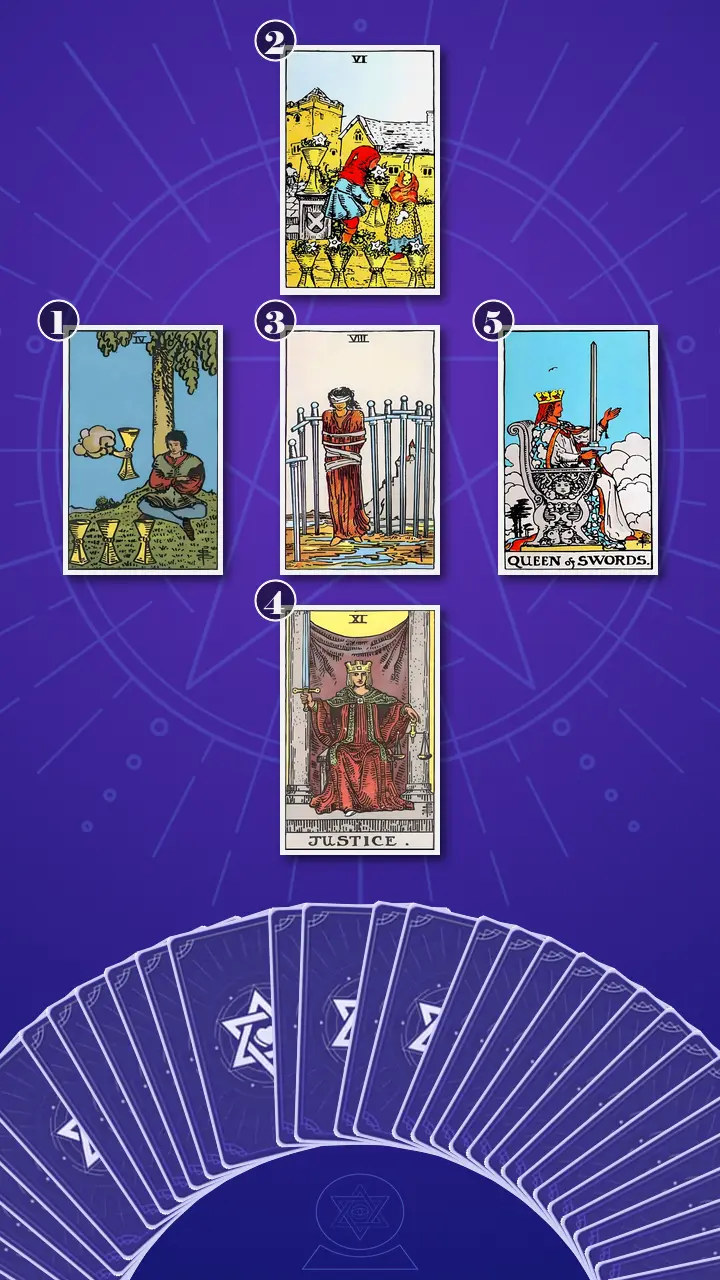
For this reading, I chose the Relationship Spread · Context Edition. It is a five-card relationship spread designed for a relational system that still has emotional history but may no longer fit in its old form. For anyone asking why they keep going to their ex's friend group after a breakup, this structure helps separate present experience, shared history, mental restriction, honest discernment, and a practical next step.
The first position would show Jordan's current place in the group: what she was doing and feeling when she continued to reply. The second would reveal what the shared history still provided and why it remained difficult to release. The third, at the visual center, would examine the current exchange and the mental story narrowing her choices. Below it, the fourth position would name the central challenge to clarity. The final card on the right would translate the insight into a self-directed way to engage.
I explained that the cards would not decide whether Jordan must stay or leave, and they could not tell us what her friends secretly thought. They would give us a neutral sequence of images and questions. We would read card meanings in context, compare them with observable facts, and let Jordan decide what deserved another experiment.
The Cups Still in the Room
The Crossed Arms of the Four of Cups
I turned to position one, the place showing Jordan's current stance inside her ex's friend group: physically present, digitally included, and emotionally disengaged in ways she had already begun to notice.
Four of Cups, upright.
The seated figure's crossed arms immediately echoed the way Jordan showed up to dinner with her emotional arms folded. She kept accepting invitations, watched where her ex was standing, compared each gathering with the uncomplicated version of the group before the breakup, and then left unable to name anything she had received beyond the temporary relief of still being included.
The fourth cup offered from the cloud mattered here. The upright energy was a blockage in emotional participation, not a flaw in Jordan's character. Her attention was fixed on the three cups already on the ground, the preserved version of belonging she had lost, while the present question hovered just outside her automatic response: what do I actually feel in this room before I say yes to the next invitation?
Being included was not the same as feeling connected. The group chat was still open, but access alone could not restore the old emotional fit. The card showed me a stagnant emotional pattern, and I said so plainly: the invitation could be real, the friendships could matter, and the after-effect could still be depletion.
Jordan did not nod. First, her thumb stopped above the phone and her breath held at the top of her chest. Then her eyes went unfocused, as if the Saturday dinner were replaying behind them: her ex laughing, her own smile held in place, the tightness under her ribs. Finally, she rubbed her jaw and gave a short, bitter laugh. “That is almost rude,” she said. “I feel included and still not at home.”
I let the laugh have its honesty. “It does not need to become a verdict,” I said. “It is information. Tarot is useful here because the image lets us look at a pattern from the outside, where you do not have to defend it or punish yourself for having it.”
The Archive That Still Feels Like Home
I moved to position two, the card showing what the shared history and familiar social bond still provided, including the belonging needs that kept Jordan connected after the breakup.
Six of Cups, upright.
I asked her to picture the Sunday night in her apartment kitchen when she watched an Instagram Story of the group on a rooftop patio. The kettle clicked off behind her. Blue phone light caught in the dark window. She reread an old group thread, laughed at an inside joke, and felt genuine warmth for a few seconds before comparing that warmth with the loneliness of the present.
The flower-filled cup in the card was the old birthday ritual, the saved group photo, the friend who still remembered exactly how she took her coffee. The affection was real. The upright energy became difficult only when nostalgia started asking the present-day group to remain emotionally unchanged, so Jordan would not have to grieve the social home that existed before the breakup.
I compared the group chat to an auto-renewing subscription. Access could continue because nobody had cancelled it, but the renewal itself was not proof that the current plan still fit. A familiar social circle could carry history without automatically carrying present-day emotional nourishment.
“I keep calling it loyalty when it may be fear of starting over,” Jordan said. Her hand tightened around the edge of her sleeve, then loosened. She looked at the Six of Cups for a long moment, caught between tenderness for the past and irritation at how easily that tenderness took over the present.
“You can care about the history without making the history decide your availability,” I said. “The question is not whether those memories mattered. The question is whether your next interaction is a current exchange with people you value, or an attempt to preserve an earlier version of belonging exactly as it was.”
The Two Buttons That Were Never the Whole App
The Blindfolded Choice of the Eight of Swords
I turned to position three, the center of the cross, which examined what was currently being exchanged in the connection and the mental story shaping Jordan's participation.
Eight of Swords, upright.
The card showed the hidden mechanism beneath the nostalgia. Jordan saw one dinner invitation and immediately checked who had responded, whether her ex was attending, and how quickly everyone else seemed to be settling into the new arrangement. She accepted before deciding because the acceptance gave her a few minutes of relief from the fear of being left out.
The blindfold represented an imagined audience reaction. The loose bindings represented agency she was overlooking. The surrounding swords were the rehearsed consequences attached to one declined plan. The upright energy was a blockage: not an objective prison, but a mental enclosure that made flexible choices feel unavailable.
I asked her to complete the sentence in her private inner operating system: “If I skip this one plan, then ____. If I take space, they will probably ____.” Her version arrived quickly: “If I skip this one plan, then I am choosing sides. If I take space, they will probably move on without me.”
That was the social version of seeing only two buttons in an app: attend every event or delete the account. I pointed to the space between those extremes. Selective attendance. One-on-one contact. A temporary pause. Muting the chat for a few hours before replying. Arriving with an exit time. None of these choices guaranteed a particular reaction, but none required total disappearance either.
Jordan's jaw tightened. Her fingers hovered over the corner of the card while her breath became shallow. Then she looked down at the loose bindings, swallowed, and said, “I have been treating a prediction like a rule.”
“Exactly,” I replied. “A prediction about rejection is not the same as a boundary that has been tested. We cannot promise that every friend will respond perfectly, and we do not need to invent a catastrophe in order to take your discomfort seriously. We can make one proportionate choice and observe what it teaches you.”
When Justice Put the Scales on the Table
The Card That Refused a Verdict
When I moved to position four, the central challenge to clarity, the room seemed to quiet around the card. Outside my window, a streetcar bell sounded once and faded. I placed the card below the Eight of Swords, where it felt less like an answer dropped from above and more like a hinge Jordan could choose to use.
Justice, upright.
Justice brought a clean, balanced air to a reading that had begun in emotional water. The level scales asked Jordan to weigh what staying gave her and what it cost her. The upright sword separated present evidence from nostalgic meaning. Its energy was discernment, accountability, and proportionate boundaries, not punishment and not a command to leave.
I returned with her to the crowded Ossington bar from the previous Saturday. There had been genuine laughter. One friend had asked about her new content project and listened to the answer. There had also been a tight stomach, a coat that felt too warm, repeated glances toward her ex, a bathroom phone check, and a TTC ride home spent scrolling through photos because she could not tell whether she had felt connected or merely relieved that she had not been visibly excluded.
“What do I know from what happened, and what am I predicting because I am scared?” I asked. I put each detail on Justice's scales. The laughter did not erase the tension. The tension did not erase the individual friendship. A boundary did not have to declare one side of that equation false.
At that point, I used one of my signature tools, Narrative Fork Analysis. I deconstructed Jordan's options as competing plotlines rather than as a single moral test. One plotline kept saying yes automatically, preserving access to the old social identity while keeping her coat on in a room that had changed. Another plotline tested a temporary limit and made room for current, reciprocal friendships. A third kept selected individual connections while reducing group exposure. I asked which plotline genuinely served the character growth arc she wanted, not which one produced the least awkward scene tomorrow.
Then I named the second lens: Safe-Choice Sabotage Recognition. The seemingly logical choice, saying yes quickly so nobody noticed a change, might be a defense against the necessary inciting incident of starting over. That did not make attendance wrong. It meant the safe choice deserved examination when it repeatedly left her tense, distracted, and depleted.
Because I work with stories, I remembered the rough cuts on my own editing table. A scene can be beautifully shot, full of history and feeling, and still have already ended. The frame is not a command to keep filming. I wanted Jordan to see that a new scene could begin without insulting the old one.
The Sentence Beneath the Fear
On Thursday afternoon, the invitation lit Jordan's phone. She checked whether her ex was going, typed “I'm in,” deleted it twice, and accepted while hoping he would cancel. The familiar group still opened the door, but her tight stomach had already decided the room might not feel like home.
You are not obligated to treat familiarity as fulfillment; weigh what the group actually gives and costs, then let Justice's level scales and upright sword support one clear boundary experiment.
You do not have to keep participating in a group that no longer feels right to prove that you still belong. Familiar access is not the same thing as present connection; clarity begins when you separate what is happening now from what you are afraid your choice will mean.
For a few seconds, I said nothing. Jordan's fingers went still around the card and her breath stopped halfway in. Her pupils widened slightly as she seemed to replay the last gathering in sequence: real laughter, ex-monitoring, the clenched stomach, the drained ride home. Her mouth parted, closed, and pressed into a line while the facts separated from the story attached to them. Then her shoulders lowered by a fraction. Her hand uncurling from the card was almost too small to notice, but I noticed it. She released a shaky breath that sounded almost like a laugh. “I can look at the whole exchange,” she said, then her eyes filled. “But I don't want the history to become fake.” The relief made her briefly unsteady, as if a clear floor had appeared where she expected a wall. I told her that grief could remain true without becoming a contract.
“Now, use this new perspective to revisit last week,” I invited. “Was there a moment when separating what happened from what you feared it meant might have changed how the room felt?”
This was the first meaningful movement from fear-based automatic participation and social vigilance toward clear, self-directed belonging and proportional boundaries. The breakthrough was not a decision about the group. It was the recognition that Jordan could examine the exchange without asking the old social map to certify her worth.
The Sentence With No Twelve-Paragraph Defense
I turned to position five, the self-directed next step: a healthier way to engage with the group without asking the ex or the mutual friends to decide whether Jordan still belonged.
Queen of Swords, upright.
The Queen's upright energy was clear air after the stuck water and constricting thoughts. Her sword offered a concise truth. Her open hand kept the boundary from becoming punishment. Her composed gaze suggested that emotional honesty could include grief without allowing grief to make every decision.
I gave Jordan a possible message: “I'm taking a little space from group plans this week, but I'd still love to catch up one-on-one sometime soon.” It did not explain the breakup again. It did not accuse anyone of mishandling the group. It did not ask ten people to reassure her that she was still chosen. No long defense required.
The Queen of Swords did not tell Jordan to disappear. She showed her how to make her level of contact legible. Jordan opened her Notes app, read the message once, and for the first time that evening did not check whether her ex was online. Her shoulders were still slightly raised, but her attention had come back to the table.
“That sounds almost too simple,” she said. “Which is probably why I keep making it complicated.”
“Simple is not the same as easy,” I said. “You can be direct without being cold, and you can choose a temporary limit without turning it into a public ending. The cards are showing you a skill you already have: the ability to name what is true and let other adults respond to it.”
The One-Event Boundary Experiment
When I read the five cards together, I could see why staying in an ex-linked social circle out of fear had become self-reinforcing. The Four of Cups showed physical inclusion without emotional participation. The Six of Cups explained the backward pull of affection, inside jokes, and a former social home. The Eight of Swords turned that pull into an all-or-nothing rule. Justice restored proportion, and the Queen of Swords gave the clarity a voice.
The core blind spot was treating continued access as proof of belonging, then treating one change in availability as proof of rejection. The transformation direction was not from caring to not caring. It was from measuring belonging by continued access to testing present fit, preserving genuine one-to-one friendships, and building a social life that reflected Jordan's current values.
This is what a five-card contextual relationship tarot spread for post-breakup mutual-friend boundaries can offer: a structured way to move from feeling included but emotionally disconnected toward actionable advice. It cannot guarantee how a group will react. It can help someone distinguish a present fact from a feared interpretation and choose a reversible level of contact with more self-respect.
I introduced my Protagonist Pivot Action, a 24-hour creative mandate to take one micro-action aligned with the most daunting but authentic plotline. Jordan did not need to solve her entire social identity. She needed one small scene in which she acted as the protagonist of her current life rather than as the caretaker of an old arrangement.
- Ten-minute give-and-cost inventoryBefore replying to the next invitation in the shared group chat, open the Notes app, set a ten-minute timer, and write two columns: “What this group gives me now” and “What staying costs me now.” Use only observable facts from the last two gatherings, then circle one present-day item on each side.Stop when the timer ends. This is information, not a verdict, and you do not have to force a permanent answer.
- One-event boundary experimentWithin the next 24 hours, choose one upcoming group plan and send a concise message: “I'm taking a little space from group plans this week, but I'd still love to catch up one-on-one sometime soon.” If declining feels too large, attend for one hour with a planned exit time and avoid monitoring where the ex is. Afterward, write one sentence about what changed in your body and mood.Use one or two sentences, speak only for your own capacity, and remember: no long defense required. A temporary boundary does not have to announce a permanent exit.
- Current-belonging testThis week, text one mutual friend or quieter friend outside the main circle and suggest a specific 30-minute coffee near the office, a walk through Trinity Bellwoods, or a short call. Try: “I've been thinking about you outside the group chat. Want to grab coffee next week?” Keep the plan separate from the ex and the larger group.Make it low-stakes and easy to cancel. Let direct friendship be its own connection, not a replacement test for the old circle.
I told Jordan that each action was an experiment, not a personality exam. She could attend, connect one-on-one, pause, or revise the boundary after gathering new information. The cards had offered a map, but Jordan was still the person holding the pen.

A Week Later, the Quiet Proof
Five days later, I received a message from Jordan: “I used the two columns, skipped Friday's dinner, and asked a friend for coffee. I slept all night, but woke thinking, What if I'm wrong? I smiled at it, and made the coffee anyway.”
That was the kind of proof I trust: not a transformed life, not instant freedom, just one clear choice followed by enough room to notice its effects. The old group had not been erased. The history had not become fake. Jordan had simply stopped asking familiarity to do the work of present connection.
Our Journey to Clarity had moved from automatic participation and social vigilance toward a more self-authored form of belonging. The decision remained in motion, but it belonged to Jordan now, and that ownership was more durable than any prediction about who might stay.
When a familiar group chat still opens the door but your stomach knots before you walk in, you may be grieving the old belonging while fearing that stepping back will prove you were never someone people chose to keep.
If belonging did not have to stay in its old shape, which small setting on your own three-level contact menu, attend, connect one-on-one, or pause, might feel worth noticing this week?