Long-Distance Friendship Overextension Gives Way to One Focused Window

The Calendar With No Blank Space: Long-Distance Friendship Anxiety
You work a junior communications job in Toronto, finish a long day, and still open four far-away chats because seeing a friend post without replying makes ordinary distance feel like a crisis. That was the sentence I offered at the beginning of my session with Casey (name changed for privacy), because it held the problem more honestly than any polished explanation could.
At 7:06 PM on a Sunday, Casey sat in their Toronto apartment kitchen, dragging a Toronto-to-London call, a Vancouver voice note, and a Melbourne birthday catch-up across Google Calendar. A pot cooled on the stove while the fridge hummed and the laptop fan kept whirring. Their shoulders climbed toward their ears as they thought, "I can keep everyone close if I give up the evening," even though none of the calls felt fully chosen.
Casey looked at the calendar and said, "Why do I keep spreading myself across friends who live far away? I care about them, but I am always catching up. If I let one chat go quiet, I feel like I am letting the whole friendship disappear." The contradiction was clear: they wanted to keep every long-distance friendship emotionally active, while fearing that allowing even one connection to drift would prove they no longer deserved a place in it.
Exhaustion sat in Casey's body like a browser with too many tabs playing different conversations at once, each tab demanding attention because it might vanish if they closed it. Their hands kept drifting toward the warm phone. Four unread messages felt heavier than four actual conversations, and their mind treated every timestamp, reaction emoji, and online status as evidence waiting to be decoded.
I said, "You are not ignoring anyone; you are trying to prevent ordinary distance from becoming proof that you no longer matter. That makes sense, and it is also using up the person doing all the holding. We do not need to decide the fate of any friendship tonight. We can draw a map of the pattern, find where your capacity is leaking, and begin this Journey to Clarity with one choice you can actually own."

Choosing a Compass for a Cross-Time-Zone Life
I asked Casey to put the phone face down, take one slow breath, and name the question again without trying to solve it. I shuffled slowly after that. For me, this was not a supernatural performance; it was a deliberate transition from reacting to notifications to looking at the problem in context.
I chose a five-card Relationship Spread · Context Edition. This spread is useful when the issue is not one person or one message, but the way distance, history, communication habits, and personal boundaries interact. It lets me use tarot as an objective cognitive tool: the images give us a shared visual language, while Casey's lived details supply the evidence and meaning.
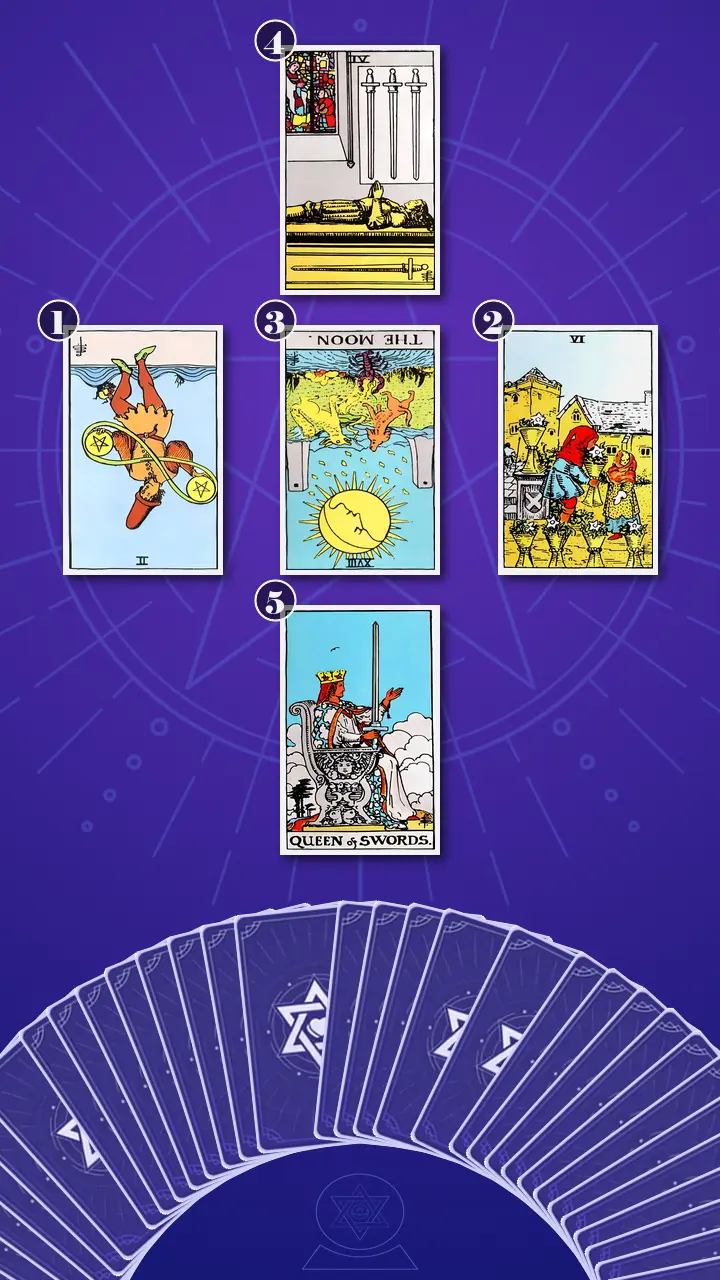
Readers often ask how tarot works in a situation like this. I do not use the cards to predict which friend will reply, who will stay, or whether a quiet chat is secretly a warning. I use card meanings in context to organize attention. The first card would show Casey's current social-energy pattern; the second would describe the long-distance friendship field and its emotional pull; the third would reveal the underlying bond dynamic behind the uncertainty. Above that dynamic, the fourth card would name the drain and the pause required to interrupt it. The fifth would offer a sustainable connection practice through conscious choice.
That structure matters because it moves from visible behavior to emotional history, then from interpretation to recovery and direct language. It gives the reading a path toward actionable advice without pretending that a spread can make another person behave differently. Casey remained the person with the authority to choose what happened next.
Reading the Map Through the Open Threads
The Two Coins in an Endless Loop
Now turned over is the card representing Casey's current social-energy pattern: how Energy Diffusion appears in their observable messaging, scheduling, and divided attention.
The card is the Two of Pentacles, in reversed position.
I pointed to the two coins held inside the infinity loop, the figure shifting weight between raised legs, and the rough sea behind them. Two of Pentacles reversed is Casey at 7:06 PM on that Sunday, moving a Toronto-to-London call, a Vancouver voice note, and a Melbourne birthday catch-up around the same calendar. They keep opening and closing apps, shifting between obligations, and telling themselves that one more adjustment will finally make every friendship fit.
The reversed energy is an excess of flexibility that has tipped into imbalance. Casey is not short on affection. They are overusing adaptation until every open hour looks like social capacity. This is the visible shape of Social Energy Drain: workday edges become friendship overflow time, rest is traded for reassurance, and contact becomes scattered because attention is being divided before a conversation even starts.
I asked Casey to notice the sentence that usually starts the loop: "If I answer this now, then I can prevent that friendship from fading." Then I named its observable consequence: "And now you are tired before any conversation has even begun." The rough sea in the card was not a forecast. It was a precise picture of the instability created by trying to hold every connection in motion at once.
Casey did not nod. They gave a small laugh with no humor in it. First, their breath caught and their thumb froze above the phone; then their eyes moved from the infinity loop to the calendar, as if replaying a dozen Sunday nights; finally, their jaw loosened and they said, "I call this being a good friend, but I am running my social life like an emergency inbox."
I let that recognition stand without turning it into a character judgment. "You are trying to maintain every thread," I said, "and the threads are using up the person holding them." I suggested that Casey list the actual hours available for friendship during the next seven days before agreeing to another call. The point was not to mute everyone. It was to measure the container before pouring more into it.
The Flower-Filled Cup of Shared History
Now turned over is the card representing the long-distance friendship field: what Casey is responding to in friends who live far away and in the changing rhythm of contact.
The card is the Six of Cups, in upright position.
The image showed a flower-filled cup being offered between two children, with six cups arranged around a quiet village. I connected it to Casey seeing an old group-chat photo resurface, reopening a familiar joke, or pressing play on a shared Spotify playlist that still carried the emotional language of an earlier chapter.
The upright energy here is genuine warmth and mutual tenderness, not a problem to be corrected. The friends who moved away are not imaginary attachments, and Casey's longing is not embarrassing. The tension appears when the generosity of the Six of Cups becomes excessive preservation, when an old photo feels like a current obligation to restore the exact closeness everyone had before jobs, cities, partners, study, and ordinary life changed.
"History can warm the present without dictating its schedule," I told Casey. "The useful question is not how often you replied in the past. It is which connections feel mutual and present when you contact them now." A pinned group chat can remain meaningful without requiring daily maintenance, and a lighter rhythm does not automatically mean the bond has failed.
Casey's fingers stopped tapping the edge of the table. They touched the corner of an old photo on their phone, smiled, and then looked away from it. I saw affection and a faint ache arrive together. The card was not asking them to care less; it was asking them to stop confusing the preservation of a memory with the permanent duty to recreate it.
The Moon Behind the Read Receipt
Now turned over is the card representing the underlying bond dynamic: the emotional and interpretive pattern that turns an ordinary gap in contact into a reason for Casey to distribute their attention across even more conversations.
The card is The Moon, in reversed position.
I used the winding path between the two towers, the dog and wolf facing the moon, and the crayfish rising from the pool as a picture of incomplete information becoming visible. The Moon reversed is Casey at 8:47 PM on a Tuesday, riding north on TTC Line 1 after work. A far-away friend has posted an Instagram Story but has not answered since yesterday. Casey checks the online status, rereads the last reply, and treats the silence as a coded statement that the friendship is slipping.
Reversed, the Moon shows a blockage beginning to clear. It does not mean every fear is false or that every friend is reliable. It means Casey can begin to see where the mind has filled an information gap with a threatening story, then tried to manufacture certainty through more messages. The fact is the post and the missing reply. The story is that the missing reply proves Casey is being forgotten.
The train brakes squealed just as Casey repeated the imagined conclusion aloud. The fluorescent light buzzed above their face, and the phone felt hot in their palm. I asked, "What if the delayed reply is a normal gap in contact, but your nervous system is reading it like a friendship status update?" I then offered a simple pause: write one observable fact and one story added by the mind before sending another follow-up.
Casey stared past me for a moment, their eyes unfocused, then unlocked the phone and opened a note. They typed, "They posted a Story and have not replied since Tuesday," followed by, "They are quietly ending the friendship." Their shoulders remained high, but one hand moved away from the message box. I said, "A quiet chat is information, not a verdict."
The Quiet Before the Clear Sentence
The Hour That Was Not Owed to Anyone
Now turned over is the card representing the drain and boundary tension: where Casey's social capacity is being consumed and what kind of pause is needed to interrupt the pattern.
The card is the Four of Swords, in upright position.
The figure resting on the stone bier, with three swords mounted overhead and one sword beneath, gave the room a different tempo. I translated the image into a familiar city-life moment: Casey leaves their phone charging in the hallway for one hour before a scheduled call, sits on the edge of the bed, and lets their attention settle after the notification sound stops.
The upright energy is restorative balance. The pause is not indifference, rejection, or disappearing for weeks. It is a deliberate interruption in the contact system, long enough for Casey to discover whether the urge to reply remains after their body has had a chance to come down from the workday. Every empty minute has been treated as available social time, when some of those minutes are the recovery that makes focused connection possible.
I asked Casey to listen for the familiar thought: "If I stop replying, I am making the distance worse." Then I gave them a different image. "Imagine the room after the notification sound ends. Nothing has been abandoned. Your attention is simply no longer vibrating in every direction."
Casey frowned at the calendar. "But I cannot even find an hour. I have the London call, and Sunday is when my Melbourne friend is free." I did not argue with the obstacle or prescribe a perfect retreat. "Then begin with seven minutes," I said. "The Four of Swords is asking for an interruption, not a performance of perfect rest. One small phone-free block can show you what changes before we make any larger decision."
They exhaled slowly, recognized that the pause felt uncomfortable rather than peaceful, and wrote a small circle around the first seven minutes before the next call. For the first time that evening, stillness appeared as a practical tool instead of a social threat.
When the Queen Cut the Loop
The Blade That Named Capacity
The air in the room seemed to narrow around the final card. I turned it over slowly.
Now turned over is the card representing Casey's sustainable connection practice: the self-directed next step for staying connected without treating every pause as proof of Long-Distance Friendship Drift or personal failure.
The card is the Queen of Swords, in upright position.
The Queen sat alert with one sword held steadily upright, butterfly carvings on her throne, and open sky behind her. I connected her directly to Casey telling one friend, "I care about staying connected, and I can reliably talk on Sunday afternoon rather than replying throughout every day." There was no second paragraph defending the calendar, no promise to compensate later, and no apology for having a life with limits.
The upright energy is discernment in balance: affection stays, but access becomes defined. The Queen does not tell Casey whom to keep, drop, prioritize, or forgive. She asks what Casey feels, what Casey can actually offer, and what Casey can say plainly without turning capacity into a confession.
My Wall Street years came back to me then. I remembered how a crowded trading screen could make every fluctuation look like an urgent decision, while one clean line in a risk report could reveal what actually mattered. I call my relational version of that lens Network ROI Analytics. I do not use it to turn friends into profit centers. I ask whether an exchange gives both people room to be present, or whether Casey keeps investing scarce time in reassurance, scheduling, and access without a sustainable return of mutual attention. A high-drain pattern is information about the arrangement, not a verdict on anyone's worth.
The Sunday Evening Test
It was Sunday evening in Toronto. Casey's laptop was still open and their phone was warm in their hand as they moved between WhatsApp threads and Toronto, London, Vancouver, and Melbourne time zones, promising one more call before Monday. The calendar filled, yet every conversation still felt unfinished.
Stop treating every quiet interval as proof that you must do more; let the Queen of Swords' upright blade name your actual capacity and support a clear, sustainable rhythm.
I let the sentence settle, then added, "You do not have to keep every long-distance friendship equally active to prove that you care. Care can have a rhythm, and a slower rhythm is not automatically a failed friendship."
Casey's body answered before their words did. First, their breathing paused and their fingers tightened around the phone; then their gaze lost focus, as if the old calendar, the unread chats, and every midnight apology were replaying in the same small space; finally, their fist opened against their knee and a low, shaky "Oh" rose from their chest. Their shoulders dropped, but the release brought a brief, almost dizzying blankness with it. The fear had not vanished, yet it no longer occupied every inch of the room. Their eyes grew wet without spilling over, and when they spoke, their voice was quieter. "So I can care without proving it every day." I did not rush to fill the silence. The clear path offered relief, but it also left Casey responsible for choosing how to walk it.
I asked, "Now, using this new perspective, can you recall whether there was a moment last week when this insight might have made you feel different?"
That was the crossing I wanted Casey to notice: from guilt-driven hypervigilance and scattered availability toward self-trusting, capacity-based care and focused long-distance connection. The Queen's single blade did not promise certainty about anyone else's feelings. It gave Casey a principle they could apply without waiting for another notification to tell them who they were.
"Availability is not the same thing as care," I said. "A slower rhythm can be intentional. You can let a friendship change pace without turning the change into evidence that you were not worth keeping."
The One-Page Capacity Map
The five cards told one coherent story. Shared history made the distant friendships genuinely precious, and that tenderness made every quiet interval feel like a debt. The reversed Moon showed how delayed replies and social-media signals converted uncertainty into urgent contact. The reversed Two of Pentacles then carried the cost: too many threads, inconvenient time zones, less rest, and conversations that became sporadic because Casey was exhausted from trying to prevent drift. The Four of Swords supplied the interruption, and the Queen of Swords supplied the language.
The cognitive blind spot was treating availability as evidence of worth. Casey had been measuring care by equal activity across every friendship, even though the result was less focused attention for everyone, including the people nearby. The transformation direction was not from loving to detached. It was from treating every delayed reply as a problem to recognizing a weekly capacity limit and choosing contact that could be offered with genuine attention.
I framed the next steps through my Social Divestment Plan. The name can sound more severe than the practice. In this reading, Casey was not being asked to cut people off, declare anyone toxic, or stage a dramatic exit. The divestment was from the extra energy spent monitoring read receipts, accepting every inconvenient call, and writing apologies before anyone had complained. The plan kept affection while liquidating reactive access.
Here was my actionable advice, kept deliberately small:
- Run a seven-minute social-capacity auditOn Sunday, before opening any chat, check the next seven days in Google Calendar for work, study, sleep, existing plans, and recovery. Write the total minutes genuinely available for long-distance friendship contact, then choose two fixed windows, such as Wednesday from 7:30 to 8:00 PM and Sunday from 2:00 to 3:00 PM. Put the windows on the calendar without assigning every minute to a person, and leave at least one window unscheduled.If two windows feel too restrictive, start with two 20-minute blocks. They are available, not mandatory. A boundary describes your capacity; it does not control when a friend replies.
- Use the Fact-versus-Story PauseWhen a delayed reply or Instagram Story triggers urgency this week, open a note titled Fact / Story. In five minutes or less, write one observable fact, such as "They posted a Story and have not replied since Tuesday," and one interpretation, such as "They are quietly ending the friendship." Wait until the next planned contact window before sending another check-in unless there is a concrete reason to believe the person needs immediate help.The pause is for observation, not for judging the friendship or forcing certainty. If both columns feel too intense, write only the fact and wait five minutes.
- Send one No-Apology Availability LineChoose one far-away friend with whom contact already feels reasonably mutual. Send or save this one-sentence message: "I care about staying connected, and I can give this conversation my full attention on Sunday afternoon rather than replying throughout the week." After writing it, do not add a second paragraph to manage the friend's reaction.Read the sentence aloud once. Remove explanations that are not necessary, and let the clear information stand. The smallest version is simply naming one day when you can be present.
I reminded Casey that small steps were not a lesser form of courage. The point was to test a sustainable contact rhythm in real life, not to solve every friendship or guarantee that no connection would ever change. They remained the person making the decisions, and the cards remained a way to see those decisions more clearly.

A Week Later: The Quiet Proof
A week later, I received a message from Casey: they had slept through the night after setting the two windows. Their first morning thought was, "What if I am wrong?" They smiled, left the phone charging in the hallway, and opened Google Calendar to one Sunday afternoon conversation.
One chat was still quieter than Casey hoped. They did not chase it with three follow-ups. Another friend accepted the Sunday window, and the conversation felt less like a task because Casey arrived rested enough to listen. The result was not a perfect social calendar or proof that every friendship would remain unchanged. It was smaller and more credible: one clear boundary had created room for one genuinely present exchange.
I saw the Journey to Clarity in that small decision. Tarot had not rescued Casey from uncertainty, and it had not selected a future on their behalf. The Relationship Spread · Context Edition had helped them separate history from obligation, facts from stories, rest from rejection, and care from constant access. Casey supplied the honesty, the limit, and the next move.
When a quiet chat leaves your shoulders tight and your hand hovering over your phone, it is easy to treat constant availability as proof that you are still worth keeping, even while trying to hold every friendship close leaves you less present with everyone. The Queen of Swords offers a gentler measure: your care can be real, your capacity can be finite, and both truths can stand together.
If one honest Sunday-afternoon contact window could hold your care without requiring your whole week, what would feel quietly different about the way you imagine staying connected?