Always Making Plans While the Group Drifts: Letting Reciprocity Show

When Holding the Friend Group Together Becomes a Sunday Shift
If you are the late-twenties friend with a hybrid job who turns a quiet Sunday group chat into a three-option scheduling poll, you may know friendship drift anxiety as a task list rather than a feeling.
At 4:18 on a Sunday afternoon, I watched Maya (name changed for privacy) sit at the kitchen table in her Toronto apartment. The kettle clicked off behind her, the radiator hissed beneath the window, and her phone warmed her palm as she moved from the inactive group chat to Google Calendar. Check the thread. Open the week. Draft three dinner dates. Nobody had asked her to organize anything.
“I tell myself I am just being proactive,” she said. “But their silence feels like a verdict. If I stop planning, the whole thing might disappear.”
A band of pressure had formed beneath her sternum, as if longing were a fragrance sprayed into a room with no open windows: sweet at first, then dense enough to make breathing feel like work. She wanted the old ease of seeing everyone together. She also wanted to stop project-managing closeness with the last of her social battery.
“I want closeness,” she said, rubbing one thumb along the edge of her phone, “but I do not want to beg for it.”
I told her I was not going to use tarot to predict whether the group would reunite or fall apart. I could not know what five separate people privately intended, and the cards would not turn speculation into fact. What I could do was help her separate observable patterns from the meaning she had been forced to invent around them.
“Let us give this fog a map,” I said. “Not so the cards can decide what happens next, but so you can see where your choice begins.”

Choosing a Five-Card Bridge for Friendship Drift
I asked Maya to place both feet on the floor, take one ordinary breath, and hold a single question in mind: “What is mine to contribute, and what am I trying to carry for everyone else?” I shuffled slowly. The pause was not a mystical performance; it was a transition from reacting to observing.
I chose the Relationship Spread · Context Edition, a five-card relationship tarot spread adapted for a friend group growing apart. I use this spread when the real question concerns reciprocity, changing closeness, unequal emotional labor, and the boundary between caring for a relationship and managing it.
I want to be clear about how tarot works in a reading like this. A broad spread would introduce life areas Maya had not asked about. This focused layout gives each card a specific analytical job, so the card meanings stay in context rather than becoming vague forecasts.
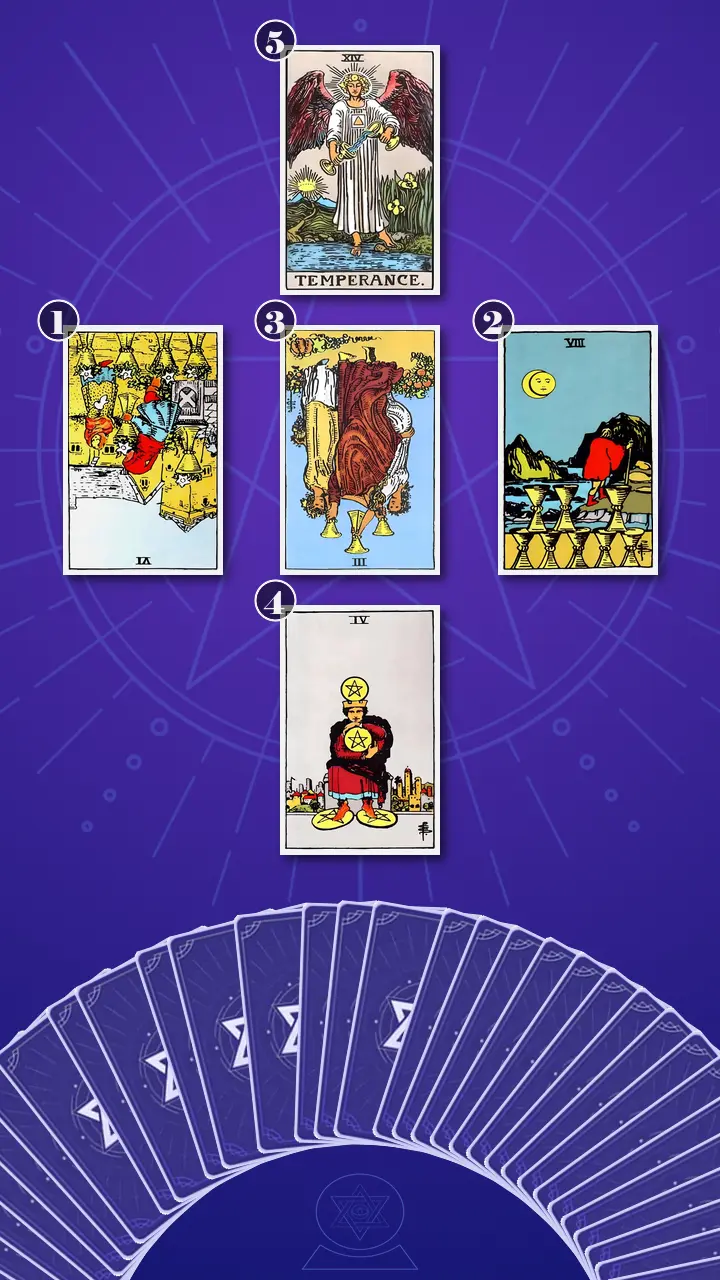
I placed the cards like a small bridge. The first would show Maya's role when the group's momentum dropped. The second would describe the group's current collective pattern through observable availability and participation. The third, at the center, would reveal the interaction loop between her effort and their response. Beneath it, the fourth would expose the fear tightening that loop. Above it, the fifth would offer a healthier contribution Maya could practice without deciding for anyone else.
The Archive and the Diverging Lines
Position 1: The Old Photo That Became a Rescue Plan
I turned over the card representing Maya's role in trying to keep the friend group together, including her habit of initiating plans and carrying the follow-up. It was the Six of Cups, in reversed position.
I pointed to the six flower-filled cups, the child offering one cup, and the enclosed courtyard. Upright, this card can hold memory with tenderness. Reversed here, that energy was blocked by an excess of backward pull: memory had stopped being only something Maya felt and had become something she used to make the present recoverable.
I asked her about the most recent quiet week. She unlocked her camera roll and found a photograph from a cottage weekend three summers earlier: sun-reddened faces, mismatched mugs, somebody laughing outside the frame. She told me she had dropped it into the chat with, “We need to do this again.” Two heart reactions appeared. Nobody answered the invitation underneath.
“What did you hope the photo would do?” I asked.
Maya looked down. “I think I was saying, ‘If they remember how good we were, maybe the present will feel secure again.’”
I told her the memory was real, and so was the affection inside it. The problem was not nostalgia itself. It was using an old iCloud album as the current relationship dashboard: the archive proved something mattered, but it could not report today's availability.
She gave a brief laugh that held more ache than humor. “That is painfully accurate. Honestly, a little brutal.”
I let the laugh settle before answering. “Then we will handle it gently. The card is not asking you to disown the past. It is asking whether the present must reenact it before you will let it count.”
Her fingers tightened around the phone, paused, and then loosened. I watched recognition arrive in three small movements: first the stillness of being seen, then her eyes drifting toward the old photograph as if replaying the moment she sent it, and finally a long breath that lowered her shoulders by half an inch.
“You can honor the history without making the present reenact it,” I said.
Position 2: Different TTC Lines from the Same Platform
I turned over the card representing the friend group's present collective pattern as it grew apart, including its shared availability and reciprocal engagement. It was the Eight of Cups, upright.
The cloaked figure was walking away from eight carefully stacked cups beneath a moonlit sky. I read the card's upright movement as a balanced but uncomfortable redirection of energy. It did not declare that Maya's friends had stopped caring. It showed that the old arrangement was no longer the only place their attention lived.
I asked Maya to list what she could actually observe. New jobs. Partners. Longer commutes. Different neighborhoods. Private routines. Smaller plans. A few warm one-to-one messages. Very little spontaneous full-group momentum.
“It is like you all once stood on the same TTC platform and took the same train,” I said. “Now work shifts, relationships, energy levels, and geography are pulling people onto different lines. The routes have changed. That is evidence of different destinations and schedules, but it is not automatically evidence that you were deliberately left behind.”
She told me about watching an Instagram Story on a westbound Line 2 train: two friends from the group eating noodles together while the rails screamed around a curve and damp coats filled the carriage with the smell of wet wool. Her stomach had dropped before she knew any context.
“The sentence in my head was, ‘Everyone has moved on, and I am the only one who did not get the memo,’” she said.
I separated the two layers for her. The observed fact was that two friends had met. The added theory was that their separate plan defined Maya's place in every friendship. Tarot could illuminate that leap, but it could not confirm it.
“A quiet group chat is information, not a verdict on your belonging,” I said.
Maya's gaze stayed on the walking figure. Her jaw remained tense, but the urgency in her eyes softened. I could see that the distinction brought relief and grief together: relief that she did not have to call every change rejection, and grief because the common platform still mattered to her.
Position 3: The Group Project Nobody Agreed to Manage
I turned over the central card representing the interaction loop between Maya's efforts and the group's response, especially whether the connection was mutual or being maintained by one person. It was the Three of Cups, in reversed position.
The three raised cups normally form a coordinated circle. Reversed, their communal energy was blocked, while the organizing energy had become excessive and concentrated in Maya. The chat could look active without the responsibility being shared.
I asked her to walk me through the last meetup. She had built the When2meet poll, found restaurants near transit, checked dietary needs, monitored the price range, sent the reminder, and considered making the Resy booking after several friends answered with a soft “maybe.” Between agency Slack notifications, she had become organizer, calendar owner, accessibility checker, reminder bot, and morale lead. The others contributed scattered hearts and tentative reactions.
“Technically, we still meet,” Maya said. “But would anything happen if I stopped producing it?”
“That is exactly what this position is asking,” I said. “Your extra labor keeps visible activity on the screen, but it also prevents you from learning whether anyone else will create momentum. A gathering by choice and a gathering sustained by one person's coordination can look identical on a calendar.”
I thought briefly of the fragrance formulas I had balanced over fifteen years as a perfumer. A finished scent can appear seamless even when one material is doing nearly all the structural work. The wearer only notices the imbalance after that material becomes exhausting.
“Activity is not the same as reciprocity,” I told her. “And resentment is not proof that you are uncaring. Sometimes it is the body's invoice for labor you never agreed to perform alone.”
Maya pressed her lips together. Her eyes moved as if she were mentally counting plans: birthday dinner, picnic, cottage weekend, holiday drinks. Then she placed her phone face down.
“I miss when being together happened without project management,” she said. “And I hate that I am starting to resent people I still love.”
I told her both feelings could be true. Love did not require her to pretend that the current distribution of effort felt good.
When the Grip Became Visible
Position 4: The Confirmed RSVP Held Against the Chest
I turned over the card representing the hidden fear and control strategy that kept Maya holding the group together after its shape had begun to change. It was the Four of Pentacles, upright.
The figure on the card pressed one pentacle against the chest, pinned two beneath the feet, and balanced another on the crown. In this position, the upright earth energy had hardened into excess: security had become gripping, and gripping had restricted movement.
I described the real-world mirror I saw. It was 11 p.m. Maya was hunched over Google Calendar, moving a workout and a call with her sister so a hesitant friend could make a third possible date. Confirmed RSVPs felt like proof held close to her chest. Calendar blocks were pinned beneath her feet. Every “yes” settled the pressure for a moment; every vague reply restarted the fear.
“If I can get everyone on the calendar, I can stop being scared for a minute,” she said quietly.
This was where I used what I call a Boundary Permeability Diagnosis. I did not mean that Maya's friends were villains or that their lives were contaminating hers. I meant that the group's uncertainty had been allowed to bleed through the edges of her life, entering her rest, budget, calendar, family time, and sense of worth until there was no breathable space between another person's availability and her own emotional safety.
At the perfume bench, I learned that even a beautiful material can suffocate a composition when it has no boundary, contrast, or room to diffuse. The answer is not to seal every note behind glass. It is to restore proportion so each element can remain itself.
“You have protected the group's continuity more carefully than you have protected your own time,” I said. “That does not make you controlling as a person. It means control became a strategy for surviving uncertainty.”
Maya's chest rose and stopped. Her thumb hovered over the blank Doodle poll still open on her screen. Her eyes lost focus for a second, and I could almost see the familiar sequence replaying: add a fourth date, message two people privately, make the plan easier. Then she exhaled and withdrew her hand.
“Before you add another option,” I said, “ask one question: ‘Am I making an invitation, or am I trying to secure an answer?’”
The unchanged screen became part of the reading. For once, silence was not an emergency she had failed to fix. It was space in which voluntary participation might finally become visible.
When Temperance Poured Between Two Cups
Position 5: A New Rhythm Without a Forced Reunion
The radiator clicked off, and the kitchen became unusually still as I turned over the final card. This was the key card, representing a sustainable way to relate to the group's changing shape through one small boundary or invitation Maya could practice without deciding for anyone else.
It was Temperance, upright.
I pointed to the angel pouring water between two separate cups, with one foot on land and one in water. The card held the balanced energy that the rest of the spread had been trying to reach: care without overextension, emotional openness with practical footing, and connection that could adjust without being forced into one container.
In modern terms, I saw Maya sending one warm, specific invitation with a real place, date, and time, then putting down her phone and returning to her evening. A yes, no, counteroffer, or silence could become information about how much energy to invest next. None of those responses had to become an instant theory about her worth.
The two cups gave my Boundary Permeability Diagnosis its corrective image. Maya could pour care from her side; each friend retained the agency to pour something back. A breathable boundary was not a locked door. It was measured diffusion: enough openness for warmth to travel, enough structure to keep Maya from becoming the atmosphere, ventilation system, and entire source of oxygen.
I asked Maya to picture the next Sunday afternoon. The chat was quiet, and she was already opening her calendar to solve a problem nobody had named. Another plan might settle her stomach briefly, but she could now feel the resentment waiting underneath that relief.
Stop measuring belonging by whether you can keep the old group intact; choose balanced, reciprocal contact and let Temperance's two cups model a new rhythm.
I allowed the words to remain between us without immediately explaining them away.
For one second, Maya did not move. Her breath stopped high in her chest, and her fingers stayed suspended above the phone. Then her pupils widened slightly as her gaze slipped past the cards, as though she were replaying every poll she had built and every “no worries!” she had typed while heat rose into her face. Her mouth tightened before her eyes turned glassy. “But does that mean I was wrong all this time?” she asked, the question sharper than anything she had said before. I heard anger first, then the grief beneath it. Her shoulders dropped, but the release left her briefly unsteady, like someone setting down a heavy bag and only then discovering how hard both hands had been gripping it. She opened her fists against the table and let out a quiet, trembling breath. The clarity had brought relief, but it had also returned responsibility to her: she could no longer make every silence mean nothing, and she no longer had to make it mean rejection.
“No,” I said. “It means the strategy once helped you feel secure. It also means you are allowed to notice that it now costs more than it gives. The group can change shape without making the friendships fake, and you do not have to keep the old circle intact to prove you belonged in it. Reciprocity becomes visible when you stop supplying every response.”
I leaned toward the cards. “Now, using this new perspective, think back to last week. Was there a moment when this insight could have made you feel different?”
Maya remembered a ninety-minute coffee with one friend who rarely replied in the group chat. Milk had steamed behind the counter, plates had knocked together, and the conversation had felt easy. Maya had left feeling warm, then dismissed the whole encounter because it did not restore the full group.
“I did not let that friendship count,” she said. “I treated it like a side conversation instead of a real relationship.”
“Temperance lets it count,” I said. “One-to-one warmth, monthly voice notes, an occasional group dinner, and a friendship that is mostly shared history can all be honest shapes. They do not have to be identical to be meaningful.”
I named the change plainly. This was not certainty about the group's future. It was the first movement from anxious friendship overfunctioning and fear of social rejection toward grounded belonging based on reciprocity, flexibility, and mutual choice. Maya still felt grief. What had changed was her willingness to let present evidence stand beside that grief without abandoning herself to prevent it.
The Space Calibration Ritual for Breathable Next Steps
I gathered the five cards into one coherent story. The reversed Six of Cups showed Maya using shared history as instructions for the present. The Eight of Cups showed the group redistributing its energy across different lives. The reversed Three of Cups revealed that Maya's added labor was keeping activity visible while concealing the lack of shared ownership. The Four of Pentacles exposed the hidden equation beneath the grip: if the old circle loosened, perhaps her belonging had never been secure. Temperance offered the resource she had not yet trusted, the ability to stay warm while allowing choice and difference to remain real.
I told Maya that her cognitive blind spot was confusing continued group activity with proof of belonging. Every extra date and follow-up gave her temporary reassurance, but it also removed the blank space in which reciprocity could be observed. She was trying to hold a circle closed with both hands while its members moved at different speeds. Her task was not to drop every relationship or force herself to stop caring. It was to release one hand, make one clear offer, and notice who reached back freely.
I translated that shift into my Space Calibration Ritual: deliberate digital and physical blank spaces that prevent uncertainty from flooding the rest of life. I framed each blank space as an observation tool, not a punishment, loyalty test, or performance of detachment.
- Draft One Invitation, Then Create Digital AirOn Wednesday at 6 p.m., set a seven-minute timer in your Notes app and write: “I am getting coffee at [place] on Saturday at 11. I would love to see you, and no pressure if you are not free.” Send it to the group or one friend only if you genuinely want the plan. Then mute the thread for two hours. When you return, record only “yes,” “no,” “counteroffer,” or “no reply yet.”Drafting without sending is a complete first version. If your chest tightens, pause; you do not owe anyone an invitation, access, or a follow-up.
- Protect Two Real Calendar OpeningsBefore the next group poll, offer no more than two dates that genuinely work for your commute, budget, existing commitments, and social battery. Do not move a workout, family call, or recovery evening to manufacture a universal option. If neither date works, write: “I cannot coordinate another date this week, but I am happy to join if someone else sets one up.”A limit is information about your capacity, not a punishment. Do not make a deposit-backed reservation until the required number of people has clearly opted in.
- Let One Friendship Have Its Own ShapeChoose one friend whose direct warmth is already observable and invite them to a 30-minute neighborhood walk, coffee, or voice-note exchange. Afterward, write one present-tense quality beside the friendship, such as “honest work talk,” “easy voice notes,” or “good monthly catch-ups.” Let that connection count without asking it to prove the whole group is intact.Use this to experience a real connection, not to test the friend or extract reassurance. The ten-minute version counts, and rescheduling once is enough.
“One clear invitation is care,” I told Maya. “The response is not yours to manufacture.”

A Week Later, the Quiet Proof
A week later, Maya messaged me. She had sent the coffee invitation, muted the chat, and slept through the night. Her first thought on waking was, “What if nobody answers?” Then she smiled, made coffee, and waited.
One friend accepted. Another could not make Saturday but suggested the following weekend. Two had not replied. Maya wrote down the four observable outcomes without adding a story about who cared, then went for the workout she would previously have moved.
She did not tell me she had solved adult friendship grief. She still missed the version of the group that once gathered without Doodle polls, TTC calculations, or soft maybes. What she had gained was smaller and more durable: she could feel that sadness without converting it into another unpaid shift.
I did not credit the cards with changing her friendships. The spread had made the pattern visible; Maya had created the evidence by changing her own participation. That was her Journey to Clarity: moving from monitoring to observing, from securing attendance to noticing mutual effort, and from treating silence as a verdict to letting it be information.
I want you to remember this when your own group chat goes quiet and your chest tightens before your fingers start fixing the calendar: you may be holding the circle together because letting it change feels dangerously close to finding out you never belonged. Noticing that reflex does not erase the history or decide the future. It simply gives you back the hand that has been gripping the calendar.
If one clear invitation could be enough for now, where could you leave a Temperance-sized pocket of air between your care and their answer, allowing the friendship to reveal its own shape?