Ghosted After Intimacy: From Story Checks to a Phone Face Down

Chasing Closeness After the Story Ring Goes Silent
I recognized the scene before Maya finished taking off her coat: you are a 26-year-old junior account coordinator in London, the workday is over, and you are rewriting a casual follow-up because their Story is active while your message sits unanswered. This is ghosting after intimacy, when reassurance starts to look like a task.
At 8:47 PM on a Tuesday, Maya sat at the small kitchen table in her London flat after riding the Central line home. Her phone was warm in her palm. The radiator ticked beside her, and the kettle clicked off behind her as she reread the affectionate messages and drafted another check-in that sounded casual enough to hide how much she wanted an answer.
She had become close with someone through long Hinge messages, late-night voice notes, and the kind of emotional and physical intimacy that made a future feel briefly plausible. Then the replies stopped. She said, I can handle rejection better than I can handle not knowing what happened. The contradiction was painfully clear: she wanted to restore closeness, but feared that stopping the pursuit would make the loss permanent and prove she had not been worth staying for.
Her longing felt like trying to keep a closing door open by pressing one fingertip against the frame. Her chest tightened, her hands kept moving, and her stomach sank each time the screen showed activity without a reply. She was trying to turn silence into a solvable puzzle.
I told her, You are not sending this because you have nothing else to do. You are sending it because part of you believes the right words could make the silence stop meaning loss. We do not have to force an answer tonight. We can use the cards to make a clearer map of what is happening, and you will remain the person choosing the route.

A Six-Position Map for No Closure
I invited Maya to place both feet on the floor, take one slow breath, and name the question without trying to make it sound less important. I shuffled slowly. For me, this small ritual is a psychological transition: it gives the mind somewhere to place its attention before we look directly at a difficult pattern.
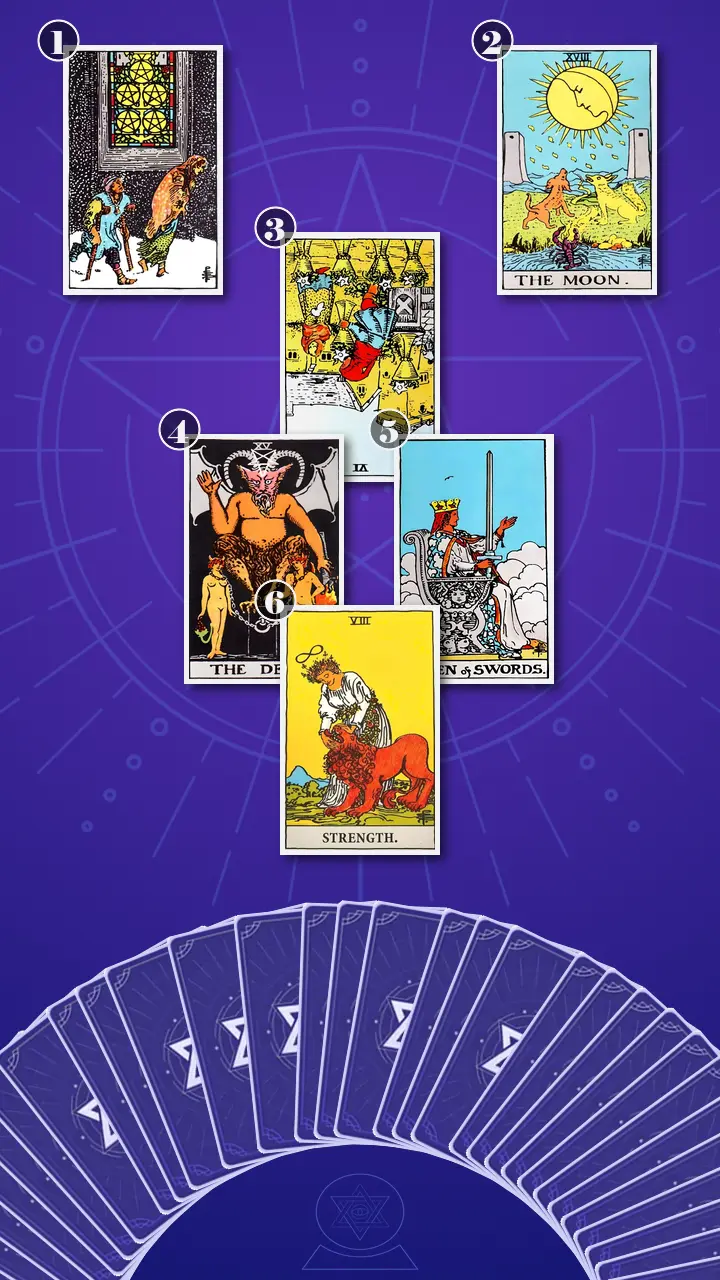
Today I used the Relationship Spread · Context Edition, a focused six-position relationship tarot spread for reflecting on ghosting after intimacy. I explained that tarot, in this setting, is not a prediction tool and does not give me access to the absent person's private thoughts. It is an objective pattern-mapping instrument. The images help us separate what is observable from what is being imagined, then turn that distinction into a choice.
This spread is suited to Maya's question because it stays with the relational rupture rather than adding unnecessary predictions about the future. Its primary structure is relational dynamics, with a secondary inner-excavation layer. The first position shows the emotional stance after the withdrawal. The second shows what the disappearance leaves unresolved. The third reveals what the intimacy activated beneath the current interaction. The fourth names the repeating pursuit pattern, while the fifth offers a boundary-based resource. The sixth is not a promise that the other person will return. It shows what self-led integration can look like.
I placed the cards in a small cross, with the upper pair framing the center and the lower cards forming a path beneath it. The arrangement looked like a bridge over a cold gap: the rupture above, discernment and self-trust below. I told Maya that we would read each card in context, because card meanings become useful when they are connected to actual behavior, actual sensations, and actual next steps.
Reading the Map, One Message at a Time
Position 1: The Warmth She Was Trying to Reach
Now I turn over the card for your emotional stance after being ghosted, including the observable presenting behavior of pursuing contact to regain warmth and reassurance.
The card is the Five of Pentacles, in upright position.
In the traditional image, two figures move through snow beneath a stained-glass window glowing with warmth. I connected that window to Maya's phone. After work, she sat with a cold dinner and a warm screen, saw the person active online, and experienced a reply as a doorway back into the intimacy they had shared. She was not only missing a person. She was trying to regain access to a felt source of care and reassurance.
The upright Earth energy here is not a punishment or a prophecy of permanent loneliness. It shows scarcity being felt in the body. Care has become something she is standing outside of, visible but seemingly inaccessible. The more deprived she feels, the more one absent reply appears responsible for restoring her sense of being chosen. The pursuit begins because the emotional need is real, but the chosen source of relief is currently not offering reliable access.
Maya gave a short, bitter laugh. That is almost too accurate. I keep telling myself I only want clarity, but I am really hoping the reply will make me feel wanted again. Her shoulders lifted toward her ears, then dropped a fraction.
I did not ask her to shame herself for wanting warmth. I asked, When you reach for another message, what are you hoping it will give you: information, reassurance, proof that the warmth was real, or a way back in? The card did not decide the answer for her. It helped her see that the chase was carrying more than a casual check-in.
Position 2: The Explanation the Silence Leaves Behind
Now I turn over the card for what the disappearance leaves unresolved in your experience, especially the uncertainty and imagined explanations that keep the unanswered intimacy psychologically active.
The card is The Moon, in upright position.
At 11:42 PM on a Saturday, Maya had watched a new Instagram Story appear while her WhatsApp message remained unanswered. The Moon's two towers became the competing explanations in her mind: they are busy, they changed their mind, they are waiting for me to say something better. The winding path became the sequence of read receipts, timestamps, Story views, and imagined motives. The dog and the wolf facing the moon showed the split between reasonable concern and instinctive alarm.
Upright Water is overflowing here. The information is incomplete, but the mind keeps moving as if one more clue will complete the picture. An active status can show that someone is online; it cannot reliably explain why they have not replied or what their silence means about Maya's worth. The uncertainty becomes a dark-mode detective board, and every small digital detail seems to ask for another theory.
This is where I use my Shadow Projection Analysis carefully. I do not use it to claim what the absent person secretly feels. I look instead at the fear or unmet need that may be projected onto an ambiguous situation. Maya's mind was adding a story that said, If I find the perfect wording, I can prevent permanent loss. That story belonged to her activated inner world, not to the evidence on the screen.
Her index finger stopped above the phone. Her eyes went briefly unfocused, as if the same chat thread had become a film she was watching again. I asked, Which part of the explanation is supported by direct evidence, and which part is your mind trying to build because no closure feels unbearable? She took a breath before answering, and for the first time the question seemed to create space instead of pressure.
Position 3: The Tenderness Pulled Backward
Now I turn over the card for what the intimacy activated beneath the present interaction, including the nurture deficit and attachment need that may make the loss feel larger than the current contact alone.
The card is the Six of Cups, in reversed position.
Maya scrolled backward through the affectionate messages and returned to the exact exchange that had made her feel uncomplicatedly wanted. The flower-filled cups became saved voice notes and sweet sentences. The child offering a cup became the reassurance she wanted the connection to offer again. The enclosed courtyard became the private emotional world she revisited alone, even while the present communication had gone quiet.
Reversed Water is pulling toward the past. It can make earlier warmth feel more authoritative than current behavior. The nostalgia was not false, and I did not tell Maya that the intimacy had been meaningless. The card asked a more precise question: which part of the longing belonged to this person as they are now, and which part belonged to a wider wish for steady, uncomplicated care?
I was careful not to invent a specific childhood history from one card. A Jungian psychological lens can help us notice an old emotional script without turning it into a fixed diagnosis. Sometimes intimacy activates a wish to finally feel securely chosen, and when the contact disappears, the present loss seems responsible for repairing that deeper need.
Maya pressed both feet against the floor. I think I am missing the version of myself that existed when the conversation was mutual, she said. Her hand moved toward the phone, then returned to her lap. The distinction was beginning to form: the tenderness could have been real without making the current silence a promise that she had to recover.
Position 4: The Chain Made of One More Message
Now I turn over the card for the repeating attachment pattern that keeps the chase active, from the belief that the right message can restore care to the short relief and long-term erosion of boundaries.
The card is The Devil, in upright position.
Maya told herself that a second follow-up was not really chasing because it only said, Hope your week is going okay. After sending it, she refreshed the thread, checked the person's Instagram Story, reread the affectionate chat, and let the silence set the mood for the next hour. The Devil's loose chains became the thought that one more harmless message was still a completely free choice, even as each check temporarily reduced uncertainty and trained the next check.
The energy here is binding, but I do not read that as a moral verdict. It is a fear-fed loop. The trigger is silence after intimacy. The prediction is, If I stop now, it means I did not matter, so one more message is harmless. The behavior is drafting, sending, rereading, and monitoring. The reward is a brief reduction in uncertainty. The cost arrives later as a tight chest, shame, lost attention, and fewer choices.
My signature Attachment Loop Diagnosis helps me map that sequence without reducing Maya to it. I use it to ask whether relational friction is being intensified by an anxious-avoidant trap, a deep insecurity, or simply the nervous system's attempt to restore certainty after an unexplained rupture. It is a diagnostic lens, not a label. It helps reveal the bargain: she was trading boundaries and attention for the possibility of renewed closeness.
Maya's thumb paused above the send button. Her breath stopped halfway, and her stomach dropped. Then her gaze lost focus as she replayed the first late-night voice note, the warmth of being chosen, and the moment the replies became less frequent. Her fingers tightened around the phone.
If I stop now, it means I did not matter, so one more message is harmless.
She said, I hate how much sense that makes. It sounds like I am bargaining for proof. I answered, You are not manipulative or foolish for wanting care. The loop is an understandable attempt to make an unanswered rupture feel controllable. But the right message is not a substitute for present-tense care. Her thumb moved away from the send button. The immediate uncertainty remained, but the decision was no longer pretending to be automatic.
Position 5: The Sword and the Open Hand
Now I turn over the card for the available boundary and practical resource that can interrupt pursuit, clarify what is known, and redirect care toward self-respect and reciprocity.
The card is the Queen of Swords, in upright position.
Instead of opening the dating chat, I asked Maya to open Notes. The raised sword became a clean distinction between what happened and what she feared. The open hand made sure that clarity would not become self-punishment. She wrote three lines:
Fact: They stopped replying after we became intimate.
Story: If I find the right words, they will remember how close we were.
Reciprocity Standard: I want contact that is clear, ongoing, and mutual.
The Queen of Swords brings Air into the reading. Her strength is not emotional detachment. It is the ability to let present behavior count as information without pretending to know every reason behind it. A reply can confirm contact; it cannot retroactively create reciprocity. Maya did not need a hostile verdict about the absent person in order to make a self-respecting choice.
My Jungian training makes me careful with the word shadow. A shadow is not an evil secret hidden inside someone. It can be a fear, need, or expectation that has been pushed outside conscious awareness and then placed onto an uncertain situation. When Maya wrote the story down, she could meet the fear as her own experience instead of asking the other person to remove it through a perfectly timed reply.
She exhaled, opened Notes instead of WhatsApp, and looked at the three lines for several seconds. Her face was still sad, but the sadness no longer had to impersonate evidence. I still want them to answer, she said. But I can see that wanting an answer and sending a message are two different decisions. That was the first visible shift from earning a reply to reading current behavior and choosing a relational standard.
When Strength Held the Lion of Longing
The room became quieter when I reached for the final card. Even the radiator seemed to pause between ticks.
Position 6: Self-Led Integration After the Silence
Now I turn over the card for what self-led integration looks like after the ghosting, specifically how to hold longing without chasing and how to make future closeness compatible with self-trust.
The card is Strength, in upright position.
The image showed a woman resting a gentle hand on a lion's muzzle. I saw no demand that the lion disappear. I saw a different relationship to power: the feeling could remain present without taking control of the next action. The modern translation was simple. Maya could place her phone beside her, notice the tight chest and restless hands, and wait before deciding whether any contact fit her values.
At 8:47 PM on a Tuesday, Maya sat at her London kitchen table after the Central line, phone warm in her palm, rereading the affectionate chat. She wanted to protect her dignity, yet kept drafting casual words because silence felt like a door she might still reopen.
The old belief that silence must be pursued until it becomes care is not the only path; Strength invites you to hold the lion of longing with patience, pause before sending another message, and let reciprocal behavior rather than pursuit define closeness.
I then gave her the sentence I wanted her to carry into the week.
You do not have to chase a vanished reply to prove the intimacy mattered. You can hold the longing, name the facts, and let reciprocal behavior, rather than pursuit, define the closeness you choose.
For a moment, Maya froze. Her thumb hovered above the silent phone, her breath caught, and the warmth of the device seemed suddenly too noticeable in her palm. Her eyes widened, then lost focus as the old scene replayed: the late-night messages, the physical closeness, the first unanswered question. Her jaw tightened. But if I stop chasing, doesn't that mean I was wrong about us? The anger arrived before the grief, sharp and protective.
I did not rush to turn the anger into relief. I said, It means the intimacy can have mattered, and the current contact can still be absent. It means your strategy was trying to protect you, but it cannot create present-tense reciprocity. Her clenched fingers opened one by one. Her shoulders lowered, then lifted again in a shaky breath. A small, stunned Oh came from somewhere below her ribs, followed by a moment of lightheaded blankness. The path was clearer, and that clarity gave her a new responsibility: she could choose it.
Now, use this new perspective to recall last week, I invited. Was there a moment when holding the longing without obeying it might have felt different? Maya looked at the phone, then placed it face down. Longing is real; it is not an instruction, she said quietly. Strength had not made her less emotional. It had made one ordinary pause available.
This was the emotional transformation in its first form: from chasing a vanished reply to prove personal worth, toward holding longing with self-compassion, clear boundaries, and a preference for reciprocal connection. It was not certainty. It was self-trust beginning in the body.
Finding Clarity in Facts, Stories, and Reciprocity
When I read the six cards together, I saw one coherent story. The Five of Pentacles showed the felt scarcity of being left outside warmth. The Moon showed how no closure turned digital activity into a stream of possible explanations. The reversed Six of Cups showed how the earlier tenderness pulled Maya backward and made the present absence responsible for more care than one connection could provide. The Devil revealed the pursuit loop that traded attention and boundaries for brief relief.
Then the direction changed. The Queen of Swords separated facts from stories and made reciprocity a standard instead of something Maya had to negotiate for through perfect wording. Strength brought that clarity into the body through patience, showing that she could miss someone, feel the loss, and still choose contact that included mutual effort.
The blind spot was not that Maya cared too much. It was that she treated pursuit as her only available route back to care. She was confusing activity with information and interpreting stopping as disappearance. The key shift was from trying to earn a reply that restored closeness to naming silence as information and choosing one clear, self-respecting boundary.
I offered practical next steps through what I call the Projection Detachment Exercise. It is a structured way to separate the partner's observable behavior from the triggered internal narrative. It does not require a permanent block, a dramatic final message, or pretending not to care. It creates a small space where Maya can decide from facts, values, and reciprocal behavior.
- The Projection Detachment ExerciseAfter work, before opening the dating chat, take five minutes in Notes and write three headings: Fact, Story, and Reciprocity Standard. Under Fact, record only observable behavior, such as They stopped replying after we became intimate. Under Story, name the explanation your mind is adding, such as I need the perfect message or they will forget me. Under Reciprocity Standard, write the kind of contact you want to enter, such as I want communication that is clear, ongoing, and mutual.Keep each line under fifteen words. The minimum version is one fact and one sentence about the reciprocity you want. The note can stay private, and no message is required.
- The Ten-Minute Longing PauseBefore sending a follow-up, reopening the affectionate chat, or checking the person's online status, set a ten-minute timer. Put both feet on the floor, name the feeling in one word, and notice one body sensation such as chest tightness, restless hands, or a sinking stomach. When the timer ends, choose deliberately between closing the app, writing an unsent draft, or taking another step that fits your boundary.If ten minutes feels too long, start with two. The pause is a choice point, not a test, and you can return to a familiar source of support if the feeling becomes too uncomfortable.
- The One-Evening Digital BoundaryAfter one London commute this week, choose a contained period, such as one evening, to mute the person's Instagram Story, archive the chat, or turn off the relevant preview. Write the end time in your calendar. If you reach for the app, open the Fact, Story, Reciprocity Standard note first and take one slow breath before choosing another action.The boundary is not punishment and does not need to be permanent. At the chosen end time, reassess your body and decide whether to renew, change, or end it.
I reminded Maya that she did not have to disappear quietly in order to stop pursuing. She could still wish for an explanation while refusing to make her worth depend on receiving one. These were small next steps, but small steps are how an inner decision becomes a lived pattern.

The First Quiet Proof
A week later, Maya sent me a message after work: I used the two-minute version before texting. I still wanted them to answer, but I did not send anything just to make the feeling go away. It was not a dramatic ending. It was evidence that the pause belonged to her.
Three nights later, she muted the Story ring for one evening, made tea, and sat alone at the kitchen table while the urge rose and fell. The next morning, her first thought was, What if I am wrong? She opened Notes anyway.
I told her that this was the quiet proof the cards had pointed toward. They had not made the absent person return or made longing disappear. They had helped Maya see the difference between wanting contact and chasing proof, then practice a boundary while the feeling was still present.
When someone goes quiet after intimacy, your chest can tighten around the phone as you try to earn back closeness, because stopping can feel less like accepting a loss and more like risking proof that you were never worth steady care. Being understood in that moment does not mean staying inside the loop. It means recognizing the loop clearly enough to choose something kinder and more reciprocal.
If you let the longing sit beside you for ten quiet minutes without making it prove anything, what might you notice about the kind of contact that actually feels mutual?