The Pinned Group Chat: From Belonging Test to Measured Choice

The 11:40 p.m. Group Chat
If you keep saying, “I do not want the breakup to cost me everyone else,” while every reply time and reaction emoji feels like a loyalty poll, I would name the problem gently: this may be post-breakup belonging anxiety, not simply a wish to stay friends.
Alex (name changed for privacy), a 27-year-old product designer in Toronto, told me about the previous Tuesday night. At 11:40 p.m., they had been lying on top of the duvet in their small apartment, opening the pinned group chat for the fourth time. The radiator clicked, a streetcar bell sounded below, and the phone had grown warm against their palm as their fingers moved between the chat and Instagram.
Three messages were unread. Alex studied who had reacted to their ex, noticed how quickly one mutual friend had replied, and accepted Saturday’s invitation before asking whether they actually wanted to attend. “If I stop showing up,” they told me, “they’ll get used to me not being there.”
You say it is about staying friends, but your body treats every invitation as an emergency referendum on whether you still matter. For Alex, fear of exclusion felt less like an abstract emotion than a streetcar braking inside the rib cage: sudden, metallic, and impossible to ignore. Under that tightening sat grief for the old social home, jealousy when the ex appeared comfortable inside it, and shame about needing reassurance at all.
“I can’t tell whether I miss my friends or the life I had with them,” Alex said. “I keep saying it’s about friendship, but every invitation feels like proof that I still matter.”
I told them, “You are not only holding onto people; you are holding onto the social map that used to tell you where home was. That does not make you possessive or pathetic. It means the breakup changed more than one relationship, and your nervous system is trying to prevent another loss.”
I also made our shared goal clear. I was not going to predict who would choose sides or tell Alex to cut off the group. I wanted us to separate observable friendship from fear-driven interpretation and draw a map through the fog, one that would return the next choice to Alex.

Choosing the Bridge: A Six-Card Relationship Spread
I invited Alex to place both feet on the floor, take one unforced breath, and hold the question in mind while I shuffled. I use this pause as a transition for attention, not as a performance of mystery. It helps the person in front of me hear the question beneath the question.
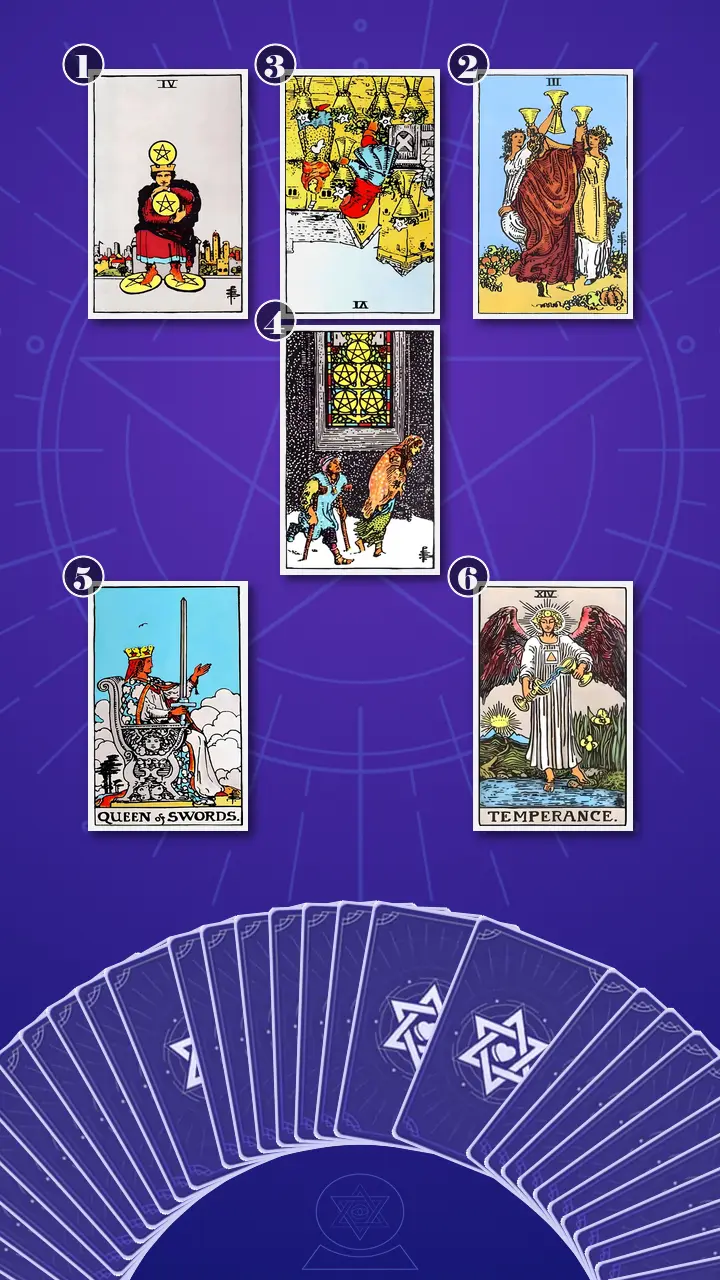
I chose the Relationship Spread · Context Edition, a six-card relationship tarot spread adapted for post-breakup friendship boundaries and belonging anxiety. A ten-card Celtic Cross would have produced more information, but more information was already part of Alex’s problem. They did not need ten more variables to analyse. They needed a focused view of six relational layers.
I explained the logic to the reader in the same plain terms I used in the room: the first card would show how Alex was currently trying to secure their place; the second would examine what the friend group genuinely offered now; the centre would reveal what kept friendship entangled with the old relationship; and the lower cards would expose the underlying fear, define the boundary challenge, and offer an integrated direction.
I arranged the cards like a bridge supported by a central pillar. Alex and the group faced each other across the top row. Beneath them sat the bond, its buried foundation, and the final pair of challenge and integration. Tarot would not decide whether Alex belonged. It would make the emotional structure visible enough for Alex to decide how they wanted to participate.
Reading the Social Map in Context
Position 1: The Hand That Would Not Loosen
The card I turned over first represented Alex’s attempt to secure belonging by holding tightly to group access, invitations, and social visibility. It was the Four of Pentacles, upright.
The figure held one pentacle against the chest, pinned two beneath the feet, and balanced another above the head. I returned Alex to the 11:40 p.m. scene: the warm phone pressed close, the shared chat pinned, the instant acceptance of Saturday’s plan. The card translated the inner bargain with painful precision: “If I keep access to the group, I can prevent myself from being replaced.”
The earth energy here was in excess and blockage. Wanting to preserve valuable friendships was not the problem. The constricted method was. Constant visibility offered a few minutes of relief, but it also prevented Alex from moving freely, resting, or asking whether a particular gathering was emotionally sustainable. Connection had started to resemble control; attendance had started to replace choice.
Alex gave a short laugh with no humour in it. “That is so accurate it feels a little cruel.” Their fingers tightened around the edge of their sleeve, then stopped.
I did not rush to soften the card into meaninglessness. I said, “The image is direct, but it is not accusing you. The hold began as protection. We are only noticing that the conditions changed while your body kept gripping the same pole.”
I asked, “The last time you accepted immediately, what did you want from the event, and what were you afraid would happen if you waited?” Alex looked at the card rather than at me. “I wanted to see two of them,” they said. “I was afraid that if I skipped it, everyone would become more comfortable with my ex than with me.”
Position 2: Three Cups, Three Separate Hands
The next card represented the friend group as the collective other: what it genuinely offered in the present, separate from Alex’s fear of losing the former social structure. I turned over the Three of Cups, upright.
This mattered because the reading did not reduce the group to a trap. A mutual friend could invite Alex to coffee or a birthday because they sincerely enjoyed Alex’s company. The three figures raised their cups into a shared centre, but each cup remained in a separate hand. Community was real; ownership was absent.
The water energy was balanced here. The group still contained warmth, shared humour, and genuine support. But real friendship did not guarantee that everyone would remain equally close, repeat the same rituals, or organise themselves around preserving the former couple’s world. The chosen-family warmth people recognise in Heartstopper can be deeply meaningful without requiring a group’s configuration to remain frozen.
“They may care about me without being able to make this feel exactly like before,” I said. “Participation is not the same thing as owning the circle.”
Alex exhaled and let their hands rest open on their knees. I asked which mutual friends had recently initiated contact, followed up, or made room for Alex as an individual. Two names came quickly. A third arrived after a pause. Several others did not arrive at all. Already, the idea of one indivisible friend group was beginning to resolve into separate relationships with different levels of present-day reciprocity.
Position 3: The Old Figma File Marked as Source of Truth
The central card represented the active bond between Alex and the group, especially the way current friendship had become entangled with nostalgia for the pre-breakup arrangement. It was the Six of Cups, reversed.
Alex knew the modern version of this card immediately. Google Photos could surface a cottage picture before they had made coffee, and every current gathering would then be graded against the ease shown in that image. They were not only meeting friends in the present. They were checking whether the old version of the group could still be restored.
I compared it to using an old Figma file as the source of truth after the team has moved to a new design system. The archived version may contain good work, familiar decisions, and genuine care. But forcing every current screen to match it prevents the new system from becoming coherent.
The reversed water energy showed blockage and backward circulation. Memory was spilling into present decisions. A less affectionate gathering became evidence that the friendship was dying; an old venue became a test of whether the old emotional atmosphere could be reproduced. An invitation can be real friendship without being a portal back to the life you had before.
I used one of my core analytical tools here: Sunk-Cost Decoupling in Loyalty. I was not asking Alex to erase history or pretend the group had meant nothing. I was asking them to separate the emotional investment already made from the evidence available now. If all the old photos, repeated rituals, and years of shared context were temporarily removed, which friendships were currently curious, reciprocal, and capable of holding honesty?
Alex’s mouth tightened. Their gaze drifted beyond the cards, as though an old cottage photo had appeared on the wall behind me. Then they said, very quietly, “Maybe I keep showing up because I want to feel like the person I was before the breakup.” Their shoulders did not relax yet, but the defence around the behaviour had begun to loosen.
Position 4: The Lit Window Across the Snow
The fourth card represented the hidden foundation sustaining the bond: continued inclusion being used as protection against the deeper fear of standing outside the circle without support. I turned over the Five of Pentacles, upright.
I asked Alex to recall the Sunday morning when they saw an Instagram Story from a brunch involving the ex and several mutual friends. The refrigerator had hummed in the quiet kitchen, the tile had been cold under their bare feet, and the kettle had clicked off untouched while they zoomed in on the seating arrangement.
The card’s two figures crossed through snow beneath an illuminated window. That was the emotional translation: everyone else seemed to be inside warmth, while Alex felt socially homeless outside it. Yet I was careful about what the card could and could not establish. It described Alex’s internal experience; it did not prove that the group had rejected them.
The earth energy now appeared as perceived deficiency and scarcity. Because hybrid work limited spontaneous in-person contact and several older friends lived outside Toronto, one local circle had become social infrastructure. One missed brunch therefore felt larger than one missed brunch. One closed door can feel like the whole city when all your belonging has been concentrated in one room.
Alex’s breathing paused. Their eyes lost focus for a moment, as if replaying the Story frame by frame, and then their chest dropped with a long, tired exhale. “The thought was not even, I wish I’d gone,” they said. “It was, that was my life, and now they still have it without me.”
I asked what the feared outcome was beyond missing the event: losing local support, being replaced by the ex, or discovering they had never mattered. Alex answered, “All three, but the last one is the worst.” Naming it did not make the grief disappear. It did stop the grief from disguising itself as objective evidence about a brunch photo.
Position 5: The Sword and the Open Hand
The fifth card represented the main challenge: separating genuine care from compulsory access and setting boundaries without turning clarity into punishment or total withdrawal. It was the Queen of Swords, upright.
Her sword stood straight, but her other hand remained open. I read that contrast as the difference between a limit and a rejection. Alex could decide that one-to-one coffee was a yes, a small dinner was a maybe, and a full-group night with the ex was a no for now. They could communicate that decision without inventing an excuse, interrogating friends about loyalties, or disappearing to see who came looking.
Air entered the spread as balance and an underused resource. The first four cards had been heavy with earth and water: security contracting around emotion, emotion circulating through memory. The Queen introduced clean language. I pictured a blank Notes screen with two columns: “What happened” and “What I am predicting.” A slow reply belonged in the first column. “They are replacing me” belonged in the second.
“I can care about them and still decline this setting,” I said. “A boundary is information about your capacity, not a verdict on anyone’s loyalty.”
I offered one sentence: “I value seeing you, and I’m taking some space from full-group plans while I work out what feels steady.” Alex sat more upright and repeated it once under their breath. The sentence did not promise that everyone would react perfectly. It simply gave Alex a way to stop making fear answer every invitation on their behalf.
When Temperance Moved Between Two Cups
Position 6: From a Social Lifeline to a Network
The final card represented the constructive direction: gradual, proportionate contact that could allow friendship and separation to coexist without making either one absolute. As I turned over Temperance, upright, the room became quiet enough for us to hear rain thinning against the window. A narrow band of afternoon light crossed the table between the two cups illustrated on the card.
The angel poured water between separate vessels, with one foot on land and one in water. The energy was balance in motion, not balance achieved by freezing everything in place. In Alex’s life, that could look like one intentionally chosen group event, one individual catch-up, one connection beyond the shared circle, and one private evening with the chat muted. No single choice had to settle the future of the whole group.
I asked Alex to picture 11:40 p.m. again: unread messages glowing, their hand reopening the chat, and Saturday’s invitation feeling urgent before they had asked whether seeing the group would feel good, painful, or both.
You are not clinging because every friendship is false; you are clinging because one social arrangement has been asked to carry the full weight of belonging. Present-day friendship can remain real without keeping the former relationship emotionally active.
I let the sentence settle before giving them the central message of the card.
You do not need to keep every old social arrangement intact to prove you still belong; practise measured contact and let Temperance move connection between separate cups instead of collapsing them into one.
Alex’s breath stopped first. Their fingers hovered above the table, no longer reaching toward the phone beside them. Then their gaze slipped away from the card, unfocused, as though they were replaying every gathering they had attended while pretending to be fine. Their jaw tightened, and a flash of anger crossed their face before their eyes reddened. “But doesn’t that mean I was wrong to keep trying?” they asked, the words sharper than anything they had said all afternoon. I answered, “No. It means staying close helped you survive the first impact, and now you are allowed to notice the cost. A coping strategy can be understandable without becoming a permanent contract.” Their fist slowly opened. Their shoulders lowered, followed by a trembling breath that sounded partly relieved and partly bereaved. The clarity left a brief blankness behind it: if they no longer had to attend everything, they would now be responsible for choosing. That freedom looked spacious, but not yet comfortable.
I asked, “Now, with this new perspective, think back: was there a moment last week when this insight might have made you feel different?”
Alex remembered the Friday gathering. They had been outside a Queen Street West bar, coat still zipped, jaw clenched before they even entered. “If I had admitted that going was partly about keeping the old structure alive,” they said, “I might not have treated the invitation like an order. I might have gone for an hour, or asked one friend to meet separately, or just gone home.”
I then asked them to open the Notes app and create two headings: “Present connection” and “Keeping the old structure alive.” The next invitation could go under one heading or under both. I gave them up to ten minutes, with permission to stop if the exercise increased distress. The minimum version was simply noticing which heading made their chest, hands, or jaw react first.
Temperance also gave me the right moment to introduce Reciprocity ROI Analysis. I do not use that phrase to turn friendship into a transaction or reduce care to a score. I use it to examine current emotional give-and-take without allowing nostalgia to hide a high-drain pattern. Who initiates? With whom can Alex be honest? Which interactions leave them steadier, and which require two days of recovery?
Watching the water move between the cups, I briefly remembered the trading floor and the brutal clarity of concentration risk. When one position carried too much of a portfolio, every fluctuation felt existential. Human belonging is not a financial product, but the structural lesson still applied: Alex had placed nearly their entire emotional budget in one social account. Diversifying support did not devalue the group. It prevented every typing indicator from moving the whole market of their self-worth.
This was the key crossing: from fearful monitoring of one shared circle toward differentiated connection and flexible belonging. Belonging becomes steadier when one group stops having to prove all of it.
The Belonging Network Reset
When I read the spread as one story, its logic was clear. Alex had found a real community in the Three of Cups. Under breakup pressure, the Four of Pentacles turned that community into something that had to be secured. The Five of Pentacles exposed the fear underneath: less access might mean social exile. The reversed Six of Cups tried to solve that fear by restoring the past. The Queen of Swords named the missing skill, and Temperance showed how to use it without swinging from total availability to dramatic withdrawal.
The cognitive blind spot was not that Alex cared too much. It was that they had begun using access to measure care and using shared history to estimate each friendship’s present value. A reply, invitation, or Story could reveal one piece of information, but Alex’s reassurance-seeking loop was turning each piece into a verdict about belonging.
The transformation direction was therefore practical: move from preserving the whole arrangement to testing each friendship through current reciprocity, emotional steadiness, and clear boundaries. I gave Alex three small experiments. None required a final decision about the group.
- The Twenty-Minute Access-as-Safety Check Before answering the next shared invitation, Alex would open Notes and write one sentence beneath each heading: “What I want from this friendship” and “What I am trying to prevent.” They would then wait twenty minutes and check the guest list, likely contact with the ex, energy cost, and whether the plan would still appeal without the belonging question attached. Treat “They may stop inviting me” as a prediction to observe, not a fact that must be defeated. The minimum version is a five-minute pause.
- The Temperance Contact Mix For one week, Alex would create four optional spaces: one selected group interaction, one one-to-one catch-up, one contact outside the shared circle, and one evening with notifications muted. After any shared event, they would use a five-minute timer to rate comfort, depletion, and ex-monitoring from 1 to 5. Balance does not require equal portions. A ten-minute notification pause counts, and ending the pause early does not make the experiment a failure.
- The Present-Tense Friendship Test Alex would invite one mutual friend for coffee and avoid discussing the ex or group loyalties for the first thirty minutes. Afterwards, they would record recent evidence under three prompts: “They initiate,” “I can be honest,” and “I feel steadier afterwards.” If a friendship repeatedly proved one-sided or high-drain, I recommended my Friendship Downgrade Strategy: reduce automatic attendance and emotional access gradually, while keeping contact polite and low-pressure. A downgrade is not punishment, a dramatic announcement, or a test of whether someone chases you. It is a proportionate response to present evidence, and the lowest-pressure start is one specific invitation with an easy opt-out.
I reminded Alex that they controlled the pace. They could write a boundary without sending it, mute the chat without leaving it, or decline one gathering without turning that choice into a referendum on the entire group. Actionable advice should create room for agency, not become another set of rules to perform perfectly.

A Week Later: The Quiet Proof
Six days later, I received a message from Alex. They had waited twenty minutes before replying to a full-group bar invitation, noticed that the event belonged under both Notes headings, and declined without inventing an excuse. Then they had asked one mutual friend to meet for coffee near Ossington. The friend had replied, “Yeah, I’d really like that.”
Alex also muted the shared chat for two hours while finishing a design task. Their hands reached for the phone twice. Their chest tightened once. No friendship ended during the silence.
That night, Alex slept through until morning. Their first thought was still, “What if they stop asking?” They smiled, left the chat muted, and made coffee before checking.
I did not see that as a solved life or a guaranteed social outcome. I saw it as the first credible evidence of a new relationship with uncertainty. The cards had not preserved the group, predicted anyone’s loyalty, or manufactured safety. They had helped Alex distinguish friendship from access, history from current reciprocity, and fear from fact. Alex made the choices.
That was the real Journey to Clarity: not becoming certain that nobody would ever drift, but discovering that distance did not automatically erase belonging. When the group chat goes quiet and your chest tightens around the thought that everyone is moving on without you, you may be feeling more than the fear of missing a plan. You may be standing in the gap between wanting these friendships and fearing that any space will prove you never truly belonged. Simply seeing that gap means you are no longer moving through it blind.
If the next invitation did not have to prove that you still belonged, which cup would you feel curious about filling for yourself this week: one present-tense friendship, one connection beyond the old circle, or one quiet evening in your own company?