A Polished Slack Reply Hid Hurt; a Fairer Draft Kept 'Disappointed'

The 8:47 p.m. Draft Where Emotional Suppression Looked Like Maturity
If you have ever said No worries after a tense Slack exchange, then deleted every emotional word from your draft on the ride home, I suspect you know the particular exhaustion Alex brought into our reading.
Alex joined my evening video call from her small Toronto apartment with her phone still in one hand. A blue rectangle of screen light lay across the duvet behind her, and the radiator clicked at uneven intervals. She told me that the previous night, at 8:47 p.m. on TTC Line 1, the fluorescent carriage lights had buzzed above her while she edited a Notes draft about a difficult UX research review.
Her original sentence had been simple: “I felt dismissed when my findings were brushed aside.” The phone had felt warm against her palm. Her throat had tightened as she deleted dismissed, replaced it with concerned, removed that too, and finally sent a polished question about project scope.
“I can be honest once I make the feeling sound reasonable,” she told me. “But by then, I usually do not feel anything. Or I tell myself I do not.”
I watched her restless thumb trace the edge of the phone. The shame around emotional exposure seemed to sit behind her sternum like a smoke alarm with the battery half removed: muted enough for everyone else, still chirping inside her body.
“It sounds as though you are torn between telling the truth and preserving an image of emotional maturity,” I said. “A hard feeling is not a character flaw; it is information arriving before you have decided what to do with it. I am not here to tell you what you must disclose, or to predict how anyone will respond. I want us to map the difference between chosen privacy and performed calmness, then find a form of honesty that still respects your boundaries.”

Choosing a Map for What Calmness Conceals
I invited Alex to take two slow breaths and hold the question in mind while I shuffled. I use this pause as a focusing transition, not as a test of faith or a mysterious ritual. It gives the nervous system a moment to arrive before the analysis begins.
I chose the Celtic Cross · Context Edition. For anyone wondering how tarot works in a question about emotional suppression versus emotional maturity, I chose this spread because a three-card timeline would not have separated the visible habit from its root belief, social reinforcement, fear of judgment, and practical route toward change. The ten positions let me treat the cards as an external cognitive map rather than a fixed prediction.
I told Alex that the first position would show the behavior she could already see: the way she held difficult feelings inside. The fifth would examine the standard she was calling maturity. The tenth would offer an integration practice, not a promised outcome. The remaining positions would show the stalemate, the internal editor, the blocked message, the social atmosphere, and the fear that kept the whole pattern in place.
When I laid the cards, the center looked dense and crossed, while the staff on the right rose with more space between each image. I thought of someone paused at an intersection beside a narrow staircase: not trapped, but unable to climb while still treating every feeling as evidence in a character trial.
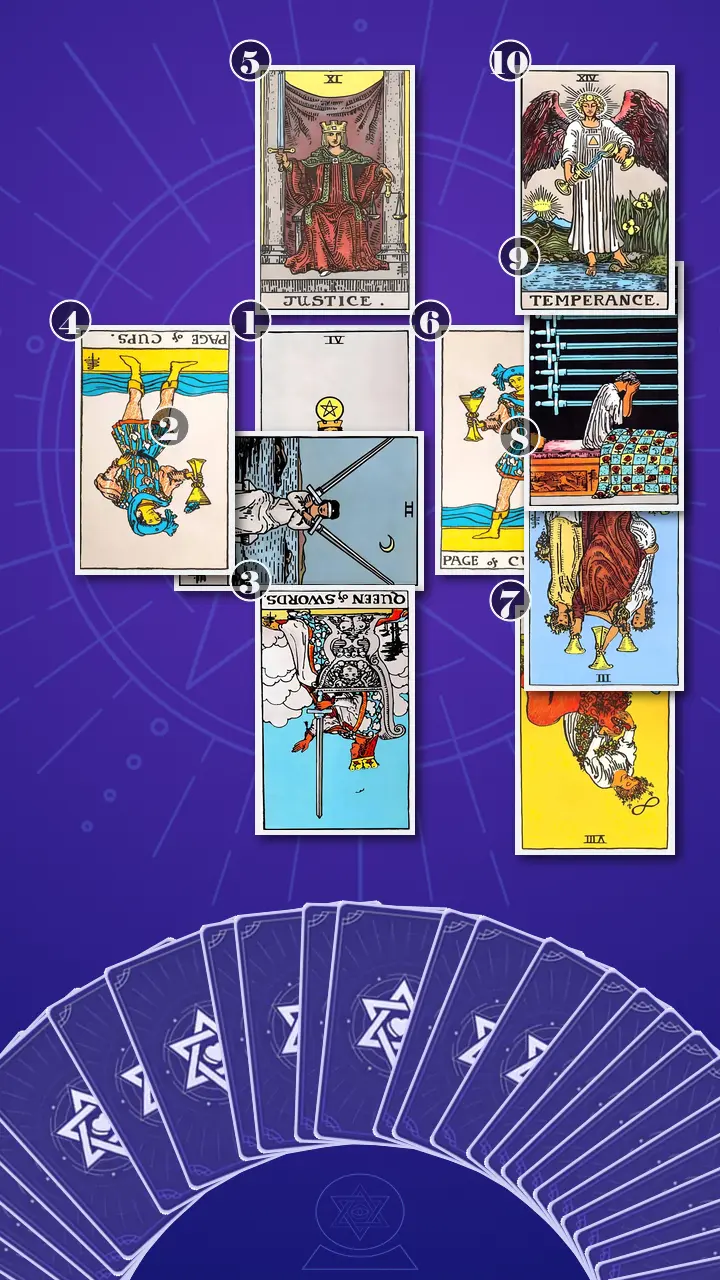
The Closed Cross and the Feeling Held Inside It
Position 1: The Message Held Against the Chest
I turned the card representing the visible emotional pattern: how hiding hard feelings to look emotionally mature currently appeared in Alex's behavior. It was the Four of Pentacles, upright.
I pointed to the coin pressed against the figure's chest and the arms folded around it. In Alex's life, this was the phone held close after a tense conversation, with the draft and the feeling contained as though composure were a resource she might lose. She typed I felt dismissed, deleted it, and sent a neutral explanation. The closed posture protected her from immediate exposure while stopping emotional information from moving through the relationship.
The card's Earth energy had moved into Excess: control had become gripping. Like a personal version of Severance, the polished professional self was allowed to communicate while the emotional self stayed on another floor and carried the day home.
Alex gave a short laugh, but there was no amusement in it. Her jaw tightened before she said, “That is so accurate it is almost cruel.”
“Then I want to slow down here,” I replied. “The card is not accusing you of being closed. It is showing a protection that worked in the short term. Our question is whether it still serves the conversation you actually want to have.”
Position 2: Two Drafts Pinned Over the Same Conversation
I laid the card representing the immediate inner obstacle: the mental stalemate between acknowledging a hard feeling and maintaining the appearance of composure. It was the Two of Swords, upright, crossing the Four of Pentacles.
I described the scene the card mirrored: Alex staring at two versions of the same text, one saying That hurt and the other saying No worries, while the cursor blinked. She was not missing the feeling. She was suspending the decision because each reply seemed to prove something about her character.
The Air energy was in Blockage. Analysis was no longer clarifying a choice; it was keeping both scripts crossed over her chest. The internal loop sounded like this: If I send the honest version, they may judge me. If I send the polished version, they cannot understand what happened. When she edited the feeling out, she kept the calm image and lost the actual conversation.
Her breathing paused. Her eyes moved away from the spread as if she were replaying the Slack thread frame by frame, and then her fingers loosened around the phone. “I am not confused about what I feel,” she said quietly. “I am scared of what the feeling will make them think about me.”
Position 3: The Internal Copy Editor
I turned the card representing the emotional root: the underlying self-judgment that made honest feeling seem incompatible with maturity. It was the Queen of Swords, reversed.
In Alex's daily life, this Queen appeared as a private editorial review of whether hurt, angry, or disappointed was precise and reasonable enough to use. Alex's intelligence helped her describe timelines and communication patterns, but the inner editor had become so sharp that it cut away vulnerability along with confusion. It was like deleting the messy participant quote from a UX report even though the mess contained the insight.
I read the reversal as an Excess of punitive discernment paired with a Deficiency of humane allowance. Precision itself was not the problem. The problem was using precision to sterilize the message before another person could understand its impact.
“Whose judgment does that editor sound like?” I asked.
Alex pressed her lips together, glanced down, and rubbed one thumbnail across the other. “Mine now,” she said. “But it sounds like every person who ever praised me for being easy and low-maintenance.”
Position 4: The Messenger Turned Into a Joke
I turned the card representing the recent reinforcement: the earlier blocked expression that had shaped the current pattern. It was the Page of Cups, reversed.
I showed Alex the fish already visible inside the Page's cup. In her recent conversations, it was the vulnerable sentence she typed, saw clearly, and converted into a joke, a thumbs-up, or a practical question. The emotional message existed. Self-consciousness stopped it from becoming relational language.
Water was in Blockage. Alex had not lost access to feeling; she had interrupted its delivery. Waiting until she felt nothing made the eventual message safer, but it also removed the information the other person would need to understand why the exchange mattered.
Her face softened and then tightened again. “I literally sent a meme after my friend hurt my feelings last Friday,” she said. “I wanted her to notice I was off, but I made sure there was nothing there for her to notice.”
When Justice Put the Feeling Back in the Sentence
Position 5: The Standard That Changed the Plot
As my hand moved to the card representing the conscious standard being questioned, the radiator clicked once and went quiet. The room seemed to hold the silence with us. I turned over Justice, upright.
This was the reading's bridge. Justice asked Alex to replace the maturity test with a fair process: What happened? What am I feeling? What am I asking for? The sword offered clarity. The level scales gave fair weight to both her feeling and the other person's actual responsibility. Justice did not ask her to prove that every interpretation was objectively correct. It asked her to separate an event, an owned reaction, and a bounded request.
The energy here was Balance: truth without punishment, accountability without emotional disappearance. Looking at the card, I pictured an editing suite. Alex had been cutting every difficult feeling from the film to preserve a coherent image of the protagonist, then wondering why the next scene no longer made sense.
I used the lens I call Hero's Journey Alignment. I told her that her stagnation resembled the Refusal of the Call: not cowardice, but an old role trying to protect the character from entering a scene where the previous script no longer works. Justice was also an act of Vision Actualization. It rewrote the limiting line I am not ready to be emotional and mature at once into I can be affected, accountable, and clear in the same conversation.
I brought us back to 9:06 p.m. in Alex's apartment, when she had opened the fourth version of a difficult text. The word hurt waited beneath her thumb, the phone was warm, and the calm version was almost ready, but it could describe the sequence only by removing its impact.
You do not prove maturity by hiding hard feelings. You practice it by weighing them honestly and expressing them with the clear sword and steady scales of Justice.
I let the sentence remain between us. Alex's inhale stopped halfway. Her fingers froze above the phone, and her eyes lost focus as though several old conversations had started replaying at once. Then her brows pulled together. “But does that not mean I have been getting it wrong this whole time?” she asked, her voice briefly sharp. I did not rush to turn the anger into relief. “No,” I said. “It means you used an intelligent protection until the protection began costing you clarity. You do not need to shame the earlier version of yourself to choose a new practice.” Her pupils widened; her lower lip pressed inward, and a thin brightness gathered in her eyes. Her shoulders dropped first, then her hand opened on her lap. She released a breath that sounded almost unsteady. “So I can be affected and still be fair,” she said. The insight left her relieved but briefly unmoored: if silence was no longer the only mature option, the next choice belonged to her.
I asked, “Now, with this new perspective, think back to last week. Was there a moment when this insight could have made you feel different?” Alex named the research review. Instead of proving she was unaffected, she could have said that the decision left her disappointed and asked how participant findings would be included.
I then gave her a ten-minute experiment: write three lines for what happened, what she felt, and what she was asking. The feeling word had to remain in the private note even if she later chose not to send it. She could pause, keep it private, or choose a safer person. The practice was about seeing the truth clearly, not forcing disclosure.
I named the shift for her: this was one step from shame-driven self-editing and performed calmness toward bounded emotional honesty and steadier self-trust. The cards had not made the choice. They had made the old test visible enough for Alex to revise it.
The Messenger Climbs the Right-Hand Staircase
Position 6: One Honest Sentence Leaves the Cup
I turned the card representing the next available opening for practice: a small way emotional honesty could become visible without becoming overwhelming. It was the Page of Cups, upright.
The same messenger that had appeared blocked in the recent past was now able to speak. In Alex's life, the card looked like one sentence offered before the whole conversation had been perfected: “I felt dismissed in that conversation, and I want to explain why.” She did not have to prove the feeling, guess the other person's intention, or provide the entire history at once.
Water was returning from Deficiency toward Balance. The fish rising from the cup became the smallest honest message allowed to leave Apple Notes. One honest sentence was still a boundary; it was not a demand for someone else to manage Alex's entire emotional life.
She rehearsed the sentence aloud. Her voice caught on dismissed, but she did not replace it. A cautious smile appeared, followed by a long exhale.
Position 7: Strength Without Making the Lion Disappear
I turned the card representing Alex's self-attitude: how she interpreted her restraint, vulnerability, and emotional strength. It was Strength, reversed.
This reversal appeared whenever Alex kept her voice perfectly even, said she was fine, and later treated the hurt she carried onto the TTC as proof that she had failed to control herself. The lion was not a flaw to erase. It was emotional force asking for patient attention.
I saw an Excess of forced restraint and a Deficiency of compassionate courage. Regulation meant staying present long enough to choose a proportionate response. Suppression meant pretending there was no response to choose.
Alex placed her palm lightly over her sternum. “I am kinder to everyone else's reactions than I am to my own,” she said, with a small, rueful shake of her head.
Position 8: The Group Chat With One Truth Outside the Circle
I turned the card representing the relational atmosphere: the social conditions that could reward lightness, silence, or emotional performance. It was the Three of Cups, reversed.
I saw the group chat full of memes, quick plans, and laughing emojis. Alex could be socially present, remember everyone's deadlines, and offer thoughtful support while leaving her own difficult day outside the circle. Connection was visible, but slower emotional reciprocity did not happen automatically.
The Cups energy was in Blockage. I was careful not to frame openness as mandatory. Not every group, workplace, or relationship has earned access to vulnerable information. The card asked Alex to notice where privacy was a deliberate boundary and where being low-maintenance had become the admission price for belonging.
Her gaze steadied. She named one friend who had listened well in the past, then crossed two other names off her mental list without apologizing for it.
Position 9: The Midnight Courtroom
I turned the card representing the emotional expectation: the fear that disclosure would produce shame, judgment, and mental replay, alongside the hope of being understood. It was the Nine of Swords, upright.
In Alex's life, this was lying awake and reconstructing a conversation, checking whether one honest sentence had sounded needy, dramatic, or immature. The nine swords above the bed became repeated private reviews of an exchange that never received a clear emotional ending. Silence avoided one visible risk while leaving her alone with an internal courtroom.
Air had reached Excess. The mind was trying to manufacture certainty about another person's judgment before any clear conversation occurred. I asked Alex what verdict she expected to hear. She answered, “That I am too much.” After a pause, she added, “But I think the hope underneath it is that someone will say I make sense.”
Her hands went still. I reminded her that another person's response could provide useful information about the relationship, but it could not serve as the final verdict on whether her feeling was valid.
Position 10: Two Cups, Neither Track Muted
I turned the card representing the integration pathway: how Alex could turn insight into balanced emotional expression rather than treating the position as a fixed prediction. It was Temperance, upright.
I pointed to one foot on land and one in water, then to the liquid moving between two cups. In a real conversation, Temperance sounded like this: “I felt hurt when that happened, and I want to understand what you meant.” The feeling remained present; the delivery stayed grounded in observation and curiosity.
This was Balance in its most practical form. Alex did not have to choose between concealment and emotional flooding. Like mixing two audio tracks until neither is muted, she could let emotional truth and responsible communication be heard together.
“The goal is not to become unfiltered,” I told her. “It is to stop making emotional disappearance the price of being taken seriously. Temperance is not promising that every conversation will go well. It is showing a repeatable practice: name the feeling, regulate the delivery, make the request, and let the response teach you what the relationship can hold.”
Writing the Next Scene With Both Cups on the Table
I drew the spread together as one coherent story. The reversed Page of Cups showed the earlier message being blocked. The Four of Pentacles held that message against Alex's body, and the Two of Swords turned it into an exhausting choice between honesty and composure. Beneath them, the reversed Queen of Swords revealed why: her inner editor treated ordinary hurt as evidence against her maturity. The reversed Strength and Three of Cups showed how forced restraint and socially rewarded lightness kept the habit in production. The Nine of Swords revealed the cost in private replay.
Justice, the upright Page of Cups, and Temperance offered the unused resources: fair discernment, one bounded disclosure, and the ability to hold feeling and responsibility in the same sentence. Alex's cognitive blind spot had been treating calmness as proof of character while treating emotional exposure as a character verdict. In the film metaphor I had carried through the reading, she kept cutting the difficult scene in post-production, then blamed herself when the relationship's next act lacked continuity.
The transformation direction was precise: replace Does this look emotionally mature? with Can I name the feeling, own my reaction, and make one clear request? She could still choose privacy. She could still delay a message for safety or timing. The difference was that the choice would become deliberate rather than an automatic deletion of herself.
The Character Bible Directive
I used my Character Bible Directive to turn that insight into behavior. I did not ask Alex to imagine a fearless future self. I asked her to write the psychological and behavioral specifications of a version of herself who could still feel a tight throat, still need time, and still keep one honest word in the scene.
- The Ten-Minute Justice Draft On the next difficult work message this week, open Notes and write three labels: What happened, What I feel, and What I am asking. Keep one accurate feeling word. Replace claims about intent with the observable event and its impact. At ten minutes, choose to send, shorten, or pause instead of reopening the edit indefinitely. Start with a work situation where the request is concrete. Naming a feeling does not require sending the message, and stepping away remains available if the exchange becomes disrespectful.
- The One-Sentence Future-Self Rehearsal Before contacting one trusted person, spend five minutes writing three character specifications: she notices one body cue, names one feeling without a joke or apology, and makes one bounded request. Then rehearse: “I am feeling disappointed about what happened. Can we talk for ten minutes? I do not need fixing; I want to explain.” Choose someone who has already shown basic respect. A private voice note counts as the first version, and Alex can stop after one sentence if more disclosure feels unsafe or premature.
I told Alex that these were experiments, not moral obligations. The point was not to become the most vulnerable person in every room. It was to gather evidence that she could remain the author of her expression even while another person remained responsible for their response.

A Week Later, One Word Stayed In
A week later, I received a message from Alex. Before replying to another tense Slack thread, she had written: “The decision changed without research input. I feel disappointed and tense. Can we review how participant findings will be included?” She kept disappointed in the final version.
The reply was practical rather than transformative. Her colleague agreed to a short review and clarified part of the decision. Alex told me the conversation still felt awkward, but it was clear. She did not have to spend the TTC ride home hoping someone would detect an emotion she had carefully removed.
Her second message was shorter: “I slept all night. My first thought this morning was, What if I made it weird? Then I laughed, made coffee, and noticed I had not reopened the draft.”
I did not read that as a life suddenly solved. I read it as the first visible proof of a different authorship. Tarot had given Alex a structured way to see the pattern, but she was the one who left the feeling word in, made the request, and tolerated the imperfect moment after sending.
When I think back to the tight throat on Line 1, I remember that swallowing the sentence can loosen the body for a moment while leaving the feeling to be carried alone. Noticing that cost does not obligate anyone to disclose. It simply means the old definition of maturity is no longer operating unseen.
If you let Justice's one honest feeling and Temperance's one grounded request exist in the same sentence, what would you want that sentence to say, and who has earned the right to receive it?