The 8:47 p.m. Slack Spiral
When I meet a late-twenties client services coordinator in Toronto who answers a Sunday-night Slack message with "No worries" and then opens a job board she cannot bring herself to read, I recognise a particular career crossroads: career red flags being minimised under stability pressure. I spent years on Wall Street, where uncertainty could sit beside a terminal long after everyone else had gone home. I know the loneliness of trying to turn a bodily alarm into a clean cost-benefit calculation.
I met Maya on a Tuesday evening. I watched her reconstruct the scene from 8:47 p.m. in her Toronto apartment: a Slack notification lit the edge of her laptop while the radiator clicked and a mug of tea went cold. She typed "No worries, I will handle it," opened the file, and ten minutes later left a job-board tab glowing beside the work document, her jaw briefly tight before the familiar explanation flattened it.
"Why do I keep brushing off career red flags as no big deal?" she asked. She told me she worked in client services at a mid-sized creative agency, where urgent requests were common enough to hide the difference between ordinary pressure and a recurring boundary violation. Her role had absorbed work outside its original scope, yet she kept calling each addition temporary. The conflict was plain: she wanted to acknowledge the pattern and respond honestly, but feared that treating it as significant would force a difficult career response before she had a plan.
I heard her apprehension as a smoke-alarm notification she kept marking read because investigating it would interrupt the meeting: the brief tightening in her chest or jaw came first, then a heavy, flattened energy after she explained it away. I told her, "You do not have to decide whether the whole job is bad tonight. We can let the concern become visible without making it a verdict. Let us draw a map toward clarity."

Choosing the Shadow Spread: A Compass for Career Red Flags
I asked Maya to put her phone face down, take one unhurried breath, and hold the question in mind without searching for the most reasonable explanation. I shuffled slowly. The point was not to summon a fixed future; it was to create a deliberate pause in the reflex that made every new request disappear into the next deadline.
For this tarot reading for career red flags, I chose The Shadow Spread, a five-card structure from the F5 Inner Excavation framework. I explained to Maya, and to anyone reading along, how tarot works here: the cards provide an external visual language and a disciplined sequence of questions. They do not certify that an employer is toxic, predict a resignation, or take choice away. They help us examine card meanings in context by separating a visible behaviour from the bargain and fear that sustain it.
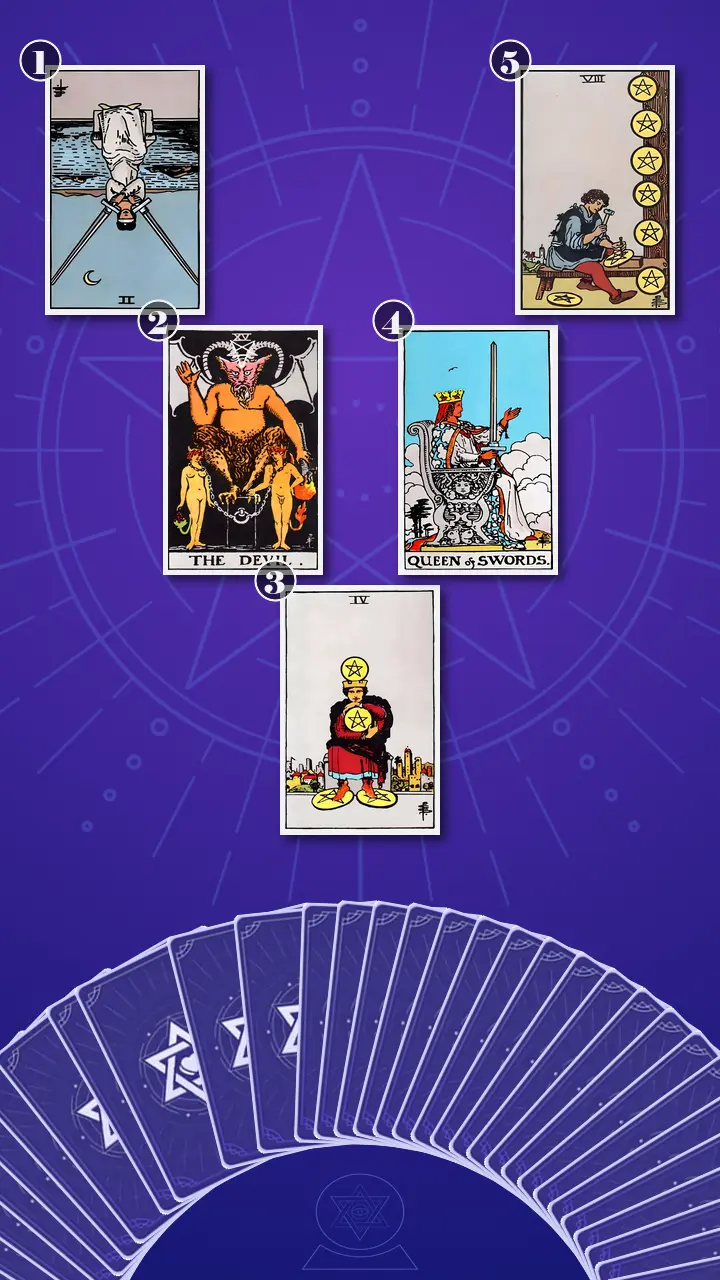
The V-shaped layout would descend from the visible symptom into denied truth and the protective root, then rise through a reclaimed capacity and a practical integration practice. The first card would show how minimisation appeared; the second, what Maya already sensed but kept relabelling; the third, why stability felt too risky to examine; the fourth, her antidote; and the fifth, the repeatable method that could turn insight into evidence. The shape was a small map for a career crossroads, not a command.
Reading the Map: The Pattern Before the Verdict
Position 1: The Notification She Calls Fine
"Now turning is the visible symptom in this case: the repeated behaviour of minimising career red flags, complying, and postponing an honest review."
The card was the Two of Swords, in reversed position.
In the visible-pattern position, the reversed Two of Swords looked exactly like the scene Maya had described: another late request arrived, she replied that it was fine, and then opened several browser tabs to decide whether the request was normal. The crossed swords became competing explanations: client urgency, agency culture, a temporary deadline, and the fear of seeming difficult. She was not missing the event. She was interrupting her own recognition before it could become a boundary.
Reversed, the card showed a blockage in clear air rather than a deficiency of awareness. Maya could see the notification, feel the impact, and remember the previous requests. The blockage began when those facts approached a conclusion. Her browser filled with explanations until the observable event was buried beneath a longer paragraph about why it might not matter. I told her that the first practical move was to record what happened before asking it to produce a stay-or-leave decision.
Maya did not nod. First, her thumb stopped above the mug and her breath held; then her gaze went unfocused as if replaying the Slack message, the job-board tab, and every paragraph she had added to explain them. Finally, she gave a short, bitter laugh and let the breath out. "That is almost annoyingly accurate. It sounds worse when I say all the incidents out loud."
I said, "That reaction is information too. We are not building a prosecution against your workplace. We are giving each incident permission to remain in the record long enough to be compared with the next one." The reversed Two of Swords also carried a useful caution: noticing a pattern did not mean every difficult day was unacceptable. Discernment would have to distinguish ordinary pressure from repeated boundary violations.
Position 2: The Availability-for-Security Bargain
"Now turning is the truth Maya already senses but keeps relabelling: what the recurring workplace pattern may be costing her and what bargain she is protecting."
The card was The Devil, upright.
I asked her to picture a Sunday at 6:12 p.m. She watched a rent-payment alert disappear from her banking app before opening Slack. The overhead light hummed, the phone felt warm in her palm, and her shoulders flattened when a new Monday priority appeared. She told herself every agency was chaotic, every client was under pressure, and every quick favour was simply part of being reliable.
The Devil was not a verdict that her agency was toxic. It represented a restrictive attachment and a shadow bargain: constant availability in exchange for being seen as useful, adaptable, and employable. The loose chains around the figures mattered to me. They showed that the terms felt fixed, but had not necessarily been tested as explicitly as Maya believed. The energy was blocked agency, maintained by a story that the price of predictability could not be questioned.
"If I call this a red flag," Maya said, "I will have to do something before I am ready." I asked, "What do you believe you must keep tolerating in order to remain secure?" She looked toward the phone, then named the salary, benefits, familiar routines, and the comfort of not having to explain a job search to anyone. I heard the shame beneath the logic: she was not confused about every detail; she was afraid of what admitting the pattern might require.
Her fingers tightened around the phone before she set it face down. A long breath lowered her shoulders by a fraction, but her mouth stayed guarded. I did not push her toward release. The work was to see the chain without calling herself foolish for having used predictability as protection.
Position 3: The Salary Held Against the Heart
"Now turning is the protective root beneath the minimisation: the fear that acknowledging the pattern will threaten stability, control, or the ability to delay a difficult response."
The card was the Four of Pentacles, in upright position.
I brought her back to the first of the month, when the Toronto rent payment left her account and her shoulders pulled upward. Later, she had opened a spreadsheet comparing job listings, salary ranges, benefits, and commute times. She kept returning to the same familiar number instead of reading a full listing. She told me she was not facing an immediate financial emergency, but uncertainty felt physically larger than the daily cost of the current role.
The Four of Pentacles showed protective earth in excess. Maya was holding salary, benefits, routine, and professional identity so tightly that evaluating the job felt like risking all of them at once. She was holding the current salary like a glass of water on a crowded TTC train: so carefully that she could not move her hand or check whether the route was still taking her where she wanted to go. Minimisation gave her short-term control, but it also protected the workplace from honest evaluation.
I told her, "You can protect your options without protecting the problem from being named." That distinction separated practical stability from emotional captivity. She did not need to quit, announce a career pivot, or turn her LinkedIn profile to Open to Work. She needed to stop treating the possibility of change as proof that the present conditions could not be examined.
Maya looked down at her hands. The fingers that had been pinching the edge of her notebook loosened, then closed again. "I keep waiting for one incident that will make the answer obvious," she said. I answered, "The spread is asking for a pattern, not a dramatic final incident."
When the Queen's Sword Made Room for Choice
When I placed the fourth card on the upward side of the V, the radiator clicked once and stopped. The room seemed to make space around the silence. This was the point where the reading moved from explaining the defence to reclaiming the capacity hidden inside it.
Position 4: The Sword That Separates Fact from Fear
"Now turning is the disowned capacity that can interrupt the cycle: clear discernment, trust in observed facts, and the ability to define a boundary without forcing an immediate stay-or-leave decision."
The card was the Queen of Swords, in upright position, the key card and the antidote in this reading.
In modern life, the Queen looked like Maya writing a dated sentence instead of another private explanation: "The deadline has changed four times in six weeks, and requests after 7 p.m. are affecting my evenings. I can handle urgent work when it is identified by 4 p.m.; later requests need a next-day deadline." The upright sword was not a weapon. It was a clean distinction between fact, personal impact, request, and prediction. The open hand showed that a boundary could be firm while remaining receptive to the response.
I brought in the diagnostic lens I developed while working on Wall Street: Power Dynamic Deconstruction. I do not use it to assign villains or turn a manager into an enemy. I ask four practical questions: Who changed the expectation? Who absorbs the cost? Who controls the priority, deadline, or missing information? What response would show whether the condition is negotiable? In Maya's case, the leverage point was not a threat. It was her documented workload, her knowledge of client commitments, and her ability to ask which existing priority should move when another one was added. A factual sentence could change the conversation from "Am I being difficult?" to "What can be prioritised, by when, and by whom?"
The room had gone quiet. It was 8:47 p.m. in a Toronto apartment: a Slack request changed tomorrow, the phone felt warm, the laptop opened, and the job-board tab appeared. Her jaw tightened before the explanation began. She was caught in the old calculation that naming the pattern would immediately remove every option.
You do not need to keep the blindfold on to keep your options open; name what you see, define what you need, and let the Queen's upright sword separate fact from fear.
Her face went still. For one beat, her breath stopped and her fingers tightened around the mug. Then her eyes left the Queen and lost focus, moving through every late "quick one" request, every vague promise about growth, and every evening she had paid for the job with her attention. She blinked hard. Her jaw trembled once, and her first response came out sharper than the rest: "But does that mean I was wrong before?" I said, "No. It means you were trying to preserve options by refusing to make the evidence real. You can update your view without prosecuting your past self." Her shoulders stayed raised for another breath, then dropped. The fist around her pen opened. She released a thin, unsteady exhale, and when she spoke again her voice was quieter: "I can be clear without making the biggest decision tonight."
"Now, use this new view to think back to last week," I invited. "Was there a moment when this insight could have made you feel different?"
She remembered a performance review where she had heard "great momentum" and "we are working on it" but left without criteria, dates, or a compensation commitment. Instead of calling herself oversensitive, she could now write what happened, how the missing details affected her, and what she needed clarified. This was the first crossing from guarded apprehension into clear-eyed self-trust: not certainty, but permission to let observable facts count.
Maya drafted a second sentence while I watched. She did not send it. She read it aloud, changed one accusation into a measurable request, and left the document open. The act of writing had already changed the shape of the problem. It was no longer a global label such as bad workplace. It was one pattern, one impact, and one possible condition.
Position 5: Version History for a Working Life
"Now turning is the integration practice for this case: a small, repeatable method for documenting patterns, testing one boundary, and reviewing the resulting information."
The card was the Eight of Pentacles, in upright position.
I translated the card into a Friday review rather than a dramatic career verdict. Maya could keep a dated record of changed expectations, compare each incident with her stated standard, test one specific boundary, and observe what happened. The craftsperson at the workbench became a version history for her working life: one entry proved little, but repeated records could show what kept changing and what stayed consistent.
The energy here was balanced earth, practical integration through repetition. The spread contained mostly Swords and Pentacles, so thought and material security had been doing nearly all the work. Cups and Wands were absent from the picture, which told me that Maya would need to add two deliberate ingredients herself: the emotional impact of each incident and one small act of initiative. She did not need to become fearless. She needed a method that allowed feeling and action to sit beside evidence.
When I mentioned the job-board tab, Maya smiled without much brightness. She agreed that opening a listing had become a private ritual for avoiding both options. I asked her to replace the all-or-nothing question with three repeatable observations: one dated incident, one boundary test, and one response. Her shoulders eased. She did not look excited about the task, but she looked less trapped by the need to find a perfect answer.
Evidence Before Verdict: The Next 48 Hours
Once I laid the five cards together, the story became coherent. The reversed Two of Swords showed the first jolt and the flood of competing explanations. The Devil revealed the unspoken exchange beneath them: availability for employability, compliance for predictability. The Four of Pentacles showed why Toronto rent, benefits, routine, and professional identity made honest evaluation feel like a threat to the entire financial plan. The Queen of Swords restored clear air, and the Eight of Pentacles gave that clarity a workable container.
Maya's cognitive blind spot was not that she could not recognise a workplace problem. It was the belief that recognition had to become an irreversible decision. She had been turning down the smoke alarm because stopping to investigate felt more disruptive than the noise. The key shift was smaller and more useful: document recurring facts, name one boundary, and observe the response before deciding what larger career move belongs next.
Evidence first. Verdict later. That was the direction of change, from stability-driven self-doubt and automatic compliance toward clear-eyed self-trust and measured boundary confidence. Naming a pattern was not the same as resigning tomorrow. A boundary was a condition she could observe, not a speech she had to perform.
I gave Maya three bounded experiments. They were actionable advice, not tests of character. Each one protected her practical options while allowing her own workplace evidence to become easier to read.
- Build the three-column Work Pattern LogOpen Notion, Apple Notes, or Google Keep and title a page Work Pattern Log. For each concerning incident this week, record the date, time, sender or context, exact change in expectation, existing workload, and immediate impact under Observable fact, Personal impact, and Explanation offered. Keep each entry to three minutes or less, then review the page once on Friday and circle repeated facts rather than the reasons used to soften them.Use the smallest version if the task feels too formal: one dated sentence and one body note such as "jaw tight" or "chest dropped." Do not store confidential client information. The log is for your decision-making, not a case you are obligated to present.
- Run one Queen of Swords boundary testChoose one recurring issue, such as requests after 7 p.m. or deadlines changing without notice. In a private document, write two sentences: what happened repeatedly, and what you can do or need confirmed. Before sending, use my The Leverage Mapping Protocol: list your true bargaining chips, including documented commitments, current workload, delivery windows, and knowledge of client priorities; then note who controls the priority and what response would give you useful information. Send the factual request during working hours, or read it aloud and save it for later.A boundary is a condition you can observe, not a confrontation you must win. If needed, ask a trusted colleague to check whether the wording is factual. If the issue involves harassment, discrimination, retaliation, or safety, use appropriate workplace, union, HR, legal, or specialist support rather than handling it alone.
- Keep one future option warmSpend ten minutes updating one CV bullet or saving one job listing that matches your current skills. I used my Transferable Asset Pricing lens with Maya to translate client triage, scope management, stakeholder communication, and cross-departmental coordination into portable skills, without pretending that opening a job board meant she had decided to leave. She could also divide a page into What I am protecting and What I want to learn, then place salary, benefits, commute, workload, growth, and manager behaviour where they belonged.Stop when the timer ends. You do not need to apply, announce anything on LinkedIn, or prove that another job is better. Saving one listing or naming one transferable skill is enough to make the future less dependent on pretending the present is fine.
I reminded her that small steps were not a disguised demand to leave. They were a way to regain choice without gambling with income or forcing certainty while activated. The goal was not to forgive, confront, stay, or go on command. The goal was to make the next piece of information easier to see.

A Week Later, One Fact Allowed to Stand
Four days later, Maya messaged me during working hours. Another request had arrived at 7:14 p.m. the night before. Instead of replying "No worries," she wrote, "I can take this tomorrow by 10 a.m. If it needs to be completed tonight, which existing priority should move?" Her manager answered that tomorrow was fine. It did not solve the agency, prove a future promotion, or settle her entire career. It gave Maya one clean piece of information: a boundary could be stated without the catastrophe her mind had been rehearsing.
On Friday, she added the incident to her log, updated one CV bullet about managing shifting client scope, and saved a listing without applying. She told me she had slept through the night, but woke with the old thought, "What if I am wrong?" This time she smiled, opened Notes, and added the fact before opening Slack. The uncertainty was still there; it no longer got the first and only word.
That was Maya's first small proof of the Journey to Clarity. The cards had not made the choice for her. They had given her a structure in which intuition, evidence, financial reality, and personal standards could sit at the same table. She reclaimed the authority to interpret her own working life, one observable condition at a time.
When a Sunday-night message tightens your jaw and you answer "no worries" anyway, part of you may be trying to stay safe by refusing to admit what the pattern may be costing you. You do not need to condemn a job to take one fact seriously.
If you could let one workplace fact be true tonight without deciding your whole career, what would you quietly want to write down first?
This story is adapted from psychological research, written so that those in a similar struggle can see their own pattern in it — and find their next step clearly.These insights are not a substitute for professional psychological, medical, legal, or financial advice.
Learn more about our Journey to Clarity.
How did this insight land for you?
🫂 This Resonates Deeply
🌀 Living This Story
✨ Now I See Clearly
🌱 Seeing New Possibilities
🧰 Useful Framework
🔮 The Confirmation I Needed
💪 Feeling Empowered
🚀 Ready for My Next Step
Author Profile
 AI
AI“I spent years in the intense, high-stakes world of Wall Street. I know exactly how isolating and heavy the weight of uncertainty can feel in the dead of night. I use strategic, commercial logic not to be cold, but to protect you from unnecessary friction. Think of me as a fellow traveler who has walked the same rocky path—offering sharp but deeply supportive wisdom to help you clear the fog and confidently win your narrative back.”
In this Career Tarot Reading :
Core Expertise
- Power Dynamic Deconstruction: Decrypting hidden agendas and leverage points in upward management and cross-departmental negotiations.
- Transferable Asset Pricing: Objectively auditing and pricing your core skills for cross-industry pivots, stripping away corporate gaslighting.
Service Features
- The Leverage Mapping Protocol: A tactical breakdown to identify your true bargaining chips before your next performance review or salary negotiation.
Also specializes in :
Explore Related Patterns:
Defensive MinimizationAt 8:47 p.m., Maya's jaw tightens before she types, "No worries, I will handle it." Work beyond her original scope has already become recurrent, but each addition is relabelled as temporary and surrounded by explanations about client urgency or agency culture. You may recognise the same split when your body registers a problem before your internal commentary reduces its importance. Downplaying the incident protects continuity in the short term because you do not have to confront, leave, or revise your career plan that night. Defensive Minimization becomes costly when each fact is made too small to be compared with the next one. Recording the event before explaining it allows you to preserve practical options without requiring yourself to preserve the belief that everything is fine.
Avoidance CopingMaya leaves a job-board tab glowing beside the work document but cannot bring herself to read it. The sequence keeps repeating as a notification produces a bodily alarm, an automatic yes, a flood of explanations, and another postponed review. You may avoid the review even while remaining fully aware of the original red flag. What is being avoided is not necessarily the fact itself, but the feared obligation attached to letting that fact become significant. Avoidance Coping creates short-term relief by delaying contact with a decision that feels too large. The cycle becomes easier to interrupt when you permit one fact to remain true without requiring it to settle whether you should stay, leave, confront, or make a complete plan.
IntellectualizationMaya feels the warning in her jaw or chest and then moves quickly into browser tabs, spreadsheets, salary comparisons, and competing explanations. The bodily impact is converted into a problem of interpretation before she has to remain in contact with what the incident felt like or what it may have crossed. You may use analysis in a similar way when direct recognition feels more disruptive than continued uncertainty. Thinking remains active and sophisticated, but it also creates distance from the emotional information that could make a personal standard visible. Intellectualization is useful when it helps you organise evidence, but restrictive when calculation replaces evidence. Analysis regains its proper role once the observable event and its impact are allowed to stand before reasons, predictions, and career scenarios are added.
Boundary DiscernmentMaya first drafts a dated sentence about changing deadlines and later responds to a 7:14 p.m. request by offering completion the next morning. She asks which existing priority should move if the task must be finished that night, and her manager replies that tomorrow is fine. You can use a boundary in the same evidence-producing way. A clear condition separates what you can do from what another person controls, while still allowing the other person to respond differently from the outcome you fear. Boundary Discernment replaces a global verdict about whether a workplace is good or bad with a specific test of what is negotiable. The goal is not to perform certainty or win a confrontation, but to make your capacity visible and let the response become usable information.
Workplace People-PleasingMaya answers an after-hours request with, "No worries, I will handle it," while her role continues absorbing responsibilities beyond its original scope. She links constant availability with being seen as useful, adaptable, and employable, so immediate agreement carries more than a simple workload decision. You may recognise this response when compliance feels like a way to protect your professional standing. Saying yes reduces the immediate risk of disappointing someone or appearing difficult, but it also makes your actual capacity and the cost to your evenings less available for negotiation. Workplace People-Pleasing does not prove that every request is unreasonable or that your employer will reject a limit. It identifies the habit of securing occupational safety through automatic accommodation, which can be tested by replacing reflexive agreement with one factual question about priority, scope, or timing.
Workplace Self-SilencingMaya's jaw tightens, but the message her workplace receives is, "No worries, I will handle it." Her concern is recognised privately and then edited out before it can become a request, while additional scope and evening work continue to be absorbed. You may silence yourself this way when expressing impact seems likely to threaten the identity of being useful, adaptable, or employable. The external interaction stays smooth, but your actual capacity and standards cannot influence a decision if they never enter the conversation. Workplace Self-Silencing is not evidence that every unspoken concern should become a confrontation. It identifies the repeated removal of your own information from decisions that affect you. Maya's later factual request shows how your voice can become present through a measurable condition rather than an accusation or dramatic declaration.
CatastrophizingMaya experiences honest evaluation as though salary, benefits, routine, professional identity, and control could all be threatened at once. Calling one incident a red flag appears to start an irreversible chain, even though she is not facing an immediate financial emergency and has not yet tested what the workplace will permit. You may recognise how one observation can expand into a complete imagined career crisis. Once recognition is mentally fused with confrontation, resignation, or financial instability, minimising the original event can feel like the only way to stop the chain. Catastrophizing loses leverage when the scale of the response is returned to the scale of the evidence. Maya's manager accepting a next-morning deadline does not settle the whole career question, but it demonstrates that one boundary test can produce information without producing the total consequence your mind has rehearsed.
Cognitive DissonanceMaya's body registers the incident before her explanation flattens it, and she later gives a bitter laugh when the repeated events are spoken aloud. She wants to acknowledge the workplace pattern honestly while also preserving the belief that she does not need to face a difficult response before she has a plan. You may experience the same internal friction when observed facts and a stability-preserving story cannot both remain unchanged. Reframing each event as temporary reduces the immediate discomfort, but the unresolved contradiction returns with the next request. Cognitive Dissonance eases more sustainably when neither side has to be erased. You can recognise a recurring cost while also recognising your financial constraints, allowing new evidence to update your position without turning that update into a judgment against your past choices.
Loss AversionOn the first of the month, Maya watches rent leave her account and later returns repeatedly to the same familiar salary number instead of reading a full job listing. Salary, benefits, routine, and professional identity become one protected bundle, while the recurring cost of late work is divided into incidents small enough to tolerate. You may weigh career options this way when possible future losses feel more concrete than costs already being paid through time, attention, and restricted choice. The current arrangement then receives protection because its benefits are known, even when its accumulating impact is also visible. Loss Aversion does not make practical caution irrational. It shows how caution becomes biased when evaluating the present feels equivalent to risking everything it provides. Separating observation from resignation lets you protect material stability without requiring yourself to discount current evidence.
Explore Related Struggles:
Availability-Worth FusionA Sunday Slack request arrives, and Maya answers with "No worries" before the effect of the request can become a limit. She calls each added task temporary and explains every quick favour as part of being reliable, while her role continues expanding beyond its original scope. When you have learned to treat constant access as evidence of usefulness, an after-hours request stops being only a scheduling question. Saying no, asking what should be deprioritised, or letting a request wait can appear to put employability itself at stake, so your professional value and your availability become difficult to separate. Availability-Worth Fusion names the hidden bargain in which continued usefulness seems to require continued access to your time. Maya's later boundary test produced a concrete response from her manager, showing that availability can be negotiated and observed rather than used as the sole measure of what you contribute.
Binary Choice LockMaya answers the 8:47 p.m. message, opens the work file, and leaves a job-board tab glowing beside it. She already has the incident in view, but she treats letting it count as the first step toward an immediate stay-or-leave verdict. When you assume that recognising a career red flag obligates you to make the biggest decision at once, clarity itself starts to carry the weight of resignation, financial uncertainty, and professional disruption. Compliance preserves the current arrangement for the night, while postponement preserves the possibility of avoiding a verdict, leaving you suspended between two incomplete actions. Binary Choice Lock names this compression of noticing, judging, and acting into one impossible move. Allowing a workplace fact to stand without demanding an instant career verdict separates those stages again, giving you room to choose from accumulated evidence rather than from deadline pressure.
Golden Handcuff BindOn the first of the month, Maya watches the Toronto rent payment leave her account and later returns to the same familiar salary number instead of reading a full job listing. Salary, benefits, routine, and professional identity have become one tightly held package, even as the role absorbs more scope and reaches further into her evenings. When you rely on a job for several forms of stability at once, evaluating its costs can feel like placing the whole structure at risk. The material benefits remain real, but their protective function starts restricting your ability to ask whether the exchange still works for you. Golden Handcuff Bind captures the tension between preserving valuable security and preserving your freedom to assess its price. Seeing the package as several separate factors, rather than one untouchable block, allows you to protect practical needs without requiring yourself to minimise recurring evidence.
Evidence DisconnectionMaya sees the Slack notification, notices her jaw tighten, and remembers the previous late requests. The event is registered clearly, but her browser then fills with explanations about client urgency, agency culture, temporary deadlines, and the possibility that she is making too much of it. When you expect each fact to justify an immediate career verdict, explanations can sever observation from significance before comparison becomes possible. You still notice what happened, yet the incident does not remain available long enough to inform a boundary, update your view of the role, or join the record of similar events. Evidence Disconnection describes this break between recognising a fact and permitting it to count. Maya's dated log and single boundary test reconnect observation with response, allowing workplace evidence to accumulate without forcing you to decide the entire future of your career in the same moment.
Explore Related Emotions:
Boundary GuiltAt 8:47 p.m. you type 'No worries, I will handle it' even though the request has changed your evening, and you worry that calling it significant will make you seem difficult. The reply keeps the interaction smooth while your own limit remains unspoken. Boundary Guilt fits the discomfort attached to taking up legitimate space. It turns a measurable request for scope or timing into a judgment about your character, making compliance feel more socially acceptable than asking which priority should move.
Evidence AnxietyWhen the 8:47 p.m. Slack notification tightens your jaw and you answer 'No worries,' the event is already visible in your body and in the changed request. You then open explanations and leave the job-board listing unread, so the evidence is held at a distance before it can become a conclusion. Evidence Anxiety names the unease created when a fact begins to carry consequences. You are not missing the pattern; you are trying to keep recognition from becoming an irreversible career verdict, which makes each explanation feel temporarily safer than letting the record stand.
Usefulness-Based Belonging FearYou tell yourself every agency is chaotic and every quick favour is part of being reliable, adaptable, and employable. Constant availability becomes the price of being seen as useful, so a changed expectation is absorbed instead of examined. Usefulness-Based Belonging Fear names the worry that your place depends on continued accommodation. The pressure is not only about the task; it reaches toward whether you can remain valued while making your capacity visible.
Verdict DreadYou open a job board but cannot bring yourself to read the listing because naming the red flag seems to demand a stay-or-leave answer before you have a plan. Waiting for one dramatic incident keeps the decision outside the room. Verdict Dread captures the anticipated finality attached to recognition. You are treating a small act of observation as if it must immediately settle the entire career, so minimising the signal becomes a way to postpone the weight of choosing.
White-Knuckle SecurityWhen rent, benefits, salary, routine, and professional identity are gathered into one bundle, examining a late request can feel like moving the hand that protects the whole bundle. You keep the current arrangement intact by calling added work temporary and treating uncertainty as larger than the daily cost. White-Knuckle Security captures the bodily grip around predictability. The holding is doing protective work, but it also makes a workplace condition seem too dangerous to name, so stability is preserved by narrowing what you allow yourself to inspect.
Scope Creep AnxietyYour role has absorbed work beyond its original scope, and each addition is labelled temporary even as urgent requests recur. The difference between ordinary pressure and a repeating boundary problem becomes harder to hold in view when every new demand arrives with a plausible explanation. Scope Creep Anxiety describes the unsettled bodily and mental response to expectations that keep expanding without a stable reset. It belongs here because the concern is not one busy night; it is the accumulating question of what your role is allowed to become.
Self-Betrayal AcheYour chest or jaw tightens when the Slack message arrives, then the familiar explanation flattens the moment and sends you back to the file. The body has recorded a cost before the mind calls it ordinary. Self-Betrayal Ache names the sting of overriding your own observed limit. It is not proof that you made a wrong past choice; it is the friction of knowing that your private record has been repeatedly edited to protect the current arrangement.
Grounded AgencyYour drafted sentence names the changed deadline, the effect on evenings, and the condition for taking the work, then asks which priority should move. The manager's response gives you information without requiring a confrontation or resignation. Grounded Agency captures the practical return of choice to the moment. Your leverage is located in documented workload, client commitments, and a clear request, so action can be measured by what happens next rather than by how forceful you sound.
Pattern Recognition CalmYou keep a dated record of changed expectations, test one boundary, and review the response on Friday instead of waiting for one incident to make the answer obvious. Repetition gives the scattered moments a shape that can be inspected. Pattern Recognition Calm names the quieter atmosphere created when facts can accumulate without being rushed into a verdict. The method lets you distinguish an isolated deadline from a recurring condition and gives your thinking a workable rhythm.
Truth ReliefAfter the manager says tomorrow is fine, one clean fact remains that a boundary can be stated without the catastrophe you had rehearsed. You save the listing, update a CV bullet, and allow the uncertainty to remain without giving it the only word. Truth Relief is the release that comes when observable information no longer has to be softened to preserve your options. It does not promise that the agency will change; it gives you room to evaluate what happens next with more of the record intact.
Cautious Self-TrustFour days later, you ask which existing priority should move and receive the answer that tomorrow is fine. You add the incident to Notes before opening Slack, while the old question about being wrong is still present. Cautious Self-Trust names the steadier relation to your own evidence that grows without requiring certainty. You can update your view, protect your options, and let an observed condition count before deciding what larger move belongs next.
Explore Related Contexts:
Golden HandcuffsSalary, benefits, Toronto rent, familiar routines, and a professional identity all sit behind the unopened job-board tab. You are not facing an immediate financial emergency, but the current income stream has become responsible for protecting every part of continuity at once. That makes constant availability look like a reasonable price for being useful, adaptable, and employable. The bargain is difficult to inspect because changing jobs appears to put material stability at risk before another option has been tested. Keeping one listing warm and translating current skills into a CV bullet creates information without gambling with income. You can protect the resources that matter while asking whether the job's demands and its actual return still belong in the same arrangement.
Ignored Red FlagsThe Sunday-night Slack message arrives at 8:47 p.m., you answer 'No worries, I will handle it,' and then open a job board you cannot bring yourself to read. The late request is not treated as an isolated signal because urgent work, out-of-scope additions, and earlier explanations keep competing for the same interpretation. That structure makes the warning easy to downgrade: acknowledging a pattern seems to require a career decision before you have a plan. You preserve short-term continuity by turning observable facts into exceptions, so the external signal remains present but never stays in the record long enough to guide a choice. The later dated log and one boundary test show a more precise route. You can let each incident remain factual, compare the response, and decide what the pattern supports without converting recognition into an immediate resignation.
Work Life Boundary CreepAt 8:47 p.m. on Sunday, a Slack notification changes tomorrow's workload, and a later request arrives at 7:14 p.m. The evening is no longer a separate part of the week when urgent requests can enter without a stated tradeoff. Because these messages are common in client services, ordinary pressure and recurring boundary violations share the same surface. You answer in a cooperative tone, while the cost is absorbed by your private time and the boundary is left to your individual reply rather than an agreed working rule. Your later question, 'If it needs to be completed tonight, which existing priority should move?' makes the boundary testable. The manager's answer that tomorrow is fine supplies evidence about what can be negotiated, even though it does not settle the larger career question.
Slack Scope CreepHer client-services role has absorbed work outside its original scope, while each addition is called temporary and urgent requests continue to arrive after hours. You are therefore asked to carry a changing workload without a clear moment when the role, deadline, or existing priority is renegotiated. The problem is structural rather than a single difficult task: the agency's delivery pressure travels through Slack, and your reliability becomes the mechanism that makes extra scope disappear. Calling each addition temporary protects the current workflow from having to name what has permanently changed. Writing the exact change and asking which priority should move turns scope into a visible exchange. You can evaluate the answer over repeated incidents instead of relying on a global label for the workplace.