A Slack Pile-On, a Reaction Check, and One Fact-Focused Reply

The Slack Thread That Asked for a Side
If you are a junior product operations coordinator in Toronto who reads a Slack thread twice before adding one mild criticism of the same coworker, then checks for reactions afterward, you may already know the peculiar guilt of workplace scapegoating.
Jordan came to me with that recognition sitting plainly between us. At 12:34 p.m. on a rainy Wednesday, they had been standing beside the office microwave, waiting for soup to heat, when Slack filled with laughing reactions beneath someone writing, “Classic them.” Fluorescent light buzzed overhead. The microwave clicked down. Jordan's phone was warm against their palm as they typed, deleted, and retyped: “The handoffs have been rough.”
They sent it. For a moment, the message felt like a small badge clipped to their shirt: I am with the team. Then their face went hot, their jaw locked, and the relief drained into the stomach-heavy feeling that would follow them home on Line 1.
“I hate that I know exactly when I am joining in,” Jordan told me. “I have real frustrations. But once people start making jokes about this one person, I add something small. Then I check whether anyone reacted. I keep calling it team alignment when it feels more like fear.”
I recognized the split immediately: understanding why they kept joining the team versus continuing to dump anger onto one coworker. Jordan was not asking me to declare their team toxic, diagnose the coworker, or tell them to become perfectly neutral. They wanted to understand why a legitimate workflow concern kept becoming a group verdict, and why they helped it happen.
I told them, “You are not confused about what happened; you are trying to stay connected while the group makes agreement feel like the entry fee.”
Guilt, in this moment, was not an abstract moral alarm. It was more like carrying a hot phone in a closed fist all the way home: the pressure to hold on had passed, but the heat stayed in Jordan's hand. “We can look at this without making you the villain,” I said. “Our journey is to find clarity about the pattern, then identify the smallest choice that gives you your judgment back.”

Choosing a Map for Team Conflict
I asked Jordan to take one slow breath, hold the actual question in mind, and let their attention settle on what happens in the thirty seconds after a team conversation turns toward that coworker. I shuffled slowly, not as a performance of mystery, but as a useful pause between a charged memory and a more deliberate look at it.
I chose the Relationship Spread · Context Edition, a four-card workplace Relationship Spread for team dynamics. This is how tarot works best for a question like this: not as a prediction of what anyone else will do, but as a structured way to separate roles, assumptions, patterns, and choices.
A larger spread would have created more noise than Jordan needed. This compact layout follows four layers: Jordan's observable move when the pile-on begins; the charged meaning the coworker has acquired in Jordan's mind; the team's shared reinforcement loop; and, finally, a proportionate response. Four cards in a line, from collective noise toward a clear personal choice.
I explained that the first card would show the moment Jordan enters the loop. The third would show why the group keeps returning to the same person. The last, the guidance card, would not ask Jordan to control the entire office culture. It would ask what belongs to Jordan's own voice.
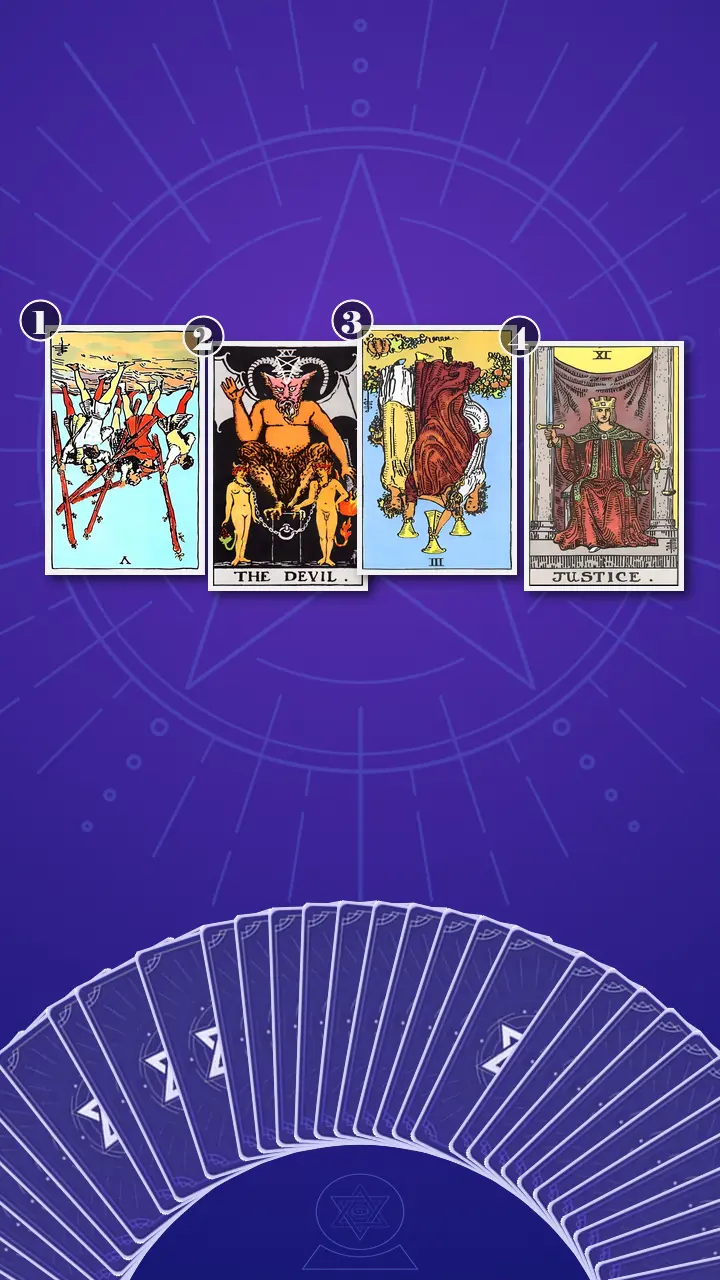
Crossed Messages, Loose Chains, and an Empty Seat
The Sideways Conflict: Five of Wands Reversed
I turned over the first card. “Now we are looking at the card representing your self in this dynamic: the observable move you make when the team begins dumping anger onto one coworker.”
Five of Wands, reversed.
On the traditional image, five wands cross in the middle of a noisy struggle. There is movement everywhere, but no clear leader, no clear boundary, and no real resolution. Reversed, I read that heat as conflict turned sideways. Instead of naming a direct concern, Jordan enters the friction through a laugh, a mild echo, or a silence that lets the group keep moving toward a target.
“This is the Slack thread,” I said. “Several people mention the same missed update. Reactions stack up. You wait for the safest opening, then type, ‘The handoffs have been rough lately.’ That sentence is not necessarily false. But the question is whether it helps solve a workflow problem or proves which side you are on.”
The card showed an excess of social-threat scanning and a shortage of clear, self-directed language. Jordan was matching the volume of a crowded meeting because lowering their voice felt like announcing that they were separate. It was like watching an episode of The Office and realizing, halfway through the laugh, that the joke is also an unofficial test of who belongs.
Jordan gave a short, bitter laugh. “That is painfully accurate. I tell myself I am being collaborative. Really, I am trying not to look difficult.”
I watched their fingers press together over the edge of the table. “Maybe it is team alignment,” I said. “Maybe it is fear wearing a collaborative badge.”
The first card did not demand that Jordan stop naming problems. Its warning was subtler: avoiding one kind of conflict had created another. If Jordan became silent in every tense conversation, legitimate handoff issues would still go unaddressed, and resentment would simply collect behind a better-looking mask.
The Story That Feels Compulsory: The Devil
I turned over the second card. “This position represents the other or projection: what this coworker activates in your perception. It is not a verdict on their character.”
The Devil, upright.
The horned figure rises above two people wearing loose chains. I emphasized the word loose. The card was not telling me that Jordan was trapped, nor that the coworker was secretly terrible. It showed an attachment that had begun to feel compulsory: the belief that shared resentment was the price of staying inside the team.
I pictured the 8:47 p.m. Line 1 ride Jordan had described. Wet coats. Hard overhead lights shining on the screen. The same coworker's name appearing again beneath six laughing reactions. The train doors beeping at the next stop while Jordan's shoulders sat high near their ears.
“At that point,” I said, “the coworker has become more than a colleague with a missed dependency. They have become the team's recurring explanation for pressure, and your shortcut to social safety. When somebody says, ‘We all know what the problem is,’ the pull to agree arrives before you have checked what you actually know.”
Jordan stared at the chain in the image. Their breath paused. Their eyes moved away from the card, as if replaying a kitchen conversation I could not see. Then their mouth tightened before they said, quietly, “If I do not add something, I think they will notice I am outside.”
That was the leverage point. In my years on Wall Street, I learned that a power dynamic is rarely only about the person speaking loudest. It is also about the currency everyone believes they must pay. I call this Power Dynamic Deconstruction: identify the hidden agenda, the perceived leverage, and the choice that remains available before the room turns its assumption into a rule.
Here, the hidden agenda was not cruelty for its own sake. It was safety. The perceived leverage was approval: project access, good references, being known as easy to work with. But the actual leverage was smaller and more usable. Jordan could pause, mute, ask for specifics, leave a thread, or name one fact. The chain felt heavy because the team habit was loud, not because it had removed every option.
“You can take your fear of exclusion seriously,” I told Jordan, “without letting it make every choice for you.”
The Circle With Someone Missing: Three of Cups Reversed
I turned over the third card. “This one represents the shared pattern: the team's relational reinforcement loop, how group bonding, anger, and repeated focus on one coworker keep the behavior circulating.”
Three of Cups, reversed.
In its upright form, this card shows people raising cups together: friendship, emotional exchange, communal support. Reversed, it asks what happens when warmth becomes a closed circle. The cups are still raised at the same height, but somebody is not at the table.
“This is the group chat or kitchen huddle becoming livelier the moment that coworker's name appears,” I said. “The synchronized reactions are the cups. The inside jokes are the toast. The absent person is the hidden cost of the closeness.”
Jordan's team had real pressures and real frustrations. I did not minimize that. But a missed handoff had become a reliable place to deposit wider stress about deadlines, unclear ownership, and hybrid-work friction. That is how belonging through a shared target forms: a group finds instant closeness, while one person becomes the container for emotions that belong to a much larger system.
Jordan swallowed, their gaze fixed on the three figures. First their jaw flexed. Then their shoulders dropped a fraction. Finally, they exhaled through their nose with a look that held both recognition and sadness. “It gets funnier when they are not there,” they said. “That sounds awful when I say it out loud.”
“It sounds precise,” I replied. “Precision is not self-punishment.”
The reversed Three of Cups showed why the pattern repeated. Joining produced a brief social reward. Feeling guilty afterward led Jordan to withdraw from informal conversations for a day or two. Then the next pile-on felt even riskier to interrupt, because Jordan was hungry to feel included again. That was not a bad-person story. It was a loop with a short-term payoff and a long-term cost.
“You can own the sentence you added without becoming responsible for the whole room's anger,” I said. “The goal is not to reject friendship or pretend frustration is harmful. It is to notice when a real work concern becomes shared entertainment.”
When Justice Held the Reply Button Still
The Fact Before the Verdict: Justice Upright
The room seemed to get quieter as I turned over the final card. Rain ticked against the window behind Jordan, and a distant elevator bell sounded from the hallway. “This is the guidance and repair position,” I said. “It asks for your next accountable response: how you can separate a specific work issue from a personal attack while preserving connection without surrendering judgment.”
Justice, upright.
Justice holds an upright sword in one hand and level scales in the other. The sword is clear language. The scales are proportion. I felt a familiar professional association surface from my former life: on a trading desk, a contract did not become sound because a room full of people repeated the same confident story about it. You checked the terms, the exposure, and the evidence. Fairness was not a mood. It was a structure.
Jordan knew the rainy streetcar ride I meant: the same name appearing again in Slack, the hot phone, the tight jaw, the reflexive check for reactions after their small complaint. The issue was real, but the verdict had grown larger than the issue.
They were caught in the old equation: If I do not agree, I may become the next outsider. If I agree, I can deal with the guilt later. Justice did not ask them to deny the missed update or rescue anyone from every consequence. It asked a different question: What do I actually know, and what am I repeating because everyone else is repeating it?
You do not have to balance the team's anger by adding your weight to it; you can restore proportion by weighing the specific facts and your own part, as Justice does with the sword and scales.
I let the sentence sit without rushing to soften it.
Jordan's breathing stopped for a beat. Their fingers hovered above the table, no longer pressing together. Their eyes lost focus, as if the 9:06 a.m. meeting room had returned: the project dashboard flickering on a wall screen, a metal water bottle tapping, three colleagues repeating the same label until it sounded like fact. Then their pupils widened slightly. Their face changed from guarded concentration to the first edge of grief, their eyes brightening without tears falling.
They leaned back. The tight line of their shoulders loosened, then loosened again. Their hands opened flat against their thighs. When they spoke, their voice started low and cautious: “But if I do that, does it mean I was wrong before?” A pulse of anger crossed their expression. “Like I have been pretending not to know better?”
I did not turn Justice into a punishment. “No,” I said. “It means you are seeing the trade you were making more clearly. You bought a few seconds of safety with agreement. That made sense as a reflex. Now you have information about its cost. Accountability is what you do next, not a permanent identity you wear.”
The anger softened into a shaky exhale that seemed to come from deep in their chest. Their shoulders fell. For a second, they looked almost unsteady in the quiet that followed, as though setting down a burden had left a small, disorienting space where their usual strategy had been.
I asked, “Now, with this perspective, think about last week. Was there a moment when this could have changed how you felt?”
Jordan nodded slowly. “In stand-up, someone said the coworker was careless. I could have said the dependency was not updated before Thursday's handoff. Can we agree on an owner and a deadline? I would still be naming the problem.”
“Exactly,” I said. “A missed handoff is a work problem. It is not automatically a personality verdict.”
This was the shift from fear-driven agreement and borrowed anger to proportionate accountability and ethical belonging. Not moral perfection. Not a heroic confrontation. One specific, respectful contribution that separates observable work behavior from a person's worth.
Justice was the antidote because it made Jordan's real power practical. Belonging is still belonging when you keep one piece of your judgment for yourself.
A Small Protocol for Ethical Belonging
I gathered the reading into one story. The reversed Five of Wands showed Jordan entering conflict indirectly, using a small agreement to avoid standing apart. The Devil showed why that move felt so compelling: approval had become a kind of social currency. The reversed Three of Cups showed the group reward, a circle that grew warmer by returning to someone who was not in it. Justice introduced another standard: fact before verdict, proportion before performance.
The cognitive blind spot was treating agreement as proof of belonging. Jordan had been asking, “Will they approve of my contribution?” before asking, “Is my contribution fair, accurate, and useful?” The transformation direction was not from participation to silence. It was from social mirroring to personal discernment.
“You do not have to fix the team culture in one meeting,” I told Jordan. “Your leverage is your next contribution. I would use my Leverage Mapping Protocol here: identify your bargaining chip before the moment arrives. Your chip is not a perfect speech. It is the ability to name a specific workflow impact, propose a next step, and decline to add a second judgment.”
- The Three-Line Accountability Check Before the next Slack venting thread, open a private note and write three lines: “Observed,” “Assumed,” and “Added.” Put one sentence under each about the issue. For example: Observed: “The dependency was not updated before Thursday's handoff.” Assumed: “They do not care.” Added: “The handoffs have been rough lately.” Do this in ten minutes or less. You do not need to send anything; if your body feels more activated, close the note and return to something grounding you choose.
- The Fact-Before-Verdict Pause When someone turns the conversation personal in a meeting, chat, or kitchen huddle, use one low-drama sentence: “The specific impact I have seen is the missed handoff. What would address that?” Then stop. Do not add a second criticism to prove that you still belong. Keep the smallest version saved in Notes: “What is the specific task impact?” A one-breath Slack pause counts, and you are not required to debate the whole team.
- Proportionate Repair Within 24 hours of the next moment you join a pile-on, write: “I joined by...” and “The smallest repair available is...” If a factual correction is needed, send it only to the relevant person or update the relevant owner, dependency, or handoff. Leave out a long confession and do not ask anyone to relieve your guilt. If direct contact could create risk or intensify the situation, make a neutral process correction or speak with a trusted manager instead.
These are actionable next steps, not a test of moral courage. A practical question can feel exposing in an early-career workplace, especially when being seen as collaborative seems materially important. That is why I kept the protocol reversible. Jordan could draft the sentence, use it once, observe what happened, and decide what fit their workplace reality.

The Quiet Proof on a Thursday Morning
Five days later, Jordan sent me a message after stand-up. A teammate had called the coworker “careless” after another project snag. Jordan felt their face heat, opened their private note beneath the table, and typed one line: Observed: dependency was not updated before Thursday. Then they said, “The issue I personally saw was that the dependency was not updated before the handoff. Can we agree on an owner and a deadline?”
There was a pause. Someone answered the workflow question. The meeting moved on. Jordan did not describe a dramatic transformation or a suddenly perfect team. They wrote, “I still worried everyone thought I was being weirdly serious. But I did not spend the streetcar ride replaying my own message.”
That was the small proof I wanted them to have. Jordan had not solved every power dynamic around them. They had interrupted one familiar loop and discovered that their voice could hold a real concern without helping make a person carry the whole team's frustration.
For me, that is the value of a four-card Relationship Spread - Context Edition for workplace scapegoating and ethical belonging. The cards did not hand Jordan a verdict or make a promise about the team. They helped us turn a charged, repeating scene into visible choices: what happened, what the group added, and what Jordan could do next.
When a team chat turns one missed handoff into a verdict on one person's worth, your face can heat, your jaw can tighten, and you can still feel the pull to agree because standing apart seems more dangerous than carrying the guilt home. But a pause can be enough to keep the story from becoming a sentence.
Next time the replies begin stacking up, what is the smallest, most honest Justice sentence you might say, draft, or leave unsent to keep belonging open without adding another judgment?