A Contract-to-Hire Promise Stalled the Search; Both Paths Reopened

The Contract-to-Hire Promise at 8:15 p.m.
I recognize the Toronto contract project coordinator who keeps cancelling application blocks after a manager says conversion is still being discussed, then calls the pause strategic patience while Sunday Scaries begin the moment a job alert arrives.
When Jordan settled into my chair, I could still see Tuesday at 8:15 p.m. in the way she held her phone: warm against her palm, screen glowing with the words "more news soon." She had closed a bookmarked permanent project coordinator application, reopened a deliverable that was already finished, and sat beneath a kitchen light while the laptop fan hummed beside her.
"Why do I keep pausing my job search for a contract-to-hire promise?" she asked. "Every time they say the role could convert, I stop applying elsewhere. Searching feels disloyal even though nothing is signed. I do not want to walk away right before they make it official."
I heard hope in her words, but I also saw the cost of carrying it. She told herself that waiting one more week was sensible, but her shoulders had already begun to show the opposite: a heavy downward pull followed by a restless buzz whenever she opened LinkedIn, checked Teams, or looked at her calendar.
"You are not foolish for wanting the possibility to become real," I said. "And you are not disloyal for needing other options. Let us use the cards as a clear-eyed mirror, not a verdict, and draw a map through this career limbo together. The goal is finding clarity without handing your career direction to someone else's unfinished sentence."

Choosing the Compass at the Career Crossroads
I invited Jordan to place both feet on the floor, take one slow breath, and name the question without trying to solve it. I shuffled deliberately, giving the small act enough quiet to separate the workday from the decision in front of us.
For anyone reading, this is how tarot works in this consultation: the cards do not predict whether an employer will approve a permanent role. They organise attention. I chose a five-card Decision Cross tarot spread for a contract-to-hire career crossroads because Jordan was not choosing between two confirmed offers. She was deciding how much authority an uncertain possibility should have over her present actions.
The centre card would show the observable job-search pause and the stagnant emotional state at the heart of the decision. The card to the left would examine the pull of waiting, including the work and hope already invested. The card to the right would show what active exploration could offer. Beneath the centre, I would look for the hidden fear supporting the stalemate. Above it, I would seek an integrating principle, a practical way to keep competing priorities moving without forcing an all-or-nothing choice.
I told Jordan that I would read card meanings in context, linking each symbol to something visible in her calendar, messages, body, or workday. That kept the reading grounded in evidence and gave her room to disagree. The querent, not the deck and not the reader, remains the person who decides what happens next.
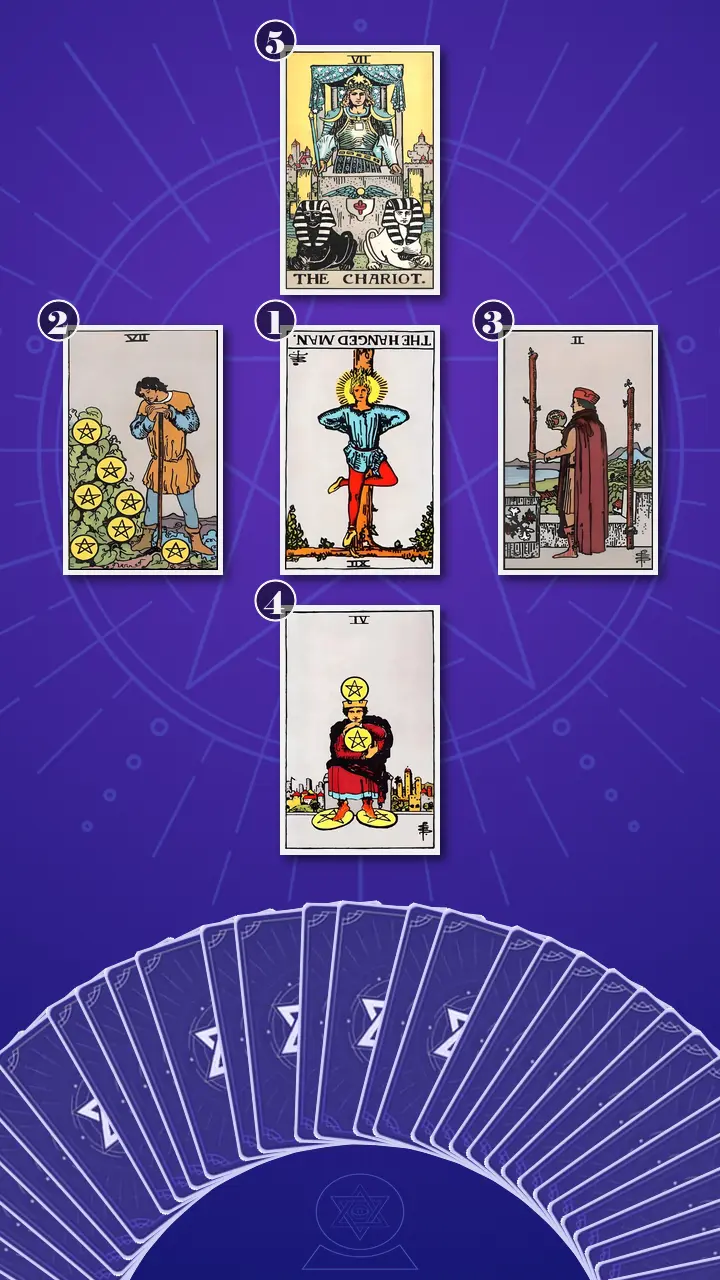
The Pause That Kept Calling Itself Patience
The Hanged Man Reversed and the Sacrificed Calendar Block
I began at the centre, with the position that shows the observable job-search pause and the stagnant emotional state currently sitting at the heart of Jordan's contract-to-hire crossroads.
The card was The Hanged Man, in reversed position.
I brought the image close to the Tuesday night scene. The single ankle bound to the living wooden frame became the 45-minute application block Jordan kept sacrificing whenever her manager said "soon." The inverted body and golden halo asked a precise question: was the suspension still creating a new perspective, or was it simply repeating the same pause with better explanations?
Reversed energy here is blockage, with an excess of waiting and a deficiency of fresh evidence. The Hanged Man can represent a deliberate pause that allows insight to arrive. In Jordan's case, the pause had already delivered its information several times: no permanent role was secured, no conversion criteria were named, no decision-maker or review date had appeared, and the external search became smaller each time she cancelled it. The wait was no longer giving her perspective. It was making her increasingly dependent on the same unresolved promise.
I described the loop as gently as I could. A positive update arrived. Jordan cancelled her search block, overperformed in the contract role, reread internal messages, and felt a brief drop in pressure because interviews and rejection were no longer waiting for her. Then the week passed without a concrete change. The relief faded, but the next vague update restarted the cycle.
"The sentence in your head sounds like this," I said. "If I wait one more week, I am being sensible. If I move now, I might ruin everything." I paused. "That is purposeful reflection on one side, and a pause that only repeats itself on the other."
Jordan did not nod. First, her breath stopped halfway in and her fingers hovered above the edge of her phone. Then her eyes lost focus, as if the closed application tab, the finished deliverable, and the same internal message were replaying in sequence. Finally, she gave a small, bitter laugh and said, "That is too accurate. It is almost cruel."
I did not ask her to agree with the card or defend her behaviour. "The laugh makes sense," I said. "The pause has been protecting you from a difficult choice, even while it narrows the choices available. That does not make you weak. It tells us what the pause is doing."
I asked her to notice one thing the next time her shoulders rose over a job board: not whether she should resign, not whether the promise was false, but whether the latest message contained anything new enough to justify giving away a scheduled search block. The Hanged Man reversed was not a command to apply everywhere. It was an invitation to stop mistaking immobility for proof of commitment.
Seven of Pentacles and the Harvest That Needs a Checkpoint
I moved to the left-hand position, which examines what keeps Jordan attached to waiting: delayed gratification, accumulated effort, and the hope that patience will validate her investment in the contract role.
The card was Seven of Pentacles, in upright position.
I pointed to the worker leaning on the tool and studying the pentacles rather than actively tending them. The modern scene was familiar: Jordan reviewing months of strong contract work, late evenings, finished project briefs, and all the emotional energy she had placed beside the possibility of conversion. The card did not dismiss that investment. It asked whether the crop was being assessed or merely admired because she had already spent so long growing it.
The energy of the Seven of Pentacles is balanced patience when it includes a review point. Without one, patience becomes a deficiency of evaluation and can quietly turn into automatic recommitment. More time is not automatically more evidence. I asked Jordan to separate the words that soothed her from the facts that could actually change the decision: an approved headcount, defined conversion criteria, a named decision-maker, written terms, or a dated status review.
"Patience needs a checkpoint, or it quietly becomes dependence on someone else's timeline," I said. "That does not mean your previous work was wasted. It means the next period of waiting should have a reason, a question, and a point at which you look again."
Her hand moved to the edge of the table. She started to say that the team valued her, then stopped and looked down at the card. "They do give me good feedback," she said. "But I keep turning that into evidence that the role is nearly approved. Maybe I am measuring how much they like my work instead of whether the job exists."
I saw the first distinction take shape between promise and proof. The Seven of Pentacles did not tell Jordan to abandon a meaningful opportunity. It gave her permission to let hope remain hope while asking it to share the table with observable information.
Two of Wands Opens a Second Browser Tab
I crossed to the right-hand position, which reveals what resuming an external search offers and requires: wider perspective, active planning, and tolerance for keeping multiple possibilities open while the current promise remains unresolved.
The card was Two of Wands, in upright position.
The figure holding the globe while looking beyond the walls brought Jordan's wider job market back into view. I imagined the browser she had closed at 8:15 p.m. opening again, not as an escape route but as a second tab. On one side, she could continue delivering excellent contract work. On the other, she could review one relevant permanent role, answer one recruiter, and compare actual terms against the criteria she wanted her current employer to meet.
This was fire energy entering a spread dominated by earth. The pentacles had been conserving, assessing, and protecting. Two of Wands supplied movement through deliberate planning rather than impulsive departure. I told Jordan that she did not need to apply to dozens of unrelated jobs in one evening. That would be an overcorrection, not freedom. The card asked for a wider horizon in a manageable size.
"You can look without leaving," I said. "A recruiter message is information. A saved listing is an option. Neither one is a resignation letter."
I used a split-screen image from her real week. On one side, Jordan completed a project milestone and kept her current responsibilities intact. On the other, she reopened a recruiter email and compared one role according to status, salary, scope, benefits, flexibility, and timeline. The globe in the card became a wider browser window, not a demand to jump.
Jordan inhaled and then let the breath travel all the way down. The tightness at the centre of her chest eased by a fraction. She looked from the card to the phone and murmured, "I can look without leaving." The phrase sounded less like permission from me than a rule she had found in herself.
I asked her to remember the last relevant listing she had saved in a folder called "Maybe" and allowed to expire. We did not turn that missed opportunity into a punishment. We treated it as information about the cost of letting one employer's update erase the wider landscape. Exploration could now be a form of planning, not evidence of betrayal.
Four of Pentacles and the Promise Held Too Tightly
I placed a card beneath the centre, the position that uncovers the hidden fear of losing security or control that turns strategic patience into a self-reinforcing stagnation lock.
The card was Four of Pentacles, in upright position.
The figure pressed one pentacle to the chest and pinned two beneath the feet. I saw Jordan holding the conditional promise in exactly that posture, protecting it so tightly that her own movement became the price of keeping it safe. The distant city represented recruiter conversations, permanent roles, benefits pages, salary calculators, and every option that remained outside the frame while she waited for an unsigned future.
The energy here is an excess of preservation and a blockage of movement. Wanting stable income, predictable planning, and a permanent status is entirely reasonable. The blind spot is believing that declining outside conversations can secure what the employer has not yet secured. No grip on a calendar, a deliverable, or a workplace message can create approved budget or hiring authority.
I asked the question beneath the practical question. "What are you protecting when you stop searching? Is it income, the possibility itself, or control over the story of what these months have meant?"
Jordan's jaw tightened. She looked toward the window, where Toronto lights sat in separate squares against the dark. "I think I am scared that if I interview now, I will miss the internal offer by one week," she said. "And if I restart, I have to admit that waiting did not give me control. I have been here too long to let it mean nothing."
I let the silence stay kind. Past effort can have value even when it does not produce the hoped-for outcome. I also named the other clock I could hear around the promise: LinkedIn announcements from former classmates, rent planning, savings goals, and the social pressure to have a permanent title by a certain age. My second diagnostic lens is Social Clock Decoupling. I used it here to separate Jordan's actual needs from the artificial timeline that made every temporary month feel like personal evidence of falling behind.
"Your career is not late because an institution has not finished deciding," I said. "And looking at another role does not rewrite the value of the work you have already done. It only refuses to let uncertainty occupy your thoughts, feelings, and calendar as if it were security."
Her shoulders did not relax all at once. They lowered a little, rose again, and then settled. That uneven movement mattered. A hidden fear had become something she could examine rather than something she had to obey.
When The Chariot Took the Wheel
The Bridge Between Two Sphinxes
Before I turned the final card, the room seemed to narrow around the spread. The ventilation clicked off. Somewhere beyond the apartment, a streetcar bell sounded and disappeared, leaving a clean pocket of quiet.
I rose to the position above the centre, the card that provides an integrating decision principle and a concrete way to coordinate contract performance with continued job-search activity until the promise becomes verifiable.
The card was The Chariot, in upright position. Its black and white sphinxes were not a good choice and a bad choice. They were two legitimate forces: Jordan's commitment to doing the current contract well and her responsibility to keep her wider career direction alive. The charioteer's upright posture suggested direction, while the absence of visible reins reminded me that structure is not the same thing as controlling the employer's decision.
This was the bridge card. Its invoked energy was disciplined agency, evidence-based self-trust, and the ability to coordinate competing priorities without forcing a premature choice. The Chariot did not ask Jordan to become relentless, send a hundred applications, or resign in a dramatic burst. It asked her to write rules for what she could direct and stop asking effort to control what belonged to the employer.
I also brought in my signature Seasonal Energy Diagnostics. After sixty-seven years of watching seasons change, I have learned to ask whether someone is tired because they lack discipline or because they are trying to force growth in the wrong conditions. Jordan had been trying to force a spring harvest, the permanent role, from institutional winter soil: unclear budget, unnamed criteria, and no reliable date. Winter was not a verdict on the eventual harvest. It was a reason to stop spending all her energy trying to make one uncertain field bloom on command.
Jordan was still inside the old bargain: if she waited perfectly, the employer would reward her; if she searched, she might make the offer vanish. The promise had become a calendar rule, and every alternative looked like evidence against her own commitment.
Waiting is not proof of commitment; steer both sphinxes by keeping your contract performance strong and your search active until the promise becomes concrete.
For a moment, Jordan's breath stopped. Her eyes widened, then went unfocused as if she were replaying every deleted calendar block and every recruiter message left in draft mode. One hand tightened around the phone until the knuckles paled. Then the grip loosened. Her shoulders dropped with a visible, almost startled heaviness, and a breath moved out of her chest with a small tremor. She looked angry for one second, not at me but at the bargain she had been obeying. "But does that mean I was wrong all this time?" she asked. The question held grief as well as relief. I watched her mouth press into a line, watched her eyes shine, and waited while the new idea became hers instead of rushing to make it comforting.
"It means the strategy may have outlived the evidence," I said. "It does not mean your hope was foolish or your work was wasted. It means you can update the rule now."
I asked her to use this new view to revisit last week: when her manager said there would be more news soon, what might have felt different if she had kept one small search block instead of treating movement as betrayal? Jordan looked at the calendar, not the cards, and wrote two words: "still interested." Beneath them she wrote, "still available."
That was the important crossing. Jordan was beginning to move from hope-driven waiting and fear of losing control toward grounded confidence in a self-directed two-track career plan. The cards had not chosen between loyalty and exploration. They had shown her that both could exist under rules she selected.
Keeping Both Lanes on the Calendar
The Promise Versus Proof Check
I gathered the five cards into one story. The Hanged Man reversed showed why the search kept stopping: a pause that once looked thoughtful had become automatic. Seven of Pentacles explained why waiting felt morally and practically sensible: Jordan had invested real work, time, income, and hope. Two of Wands reopened the horizon without demanding departure. Four of Pentacles revealed the hidden foundation: the attempt to hold an uncertain future tightly enough that it could not be lost. The Chariot gave the pattern a direction, integrating patience with exploration through chosen structure.
The deeper metaphor was not a journey from patience to impulsiveness. It was a departure board that kept displaying "delayed" without announcing a new time, while Jordan stood beside it and gave away every other appointment. The new plan was not to leave the station in anger. It was to keep the current route visible while checking the next connection before it disappeared.
I named the cognitive blind spot plainly: Jordan had been treating an employer's encouraging language as if it were a personal instruction. She could control the quality of her contract work, the number of search blocks she protected, the questions she asked, and the date on which she reviewed the evidence. She could not control budget approval, hiring authority, or the final timeline. The transformation direction was therefore from passive exclusivity to parallel agency, from loyalty anxiety to evidence-based self-trust.
I also noted that the spread contained no Cups or Swords. I did not treat that as a deficiency in Jordan. I read it as a useful reminder that the cards had emphasised effort, security, and movement, while emotional acknowledgement and clear language would need to be added deliberately. We would need to name the disappointment and ask the factual questions ourselves.
Before we discussed next steps, I gave Jordan my Winter Dormancy Ritual. For seven days, she would do nothing to force the employer-controlled part of the conversion process. No polishing a finished deliverable after hours to manufacture indispensability. No rereading a vague message for a hidden date. No bargaining with the timeline in bed. She would complete the work she had agreed to do, but she would stop adding guilt-driven effort to make winter produce a spring harvest.
The ritual was not a week of freezing her whole life. It was a deliberate release of one blocked goal, creating enough quiet to rebuild organic energy while the two-track career plan continued. I wanted her to discover the difference between resting a lever she could not pull and abandoning the parts of her future she could still tend.
I then translated the reading into small, bounded actions. I told her that actionable advice should be light enough to begin on a crowded week and clear enough to survive another "quick update" message.
- The Calendar Block BoundaryOn Sunday evening, I asked Jordan to open Google Calendar and restore two blocks for the coming week: one 45-minute block for contract priorities and one 45-minute block for a carefully chosen permanent-role application. If a vague conversion update arrived, she would leave the search block in place for 24 hours before changing it.I told her to begin with a 20-minute version if 45 minutes felt too exposed. She could research, draft, or apply; the boundary was simply that one employer message could not erase the block automatically.
- The Promise Versus Proof CheckBefore her next one-to-one, I asked Jordan to write three questions in Notes: What criteria would need to be met for conversion? Who makes the decision? When should the status be reviewed again? Afterward, she would place concrete evidence in one column and encouraging language such as "we hope" or "soon" in another, then choose a personal review date.I suggested drafting the questions first and deciding later whether to send them, say them, or keep them as a private standard. Asking for information is not the same as demanding a guarantee.
- The One-Role Reentry ExperimentI asked Jordan to open her saved listings, select one role matching at least two of her criteria, and set a 20-minute timer at her kitchen table or in a quiet library corner. She could tailor one resume section, draft the first paragraph, or reply to one recruiter without promising an interview or a departure.She was not allowed to turn discomfort into an anxious evening of dozens of applications. One relevant role and one honest message were enough to reopen the professional horizon.
"The point is not to prove that the outside market will save you," I said. "The point is to stop making one undefined internal possibility the only future you are permitted to notice. Keep both lanes moving until the promise becomes concrete."
Jordan looked at the two empty calendar blocks. They were small rectangles, but they no longer looked like a threat to the current role. They looked like evidence that her time belonged to her again.

A Week Later, One Tab Still Open
Five days later, I received a message from Jordan: she had restored a 20-minute Wednesday block, replied to one recruiter, and asked for conversion criteria. That night she slept through. At breakfast, "What if I am wrong?" arrived first. She smiled anyway; the question no longer erased her calendar.
There was no permanent offer in her message, and I would never pretend that a tarot reading could create one. There was something more immediate: a submitted question, a live external option, a review date, and a contract role no longer carrying the entire weight of her future.
I thought of the Chariot again, not as a promise of victory but as a picture of direction. The quiet proof was that Jordan had stopped waiting for certainty to grant her permission to move. She remained responsible for her choice, which was both lighter and more vulnerable than believing the employer's next update would decide everything.
When another "soon" makes your shoulders tighten and your job-search tab disappear, it can feel safer to protect the promise than to risk discovering that your patience never controlled the outcome. But noticing the difference between hope and evidence is already a return of direction.
If you could keep your current role and your wider career direction in the same two-tab frame for one small moment, what would you want to notice before deciding what either path means?