One Unfinished Bullet Becomes Three Criteria Before the Next Yes

The 11:40 p.m. Yes: Rushing Into Major Commitments Before You Know What You Want
If you are the early-career city worker who can answer a client Slack in two minutes but needs a binding commitment to stop a personal decision from following you into Sunday night, I may know your urgency-to-clarity loop.
I met Alex, a 28-year-old project coordinator in Toronto, after one of those nights. At 11:40 p.m., they had sat beside an open confirmation page in their small apartment. The laptop was warm under their wrists, the radiator clicked in the dry room, and a payment receipt was already in their inbox. Their calves kept twitching. A fresh note titled Is this actually what I want? held one unfinished bullet.
“I do the paperwork first and ask what I want afterward,” Alex told me. “The minute I say yes, I feel like my life is moving. Then I start researching whether I should have done it.”
I could see the contradiction clearly. Alex wanted the confidence and direction of a decisive major commitment, but the pause required to discover a genuine preference felt physically unbearable. Urgency moved through their body like an airport travelator set too fast: even standing still seemed to carry them toward a departure gate they had not chosen.
“I am not here to tell you whether your past choices were right or wrong,” I said. “I want us to understand what happens in the few minutes before the yes. We can give that pattern a map, then find a way for you to keep your agency without forcing certainty.”

Choosing the Compass: A Five-Card Shadow Spread
I invited Alex to take one slow breath while I shuffled. I treat this small ritual as a transition, not a supernatural performance. It helps the nervous system leave the confirmation screen long enough to look at the decision itself.
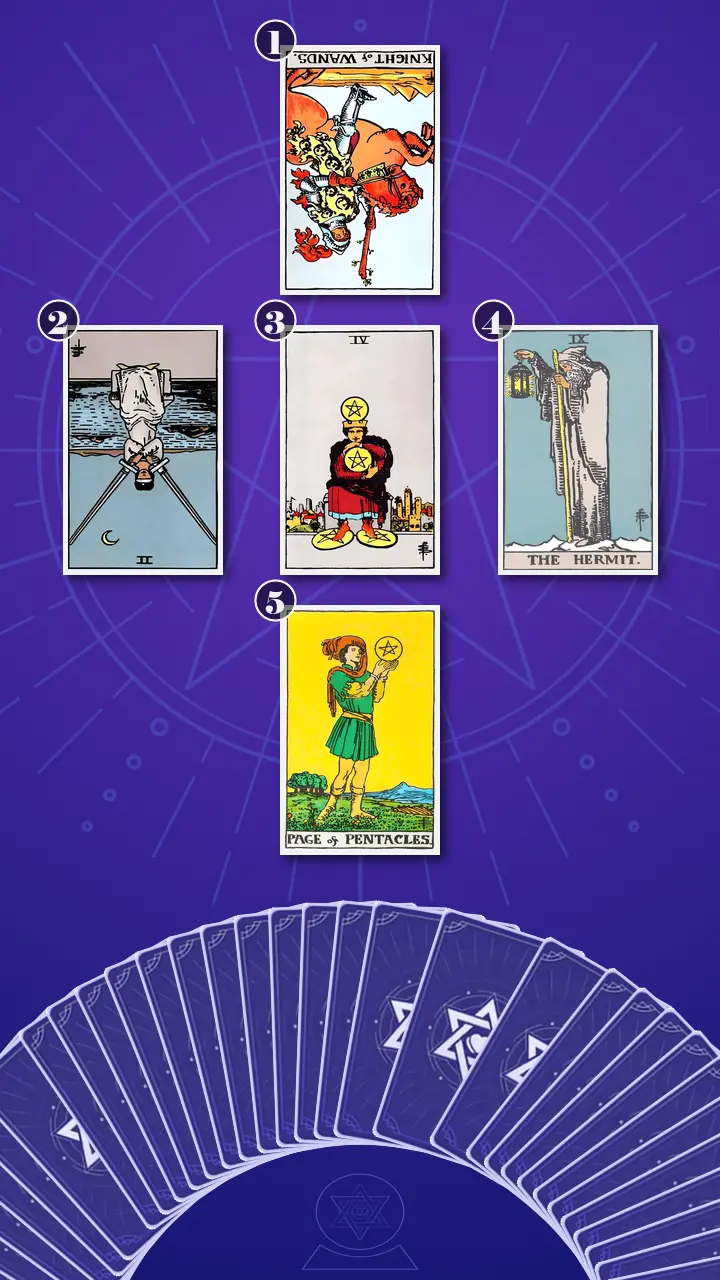
I chose the five-card Shadow Spread. For anyone wondering how tarot works in a reading about decision anxiety, I use the cards as a structured cognitive mirror. They do not predict which opportunity Alex must choose. Their images separate a compressed experience into visible behavior, hidden trigger, root fear, integrating resource, and grounded practice.
This focused spread suited the question better than a larger Celtic Cross because Alex was not comparing two defined options. We were tracing one reinforcing loop. The first position would show the observable rush. The second would reveal what makes waiting intolerable. The center card would expose what the commitment is trying to secure. The final two positions would move us toward reflective discernment and a practical test.
I arranged the cards as a cross. It looked like a compass whose central magnet might explain why the needle kept snapping toward the first available direction.
Reading the Map of the Rushed Yes
Position 1: The Horse That Rears Before It Travels
I began with the card representing the observable symptom: accelerating into a major commitment before personal wants have been named. I turned over the Knight of Wands, in reversed position.
I pointed to the horse lifting its front legs beneath the rider. There was tremendous activation, but not stable travel. I connected it to a recent agency offer Alex had described. A director had invited them to join a six-month account, and Alex replied yes during the first rush of feeling wanted. By bedtime, they had moved appointments, told friends, and opened a budgeting sheet. Only then did they read the travel expectations and ask whether the account supported the skills they actually wanted to build.
“This is Fire in excess,” I explained. “Enthusiasm is being converted into a binding plan before it has had time to become a durable preference. The problem is not that you have too much agency. Your agency is arriving in the form of acceleration rather than direction.”
Alex gave a short, bitter laugh. “That is so accurate it is almost cruel.” Their fingers tightened around the coffee cup, then loosened as if they had noticed themselves doing it.
“The card is not calling you reckless,” I said. “It is showing a sequence. An option appears, your body pitches forward, and visible progress promises relief. Momentum can end uncertainty without creating clarity.”
I asked what they had confirmed, paid for, scheduled, or announced before writing down what they wanted. Alex named the account, a certificate course, and a relationship milestone. Each decision had looked different from the outside, but the internal timing was almost identical.
Position 2: Two Browser Tabs and No Quiet Answer
I moved to the card representing the hidden trigger, the point where inner conflict becomes so uncomfortable that a fast decision seems easier than continuing to hold it. I turned over the Two of Swords, in reversed position.
The blindfolded figure held two swords across the chest while water waited behind them. I translated that image into Alex's Sunday-night routine: a course checkout page in one tab, a job application in another, LinkedIn announcements glowing nearby, and a Notion comparison table gaining columns while the field marked what I want on an ordinary Tuesday remained blank.
Alex had toggled between options until their chest tightened and the comparison itself became intolerable. Enrolling in the course offered an instant confirmation page. It did not answer which path they wanted, but it ended the argument.
“This is blocked and overloaded Air,” I said. “The inner sentence is not, I know I want this. It is, I do not know which one I want, but I need this argument to stop. You are trying to obtain an honest answer, but the exhausted part of you settles for immediate relief.”
Alex's breath paused. Their thumb hovered over the cup handle while their gaze slipped away from the table, as though they were replaying a sequence of checkout screens. Then a low “Oh” left their chest, and their shoulders dropped a fraction.
“I always thought the calm afterward meant I had trusted myself,” they said.
“The relief of deciding is not the same as the clarity of wanting,” I replied. “Relief is real, and you do not need to shame yourself for seeking it. We simply should not make it carry evidence it does not contain.”
Position 3: The Anchor That Pins Both Feet
I turned to the center, the position representing the control-based fear sustaining the pattern: the belief that waiting might leave Alex without a viable path or stable identity. The card was the Four of Pentacles, upright.
I drew Alex's attention to the pentacle clutched against the figure's chest and the two beneath the feet. The image echoed a signed agreement, a paid deposit, a public announcement, and a packed calendar. Those four points could lock a choice into place so thoroughly that uncertainty had nowhere visible to enter.
“If I secure this, I cannot fall back to zero,” Alex said quietly when I offered the sentence.
I nodded. “This is protective Earth becoming excessive and rigid. A signed plan can stabilize your calendar while silencing your preference. You may defend the commitment and add more supporting tasks because reopening it feels like losing control. What you acquired as an anchor then reduces your freedom of movement.”
I did not frame Alex's need for security as a flaw. Toronto rent, non-refundable deposits, workplace deadlines, and relationship consequences are real. I asked a narrower question: “What do you hope the commitment will guarantee, and could any part of that guarantee be created without making the choice irreversible?”
Alex exhaled through their nose. Their expression held recognition and grief at once. “I want it to guarantee that I am not drifting,” they said. “And once other people know, changing my mind feels like admitting I cannot trust myself.”
I watched the central pattern settle into view. The rush was not simply impulsiveness. It was an attempt to turn an open future into something Alex could hold, even when holding it meant becoming unable to move.
When the Hermit's Lantern Interrupted the Algorithm
Position 4: One Honest Criterion Is Enough Light
The room seemed to quiet as I reached the position representing the quality that could translate private wants into explicit criteria before a promise. Outside, a streetcar bell sounded once through the window and faded. I turned over The Hermit, upright.
I contrasted the Hermit's planted staff and small lantern with the reversed Knight's rearing horse. The Knight tried to outrun the dark. The Hermit accepted that only a few steps could be visible and used that limited light carefully. This was reflective Fire in balance: attention concentrated into discernment instead of acceleration.
In Alex's life, the card looked ordinary. It meant closing the comparison tabs, delaying the group-chat announcement, and spending one private evening writing three non-negotiable needs and three signs that more evidence was required. The lantern did not have to reveal a complete career, relationship, or city. It only had to show whether the next promise belonged to Alex.
I used my Analysis Paralysis Deconstruction here. I asked Alex to strip away every abstract scenario beginning with what if someday and name only the immediate realities: the actual deadline, money at risk, weekly energy required, ordinary routine, and available exit. Then I reduced the decision to one practical binary question, not Is this my perfect path?, but Does this meet enough of my stated criteria to test, or should it remain an option?
Alex knew the familiar scene already: the receipt in the inbox, the calendar reorganized, and only then the blank note asking whether the choice fit.
The relief of having decided is not the same as the clarity of knowing what you want.
I let the sentence rest before giving them the Hermit's message in full.
You do not have to lock in a path to prove that you know yourself; pause, name your criteria, and let the Hermit's lantern illuminate only the next honest step.
Alex stopped breathing for a beat. Their fingers remained suspended above the cup, and their pupils widened as if the late-night receipt had appeared between us. Their brow tightened first, not with relief but resistance. “But doesn't that mean I got all those earlier decisions wrong?” Their voice sharpened, then thinned at the end. I saw their shoulders rise, their jaw brace, and their free hand close into a fist.
“No,” I said. “It means you can update the process without putting your whole history on trial. Some past choices may still fit. Others may need revision. New information is not proof that your judgment failed.” Alex looked down again. Their eyes shone, the fist opened one finger at a time, and a long breath left them with a slight tremor. Their shoulders lowered, but the new space seemed to make them briefly unsteady. Clearer choice meant more freedom, and also more responsibility for naming what they wanted.
I asked, “Now, using this new perspective, can you recall a moment last week when this insight might have changed how the situation felt?”
Alex returned to the Friday account offer. “I could have said I was interested and asked for Monday,” they said. “I did not need the whole route that afternoon. I needed one honest condition for continuing, and mine would have been knowing the travel schedule.”
I asked them to imagine the lantern as a phone note containing only three headings: I want, I need, and I need more evidence about. One sentence under each would be enough. “I can let this option remain an option for 48 hours,” Alex said, testing the words aloud.
That sentence marked the real breakthrough: a first movement from restless urgency and control-seeking through commitment toward grounded clarity and reflective self-trust. Pausing had stopped looking like a loss of agency. It had become an active form of self-direction.
From the Lantern to One Ordinary Tuesday
Position 5: Becoming the Beginner on Purpose
I turned over the final card, representing the bounded, low-risk practice through which insight could become lived experience. It was the Page of Pentacles, upright.
The Page held one pentacle at eye level and studied it. I saw the practical correction immediately. Instead of purchasing an entire future identity, Alex could examine one realistic sample: complete a course module, follow a proposed commute on a rainy weekday, or ask someone in the role what an unremarkable Tuesday actually looked like.
“This is receptive Earth in balance,” I said. “The Four tried to possess certainty. The Page gathers evidence. You can notice your energy before, during, and two hours after a trial, then compare what happened with your criteria on a scheduled review date.”
I had an old professional association at that moment. Project teams often want to push a build into production because an open decision feels untidy. The Page offers a limited beta instead: define what the test can reveal, protect the exit, and review the evidence before allocating the full budget.
“Becoming the Page is the mature move,” I told Alex. “A reversible test is not indecision. It is evidence.”
Alex reached for their phone, then paused before unlocking it. “For the account, I could talk to someone already on the team and ask what a normal week is like. Not the pitch. The actual Tuesday.”
I nodded. The Knight's hand had held a wand for acceleration. The Hermit had held a staff and lantern for support and illumination. The Page now held one concrete possibility still enough to examine it. Alex did not need less power. They needed their power to mature from immediate movement into discernment and then into a practical, revisable step.
The Criteria-Before-Calendar Method
I gathered the five cards into one story. The reversed Knight showed the visible rush. The reversed Two revealed the internal argument that made any completed decision feel soothing. The Four exposed the fear underneath: if nothing was fixed, Alex might be left with no path. The Hermit replaced external locks with internal criteria, and the Page turned those criteria into an experiment that could produce evidence.
The missing element across the spread was active Water. Feeling appeared only as the distant sea behind the Two of Swords. Alex's thoughts and logistics had been doing the work before felt preference could enter the conversation. Their cognitive blind spot was assuming that discomfort during a pause meant the option was disappearing or that control was being lost. Often, it meant only that an old regulation strategy was no longer ending the uncertainty on command.
I returned to the train image. Alex had been boarding the first train because waiting on the platform felt like being left behind. The new direction was not to stand there forever or inspect every possible timetable. It was to check the destination, name the conditions for travel, and take a small trip before buying a non-refundable pass.
The Coffee Bean Filter Protocol
I gave Alex my Coffee Bean Filter Protocol, a 24-hour sorting exercise for the first half of a major-decision pause. I call it a filter because the goal is to separate useful grounds from the pressure clouding the cup. I made one distinction explicit: emotional noise does not mean emotions are irrelevant. It means assumed deadlines, LinkedIn comparison, public embarrassment, and adrenaline should not impersonate personal criteria. Felt desire remains information.
- Place the major yes on a 48-hour hold. For the next non-emergency choice affecting substantial time, money, work, location, or relationship expectations, ask for the real deadline and put the response time in your phone calendar. Send: “Thanks for the offer. I do not make major commitments on the spot, so I will confirm by Thursday at noon.” During the first 24 hours, spend ten private minutes sorting each decision factor on paper into Absolute Must-Haves or Emotional Noise. Keep no more than three must-haves. If 48 hours is genuinely unavailable, use the smallest viable pause: ten minutes, one walk around the block, or one night without paying or announcing the choice.
- Run the Ordinary-Tuesday Test. Within seven days, test one realistic piece of the possible future. Book one 25-minute conversation with someone doing the day-to-day work, complete one sample module, or follow the proposed commute and budget on a normal weekday. Schedule a 15-minute review and compare your observed energy, interest, cost, and friction with the three must-haves before increasing the commitment. Define in advance what the test can and cannot decide. Protect the exit by avoiding a long contract, public announcement, or non-refundable payment until the review.
I reminded Alex that this written pause-and-test process could not guarantee a perfect decision. Its value was more grounded: it let personal criteria and real-world evidence enter the room before momentum turned an option into a promise. Tarot had not chosen a path for Alex. It had helped them see where their own choice-making power was being redirected.

A Week Later: The Quiet Proof
Six days later, I received a message from Alex. Their manager had offered another long assignment on a call, and Alex had used the boundary sentence. They asked for the real deadline, spoke with someone already on the account, and learned that an ordinary week included two recurring travel days, not the occasional trip implied by the pitch.
Alex's Coffee Bean Filter showed that predictable evenings were an absolute must-have, while the fear of looking unambitious belonged in the emotional-noise column. They did not reject the opportunity dramatically. They asked whether the role could be redesigned as a three-month trial with one travel day and a review date.
That night, Alex slept through until morning. Their first thought was still, “What if I lose it?” The doubt had not vanished. This time, they smiled, opened the criteria note, and let the question remain a question.
I took that as the quiet proof of our Journey to Clarity. Alex had not solved their entire future. They had moved from using commitment to manufacture control toward using a pause, personal criteria, and evidence to author the next step.
If standing still makes your limbs restless and the future look like a dangerously blank platform, even the wrong train can feel safer than admitting you do not know yet. I hope Alex's lantern offers a gentler truth: noticing that urge means you are already capable of choosing how to meet it.
If you let one option remain on the platform for 48 hours, what is the smallest honest preference your Hermit's lantern might help you notice?