Explaining Away Red Flags, Then Naming the Fact Before the Next Yes
The 8:47 p.m. “Accept”: Why I Keep Seeing People Move Past Red Flags
“I notice the mismatch, open the same message again, and somehow end up making one more commitment,” Jordan told me when our video call began. “Why do I keep moving forward when red flags show up?”
I asked Jordan to take me back to the most recent example. They described Tuesday at 8:47 p.m., when a Line 1 train pulled away from Bloor-Yonge and the door chime cut through the fluorescent buzz. Wet coats carried the faint mineral smell of Toronto rain. Jordan held a warm phone in one restless hand, reread a Teams message that contradicted Friday’s agreement, and tapped “Accept” on another meeting while their chest pulled tight beneath their jacket.
“I knew the scope had changed,” Jordan said. “But I also thought they might be under pressure. Maybe I’d missed some context. Maybe bringing it up would make me difficult. So I just accepted it and told myself I’d deal with it later.”
I heard the core conflict immediately: Jordan wanted to trust what they had observed, but they also wanted continued progress to prove that their earlier choice had not been a mistake. Their apprehension had the physical shape of a seat belt pulled one notch too tight while the train kept accelerating. Pausing did not feel neutral. It felt like being forced to turn around and read every warning sign as a judgment on their intelligence.
“That makes sense,” I told them. “You’re not failing to notice the evidence. You’re trying to protect yourself from what changing course might seem to say about you. I’m not going to use tarot to declare that you must stay, leave, confront, or forgive. I want us to build a map of the pattern so you can decide your next step from present evidence rather than shame.”
Choosing the Compass: The Four-Card Shadow Spread
I invited Jordan to put both feet on the floor, take one slow breath, and hold the question without trying to answer it. I shuffled slowly. I treat this small ritual as a transition for attention, not as supernatural theatre; it gives the nervous system a moment to stop racing ahead of the inquiry.
I chose The Shadow Spread, a linear four-card tarot spread designed to examine a repeating inner pattern. A larger Celtic Cross could have introduced external influences and possible outcomes, but Jordan’s question was not fundamentally predictive. It was about red-flag discernment, sunk-cost thinking, and the point at which intelligence stopped serving clarity and started defending momentum.
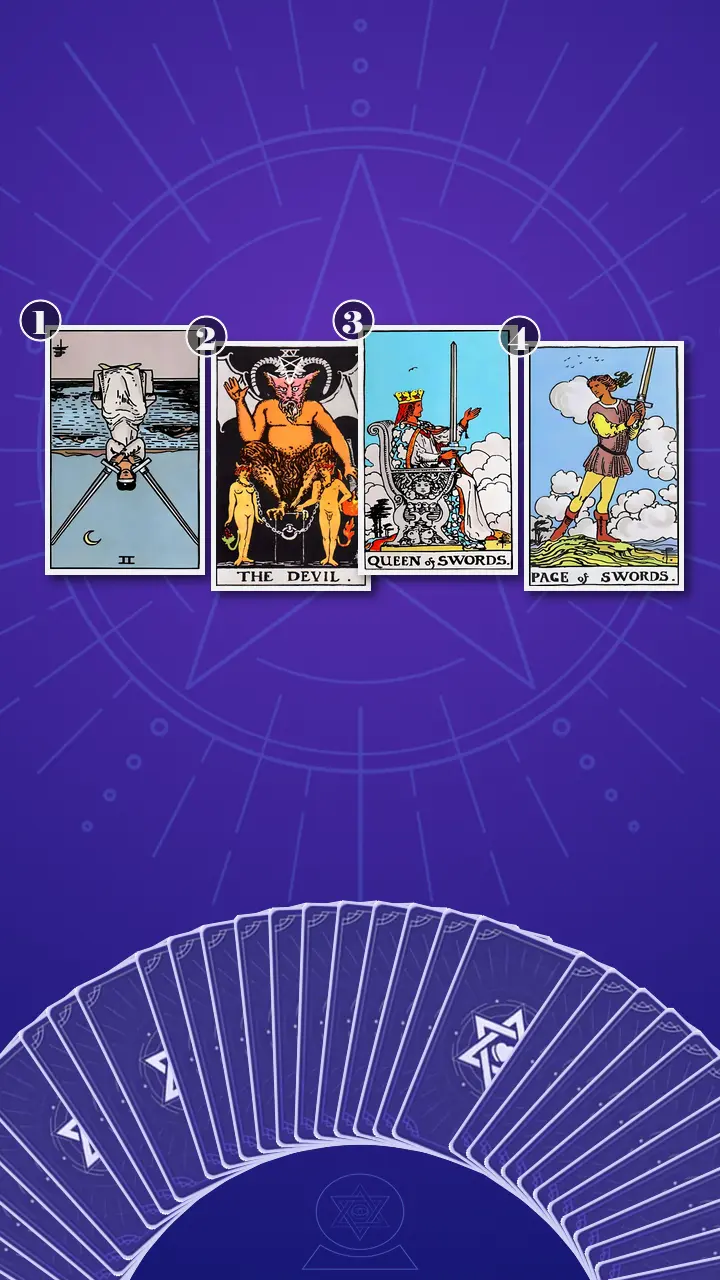
I placed four cards from left to right. The first position would show the present pattern, or the shadow already visible in everyday behaviour. The second would reveal the hidden driver that made the pattern feel necessary. The third would identify the integrating insight capable of interrupting it. The fourth would translate that insight into one practical next expression.
This is how tarot works in my practice: the spread externalises a mental loop so I can examine its parts with the person sitting across from me. The cards do not issue a verdict. They create enough distance for facts, explanations, fears, and choices to stop impersonating one another.
The Blindfold, the Contract, and the Cost of One More Step
Position 1: The Shadow in Plain Sight
I turned over the card representing Jordan’s present pattern: the observable habit of seeing a red flag, rationalising it, and continuing before naming what had happened. It was the Two of Swords, reversed.
I pointed to the blindfold, the crossed swords held defensively across the figure’s chest, and the water waiting behind them. “This card does not tell me you cannot see,” I said. “It shows me that what you see gets held behind competing explanations until another action makes the decision for you.”
I brought the card directly into Jordan’s workday. At 5:42 p.m., a stakeholder’s new Teams message contradicted the project agreement from Friday. Jordan reopened both threads, wrote three reasons the change might be harmless, and accepted the new deadline before asking what had changed. The real-life card meaning was not indecision in the abstract. It was the moment when accurate information became a research project and momentum took over.
I described the reversed Swords energy as a blockage. Jordan had plenty of intelligence, but it was compressed behind selective attention and rapid rationalisation. Their mind worked like a browser with twelve explanation tabs open while the original error message remained unread underneath them. Every new tab felt productive, but the central fact remained unnamed.
Jordan gave a short laugh that carried no amusement. Their thumb stopped rubbing the edge of their mug. “That’s so accurate it’s almost brutal,” they said. “I saw the change. My internal monologue was basically, ‘I saw X, but maybe Y. I should wait for more context, so I’ll just do Z for now.’”
“Then we won’t turn that recognition into another reason to judge you,” I replied. “We’ll use it. The question in this position is simple: what camera-observable fact are you refusing to name before you take another step?”
Jordan looked away from the screen and let out a slow breath. “The deadline changed after I agreed to the original scope,” they said. I noticed how different that sentence sounded from the explanations around it. It was smaller, cleaner, and far less exhausting.
Position 2: The Auto-Renewing Contract
I turned over the card representing the hidden driver beneath the pattern: what continued forward motion protected Jordan from having to admit. It was The Devil, upright.
I kept my interpretation grounded. “I’m not reading this card as proof that another person is evil or that a situation is destined to trap you,” I said. “The useful image is the loose chain. It shows how an attachment can feel compulsory even when the next commitment is still technically a choice.”
Jordan had already described the modern version of that chain. On Sunday night, they had totalled the hours, favours, money, and hope invested in an arrangement that no longer matched its original terms. Pausing seemed capable of converting every previous investment into proof that they had chosen foolishly, so they sent one more reassurance message. The immediate reward was a few minutes without shame. The longer-term cost was another exit that felt less available.
I read The Devil’s energy as an excess of attachment that created a blockage in autonomy. Time, money, trust, and emotional labour had become clauses in an auto-renewing contract Jordan had never consciously signed. Nothing formally required the next payment, but each previous payment was being mistaken for consent to continue.
The card took me back, briefly, to my years on Wall Street. I remembered watching intelligent people defend a position because closing it would make the loss visible. The entry price could explain how they arrived there, but it could not improve the future risk-benefit profile. A market did not refund pride because someone stayed longer. Present conditions still had to justify present exposure.
I call the lens I used with Jordan Sunk Cost Neutralization: I separate past investment from the opportunity cost of the next decision. I do not pretend that the past meant nothing. I simply refuse to let money, effort, or hope already spent impersonate a reason to spend more.
“Past effort is context, not a contract,” I told Jordan. “If you paused this commitment now, what are you afraid the investment would seem to say about you?”
Their fingers tightened around the mug, then released. Their gaze lost focus for a moment, as if they were replaying several old conversations at once. “That I should have known,” they said quietly. “That I let it get this far because I’m not as perceptive as I think I am.”
I let the silence hold without turning it into drama. “So the pressure to continue is not only about the external situation,” I said. “It is also an attempt to keep your past self out of court. That is why a pause feels heavier than one more commitment.”
When the Queen’s Blade Turned Clarity Into a Verb
Position 3: The Boundary That Is Not a Verdict
A streetcar bell sounded faintly through Jordan’s window as I reached for the third card. Then the room seemed to settle around the single pool of lamplight on my table. I turned over the card representing the integrating insight and transformation key: the Queen of Swords, upright.
I traced the Queen’s upright sword and her open left hand. The sword offered precise naming; the open hand left room for accurate new information. Together, they showed discernment without punishment. I read this as balanced air energy: thought no longer blocked, distorted, or recruited to defend a previous investment.
“The Queen does not ask whether the warning is dramatic enough to justify a prosecution,” I said. “She asks whether the behaviour you observed fits the values governing your time, trust, access, and effort. Her boundary does not have to diagnose the entire person or situation. It only has to govern what happens next.”
I gave Jordan the modern-life version: “The scope changed twice without acknowledgement. Predictability matters to me. Before I commit to Friday, I need confirmation of the final scope.” I watched them read the three lines I placed in our shared note: What happened. What value it touches. What I need to ask or limit.
I returned to Sunk Cost Neutralization here because the Queen was the card that made the analysis actionable. I asked Jordan to remove the historical investment from the next-step column for one minute. The strategic question was no longer, “How do I make the old choice come out right?” It became, “Given current evidence, what does the next unit of time, trust, or effort realistically buy?” That shift did not erase the past. It stopped the past from setting the price of Jordan’s future.
I watched Jordan mentally return to the Tuesday commute: the blurred Teams thread, the tightening chest, the thumb hovering over “Accept.” Their mind had offered only two options: continue and preserve self-image, or pause and confess failure. The Queen introduced a third reality: pausing could be competent use of new information.
You do not need to keep proving that a choice was right; raise the Queen of Swords' blade, name what is true, and let a clear boundary guide the next step.
Jordan’s breath stopped. Their fingers remained suspended above the mug, and their eyes stayed fixed on the card as if the sentence had interrupted a replay running behind them. Their pupils widened; then the muscles around their mouth pulled tight. A faint redness rose beneath their eyes, but their shoulders did not release yet.
“But doesn’t that mean I’ve been wrong this whole time?” they asked. The words came out sharper than anything they had said before, carrying a flash of anger beneath the hurt. “I could have stopped earlier.”
“It means you have new evidence now,” I said. “I won’t ask your present self to punish your past self for not having today’s clarity. Revising a choice is not an admission that you were foolish. It is evidence that your judgment is still active.” Their fist slowly opened against the tabletop. Their shoulders dropped, followed by a shaky exhale from deep in their chest. For a second, relief crossed their face; then I saw the slight blankness that can follow when a burden disappears and responsibility becomes visible. The path was clearer, but now Jordan knew they were free to choose it.
“Now, with this new perspective, think back to last week. Was there a moment when this insight might have made you feel different?” I asked.
Jordan looked down. “Friday,” they said after a pause. “I didn’t need to decide whether the stakeholder was unreasonable. I only needed to say the agreement had changed and ask which scope was real. I could have paused before accepting the deadline.”
I placed one more sentence in the shared note: A red flag is evidence to examine, not a verdict on your intelligence. You can revise the next step without putting your past self on trial.
I named the crossing I had just witnessed. Jordan was moving from apprehensive, sunk-cost-driven forward motion toward evidence-based self-trust, direct communication, and values-aligned boundaries. It was not a total transformation or a promise that every future decision would feel easy. It was the first honest separation between a fact and the shame attached to changing course.
Position 4: One Fact in the Wind
I turned over the final card, representing the practical next expression of the insight: the Page of Swords, upright.
I drew Jordan’s attention to the raised sword, the Page’s watchful posture, and the windblown clouds. “The Page is an investigator of the present, not a prosecutor of the past,” I said. “This card asks for one observable fact and one focused question before another promise.”
I described the scene I wanted Jordan to test. The next time a mismatch appeared, they would open a private note before opening the group chat. They would record the exact statement or action, leave the motive blank, and ask one verifiable question such as, “Is this change now expected going forward?” Only then would they decide whether to make another commitment.
I read the Page’s energy as balanced curiosity with a clear overuse risk. In balance, curiosity gathers enough information to support choice. In excess, it becomes Reddit searches, screenshot analysis, saved TikToks, and an endless case file about motives. “Curiosity needs a limit,” I told Jordan, “or it becomes another way to postpone the choice.”
Jordan picked up their phone, opened Notes, and typed a heading while I watched. “One fact, one question,” they read aloud. Their voice was still soft, but it no longer sounded as though they were asking permission.
The Next 72 Hours: A Boundary Without a Verdict
I read the four cards back as one coherent sequence. The reversed Two of Swords showed the visible behaviour: Jordan noticed the warning but held it behind competing explanations until momentum chose for them. The Devil revealed why: continuing protected them from the shame of revising a choice after time, trust, or money had been invested. The Queen of Swords restored accurate language and independent judgment. The Page of Swords converted that judgment into a small test of current reality.
I returned to the image of a traveller passing a warning sign. Jordan’s blind spot was not a lack of perception. It was the belief that turning around to inspect the sign would transform it into a verdict on the whole journey. Their intelligence had therefore been used to reroute around the warning without asking whether the destination still matched their values.
The transformation direction was precise: move from proving that a previous choice could still work to pausing, naming current evidence, and choosing the next step from current values. Jordan did not need perfect certainty, and they did not need to prove anyone entirely wrong. They needed sufficient clarity for the next boundary, question, or change in access.
I used my 3rd-Option Leverage Test because Jordan’s nervous system kept presenting only two dramatic options: continue unchanged or end everything immediately. The hidden third option was a structured pause that reduced exposure, gathered one useful fact, and preserved Jordan’s authority over whatever came next.
- The Seven-Minute Current-Evidence Check On the next mismatch, set a seven-minute timer and open a private note with two headings: “What I directly observed” and “What I am explaining.” Write one sentence under each. Add three short lines: “I observed…,” “This matters because I value…,” and “Before I continue, I need to ask or decide….” Tip: One sentence does not have to capture the whole context. Use one camera-observable fact, one value word, and one question or limit.
- The 24-Hour No-New-Commitment Window Choose one non-urgent Teams message, email, invitation, or personal plan this week. Instead of accepting immediately, reply: “I need a little time to check my capacity and the details. I will reply by [specific time].” Put a reminder in your calendar and reread your factual observation before responding. Tip: The pause is neither punishment nor a promise to leave. If 24 hours is impractical, use three minutes or request a realistic reply time.
- The 3rd-Option Leverage Test Over 72 hours, map three paths for one current commitment: A, continue unchanged; B, withdraw immediately; C, pause, reduce scope or access, and ask one verifiable question. On day one, record one fact. On day two, name the value and question. On day three, choose the smallest reversible next move that protects the value. Tip: The third option is not automatically a compromise. It is a controlled test. Cap the exercise at ten minutes a day so analysis does not become another explanation loop.
I also made the limits explicit. If a situation involved safety, housing, employment power, discrimination, coercion, or access to essential resources, I would not treat direct confrontation as the default. The same clarity could support a private note, a lower-risk channel, documented communication, or appropriate professional support. A boundary is meant to protect agency, not demand unnecessary exposure.

A Week Later: The Quiet Proof
A week later, Jordan messaged me: they had sent the scope question, slept through the night, and still woke thinking, “What if I’m wrong?” This time, they smiled, checked the documented reply instead of putting their worth on trial, and made breakfast before deciding.
The stakeholder had confirmed that the scope had changed and agreed to move the deadline. The reply did not solve every tension on the project, and Jordan still felt a small jolt before opening Teams. What had changed was simpler: they no longer needed to erase the jolt by accepting something immediately.
For me, that was the Journey to Clarity in its most honest form. Jordan did not receive perfect certainty or a prediction about how anyone else would behave. They found enough clarity to name one fact, protect one value, and make one deliberate next move.
I did not see the cards save Jordan. I saw Jordan use the four-card Shadow Spread as an objective map and then create the change themselves: from sunk-cost-driven momentum toward evidence-based self-trust, direct communication, and a values-aligned boundary. Tarot offered perspective. Jordan remained the author of the decision.
I know how heavy the original moment can feel: your chest tightens at a mismatch while your hand still hovers over “Accept,” because pausing seems capable of turning one imperfect choice into a verdict on your worth. I would keep the Queen’s open hand beside her blade as the anchor from this reading: precision without punishment, and truth without a demand for perfect certainty.
If the red flag in front of you were information rather than a verdict on your judgment, what is the smallest fact you could name and the one question you would hold before taking one more step?