Nobody Asked for Friday: How a Promise Became a Twenty-Minute Test

When the Gut Says Wait and the Calendar Says Friday
I met Morgan (name changed for privacy), a 29-year-old hybrid product designer in Toronto who could turn one vague Slack request into a Friday deadline before the next stand-up, then spend the week wondering why “bias for action” felt so much like self-abandonment.
At 10:47 p.m. on a Tuesday, my video window showed Morgan at the kitchen table in their small apartment. Blue calendar light washed across their face. The laptop fan hummed beside a mug of cold tea, and their fingers kept moving between Google Calendar and Slack while their shoulders pulled subtly away from the screen. Three work blocks were already in place. A message promising a first draft by Friday had just been sent.
“Nobody asked for Friday,” Morgan said, rubbing one thumb against the edge of the mug. “I offered Friday so I couldn't change my mind. My gut says wait, but my calendar says prove it.”
They described the sensation before sending the message as a metronome strapped beneath the ribs, clicking faster until even a harmless pause felt physically out of time. The commitment had quieted that beat for about ten minutes. By Thursday, they already knew their jaw would be tight and the private question would return: “Why did I make this urgent?”
“I keep calling urgency ambition because it sounds better,” they said. “If I stop moving, I might have to admit I don't want this yet.”
I told Morgan I was not going to treat their hesitation as laziness, a prophecy, or proof that the opportunity was wrong. The quiet “not yet” might be discernment, fear, fatigue, incomplete information, or some mixture of all four. Our work was to keep it visible long enough to find out.
“Let's give this pressure a map,” I said. “We are not asking the cards to choose for you. We are looking at what happens between the first gut signal and the moment your hands make pausing impossible.”

Choosing the Compass: A Five-Card Shadow Spread
I asked Morgan to close the planning apps, place both feet on the floor, and take three ordinary breaths. I shuffled slowly while they held one question in mind: “Why do I force progress when my gut says not yet?” The breathing and shuffling were not supernatural theatre. They created a clean transition from reacting to observing.
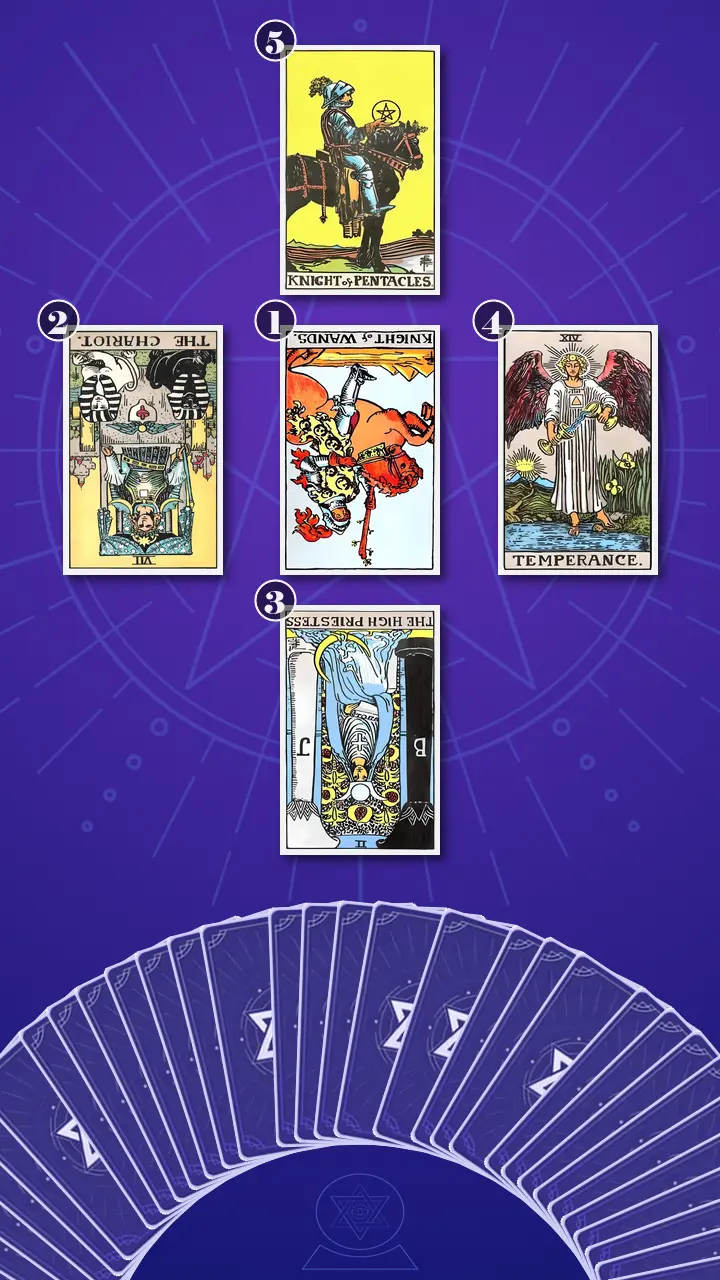
I chose a five-card Shadow Spread because the problem was not a simple choice between “go” and “stop.” It was a repeating internal sequence. This spread could separate the visible rush, the protective need for control, the mistrusted inner signal, the capacity that could integrate those forces, and the grounded practice that might replace the loop.
For anyone wondering how tarot works in a decision like this, I use card meanings in context rather than treating images as fixed predictions. The first position would show what Morgan visibly did when their gut said “not yet.” The second would reveal the hidden control strategy beneath that behaviour. The third would uncover why subtle internal information became so easy to overrule. The fourth would offer the bridge between intuition and evidence, while the fifth would translate that insight into a repeatable next step.
I placed the cards in a cross. The arrangement resembled a compass whose needle had been pulled away from usable north: haste at the centre, control to the left, silenced inner information below, integration to the right, and grounded movement above. Nothing in that map could command Morgan's future. It could only make the present mechanism easier to see.
Reading the Route from Unstable Fire to Solid Ground
Position 1: The Message Sent to Make Uncertainty Stop
“The card I'm turning now represents the observable forced-progress behaviour that appears when your gut says 'not yet,'” I said. I revealed the Knight of Wands, reversed.
The rearing horse looked like Morgan's body in the seconds before the Slack message: hands already moving while the chest and shoulders pulled back. The raised wand carried real initiative, but reversed, that fire had tipped into excess. It was action moving faster than reflection, capacity, or settled direction.
I brought us back to 10:47 p.m. Morgan had felt the heavy signal, opened Google Calendar instead of closing the laptop, scheduled three work sessions, and promised a Friday draft nobody had requested. The inner script beneath the motion was painfully efficient: “I do not know whether I want this yet, but I can at least prove I am moving.”
“The card is not criticising your ambition,” I said. “Your initiative is real. The problem begins when you use that initiative to eliminate the discomfort of an unanswered question. Movement brings relief, but relief is not necessarily direction.”
Morgan gave one short laugh, then winced at the sound of it. “That's so accurate it feels almost cruel.” Their fingers froze against the mug, their gaze returned to the sent message, and then their mouth softened into a tired half-smile.
I slowed the reading down. “Recognition can sting, but this is not an indictment. That fast plan has been doing a job for you. It turns a shapeless pause into something you can see and manage. We are only checking what that strategy costs after the first ten minutes.”
Position 2: The Polished Plan with No Agreed Direction
“The card I'm turning now represents the hidden control strategy that converts uncertainty into artificial urgency and external commitment,” I said. It was The Chariot, reversed.
The black and white sphinxes became two browser tabs that could not be merged. One read “ship it now.” The other read “not enough information.” The charioteer held no visible reins, yet the armour and vehicle projected control. Reversed, the Chariot showed blocked coordination: willpower was being asked to force two honest but conflicting signals into one performance of certainty.
I connected it to a familiar work pattern. Morgan would receive an ambiguous redesign request and build a detailed Jira plan before confirming the problem, scope, decision-maker, or real deadline. The plan looked composed from the outside. Inside, the reasons for pursuing it and the bodily resistance to it still pulled in opposite directions.
“It has a little of the work-self split in Severance,” I said. “The visible operator keeps producing clean tickets and confident timelines while the quieter self has not consented to the direction. If the plan becomes detailed enough, maybe you will stop noticing that you are split.”
The reversal indicated blockage rather than weak drive. Morgan had plenty of force. The force simply could not create alignment by itself. A full calendar could hide an unresolved direction, just as colour-coding a Notion dashboard could make a question look organised without answering it.
Morgan's knee stopped bouncing beneath the table. Their chest held still for a moment, and they looked away from the cards toward the dark window.
“I thought control meant being able to make myself execute,” they said. “I didn't think it might mean being able to leave something open without falling apart.”
Position 3: The Signal That Could Not Produce a Business Case
“The card I'm turning now represents the root of the split: why you mistrust or talk over subtle internal information,” I said. I revealed The High Priestess, reversed.
The partly concealed scroll in her lap resembled an early user-research note: incomplete, not automatically conclusive, but too relevant to delete. The veil behind her marked information that could not be forced into total visibility on demand. Reversed, her receptive energy was blocked. The intuition had not vanished; it was being required to submit a complete business case within seconds.
I asked Morgan about the last invitation that had produced a bodily hesitation. They remembered reading a side-project message on the Line 1 train. The phone had felt warm in their palm, the rails had squealed around a curve, and their stomach had contracted before they could explain why. They had immediately searched for decision frameworks, opened Reddit, and texted two friends. By the time they reached their stop, the first signal had been buried beneath other people's language.
“The shift here is precise,” I said. “Intuition is information, not an order and not an inconvenience. You do not have to obey 'this feels premature.' You also do not have to erase it because it arrived without citations. Record it before analysis changes its wording, then compare it with reality.”
Morgan inhaled, held the breath briefly, and let it out through parted lips. Their hand hovered over the trackpad without opening another tab.
“So I don't have to decide whether my gut is correct before I'm allowed to hear it,” they said.
“Exactly,” I replied. “The signal can be incomplete and still belong in the decision.”
When Temperance Changed the Tempo
Position 4: Two Cups for Finding Calibrated Clarity
The rain against Morgan's window thinned as I reached for the fourth card. At almost the same moment, the laptop fan clicked off. The sudden quiet did not feel mystical; it simply made room for us to hear the next sentence without competing noise.
“The card I'm turning now represents the key integration that allows intuition and practical reality to inform each other without forcing immediate certainty,” I said. I revealed Temperance, upright.
The angel poured water between two cups, keeping distinct sources in active relationship. One foot rested on land and the other in water. Upright, this was balanced energy: not passive waiting, not impulsive trust, and not another argument designed to overpower the body. It was proportion, comparison, and adjustment.
I pictured a phone note with the gut signal in one place and observable facts beside it. Before answering a non-urgent request, Morgan could write the exact inner message, two facts about capacity and the real deadline, and one genuine unknown. After a bounded pause, they could choose a limited experiment that both the inner signal and external conditions could support.
Over ten years of sound-energy research, I have learned to listen for the moment effort loses its workable rhythm. Looking at the water passing between the cups, I used what I call a Tempo Misalignment Audit. I traced Morgan's sequence as a series of beats: a subtle contraction arrived; the planning app opened; their executive tempo doubled; a public promise locked that speed in place; resentment appeared when daily capacity could not sustain the imposed BPM.
The audit revealed that Morgan was not pushing against a wall because they lacked discipline. Their ambition and execution rhythm were out of sync. They were trying to play the commitment at launch tempo while their information was still in rehearsal. The necessary adjustment was not to become permanently slower. It was to insert one deliberate rest beat before the non-urgent yes, then let the available evidence set the next tempo.
I asked Morgan to return to 10:47 p.m.: jaw tightening over a voluntary project, calendar opening, three sessions appearing, an unrequested Friday promise leaving their hands. Their familiar thought was already running: if the plan became real fast enough, the split inside would stop being visible.
I said, “You do not need to outrun uncertainty. Let your gut signal and the available facts share the same page, then make only the smallest move that both can support.”
Waiting is not failed progress; let intuition and evidence pour into one measured next step, as Temperance joins water between two cups.
For one beat, Morgan stopped breathing. Their fingers hung above the mug, and the small crease between their eyebrows held. Then their gaze slipped off the card and went unfocused; I could almost see the replay: calendar blocks, sent message, ten minutes of relief, Thursday resentment. Finally, their fist opened against the tabletop, their shoulders dropped, and a breath left them with a tremor. Their eyes shone, but their first words were sharp: “But doesn't that mean I was wrong every time I pushed?”
“No,” I said. “It means speed was serving a protective function. It gave you control before it gave you alignment. We can respect what it tried to do without letting it run every decision.”
I let the silence settle, then asked, “Now, with this new perspective, think back over last week. Was there a moment when this insight could have made you feel different?”
“Tuesday,” they said, almost inaudibly. “I could have waited until morning. Nobody needed Friday.”
The relief was real, but so was the brief blankness after it: without the old pressure, choice belonged to them again. They looked a little unsteady, like someone stepping off a moving walkway onto still ground.
I named the crossing we had just witnessed. This was not complete certainty. It was the first move from compressed urgency and control-seeking overcommitment toward calibrated patience, proportionate action, and steadier self-trust. Morgan did not have to prove that every pause was wise. They only had to stop treating every pause as failure.
Position 5: The Still Horse and the Reversible Next Step
“The card I'm turning now represents the smallest grounded practice for replacing forced progress with sustainable, reviewable movement,” I said. I revealed the Knight of Pentacles, upright.
The still dark horse answered the rearing horse from the first card. The Knight held one pentacle steadily at eye level while cultivated fields stretched behind him. Upright, the Earth energy was balanced: practical, consistent, and willing to let evidence accumulate before expanding a commitment.
I translated the card into Morgan's side project. Instead of promising a launch or building a complete delivery schedule, they could set one two-hour prototype session, choose a fixed stopping point, and record what the session revealed about interest, workload, and timing. If two hours felt too large, the valid version was twenty minutes or one Figma screen. The scope mattered more than the drama.
“I am allowed to learn from one contained step before I expand the commitment,” I said. “Scope can create safety where speed only creates relief.”
Morgan unlocked their phone, removed two of the three calendar blocks, and changed the remaining one to twenty minutes. Their thumb paused before saving it, but this time the pause stayed available. They saved the smaller block without sending anyone a new promise.
The Compass Was Never Broken
When I read the spread as one continuous story, the pattern became coherent. Repeated bursts of action had taught Morgan that a deadline could relieve the physical pressure of uncertainty. The Knight of Wands showed that relief becoming visible haste. The reversed Chariot revealed the control strategy beneath it: if Morgan could make the plan look settled, perhaps the competing signals would stop feeling dangerous. The reversed High Priestess showed the quieter cost, an inner signal talked over before it could be described. Temperance restored communication between intuition and reality, and the Knight of Pentacles gave that communication a body: one bounded action, one stopping point, and evidence before expansion.
The compass had not failed. Urgency had pulled its needle off course, and Morgan had been responding by pressing the accelerator while the navigation system was still recalculating. That produced movement, but it also produced U-turns, rework, and commitments they later had to shrink or withdraw.
I named the cognitive blind spot directly: Morgan had been treating speed as evidence of control and a pause as evidence of poor judgment. Yet the fast plan often regulated discomfort rather than clarified direction. Their next shift was not from action to inaction. It was from forced motion to calibrated progress: pause when the choice was genuinely non-urgent, preserve the gut signal, verify present facts, and select the smallest reversible next step.
The Syncopation Reset: Three Days to Restore a Workable Beat
I shaped the actionable advice into my Syncopation Reset, a three-day tempo adjustment experiment. Each day introduced one smaller beat where Morgan's old routine had rushed directly from hesitation to commitment. The experiment was not a new productivity system to perform perfectly. It was a short way to test whether a different rhythm reduced resentment and unnecessary rework.
- Day 1: Ask for the Real Deadline. For one non-urgent Slack, email, or side-project request, do not create a private due date. Ask, “When do you actually need a decision?” Then send a capacity-check reply such as, “Thanks for thinking of me. I want to check scope and capacity, and I can confirm by 3 p.m. tomorrow.” Tip: Save the reply as a phone text replacement called “pause.” If 24 hours is unavailable, use twenty minutes or one commute. The buffer serves discernment; it is not another rigid rule.
- Day 2: Put Both Cups on One Page. Set a five-minute timer and open one note for a low-stakes decision. Write four single-sentence lines: “My signal says...,” “Fact 1...,” “Fact 2...,” and “Unknown....” Stop when the timer ends, without searching, polling friends, or deciding the final outcome. Tip: If the gut message has no words, record a body fact such as “jaw tight” or “chest pulling back.” Review the note after one night's sleep and circle only what remains true.
- Day 3: Test Scope Before Speed. Choose one active project and run a fixed twenty-minute prototype session without attaching a delivery promise. Before starting, write one review question: “What will this test reveal about my interest, capacity, or timing?” Stop at twenty minutes and record three observable results. Tip: Wait until the next day before adding another session. The right to stop at the agreed endpoint is part of the experiment, not a sign that the work failed.
I reminded Morgan that an urgent or high-stakes situation might not allow a full pause. In that case, they could use the facts available and make the most proportionate choice possible. The purpose was to increase agency, not to transform waiting into a purity test.
“The cards have not decided whether you should do the project,” I said. “They have shown you how to stop making the decision before you have actually made it. You still choose the project, the pace, and the boundary.”

A Week Later: The Quiet Proof
Six days later, I received a message from Morgan. An optional workshop request had arrived in the lift at work, and their hand had begun typing an immediate yes. They used the saved holding reply instead, asked for the actual deadline, and waited until the next afternoon.
During the review window, Morgan wrote one gut signal, two facts, and one unknown. Their internal message was not “never.” It was “not at the current scope.” They offered to design one workshop exercise rather than own the entire event. Their colleague accepted without protest.
That night, Morgan slept through until morning. Their first thought was still, “What if I'm wrong?” They told me they smiled, left the smaller scope unchanged, and made coffee before opening Calendar.
I did not read that message as proof that pausing would always produce the right answer. I read it as something more useful: Morgan had tolerated an unfinished decision, compared intuition with reality, and acted without abandoning either. The cards had provided a mirror and a structure. Morgan had supplied the discernment, boundary, and choice.
When your gut says “not yet” and your hands reach for the calendar anyway, the tight jaw and sudden deadline may be the cost of trying to feel in control before you feel aligned. Noticing that first beat already changes your relationship to the whole rhythm.
If a pause could hold information rather than erase momentum, what is the smallest possibility you would let remain tonight in the living space between Temperance's two cups?