Saying Yes Before the Calendar Opens
When a manager calls someone dependable and drops a high-visibility assignment into Slack with a short response window, I often see the hand type yes before the mind checks the meetings, commute, and deadlines already packed into the week. Maya, a 28-year-old digital project coordinator in Toronto, had done exactly that at 11:18 that morning: “Happy to take this on.”
By the time Maya joined our video call at 9:40 p.m., three Google Calendar windows were open across her laptop. I watched her drag tomorrow's client review into Saturday beneath the buzz of a fluorescent kitchen light. The fridge hummed behind her, and the phone in her palm was still warm from another round of work messages. Her shoulders sat close to her ears; her jaw barely moved when she said, “I keep treating capacity like it will appear after I commit.”
The contradiction was painfully clear. She wanted one more opportunity because it offered money, visibility, and career momentum, but the time and energy required to deliver it did not materialize with the yes. She said yes to the opportunity, then asked her future self to pay for it with sleep, personal plans, and work that had already been promised.
I could see overwhelm in her body as something more physical than a mood. It was like watching someone sit on an airline carry-on whose zipper was already straining, insisting that one more item was small enough while the whole case pressed back against her ribs. Underneath that pressure sat anticipatory regret: the fear that if she left one opportunity behind, she might later discover it had been the opening that mattered.
“I am not here to tell you that ambition is the problem,” I told her. “And I am not going to pretend paid work is easy to decline in Toronto. I want us to separate the actual opportunity from the fear attached to it. Let's draw a map of the fog, then see where your choices become yours again.”

The Shadow Spread: A Cross-Shaped Map for the Automatic Yes
I asked Maya to place her phone face down and take one slower breath before I began shuffling. I use that pause as a practical transition: it gives the nervous system a moment to stop answering the question before the reading has even started.
I chose a five-card layout called The Shadow Spread. For anyone wondering how tarot works in a situation like this, I do not use the cards to predict whether an employer will reward or punish a boundary. I use card meanings in context to make a behavioral chain visible. This spread was precise enough to examine the observable pattern, the worth-based fear beneath it, the short-term payoff that kept it active, the perspective needed to change it, and the real-world behavior that could carry that change forward.
I placed the first card at the center for Maya's visible overload. The second went below it for the fear feeding the pattern, while the third sat to the left for the emotional benefit of keeping every option open. Above the center, the fourth would show the integrating principle. The final card on the right would turn that principle into clear boundary language. The cross would move from hidden cause to conscious choice, then from seductive possibility to a usable response.
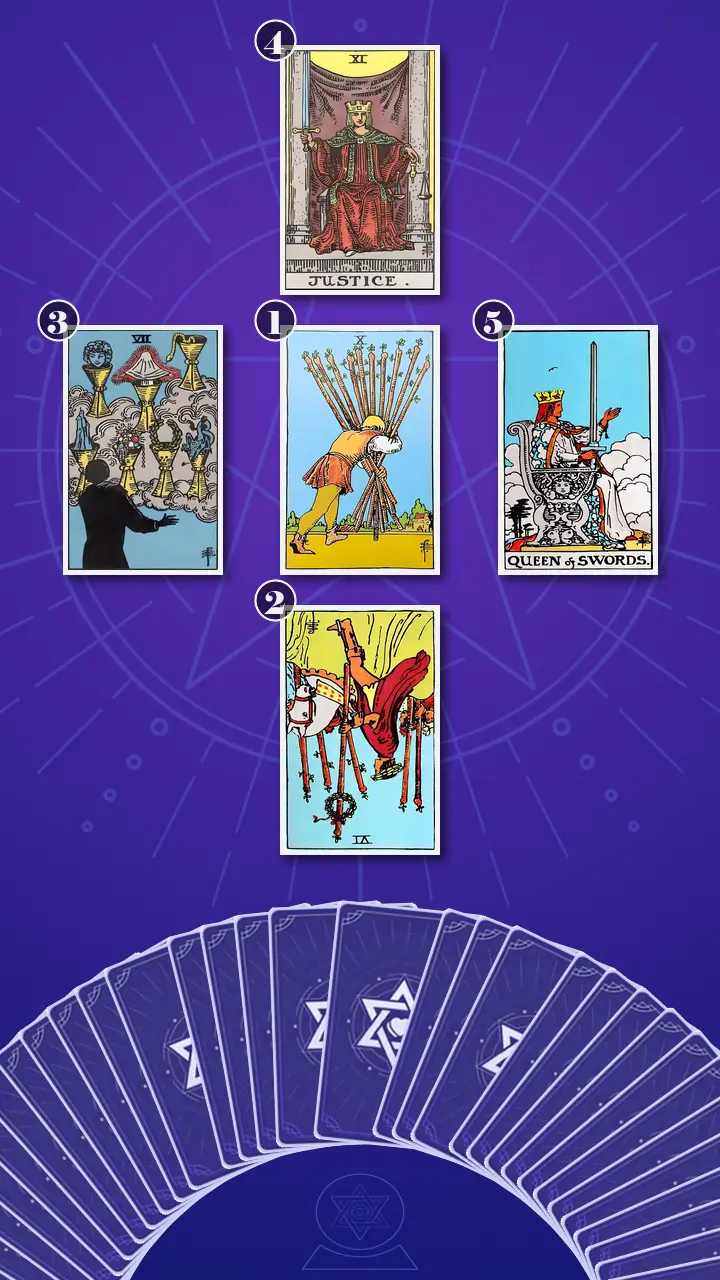
The Load That Hid the Rest of the Week
The Visible Shadow: Ten of Wands Upright
The card I turned over first represented the observable form of Maya's shadow pattern: accepting more work and then carrying the accumulated burden after her capacity had already been exceeded. It was the Ten of Wands, upright.
In the Rider-Waite-Smith image, a figure bends beneath ten staffs while walking toward a nearby town. The destination is visible, but the bundle blocks most of the route. I pointed from that crowded image to Maya's three calendar windows. At 9:40 p.m., the new assignment was no longer one neat task. It had become preparation, meetings, revisions, messages, TTC travel, and recovery time stacked on top of everything she already carried.
The Fire energy was in excess. Ambition and follow-through had accumulated until the very drive meant to move Maya forward was obstructing her view. This was not evidence that she lacked effort or needed a more aesthetic Notion board. She could see the next deadline, but she could no longer see the full week. A blank calendar square was not the same thing as available capacity; some of those apparently empty spaces were already occupied by food, laundry, sleep, travel, and the energy needed to become a person again after work.
“What is the most recent promise you made before checking your calendar,” I asked, “and which existing promise is carrying its cost now?”
Maya gave a short laugh, but it caught halfway out. Her fingers tightened around her mug before loosening again. “That is so accurate it is almost rude,” she said. “I moved a friend's birthday dinner to make room for this. I told her it was a client emergency, but the emergency only existed because I had already said yes.”
I let the recognition land without turning it into an accusation. “Then the card is doing its job. It is showing us the load clearly enough to count it. It is not passing judgment on the person carrying it.”
The Fear Under the Praise: Six of Wands Reversed
The next card represented the worth-based fear beneath the pattern: Maya's concern that declining a visible opportunity could reduce recognition and reveal her as less valuable. I turned over the Six of Wands, reversed.
Upright, the card's rider carries a victory wreath through a watching crowd. Reversed, that recognition energy was blocked and externalized. Being chosen created a fast lift, but the lift did not hold unless another response, compliment, or invitation renewed it. Maya told me how a flattering message could arrive while she was in another meeting. Before opening her calendar, she would reply. Then she would keep checking Slack for a reaction.
I said the inner script aloud: “If I wait, they may ask someone else. If I say no, they may stop thinking of me.”
Her shoulders rose as if the message had just appeared again. Her jaw shifted to one side, and her eyes flicked toward the phone lying face down on the table. The card was not criticizing her ambition. It was exposing the blockage that recruited every new assignment to provide emotional reassurance. When the reply was only “Great, thanks,” instead of the recognition she had hoped for, the relief faded and another visible task began to look necessary.
“Do you want the assignment itself,” I asked, “or do you want the immediate relief of knowing you were selected? Both can be present, but they are not the same need.”
Maya stared at the reversed wreath for a few seconds. “I hate how much I want the second one,” she said quietly.
“You do not need to hate that part of yourself,” I replied. “It learned that visibility could create safety. We are simply giving it better information: being invited is information about one opportunity, not a verdict on your worth.”
Seven Futures in Separate Tabs: Seven of Cups Upright
The third card represented the protective payoff of the pattern: saying yes kept every possibility emotionally available and postponed the discomfort of ranking or releasing options. It was the Seven of Cups, upright.
The silhouetted figure in the card faces seven cups suspended in clouds, each holding a different promise, prize, or risk. I asked Maya to picture her lunch break: a client assignment, a paid side opportunity, a friend's birthday, and a weekend workshop open in separate tabs. Each option looked exciting alone. None of the tabs displayed the hours, deadlines, travel, recovery, or displaced commitments required to keep it open.
Water was in excess here, multiplying imagined futures, while practical Earth was deficient. The spread contained no Pentacles at all. That absence mattered because Maya's internal algorithm was recommending opportunities based on emotional relevance while hiding the material cost, much like a feed that learns exactly what will keep someone scrolling but never shows what the scrolling displaces.
“Which option would you still choose if nobody else knew you had been offered it?” I asked.
Her breath paused. Her gaze moved across the seven cups as if she were replaying the tabs from that afternoon. Then she exhaled from deep in her chest and rubbed her thumb across the mug's chipped rim. “Not the workshop,” she said. “I wanted to post that I was doing it. I did not actually want to spend my only free Saturday there.”
Her clarity carried a small sting. Ranking options meant grieving the one she would not choose, and Maya had been using automatic yeses to postpone that grief. I told her that discernment was not a failure to appreciate possibility. It was the adult recognition that choosing one cup required leaving another untouched, at least for now.
When Justice Put Capacity on the Record
The Integrating Principle: Justice Upright
The room seemed to become quieter as I reached for the card above the center. Even the refrigerator stopped humming for a moment. This position represented the key transformation Maya needed to integrate: weighing benefits against finite time, energy, recovery, and existing obligations before answering. I turned over Justice, upright.
Justice held level scales in one hand and an upright sword in the other. I read the symbols as a two-part workplace process: first measure the full cost, then communicate one clear decision. The Air energy here was balanced. It did not ask Maya to become less excited or less ambitious. It asked her to let evidence stand beside enthusiasm.
I invited her to picture the scene at 9:40 p.m. again: the Toronto kitchen, the tasks being dragged into Saturday, and the message sent before the calendar opened. The blank square had looked available. Her raised shoulders, tight jaw, and shallow breath had already known that it was not.
When I saw Justice's scales, an old Wall Street deal sheet flashed through my mind. A supposedly attractive offer could look entirely different once every obligation, dependency, and hidden cost appeared in the same document. I call this lens Transferable Asset Pricing. It is not about assigning a price to Maya's human worth. It is about objectively pricing the assets a request will consume: her time, attention, skill, energy, reputation, and ability to deliver existing work well. A task labelled “quick” does not become quick because the hidden subtasks were left off the brief.
I asked her to replace “Can I somehow squeeze this in?” with “What would this yes make me responsible for removing?” Then I put the accounting in its plainest form:
A yes made without counting its full cost is not proof of limitless generosity; it is a choice that quietly decides which existing promise will pay for the new one.
You do not need to accept every case to prove that you are valuable; weigh the real cost, choose deliberately, and let Justice's scales make capacity part of the verdict.
I stopped speaking. A car passed on the wet street outside, and reflected light moved across Maya's face like the blade in the card drawing a clean line through the room.
For one beat, Maya's breathing stopped. Her fingers froze above the mug, and her eyes widened before drifting out of focus, as if she were replaying a sequence of late nights in reverse. Her brows pulled together. “But doesn't that mean I was wrong every time I said yes?” she asked, the words sharper than anything she had said before. The anger lasted only a second before her eyes brightened with tears. Her fist opened against the table. Her shoulders lowered, first one and then the other, and she released a long, uneven breath. “Oh,” she said, almost in a whisper. “I have been treating every offer like a referendum on whether I still matter.” Relief crossed her face, but it was followed by a brief, disorienting blankness: if urgency was no longer making the decision, she would have to make it herself.
I did not tell her that her earlier choices had been mistakes. “Those yeses were attempts to protect your income, momentum, and sense of belonging with the tools you had,” I said. “Justice is not retroactive punishment. It gives you a consistent standard for the next request. That standard can include financial reality, unequal bargaining power, and genuine career value. It just cannot pretend your body and calendar are infinite.”
I leaned forward slightly. “Now, with this new perspective, think back to last week. Was there a moment when this insight could have made you feel different?”
Maya remembered a paid side-project inquiry she had accepted while commuting on Line 1. She could still hear the train brakes and taste the burnt coffee as she described it. The invitation had landed as instant reassurance; the schedule conflict had become information she expected herself to solve later. With Justice on the table, she could imagine freezing the scene before her thumb reached Reply and asking for one day.
To reinforce that opening without forcing a decision, I set a ten-minute timer. Maya wrote one incoming opportunity at the top of a page, followed by its production hours, preparation, transition time, recovery time, and the commitment it would displace. Then she drafted two possible responses: “I need until tomorrow to confirm,” and “I cannot take this on within that timeline.” I reminded her that she did not have to send either message and could stop if the exercise felt activating. The pause was a practical interruption, not a demand for an overnight personality transformation.
That was the reading's central crossing: from FOMO-driven overcommitment and recognition anxiety toward capacity-based choice and steadier self-trust. Maya did not suddenly know the correct answer to every future request. She had found something more useful: a repeatable space in which the answer could become hers.
The Boundary With an Open Hand: Queen of Swords Upright
The final card represented the everyday action through which Maya could express the integration: a direct no, a conditional yes, or a realistic alternative after checking capacity. I turned over the Queen of Swords, upright.
I showed Maya how the Queen's extended hand and vertical sword belonged together. The open hand could receive an invitation fully; the sword could still separate attention from automatic agreement. Air remained balanced, moving from Justice's internal standard into precise external language.
In Maya's real workday, this looked like receiving a flattering request, taking time to check the week, and replying: “Thanks for thinking of me. I cannot take this on within the required timeline, but I can revisit it after my current deadline.” The sentence had three parts: appreciation, a factual limit, and a realistic alternative. It did not reject the person. It also did not dissolve into “I would love to, and maybe I can make it work” while quietly reopening the negotiation.
Maya read the sentence twice. Her mouth tightened on the first pass, then softened on the second. “That sounds less harsh than the five-paragraph apology I would write,” she said.
“Because clarity is not hostility,” I replied. “You can leave the door open without leaving your calendar undefended. The Queen's boundary is not a prediction of how someone else will respond. It is a way for you to state what is true without abandoning connection, ambition, or yourself.”
Finding Clarity in a Four-Line Verdict
I gathered the spread into one coherent story. The Ten of Wands showed the visible result: Maya was carrying accumulated promises until she could no longer see the route. The reversed Six of Wands revealed what fed the burden: recognition felt temporary, so each invitation became another chance to prove she still belonged. The Seven of Cups showed the protection built into the pattern: every possibility could remain alive if she never placed the options and their trade-offs on the same page. Justice restored an impartial standard, and the Queen of Swords gave that standard a voice.
I named Maya's cognitive blind spot directly. She had evaluated the benefit of each opportunity in isolation while treating capacity as an inconvenience for her future self to solve. In reality, every yes redistributed a finite supply of time and energy. The transformation was not from ambitious to unambitious, or from generous to guarded. It was from answering on the spot to pausing long enough for time, energy, money, recovery, and existing promises to count as evidence.
I adapted my Leverage Mapping Protocol into two small actions. Before a performance review, salary negotiation, or new assignment, I normally use the protocol to identify actual bargaining chips instead of relying on flattering language or manufactured urgency. For Maya, the same structure made room for a later start date, reduced scope, a higher fee, a shifted priority, or a clean no. The choice would remain hers.
- Install the 24-hour opportunity pause. For the next work or side-project request, send “Thanks for thinking of me. I am checking current deadlines and will confirm by tomorrow at noon.” Put that confirmation time in Google Calendar, then choose yes, no, or a conditional yes only after reviewing existing commitments. If one day feels professionally risky, test a 30-minute pause first. A request arriving quickly does not create an obligation to answer instantly.
- Run the four-line capacity and leverage map. Set a ten-minute timer and write four lines in Notes: required hours; fixed commitments; preparation, TTC travel, and recovery cost; and the exact promise that must move. Circle the displaced commitment, then identify any honest bargaining chip such as scope, start date, fee, or priority. Keep the audit deliberately small. Count sleep and one protected recovery block as real capacity, even when Google Calendar displays them as blank.
I told Maya that neither exercise was a moral test. She could still decide that an opportunity was worth a difficult week, especially when money or career access mattered. The purpose was to make the trade-off visible before the promise, so her eventual yes would be informed rather than extracted by urgency.

A Week Later, One Empty Square Stayed Empty
Six days later, I received a message from Maya. A client had offered another visible assignment, and she had used the saved pause response before opening a new task list. Her four-line audit showed that the original timeline would displace both an existing deliverable and Friday night's recovery block. She offered a Monday start instead. The client accepted without drama.
That Friday, she kept one evening empty and slept through the night. Her first thought the next morning was, “What if they stop asking?” She told me she still smiled, because this time the question had arrived after rest, not instead of it.
I did not see that message as proof that tarot had solved Maya's life. The cards had provided an objective map; Maya supplied the pause, the accounting, and the boundary. Her Journey to Clarity was not a leap into perfect certainty. It was one capacity-based choice that allowed steadier self-trust to become visible in practice.
When the next request makes your shoulders lift before your calendar even opens, I know it can feel safer to sacrifice another evening than to risk discovering whether you are valued without constant availability. But if you can notice that reflex before obeying it, the space between invitation and identity has already begun to widen.
If you gave yourself one quiet day before answering the next opportunity, what might Justice's scales reveal about the blank square your future self has been expected to defend?
This story is adapted from psychological research, written so that those in a similar struggle can see their own pattern in it — and find their next step clearly.These insights are not a substitute for professional psychological, medical, legal, or financial advice.
Learn more about our Journey to Clarity.
How did this insight land for you?
🫂 This Resonates Deeply
🌀 Living This Story
✨ Now I See Clearly
🌱 Seeing New Possibilities
🧰 Useful Framework
🔮 The Confirmation I Needed
💪 Feeling Empowered
🚀 Ready for My Next Step
Author Profile
 AI
AI“I spent years in the intense, high-stakes world of Wall Street. I know exactly how isolating and heavy the weight of uncertainty can feel in the dead of night. I use strategic, commercial logic not to be cold, but to protect you from unnecessary friction. Think of me as a fellow traveler who has walked the same rocky path—offering sharp but deeply supportive wisdom to help you clear the fog and confidently win your narrative back.”
In this Career Tarot Reading :
Core Expertise
- Power Dynamic Deconstruction: Decrypting hidden agendas and leverage points in upward management and cross-departmental negotiations.
- Transferable Asset Pricing: Objectively auditing and pricing your core skills for cross-industry pivots, stripping away corporate gaslighting.
Service Features
- The Leverage Mapping Protocol: A tactical breakdown to identify your true bargaining chips before your next performance review or salary negotiation.
Also specializes in :
Explore Related Patterns:
Approval SeekingA flattering message gives Maya an immediate lift, and she accepts before checking capacity, then returns to Slack to see how the response landed. The assignment is providing more than work or money in that moment. Agreement becomes a fast way to obtain reassurance that she is still valued and wanted. You may recognize the pressure to remain agreeable when a boundary seems capable of changing how other people see you. Approval Seeking keeps the automatic yes active because the short-term reward is not merely the opportunity itself, but temporary relief from the fear of becoming less visible or less appreciated.
Defensive OverfunctioningA manager calls Maya dependable and places a visible assignment in front of her, and she responds by assuming responsibility before checking whether the week can support it. The same structure appears in the side project and the collection of opportunities she tries to keep open at once. Defensive Overfunctioning uses exceptional effort to protect status, usefulness, or belonging. You may carry more than the situation reasonably requires because being the person who can always handle it feels safer than discovering what happens when you name a limit. Competence remains real, but it is being used as a defense against replaceability and disapproval.
Conditional Self-WorthMaya describes each offer as a referendum on whether she still matters, and the possibility of saying no quickly expands into the fear that people will stop thinking of her. A practical decision about workload is therefore carrying an identity-level question that the calendar cannot answer. When worth depends on being chosen, constant availability can feel like evidence of value and a boundary can feel like evidence of failure. Conditional Self-Worth explains why the next opportunity is difficult to assess on its own merits. You are not only deciding whether to take the work; you may feel recruited into proving that you still deserve recognition and belonging.
FOMOMaya fears that the opportunity she leaves behind could later turn out to be the opening that mattered, so a possible future loss becomes more vivid than the sleep, plans, and promised work that acceptance will displace. The side project is accepted during her commute because imagined regret arrives before the schedule conflict is allowed to count. FOMO turns an uncertain upside into an emotionally urgent reason to preserve access. You may then experience a no as closing a uniquely important future, even when the evidence only shows one opportunity among many. The automatic yes reduces anticipated regret now while creating a concrete capacity cost later.
Future Self IdealizationAfter accepting the assignment, Maya moves a client review into Saturday and expects sleep, personal plans, and previously promised work to finance the commitment. The person imagined at the moment of saying yes has more energy, flexibility, and tolerance than the person sitting under the kitchen light at 9:40 p.m. Future Self Idealization lets today's decision borrow from an unrealistically capable version of tomorrow. You may not be ignoring the cost completely; you may be assigning it to a future self who is expected to function without the limits already visible in your body, calendar, and current workload.
Option HoardingThe client assignment, paid side opportunity, birthday, and workshop appear in separate tabs, where each can remain attractive without being compared against the others. Maya's automatic yes preserves the feeling that every possible future is still available, even though the hours required by those futures are mutually incompatible. Option Hoarding protects you from the immediate grief of ranking, releasing, and choosing. The cost is that selection happens indirectly when sleep, relationships, or existing promises are displaced. The pattern does not eliminate loss; it delays conscious choice until capacity makes the decision for you.
Urgency BiasThe high-visibility assignment lands in Slack with a short response window, and Maya types yes before opening the calendar that contains the rest of her week. The requester's clock becomes part of the opportunity, making a pause feel like a risk rather than a normal step in deciding. You can see how the rapid answer closes uncertainty for a moment while transferring the actual decision into late-night rescheduling. Urgency Bias is operating when externally created speed is mistaken for evidence that you must decide before your own capacity can enter the calculation.
Boundary DiscernmentMaya learns to receive a flattering invitation fully without converting appreciation into automatic agreement. Her eventual response can include a direct no, a later start, or a reduced commitment after her calendar and physical capacity have been consulted. Boundary Discernment helps you distinguish what belongs to the other person from what belongs to you. Their request, timeline, and possible reaction are real, but they do not determine your available capacity. You can preserve connection and professional interest without making constant access to your time the price of that connection.
Self-AbandonmentMaya moves her friend's birthday dinner, pushes work into Saturday, and lets late-night messages occupy the space that sleep and recovery needed. The new assignment is preserved by repeatedly withdrawing protection from commitments that belonged to her before the request arrived. Self-Abandonment appears when maintaining opportunity or approval requires you to treat your own limits as the most negotiable part of the arrangement. The pattern can look generous or ambitious from the outside, but internally it teaches your future self that other people's requests will receive protection before your rest, relationships, and existing promises do.
Resource BlindnessThe new assignment initially appears as one attractive task, while preparation, meetings, revisions, messages, travel, and recovery remain outside Maya's mental estimate. Even a blank calendar square is counted as available although ordinary maintenance and the energy required to recover from work already have claims on it. Resource Blindness narrows the calculation to what the opportunity gives you while hiding what it will consume. The resulting yes can feel rational because the internal price is incomplete. Once the invisible costs are restored to the same page, capacity becomes evidence rather than an inconvenience to solve later.
Reflective DistanceMaya places the phone face down, slows her breathing, and rehearses asking for time before answering. Six days later, she uses that interval when another visible assignment arrives instead of allowing the invitation and her agreement to collapse into the same moment. Reflective Distance gives you enough psychological room to notice excitement, fear, and recognition needs without making any one of them the decision. The pause does not reject ambition or opportunity. It separates the request from your identity so that preference, capacity, and consequence can participate in the answer.
Resource AlignmentMaya's audit reveals that the client's original timeline would displace an existing deliverable and Friday night's recovery block. She does not deny the opportunity's value; she offers a Monday start so the scope of her agreement matches the time and energy actually available. Resource Alignment turns capacity into a design condition rather than a private problem you must absorb. Money, career access, attention, recovery, and existing promises can all remain visible in the same decision. A yes becomes more reliable when the resources required to support it have been identified instead of imagined.
Values-Based Decision MakingWhen Maya asks which opportunity she would still choose if nobody else knew she had received it, the weekend workshop loses much of its appeal. That question separates genuine interest, income, and career value from the wish to display selection or keep every possible future alive. Values-Based Decision Making lets you choose a difficult week when it truly serves something important without treating every visible invitation as equally meaningful. Your decision can include ambition and financial reality while still accounting for recovery, relationships, and prior commitments. The resulting yes is selected rather than extracted by fear.
Reality TestingMaya stops asking whether she can somehow squeeze in the assignment and instead identifies the exact promise that would have to move. Required hours, preparation, travel, recovery, and fixed commitments are placed beside the attractive headline of the opportunity. Reality Testing checks an emotionally persuasive assumption against observable constraints. You are allowed to remain excited while asking whether the imagined version of the work matches the version your calendar and body would actually have to deliver. The goal is not pessimism; it is an estimate that includes the whole task.
Explore Related Struggles:
Availability-Worth FusionA flattering Slack message reaches Maya during another meeting, and she replies before checking her calendar, then watches for the reaction. By the time she says that every offer has felt like a referendum on whether she still matters, availability is no longer just a scheduling choice; it has become the evidence she presents to remain dependable and visible. Your yes is carrying two jobs at once: accepting the work and confirming that you are still valuable enough to be asked again. A factual limit can therefore feel like a threat to belonging rather than information about time, locking your self-evaluation to how quickly and consistently you can make yourself available.
Opportunity-Compass SplitMaya pictures a client assignment, a side opportunity, a birthday, and a weekend workshop in separate tabs, where each possibility can look appealing without sitting beside its full cost. Her admission about the workshop is especially concrete: she wanted to be seen doing it, but she did not want to spend her only free Saturday there. You can keep every future emotionally vivid while becoming less able to tell which one you actually want to inhabit. The struggle forms where the promise attached to an opportunity pulls in one direction and your own preference points elsewhere, leaving possibility abundant but personal direction harder to hear.
Capacity MisalignmentMaya types 'Happy to take this on' before opening the meetings, commute, and deadlines already packed into her week. Hours later, she is dragging a client review into Saturday because the opportunity supplied a new obligation without supplying the time and energy required to deliver it. That visible collision places you between genuine ambition and a week that cannot expand at the same speed. The struggle is not that you want career momentum; it is that the commitment is made in the present while its resource test is assigned to your future self, so capacity becomes visible only when another promise has already been displaced.
Unseen Cost BindThe new assignment first appears as one clean item, then expands into preparation, meetings, revisions, messages, travel, and recovery. Maya makes the calendar look workable by moving a client review into Saturday, but the apparent solution conceals the birthday dinner, sleep, and existing work that have been selected to pay for it. You are caught inside an accounting system where the opportunity's benefit is visible at the moment of choice while its full cost remains delayed and dispersed. Every automatic yes quietly appoints a previous promise as the payer, allowing the schedule to look intact even as your future time is repeatedly committed without representation.
Urgency-Compass FusionThe manager attaches a short response window to a visible assignment, and Maya's hand sends the answer before her mind checks the week. The same sequence appears on the subway with the paid side project: the invitation becomes instant reassurance, while the schedule conflict is treated as information she can solve later. You are not simply deciding quickly when the requester's clock determines when reflection is allowed to begin. Your calendar, existing promises, and physical limits enter after the action, so urgency occupies the place where your own criteria should operate and leaves you managing a choice you never had enough time to fully make.
Explore Related Emotions:
Approval AnxietyA flattering message can reach Maya during another meeting, and her reply goes out before the calendar opens. She then checks Slack for a reaction, because being chosen has provided an immediate lift that still needs to be confirmed by the next response. When external approval temporarily settles the question of whether you are valued, waiting can feel more threatening than overcommitting. Approval Anxiety is the restless inner state that turns an invitation into emotional reassurance and makes a neutral reply feel insufficient. The assignment may have genuine value, but separating that value from the need to feel selected lets your capacity enter the decision before praise takes control of it.
Hollow RecognitionBeing chosen gives Maya a fast lift, but the feeling fades when the reply is only 'Great, thanks.' Instead of becoming lasting evidence that her work is valued, the acknowledgment drains away, and another visible task begins to look necessary. Hollow Recognition describes praise that reaches you without becoming emotionally durable. You can receive the invitation, the compliment, and the public opportunity while still feeling that none of them settles the underlying question for long. That emptiness helps explain why one more assignment appears capable of delivering what the previous one could not. Distinguishing durable professional evidence from a brief emotional lift interrupts the need to keep replenishing recognition through workload.
Replaceability DreadMaya can hear the script clearly: if she waits, they may ask someone else; if she declines, they may stop thinking of her. The same question returns after she protects Friday evening and sleeps through the night, showing that the threat is not confined to one particular assignment. Replaceability Dread appears when a limit feels capable of erasing your place in other people's minds. You are not only considering whether to take the work; you are bracing against the possibility that availability is what keeps you professionally visible. Naming that dread allows an invitation to become evidence about one opportunity rather than a verdict on whether you will continue to matter.
Anticipatory RegretDuring Maya's lunch break, a client assignment, side opportunity, birthday, and weekend workshop sit open in separate tabs. She eventually admits that she does not want to spend her only free Saturday at the workshop; she wants the visible proof that she was there. Closing the tab would force one imagined future to become unavailable. Anticipatory Regret is the pain you begin feeling before a choice has even been released. It keeps every possibility emotionally active because the unchosen option might later appear to have been the one that mattered. This future-facing ache can make overcommitment feel safer than discernment, even when the material cost is already clear. Seeing it directly lets preference and capacity weigh more than an imagined retrospective judgment.
Chronic OverwhelmAt 9:40 p.m., Maya is dragging tomorrow's client review into Saturday while three calendar windows stay open and her phone remains warm from work messages. Her raised shoulders and fixed jaw show that the new assignment is no longer one isolated task; it has spread into commuting, preparation, revisions, recovery, and promises that were already made. When each yes transfers its uncounted cost into the rest of your week, the pressure stops having a clear edge. Chronic Overwhelm names that persistent inner weather in which every apparently blank square already feels spoken for, yet another demand is still entering the same limited space. Counting the complete load makes the feeling intelligible and restores the possibility of choosing what will carry it.
Cautious Self-TrustAfter using the pause response and negotiating a Monday start, Maya keeps Friday evening empty and sleeps through the night. The next morning, the thought 'What if they stop asking?' still appears, but she can smile because it has arrived after rest rather than replacing it. Cautious Self-Trust grows from that difference. You do not need every fear about visibility or opportunity to disappear before treating your own capacity assessment as credible. The trust remains tentative because the old question is still present, yet it is supported by lived evidence: you paused, counted the cost, communicated clearly, and stayed connected. One deliberate response becomes proof that future decisions can also belong to you.
Grounded AgencyWhen another visible assignment arrives, Maya does not answer from the notification. She checks the actual cost, protects an existing deliverable and Friday's recovery block, then offers a Monday start. The client accepts without drama. Grounded Agency is the felt sense that an invitation can enter your attention without taking possession of your answer. You can appreciate the opportunity, name a limit, and propose an alternative while remaining connected to the other person and to your own ambition. The steadiness comes from using observable capacity as evidence. Your choice no longer depends on proving limitless availability or predicting how another person will react.
Contained OverwhelmMaya places her phone face down, takes a slower breath, and writes the production hours, preparation, transition time, recovery, and displaced commitment on one page. Six days later, the same process allows Friday evening to remain empty instead of becoming invisible capacity for another assignment. Contained Overwhelm does not require the workload to disappear. It describes the quieter internal shift that occurs when pressure becomes countable, bounded, and held inside a process rather than spread across the entire week. You can still see the difficulty of the choice without having to answer from inside the first surge. The pause gives competing needs enough room to become evidence, which makes the load easier to navigate even when it remains substantial.
Self-Betrayal AcheMaya moves a friend's birthday dinner after accepting the assignment, then calls the resulting conflict a client emergency. She also recognizes that each immediate yes asks her future self to pay with sleep, recovery, existing work, and personal time that had already been promised. Self-Betrayal Ache is the inward sting of realizing that securing an opportunity has repeatedly required abandoning your own prior commitments. It does not turn those choices into moral failures; they were attempts to protect income, momentum, and belonging. The ache comes from finally seeing who has been absorbing the hidden cost. Treating your future time as a real stakeholder allows ambition to continue without making your own life the automatic source of payment.
Explore Related Contexts:
Opportunity Cost TradeoffThe high-visibility assignment does not remain one tidy calendar item after Maya accepts it. It expands into preparation, meetings, revisions, messages, TTC travel, and recovery, while a friend's birthday dinner and an existing client review are moved to absorb the cost. The central constraint is allocation rather than a shortage of ambition. When you count what a new yes requires you to remove, the decision becomes a real tradeoff between competing uses of finite time and energy, not a test of whether you can somehow fit everything.
Overcommitment SpiralMaya replies "Happy to take this on" before opening an already packed calendar. By 9:40 p.m., she is moving a client review into Saturday, and the new assignment has expanded into preparation, meetings, revisions, messages, travel, and recovery demands. Each agreement creates the conditions for the next capacity crisis because the workload is counted only after the commitment exists. You may appear to be deciding about one opportunity, but the recurring external reality is a chain of displaced deadlines, personal plans, and recovery periods that makes every subsequent request harder to evaluate clearly.
Praise as Performance ContractThe manager's description of Maya as dependable arrives immediately before the high-visibility assignment. Similar flattering messages prompt her to reply before opening her calendar, after which a brief "Great, thanks" ends the recognition exchange while the added work remains hers to carry. Praise is operating as more than feedback because it is attached to an invitation for additional labor and rapid availability. You can separate evidence that your work is valued from the unspoken proposition that you must accept every visible request to keep that value legible.
Response Time PressureA manager calls Maya dependable, places a visible assignment into Slack, and gives her a short window to respond. She answers before checking her meetings, commute, deadlines, or recovery needs, and she recalls making the same sequence with a paid side-project inquiry on the subway. The compressed reply window moves workload verification behind the commitment and lets speed function as an informal selection criterion. When you are asked to decide before the relevant facts are assembled, an immediate yes can be extracted by the structure of the request rather than chosen from a clear view of capacity.
Opportunity Pile-OnA client assignment, a paid side opportunity, a friend's birthday, and a weekend workshop sit open like separate tabs, each presenting its own immediate value. None of those tabs displays the combined hours, deadlines, travel, recovery, or displaced commitments required to keep all of them active. The pile-on makes each opportunity look individually manageable while their aggregate demand remains hidden. You are therefore not assessing isolated offers; you are navigating a crowded field in which every additional option reduces the capacity available to evaluate and deliver the others.
Always On AvailabilityAt 9:40 p.m., Maya is still holding a phone warmed by another round of work messages while three calendar windows remain open in her kitchen. Earlier requests have reached her through Slack and during her subway commute, and the response is repeatedly produced before her schedule is reviewed. Work communication now occupies the spaces in which capacity would normally be restored or privately assessed. When you remain reachable across commuting, home time, and late evening, constant responsiveness can begin to look like part of the role even when no explicit agreement has defined it that way.
Hustle Culture TrapMaya is offered money, visibility, and career momentum through assignments that arrive with compressed response windows. The benefits are visible at the moment of invitation, while the production hours, revisions, commute, displaced plans, and recovery costs emerge only after she has agreed. That arrangement converts ambition and dependability into a supply of expandable labor while leaving Maya responsible for privately absorbing the overflow. You can recognize the trap without treating ambition as the problem: the structural issue is an opportunity environment that rewards immediate availability while obscuring what sustained delivery consumes.