How Much More Before the Offer?

Explore expanding post-interview demands, the Tarot Cards that mirror them, and related reading insights from others facing the same process.

Post-interview Boundary Trial
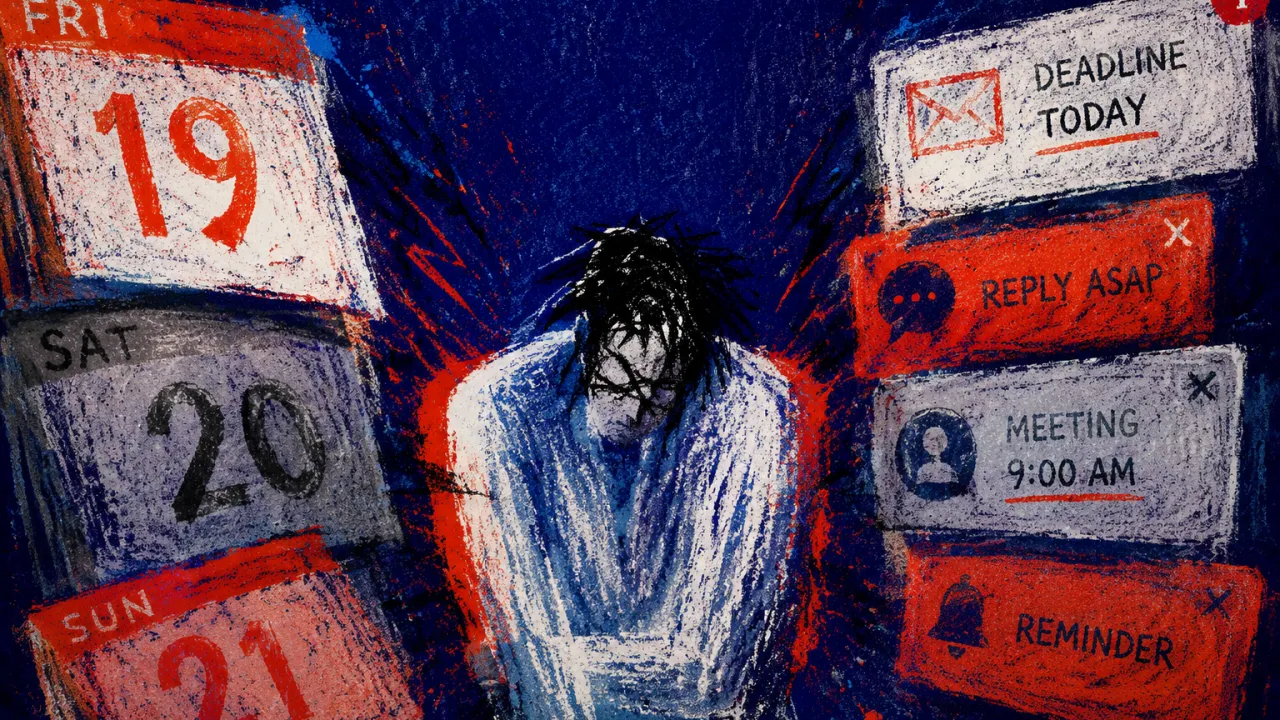
A solitary figure with lowered shoulders between red calendar blocks and silver message windows pressing inward.

What is this situation?

Post-Interview Boundary Trial is the stretch after a job interview when a hiring process starts asking for more access than the role or timeline seems to justify. You leave the call expecting a decision, then wake to an email introducing "one final step": a take-home assignment due within 48 hours, another conversation with a senior lead, or a request for references and full availability. You rearrange work, classes, or plans to respond, only for the promised decision date to move and another "quick ask" to arrive. Each request is framed as standard, urgent, or proof that you are flexible, while details about pay, scope, start date, and who makes the decision stay vague. When you ask what remains in the process, the answer may be delayed, softened, or replaced with another calendar link. They control the opportunity, the timetable, and the information; you are expected to keep demonstrating effort before there is a clear commitment on the other side. Your shoulders tighten whenever a new inbox notification appears, and ordinary parts of the day become organized around waiting, preparing, and replying in exactly the right tone. By the time another final request lands, you are defending the edge of your own schedule on uneven ground, much like the Seven of Wands, where one figure braces as six raised wands press up from below.

Why it's not you?

The problem is not that you are difficult or insufficiently flexible; a process that keeps adding labor, access, and urgency while withholding clear terms and a decision creates this pressure through its own setup. Repeated "final steps" and one-sided deadlines belong to the hiring process, not to a flaw in you.

Post-interview Boundary Trial in Tarot Cards

Post-Interview Boundary Trial takes shape when each supposed final step brings another assignment, call, or demand for availability before any offer is clear. Your shoulders tightening whenever a new inbox notification appears reflects an environmental, structural dynamic: the employer controls the timeline and information while your time remains on call. The Tarot Cards below mirror the visible contours of that uneven pressure without telling you what decision to make.

The Emperor
Reversed
An armored ruler sits on a stone throne marked by ram heads, holding a scepter and an orb. The fixed seat and heavy symbols of authority mirror a hiring process that controls access, sets the timetable, and can summon more demonstrations without exposing who has final decision power. In the reversed texture, authority remains organized but loses accountable limits. You are dealing with a system that can treat flexibility as an obligation, so the career boundary becomes a way to identify whether the person or institution holding power can state the role, scope, and endpoint clearly.
Wheel of Fortune
Reversed
The wheel turns at the center while figures occupy different positions around its rim and the surrounding symbols mark a larger system in motion. The image mirrors a hiring calendar whose position keeps changing as the employer introduces new steps, revises dates, and decides when the candidate must be available. In the reversed texture, the cycle is still active but your position within it is determined elsewhere. You are asked to keep rotating around the opportunity without receiving control over the schedule or enough information to know whether the next turn is actually closer to a decision.
Justice
Reversed
Justice sits between two pillars with a sword held upright and scales poised in the other hand. The formal scene resembles a hiring process that presents each new request as procedural while the actual criteria, decision authority, and promised dates remain difficult to verify. In the reversed texture, the symbols of due process stay visible without producing balance. You are left comparing the effort demanded from you with the information and commitment returned, separating a legitimate evaluation standard from polished language that conceals an asymmetrical process.
The Hanged Man
Upright
A figure hangs by one foot from a living tree, hands held behind the back and a halo around the head. The suspended body mirrors the post-interview position of being unable to secure a decision while still being expected to remain available for the next request. The upright structure makes the pause itself the subject of scrutiny rather than treating it as empty time. You are asked to see what the hiring process has placed on hold: your calendar, your planning horizon, and your ability to decide what further access is proportionate before the employer releases a clear answer.
The Devil
Upright
The chained pair stand beneath a winged figure, with the chains visibly loose enough to suggest attachment maintained through conditions rather than physical force. The image mirrors a job opportunity where every new assignment, reference request, or availability demand is tied to the possibility of being chosen. The upright structure shows how a scarce opportunity can turn continued surrender into an apparent requirement. You can see the exchange more clearly when the promise of access is separated from the concrete terms that would make the role a mutual commitment.
The Moon
Upright
The moon casts uneven light over a winding path between two towers, with a dog, a wolf, and a crayfish occupying different points around the water. The layered scene matches hiring messages that sound urgent and official while leaving the route, decision-maker, and endpoint difficult to read. The upright structure keeps uncertainty external and concrete: the path exists, but its signals do not provide a stable map. You are navigating a process where guessing the right tone and level of availability can become a substitute for receiving clear information about the job itself.
Judgement
Reversed
An angel sounds a trumpet above figures rising from coffins, creating a scene built around a public call and a response that should bring a period to a close. The image mirrors the decision expected after an interview, when the candidate instead receives another evaluation request. In the reversed texture, the call is present but the verdict does not arrive in a usable form. You remain accountable to the process while the process postpones its own act of judgment, turning closure into another round of proof and availability.
The World
Reversed
A dancing figure is enclosed by a wreath, with the four symbolic figures stationed at the corners of the scene. The nearly closed circle mirrors a hiring process that repeatedly presents an endpoint, then places another interview, assignment, or reference request just beyond it. In the reversed texture, completion remains visibly promised but structurally unachieved. You are dealing with a cycle whose language says final while its calendar keeps reopening, making the absence of closure a concrete feature of the process rather than a failure to finish your part.
Two of Pentacles
Upright
Two coins loop through the juggler's hands while waves rise behind him and one foot shifts to keep balance. The physical juggling mirrors a candidate moving between paid work, classes, preparation, reference requests, and sudden interview slots as the hiring process changes its demands. Your schedule becomes the shock absorber for an opportunity that has not yet supplied a stable shape. The upright rhythm shows that coordination is possible only while the competing obligations remain visible and bounded, rather than allowing every new calendar link to displace the rest of your life.
Six of Pentacles
Reversed
A seated figure holds a balance scale while distributing coins to two kneeling figures. The visible flow of resources mirrors an employer deciding who receives access to the opportunity while requesting more of your time, labor, references, and availability. In the reversed texture, the scale no longer establishes a dependable exchange: the giver retains control over the coins, and the recipients remain positioned below. You are asked to keep contributing before the process makes its own side of the bargain legible through pay, scope, authority, or a firm decision date.
Seven of Pentacles
Reversed
A gardener leans on a hoe beside a vine of pentacles, looking over the visible results of work that has not yet been harvested. The scene matches a candidate who has already invested interview preparation, assignments, and availability but still receives another demand instead of a decision. In the reversed texture, the pause stops functioning as a deliberate review of return. You are assessing whether the hiring process still has a credible path to employment or whether it has begun using the promise of a future result to keep harvesting more effort.
Eight of Pentacles
Reversed
At the bench, the craftsman hammers one pentacle while completed pentacles line the wall. The repeated production scene mirrors a hiring process that keeps converting your candidacy into more deliverables, presentations, and proof of competence after the interview was supposed to have narrowed the decision. In the reversed texture, the workbench becomes a production station without a reliable exchange around it. You can be evaluated through genuine skill while still naming the point at which an unbounded take-home task is functioning as unpaid project labor rather than a proportionate selection step.
Five of Swords
Upright
One figure gathers three swords while two others walk away across a grey shore, leaving the tools of the encounter in one person's hands. The arrangement mirrors an adversarial hiring process where the employer can collect candidate work and control the terms of participation while presenting continued extraction as a test you should accept. The upright scene makes the cost of a narrow win visible: staying in the process may preserve the possibility of an offer, but it can also normalize a one-sided exchange. You can examine whether the next request advances a defined hiring decision or simply transfers more risk and labor to you.
Eight of Swords
Upright
A blindfolded figure stands bound among eight swords, with a castle and open ground visible beyond the perimeter. The scene mirrors a candidate who can technically refuse another task but experiences the employer's control of the opportunity as a narrow field in which every boundary appears expensive. The upright structure locates the restriction in the arrangement around you: limited information, unequal leverage, and the fear that access will disappear if you stop complying. The visible opening matters because the process is constraining your practical choices without proving that compliance is the only available route.
Seven of Wands
Upright
The lone figure on higher ground raises one wand against six wands coming up from below. The physical arrangement mirrors a hiring process where the employer controls the gate and successive requests arrive from a position of leverage, each one framed as a final test of your flexibility. You are not defending an abstract attitude; you are defending hours, access, and the right to know what the effort is buying. With a clear limit, the elevated ground becomes a negotiable position: you can keep evaluating the role while requiring the next demand to have a defined purpose, owner, and endpoint.
Ten of Wands
Upright
The carrier's bundle of ten wands hides the road and forces the body into a forward lean. The blocked view mirrors a career process where every new proof point increases your workload while the role's scope, compensation, start date, and decision authority remain out of sight. The upright load is built from many separate obligations rather than one dramatic event. You are being asked to carry the hiring process as though employment were already established, even though the employer has not made the reciprocal commitment that would give the work a defined place or purpose.

Post-interview Boundary Trial in Tarot Card Reading Insights

When a hiring process keeps adding last-minute requests after the interview, other candidates have brought that same boundary trial into readings. The Tarot Reading Insights below show what surfaced in those sessions as the process continued.

Psychological Contexts Related to Post-interview Boundary Trial