Who Gets Heard in Hybrid Work?

See how split rooms shape collaboration, which tarot cards mirror the pressure, and what related reading insights have surfaced.

Hybrid Collaboration Trial
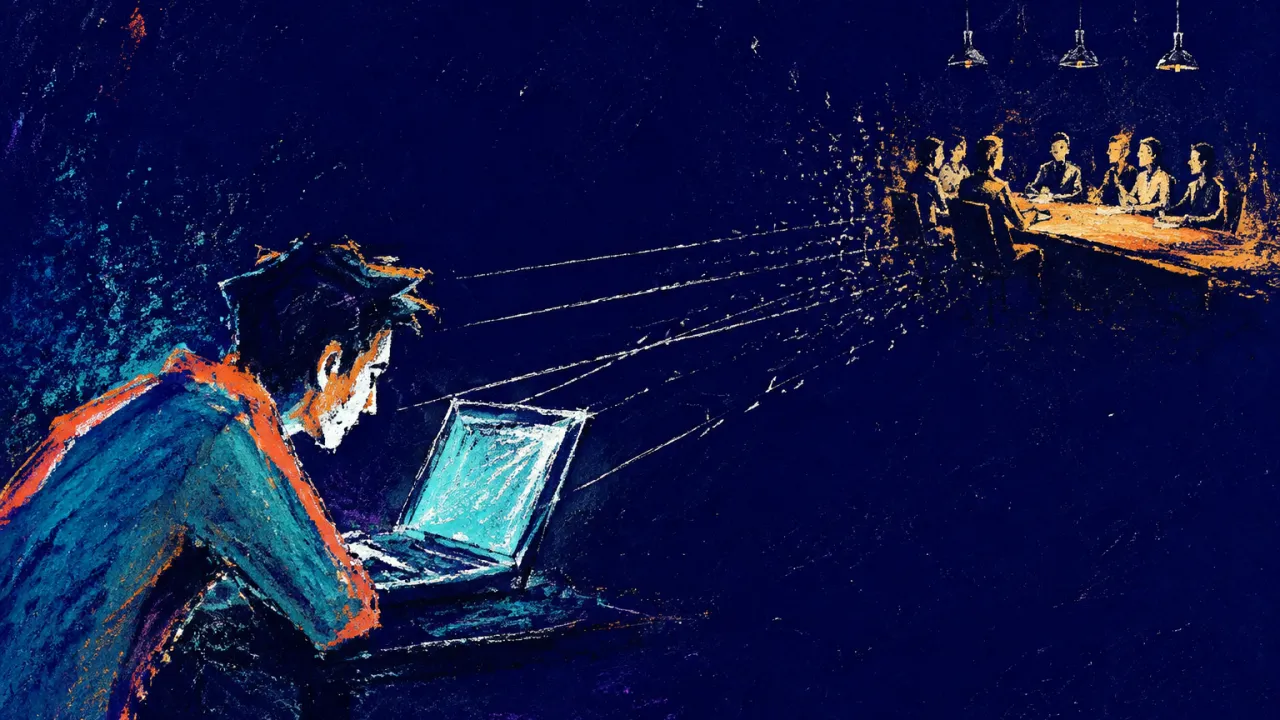
A figure leans toward a laptop, shoulders angled forward as a silver gap widens toward an amber-lit conference table.

What is this situation?

Hybrid Collaboration Trial — the pilot begins with a calendar invite announcing which days your team will work remotely, which days require office attendance, and how leadership will decide whether the arrangement continues. The schedule looks orderly until the workday starts: you reserve a desk, adjust your commute, open multiple chat threads, and join a video call where half the team sits together around a conference table. People in the room turn toward one another, microphones miss parts of the exchange, and your comment arrives just after the conversation has moved on. A decision mentioned on the call changes in a hallway conversation, then appears in a message without the context that produced it. Documents sit in different channels, meeting notes trail behind verbal agreements, and the same update has to be repeated for people who were not in the same place at the same time. Physical visibility quietly shapes access: those near the room hear quick clarifications and see who has already agreed, while everyone else waits for a link, recap, or reply. Because the setup is still a trial, the rules can shift with each survey, leadership check-in, or attendance request, yet the team is still expected to deliver as though the system were settled. By late afternoon, your shoulders are angled toward the laptop and your body has stayed forward all day, tracking who heard what and which version now counts. The work is doubled by the effort of keeping fragmented conversations aligned, much like the Five of Wands, where five figures raise crossing staffs in the same space without moving in one shared direction.

Why it's not you?

This is not a personal failure to communicate. A trial that splits information across rooms, screens, chats, and hallway exchanges while repeatedly changing its rules creates uneven access through the setup itself; the extra coordination belongs to that setup, not to you.

Hybrid Collaboration Trial in Tarot Cards

A Hybrid Collaboration Trial can scatter one workday across conference rooms, video calls, chats, and side conversations, making access to decisions uneven. Your shoulders angle toward the screen as you try to follow several versions of the same discussion. This is an environmental and structural dynamic created by divided communication channels and unequal visibility, not a measure of how well you collaborate. The Tarot Cards below reflect the contours of this split working arrangement.

The Emperor
Reversed
The Emperor's stone throne, rigid armour, and raised sceptre place operating rules under a visibly central authority. Reversed, that structure stops functioning as dependable governance: leadership still controls attendance and continuation, but its standards move from one check-in to the next and leave no stable protocol beneath the team. You are expected to deliver inside rules you cannot fully predict or shape. The reversal locates the blockage in governance rather than personal adaptability: authority is present, yet the consistent framework, documented decision rights, and location-neutral operating rules that would make its authority useful are withheld.
Wheel of Fortune
Upright
The turning wheel, the figures rising and falling around its rim, and the fixed creatures observing from the corners frame change as an external cycle rather than an individual preference. In the hybrid pilot, surveys, leadership reviews, and attendance requests keep rotating the conditions under which the team must work. You are coordinating against a system whose next version may arrive before the current one is fully established. Upright, the wheel keeps the cycle visible and therefore mappable: the pressure is not random personal inconsistency but a sequence of organisational checkpoints, each capable of changing the schedule, access pattern, and version of the rules that currently counts.
Justice
Reversed
Justice's scales, upright sword, and central seat ordinarily connect authority with transparent standards and balanced treatment. Reversed, those instruments no longer produce a reliable balance: office proximity quietly buys faster clarification and informal influence even though remote and in-room workers remain subject to the same performance expectations. You may be measured as though everyone received the same context, while the actual distribution of information depends on location, microphone reach, and hallway access. The blocked path is procedural fairness itself; equal accountability cannot function as equal treatment when the system does not provide equal access to decisions, records, or the criteria leadership will use to judge the trial.
Temperance
Upright
Temperance's two cups, split footing on land and water, and open path toward the horizon depict distinct environments being joined through an intentional transfer process. In career terms, the image mirrors a team that cannot become genuinely hybrid merely by placing office and remote days next to each other on a calendar. You need access to one collaboration system even when colleagues occupy different rooms. Upright, the flow remains possible: shared records, location-neutral participation, and clear handoffs can connect the two settings, making the card a test of whether the organisation is designing integration or asking workers to bridge every gap individually.
Judgement
Upright
Judgement's trumpet, the figures rising in response, and the distant boundary of mountains create a visible moment of collective review. The image fits the point at which leadership gathers surveys, attendance data, delivery evidence, and employee feedback to decide whether the hybrid arrangement continues or changes. You are working before that verdict while knowing the current setup is being assessed. Upright, the review point is explicit rather than hidden, which makes the timing structure legible: the pilot has a decision threshold, and the central issue is whether the evidence presented at that threshold captures coordination costs and proximity bias as clearly as it captures output.
Two of Pentacles
Reversed
The linked pentacles, moving hands, and rough sea create a picture of two workstreams requiring constant active balancing. Reversed, that balance becomes a career bottleneck because office conversations and remote channels operate as separate systems while one employee remains accountable for keeping both current. You may appear to be managing the arrangement until a late update, changed attendance request, or undocumented decision knocks the sequence out of alignment. The blocked resource is not effort but coordination capacity: the pilot doubles the interfaces around the work without reducing scope or stabilising the rules.
Three of Pentacles
Reversed
The three figures, detailed arch, and visible plan depict work that depends on different roles consulting the same design. Reversed, the architecture remains ambitious while the shared method breaks down: documents sit in separate channels, verbal agreements outrun notes, and location determines which version reaches you first. You are still expected to produce work that fits the whole structure even when no authoritative plan stays current. The reversal identifies a career process failure: collaboration is being evaluated as an individual competency while the team lacks the common documentation and decision protocol that competent collaboration requires.
Five of Pentacles
Upright
Two figures move outside in the snow while a lit stained-glass window marks warmth and resources on the other side of a wall. The scene closely mirrors remote colleagues who can see that a team conversation exists but cannot hear the quick clarification, read the room, or witness the moment when agreement forms. You are not entirely disconnected, yet your route to the group's social resources depends on someone inside sending a link, recap, or reply. Upright, the window keeps the missing resource visible and locatable: the exclusion is produced by an access boundary in the hybrid setup, not by a lack of interest or contribution.
Six of Pentacles
Reversed
The scales, coins, and unequal physical positions show resources passing through a visible gatekeeper. Reversed, the exchange stops functioning as fair workplace support: proximity to the office room determines who receives context automatically and who must ask, wait, or reconstruct the decision later. You remain accountable for acting on information that the system does not distribute equally. The blocked career resource is direct access, and the reversal exposes how informal gatekeeping can affect execution, influence, and credibility even when leadership describes the hybrid arrangement as universally available.
Seven of Pentacles
Upright
The worker pauses against his tool, studies the pentacles growing on the vine, and waits before the harvest is complete. The scene fits a pilot that has produced enough evidence to examine but has not yet reached the point where leadership can honestly treat its results as settled. You are working inside that assessment period while temporary friction already carries real daily costs. Upright, the crop and evaluation point are visible, making patience conditional rather than passive: the timing structure depends on whether the trial is being given enough time to reveal patterns and whether its review measures hidden coordination labour alongside visible output.
Seven of Swords
Upright
The swords split between the moving figure and the camp, while his backward glance keeps attention on the information left behind. In career terms, the image resembles a decision process that exits the documented meeting, changes through an informal office exchange, and returns as an update stripped of the reasoning that produced it. You are then asked to execute against an outcome you had no equal chance to shape. Upright, the route can still be identified and audited: the problem is the gap between formal decision ownership and the backchannel where practical authority is being exercised.
Five of Wands
Upright
The five raised staffs cross above a group whose effort is energetic but whose movements are not aligned. In the workplace, that is the architecture of duplicated updates, overlapping chat threads, mixed-room meetings, and decisions that change after the formal call has ended. You are doing both the assigned work and the extra work of identifying who heard which version. Upright, the conflict remains visible enough to audit: the career bottleneck is not a shortage of contribution but the absence of one collaboration protocol capable of turning simultaneous effort into a shared, documented direction.
Six of Wands
Reversed
The rider's elevated position, laurel-topped wand, and surrounding crowd organise recognition around public visibility. Reversed, the procession loses a dependable centre: contribution can remain substantial while access to acknowledgement is blocked by who is physically present when progress, agreement, or ownership becomes socially legible. You may deliver from outside the room yet receive less career credit than colleagues who are repeatedly seen near decision-makers. The reversal locates the blockage in the recognition system; proximity bias turns office presence into a proxy for influence and commitment, even when the underlying work is distributed across the whole hybrid team.
Eight of Wands
Reversed
The parallel staffs, open flight path, and visible destination normally suggest information travelling without obstruction. Reversed, the lines stop functioning as one coordinated stream: chat messages, verbal decisions, documents, and recaps arrive separately and no longer preserve a reliable order. You may complete work against the version available to you only to discover that the decision changed elsewhere. The career blockage is not a lack of responsiveness; it is an asynchronous decision system in which access to the latest context depends on location, leaving rework and credibility risk with the person who received the update last.
Ten of Wands
Upright
The ten staffs fill the worker's arms, pull his body forward, and obstruct his sight even though the destination is close. In the hybrid workplace, that bundle becomes the invisible second job of reconciling chat, meetings, hallway changes, shared documents, and absent colleagues before the substantive work can move. You can remain highly responsible while the load becomes structurally unreasonable. Upright, the burden is countable and attached to a visible route, allowing the career pattern to be named: the organisation has concentrated the cost of collaboration in the people who repeatedly translate between locations without granting them formal ownership of the system.

Hybrid Collaboration Trial in Tarot Card Reading Insights

Other people navigating a Hybrid Collaboration Trial have brought its missed handoffs, uneven meeting access, and shifting decisions into their readings. The articles below gather Tarot Reading Insights from those sessions.

Psychological Contexts Related to Hybrid Collaboration Trial