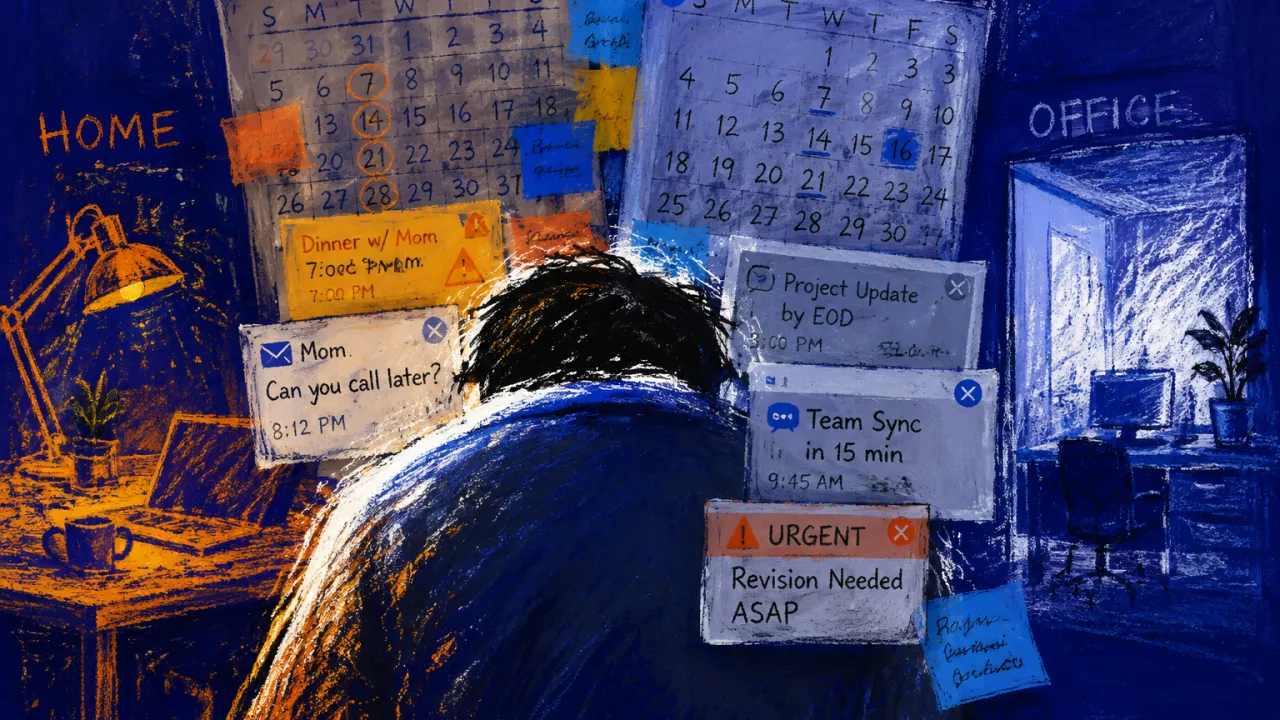
Explore a hybrid workday without shared structure, the tarot cards that mirror it, and reading insights from similar workplace setups.
Unscaffolded Hybrid Workday
What is this situation?
Unscaffolded Hybrid Workday — your employer calls the week flexible, but the flexibility begins and ends with choosing which building contains your laptop. On home days, the first meeting lands before you have cleared a place to work; on office days, the commute, desk search, headset setup, and room booking sit outside the time anyone counts. Teammates appear in different combinations across a conference table and a grid of muted tiles, so a quick question becomes a Slack thread, an email, and a follow-up call before the person who can answer sees it. Meetings are scheduled as if everyone occupies the same room, while decisions happen in side conversations that remote people miss and office noise follows everyone else through open microphones. Your manager asks for autonomy but still reads visibility as commitment, so the day carries two instructions at once: use flexibility, and remain continuously reachable. Calendar blocks overlap with travel; focused work is pushed between calls; lunch becomes the buffer when a room runs late or the train does. By midafternoon, your shoulders stay rounded over whichever surface is available and your back tightens as notifications keep reopening work you had just begun. By evening, you have spent hours coordinating the conditions for work as well as doing it, yet the unfinished tasks still look like your responsibility, much like the figure on the Two of Pentacles, juggling two coins inside a looping ribbon while ships rise and fall behind him.
Why it's not you?
The problem is not that you cannot organize yourself; the workday has been split across locations without shared routines, protected transition time, or clear rules about availability. Conflicting calendars, visibility expectations, and duplicated setup work belong to the arrangement itself, not to any personal failure on your part.
Unscaffolded Hybrid Workday in Tarot Cards
An Unscaffolded Hybrid Workday is the repeated work of moving between home and office while meetings, messages, and visibility expectations continue as though no transition exists. The rounded shoulders and tightening back beneath overlapping schedules register an environmental and structural dynamic, not a personal failure of organization. The Tarot Cards below mirror the contours of divided locations, shifting access, and work that keeps crossing its own boundaries.
Scales held beside an upright sword depict a system claiming to weigh evidence and apply clear standards. Reversed, the weighing mechanism is distorted: office visibility is treated as commitment, immediate replies are treated as autonomy working well, and the coordination costs borne by remote or mobile workers are excluded from the evidence. You can deliver comparable output and still receive a different reading because proximity supplies managers with informal signals that remote work does not. The reversed scales expose an evaluation design problem and keep that unequal judgment separate from the actual value of your work.
One foot on land, one in water, a stream passing between cups, and a path connecting the foreground to a distant destination depict different systems being made interoperable. Reversed, the organization keeps the locations but removes the integration work: meetings follow office-era assumptions, remote participation follows platform constraints, and no common protocol reconciles the two. You are asked to exercise autonomy inside a structure that still rewards office presence and immediate replies, producing two incompatible definitions of good performance. The reversed card locates the contradiction in the operating model rather than in your ability to adapt to it.
Two pentacles held in one continuous loop, the juggler's divided stance, and the turbulent ships behind him show output being maintained through constant compensatory movement. Reversed, the loop becomes a workplace system that keeps adding coordination demands without stabilizing access, availability rules, or the conditions needed for concentrated work. You receive nominal autonomy over location while being evaluated through responsiveness and physical visibility, so managing the arrangement becomes a hidden part of your role. When the visible deliverables remain incomplete, the organization can assign the shortfall to you while leaving its own coordination overhead unmeasured.
Three figures meeting beneath a stone arch, a plan held between them, and crafted pentacles embedded above show collaboration depending on shared design, visible roles, and a common worksite. Reversed, the plan no longer organizes the group: people occupy unequal rooms and channels, questions are duplicated, and informal office conversations outrun the record available to remote teammates. You may spend more time locating the person, channel, and decision than completing the task that depends on them. The reversed workshop makes this a coordination-design failure, not evidence that you lack initiative or collaborative skill.
Eight pentacles arranged around a worker's bench, with one piece held under the tool, present focused work as a sequence that depends on continuity, a stable surface, and repeated attention. Reversed, that sequence is repeatedly broken by calls, room changes, transit, notification returns, and the need to reconstruct context after every interruption. You may spend the day working without receiving enough uninterrupted time to move the core task through a complete cycle. The reversed workshop identifies degraded focus as an environmental production constraint rather than a lack of discipline, effort, or skill.
Eight airborne staffs crossing the same field suggest information traveling quickly along aligned routes. Reversed, the routes fragment into competing channels: a simple work question becomes a Slack thread, an email, and a follow-up call, while the answer still depends on where the relevant colleague happens to be. You remain visibly active across platforms without gaining equivalent progress on the underlying task. The reversed card distinguishes communication volume from functional communication flow and exposes the unpaid routing work hidden inside hybrid execution.
Ten staffs gathered into one unwieldy load, a worker bent beneath them, and a destination still ahead depict responsibility accumulating faster than it is distributed. Upright, the work can still be completed, but the route depends on you carrying coordination, setup, communication recovery, and deliverables as if they were one indivisible job. You may appear productive and dependable precisely because the extra logistics remain hidden inside your effort. The card names that competence without allowing the organization to mistake successful compensation for a sustainable or properly scoped role.
No cards available for this filter.
Unscaffolded Hybrid Workday in Tarot Card Reading Insights
When hybrid days keep splitting the same workload across home, transit, and office, other people have brought that setup into their readings too. The articles below gather Tarot Reading Insights from readings shaped by unclear transitions, overlapping channels, and shifting visibility.