Workplace Boundary Creep: From Assumed Access to One Clear Limit

The 10:47 p.m. Work-Spouse Message
I recognised Maya immediately: she was a project coordinator at a Toronto hybrid tech company, answering a non-urgent personal Slack message at 10:47 p.m. because being her work spouse's first call felt safer than letting tomorrow feel weird. I have spent twenty years listening to people describe the moment they know a line has moved, even while they are still trying to explain it away.
She had told me the scene in detail. Barefoot in her condo kitchen, she stood beside the humming refrigerator with a warm phone in one hand. The blue screen lit her face while the rest of the apartment stayed dark and quiet. She typed, "I am offline now," deleted it, and sent an affectionate joke instead.
"I know the line moved, but I cannot explain why I did not stop it," she said. A teammate's familiar joke that they were basically married had made the closeness look harmless and socially approved. Yet the personal messages kept arriving after work, the one-to-one debriefs kept running long, and whenever Maya tried to set a limit, she softened it with reassurance or quietly restored the old routine after their next shared task.
Her ambivalence felt like holding a security gate shut with one hand while repeatedly tapping the same familiar badge with the other. Every message brought a tight chest and restless energy, followed by the quick warmth of being wanted. Guilt, longing, and resentment crowded together until even a simple reply felt like a referendum on whether she belonged.
I told her that I was not there to label the coworker, predict their intentions, or make her choose between closeness and self-respect. I was there to help her look at the pattern without selling her fear back to her. "We can let the cards organise what your body and your behaviour already know," I said. "Today, our Journey to Clarity is simply to draw a map through the fog and return the steering wheel to you."

Choosing a Map for Blurred Boundaries
I asked Maya to place both feet on the floor, take one slow breath, and name the question in plain language. I shuffled slowly while she focused on the difference between what she wanted to preserve and what she no longer wanted to provide. The ritual was a practical threshold: a few quiet minutes to move from reacting to the next notification into observing the whole system.
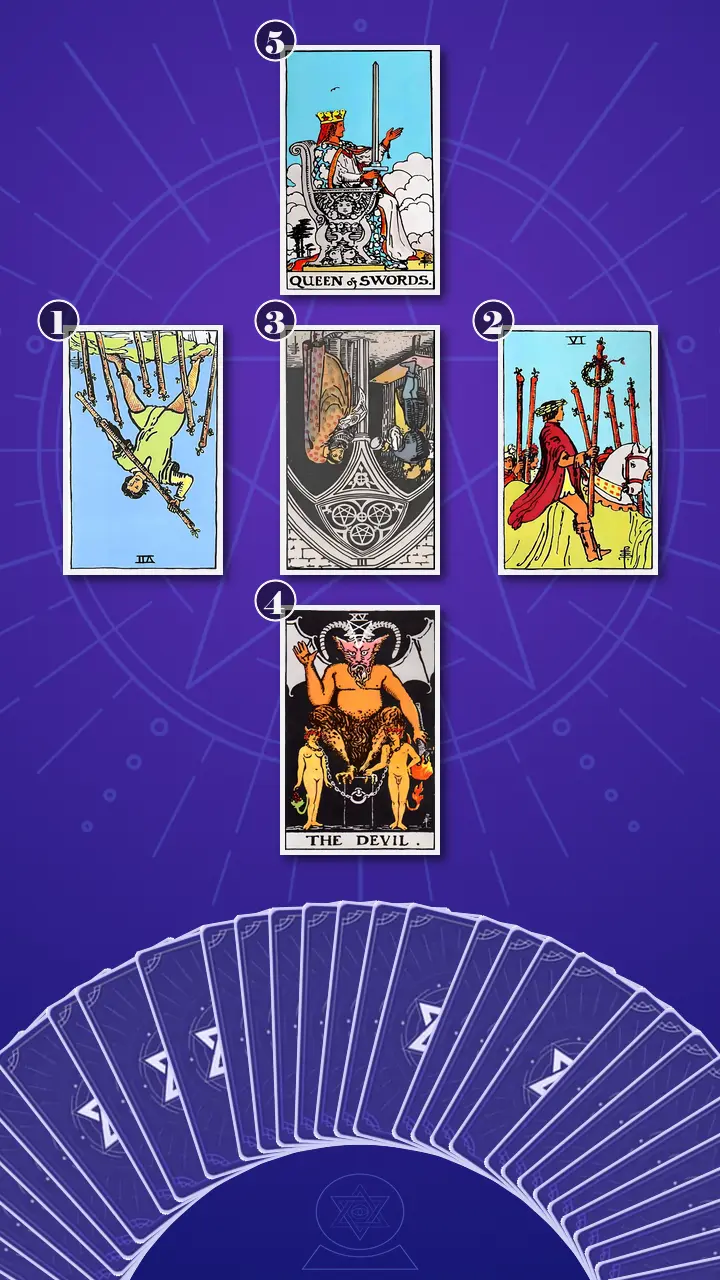
For this reading, I chose the Relationship Spread · Context Edition, a five-card relationship tarot spread designed for workplace boundary clarity. If you have ever wondered how tarot works without guessing another person's private thoughts, this is the useful distinction: the cards do not give me access to the coworker's mind. They help us examine Maya's observable behaviour, the cues she experiences, the shared structure they have created, the reward beneath the habit, and the boundary practice available to her.
I explained why I was not using a Celtic Cross. That spread can be valuable, but it would be unnecessarily broad for a focused question about after-hours work chat anxiety and work-spouse closeness. This contextual spread gives us five clean information layers: present behaviour, perceived recognition, the shared work-and-personal dynamic, the hidden attachment, and a self-directed response. I placed the third card in the centre, the first and second cards on either side, the fourth below as the submerged weight, and the fifth above as the stance that could lift the pattern into clarity.
"We will begin with where your footing gives way," I said. "Then we will look at what the closeness rewards, how the work container became blurred, what makes the exceptions compelling, and finally what you can say without trying to control the outcome."
The Ground Beneath the Reply
Position 1: The Unsteady Wand at 10:47 p.m.
Now turned over was the card for Maya's observable part in the present boundary creep: continuing access, softening limits, and surrendering her position to avoid immediate discomfort.
Seven of Wands, in reversed position.
In the Rider-Waite-Smith image, one figure stands on uneven ground while six wands press upward from below. The single wand is held across the body, as though it could protect the figure, but the footing is unstable. In Maya's life, that wand was the unsent sign-off. At 10:47 p.m., she felt the exact moment she wanted to stop, but the fear of making the next workday awkward pushed her thumb back toward reply.
The reversed Fire here is not a lack of awareness. It is a deficiency in sustainable self-protection and a blockage at the moment of action. Her energy was not disappearing; it was being redirected into jokes, apologies, and extra warmth designed to make sure the coworker would not notice her hesitation. A Do Not Disturb setting kept getting overridden because every notification felt like a test of whether she still mattered.
"If the limit disappears inside the reassurance, it was never fully communicated," I said. "That does not mean you have to become cold or end every informal conversation. It means the smallest honest limit needs to survive the sentence around it."
Maya did not nod. First, her breath caught and her fingers went still around the coffee cup. Then her eyes lost focus, as if they were replaying the draft she had deleted and the affectionate joke she had sent. Finally, she gave a short, bitter laugh and said, "That is too accurate. It is easier to let it slide than make tomorrow weird." I let the laugh stand. I did not ask her to prove that the boundary was justified; I asked her to notice that she had already felt it.
Position 2: The Laurel Crown of Being Chosen
Now turned over was the card for the interaction cues Maya noticed and the psychological reward she assigned to them, without treating those cues as proof of the coworker's private intentions.
Six of Wands, in upright position.
The laurel-crowned rider, the raised wand, and the crowd carrying matching wands all speak of visible approval. After a difficult project meeting, Maya received a message that said, "You are the only person who gets it." The praise landed as a quick lift in her stomach, a moment of warmth and importance. She answered over dinner, then felt the cost when the conversation stayed personal and the expectation of access followed.
The Six of Wands shows recognition flowing strongly. That is not wrong. Being trusted, singled out, and treated as a preferred collaborator can feel genuinely good, especially in a hybrid workplace where so much belonging arrives through Slack reactions, private DMs, team-channel praise, and who gets contacted first. But the reward was competing with the depleted defence of the reversed Seven of Wands. Maya was protecting her position by becoming more available, then resenting the availability she had used to earn recognition.
"You can like being chosen without agreeing to be always available," I told her. "The useful question is not whether the attention is real. It is which forms of recognition you want to keep, and which ones currently require more personal access than you can comfortably offer."
Maya smiled, but the smile did not settle her. She looked at the card's wreath, then at the phone lying face down beside her. "I like being the person they come to," she said. "I hate what that costs me." I heard both truths as clearly as I heard the refrigerator in the opening scene. The reading did not require her to deny the first in order to honour the second.
The Architecture of a Blurred Workday
Position 3: The Unfinished Work Container
Now turned over was the card for the pattern created between professional collaboration and personal intimacy, including the repeated interactions that reinforced the confusion.
Three of Pentacles, in reversed position.
The upright Three of Pentacles is an architectural plan, a shared worksite, and three people contributing distinct skills to a structure. Reversed, the design has lost its agreed properties. I connected it to a familiar scene from Maya's week: at 5:41 p.m., a legitimate project question began in a private Teams chat, became forty minutes of emotional debriefing and inside jokes, and left the task information in a private thread instead of the shared channel. By the time she closed her laptop, her shoulders were raised and her jaw was tight.
This reversed Earth is a structural blockage. The problem is not that Maya and her coworker work closely; it is that the relationship has no agreed container. Task coordination, personal catch-up, emotional support, and informal reassurance had been built in the same unlabelled space. Maya was performing invisible support work as though it were part of her project role, while the absence of a clear stopping point made ordinary collaboration feel like a request for unlimited access.
"A boundary here does not need to punish the partnership," I said. "It can give each part a proper room. Task facts can live in the shared Slack or Teams channel. A personal catch-up can happen during a defined lunch or coffee break, if you genuinely want it. The point is not distance. The point is design."
Maya's thumb moved along the edge of her phone. She looked relieved for half a second, then tightened again. "But moving it back to the shared channel could make it look like I am making a statement," she said. I answered carefully: "It may feel like a statement because the old arrangement has been carrying meaning. That does not make the reset aggressive. We can change one recurring container rather than rewrite the whole relationship in a single afternoon."
When the Devil Made the Bargain Visible
Position 4: The Loose Chain Behind the Notification Loop
Now turned over was the card for what kept the closeness compelling: the unmet need and shadow reward that made each exception feel worthwhile in the short term.
The Devil, in upright position.
I want to be precise here. This card did not prove romance, manipulation, malicious intent, or fate. It named an attachment within Maya's own experience: attention, specialness, and relief from uncertainty had become tied to continued access. Before opening the shared project board, she checked the private chat because its notification supplied a faster sense of being wanted. The pattern resembled an app notification loop: a warm message gave instant relief, the reply preserved the connection, and the next alert became harder to ignore.
The card's chains are loose enough to remove. That detail mattered to me. The Devil showed participation and reinforcement, not helplessness. Maya had been holding two thoughts at once: "I know I do not want this much access, but I do not want to lose what the access seems to prove." The proof seemed to be importance, belonging, and the reassurance that she was still someone's first call.
I asked her to finish the sentence, "The question is not whether this matters; it is what access I keep trading for the feeling that it matters." For a moment, she stared at the private-chat icon before looking at the shared project channel.
Her reaction came in layers. Her fingers froze above the phone. Her eyes went distant as she replayed the small rewards that had looked like ordinary professionalism: the first message, the inside joke, the late-night debrief. Then her mouth tightened and released with a quiet exhale. "I do like being chosen," she admitted. "That is part of why this is hard." I told her that naming the reward was not a confession she needed to defend. It was data, and data gave her more choice than disguise did.
When the Queen of Swords Raised the Line
Position 5: The Upright Sword and the Open Hand
The room became very quiet as I reached for the card above the centre. Now turned over was the card that translated insight into a self-directed boundary practice: the quality Maya could embody and the next limit she could communicate without predicting the relationship's outcome.
Queen of Swords, in upright position.
The Queen's sword is vertical and unmistakable, while her other hand remains open. The image holds discernment and invitation together. In modern life, it sounded like this: "I am keeping personal messages to work hours, and I am happy to handle project questions in the shared channel." No joke softened it. No apology made it negotiable. No promise about the coworker's feelings was attached.
The Queen was the spread's antidote. She did not ask Maya to erase the connection or pretend the recognition had never mattered. She asked her to describe access accurately. I used my signature Analysis Paralysis Deconstruction at that point, stripping away the abstract what-ifs and returning to grounded realities: the message was non-urgent, work tasks had a shared channel, work hours existed, and Maya could choose when to respond. Then I used Complexity Reduction to turn a crowded emotional question into a clean binary: assumed access or chosen access. It was not closeness versus distance.
The Sentence That Stops Being a Verdict
At 10:47 p.m., the phone is warm in Maya's hand, the Toronto condo is quiet except for the refrigerator, and the boundary sentence sits unsent in the draft box while an affectionate joke has gone out instead. Familiar relief and a tight chest arrive together. This is the old loop, not proof that Maya has failed.
Silence is not kindness when it erases your limit; clear, proportionate language is care, and the Queen's raised sword shows where ambiguity must end.
"You can value the connection without granting it unlimited access. A clear limit is accurate information about what you can offer, not proof that the closeness was fake or that you are rejecting the person."
Maya's face went still. Her breath stopped and her thumb hovered above the phone. Then her gaze unfocused, replaying the sign-off she had deleted, the joke she had sent, and the next morning she had tried to make normal. A flush touched her cheeks and eyes. Her shoulders, held high for much of the session, lowered by a fraction, and the hand she had kept closed around her cup opened on the table. When she spoke, her voice was thin but steady: "I can be clear without deciding the entire future of this connection today." She took a shaky breath that sounded like relief, then sat in a small, startling blankness, the vulnerability that arrives when the responsibility of choosing is finally hers. I set a ten-minute timer and asked her to write one sentence, without sending it until she chose to. She could notice what she feared the sentence would cause and stop when the timer ended. The choice remained hers.
I asked, "Now, use this new perspective to think back to last week. Was there a moment when this insight could have made you feel differently?"
Maya remembered the message after the difficult meeting, the one that called her the only person who understood. She could still value that recognition while noticing the trade attached to it. This was the first crossing in the emotional transformation from uneasy, approval-driven ambivalence to clear boundaries, chosen access, and restored self-respect. It was not a finished identity. It was a stable sentence she could return to.
From Insight to Chosen Access
When I gathered the cards into one story, the logic was direct. The reversed Seven of Wands showed Maya losing her footing whenever a limit threatened immediate awkwardness. The Six of Wands showed why the pattern paid her so quickly: praise and first-call status made her feel visible. The reversed Three of Pentacles showed the practical consequence, a work structure with no agreed container for emotional labour. The Devil revealed the hidden bargain beneath it all, while the Queen of Swords offered an integrated response: accurate language, clear categories, and a boundary that did not require a dramatic exit.
Maya had been holding a door half-open while insisting it was closed. Each exception looked harmless by itself, but the accumulated access kept teaching the relationship that the door was available. Her cognitive blind spot was not an inability to detect the line. She was treating every message as a separate case that needed more evidence, more perfect wording, and a guarantee that nobody would feel rejected. The deeper shift was from monitoring whether the coworker might feel rejected to stating one specific limit and observing whether the working dynamic could respect accurate information.
"Your next steps do not need to solve the entire bond," I said. "They only need to make access conscious, return work to an appropriate container, and let the response become information rather than something you have to manage in advance." I gave her actionable advice in small pieces, because practical clarity is easier to trust when it can survive an ordinary Tuesday.
The Clear Access Check
- Use the Coffee Bean Filter ProtocolWithin the next 24 hours, sit at a kitchen table or coffee shop and write every decision variable on paper in two physical columns: "Absolute Must-Haves" for reliable project coordination, respectful communication, work-hour expectations, and an urgent-work route; "Emotional Noise" for predicting rejection, making tomorrow perfectly normal, explaining the entire history, or preserving preferred-person status. End by choosing one limit, not by solving the whole relationship.Use a ten-minute version if the list feels overwhelming. Keep the page private, and stop when the timer ends; the goal is conscious sorting, not a perfect verdict.
- Leave one no-apology sign-off standingFor the next non-urgent personal message from this coworker after sign-off, first draft "I am signing off now, so I will pick this up during work hours" in your notes app. During one workday this week, use the sentence without adding "but it is totally fine," a second paragraph, or an apology designed to manage the other person's reaction. Add a realistic Slack status or calendar boundary so the communication system supports the limit.You do not owe immediate access or a prediction about the relationship. If the matter is genuinely urgent, use the workplace's existing escalation process rather than applying a blanket rule.
- Reset one shared work containerChoose one recurring project question this week and place its task details in the shared Slack or Teams channel, shared document, or project board. If personal catch-up is welcome, give it a defined lunch or coffee break instead of allowing it to expand indefinitely. For the next meeting, clarify whether the exchange needs a work agenda, a shared note, or a shorter check-in.Start with one conversation, not every conversation. Selective boundaries preserve ordinary one-to-one collaboration while stopping private emotional access from becoming an invisible job requirement.
After that, I asked Maya to repeat the sentence and observe what happened in the working dynamic. If there was awkwardness, she did not need to rush in and smooth it over. "Let the awkwardness be information, not a disaster," I said. A respectful response would be information. A tense response would also be information about what the old access had been carrying. Neither response would become a verdict on Maya's worth.

A Week Later, the Quiet Proof
Four days later, Maya sent me a message at 9:02 a.m. She had used the Coffee Bean Filter Protocol, placed the next project question in the shared channel, and written the sign-off in her notes before sending it after a non-urgent personal message. When the coworker asked whether something was wrong, Maya replied, "No. I am keeping personal messages to work hours, and project questions can go in the shared channel." The reply she received was simply, "Got it." The next task arrived publicly. That was all, and it was enough evidence for one day.
That night she slept a full night, but woke with the old thought, "What if I am wrong?" She smiled at it, made coffee, and opened the project board before the private chat. The clarity was real, but it was still tender.
I did not treat the coworker's response as a happy ending or a guarantee. I watched Maya take the first practical step toward a warm but defined professional connection, where access could be chosen rather than assumed. The cards had not made the decision for her. They had helped her see the reward, the role confusion, the cost, and the sentence she was capable of holding.
When a late-night message tightens your chest and you answer anyway, you may be protecting the closeness from awkwardness while quietly asking it to prove that you belong. A connection can matter without carrying unlimited personal access. A clear limit can be information about what you can offer, not a verdict on what the connection meant.
If one clear limit could be information rather than a verdict on the connection, what small sentence, in your own voice, would you want to leave standing this week, with the sword upright and the open hand still available?