When Accountability Becomes a Public Trial

A close look at public peer judgment, the Tarot Cards that mirror its pressure, and Tarot Reading Insights from similar sessions.

Community Accountability Trial
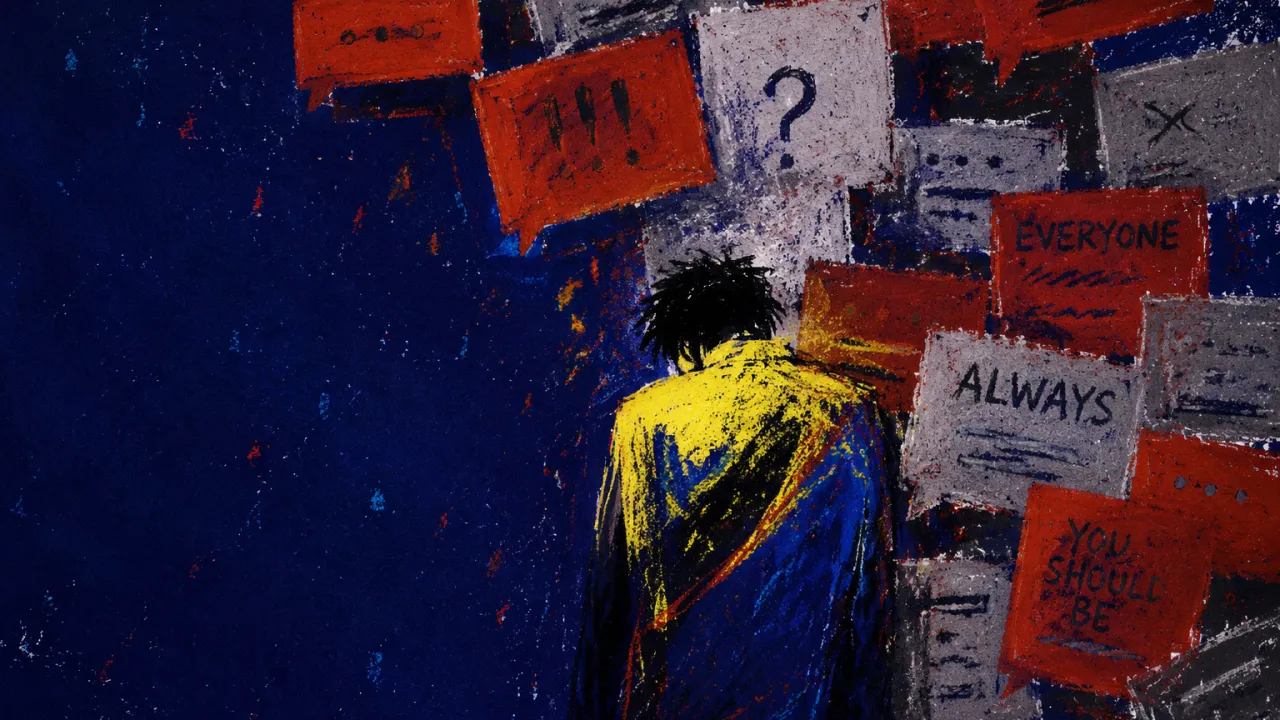
A solitary figure faces overlapping message panels, shoulders drawn inward as rust-red blocks close across deep indigo space.

What is this situation?

Community Accountability Trial — you first realize you are in one when a disagreement, complaint, or account of harm leaves the original conversation and becomes a shared community matter. A private message becomes a screenshot; a group chat becomes the place where people compare versions; friends, housemates, classmates, coworkers, or mutuals begin asking for a statement before you know what has been said or who is deciding what happens next. You are expected to answer quickly, completely, and in the right tone, yet each response can be reposted, summarized, or treated as further material for discussion. Some people contact you directly, others withdraw without explanation, and others speak about you in channels you cannot see, so the audience grows while your access to the process shrinks. The standards can move from acknowledging impact, to accepting a particular account, to making a public apology, stepping back from spaces, or proving change on a timeline set by people with different roles and expectations. There may be no agreed moderator, no shared record, no clear endpoint, and no separation between the person raising a concern, the people interpreting it, and the people enforcing consequences. Each notification brings your shoulders inward; every invite, event, or online post now has to be read for who is present, what has circulated, and whether another response is being demanded. The daily drain comes less from one conversation than from being continuously visible to a network whose rules and membership keep shifting. You can be asked to participate in accountability while also being denied a stable way to know what accountability requires, much like the figure on the Seven of Wands, standing alone above six raised staffs coming from outside the frame.

Why it's not you?

The problem is not that you failed to produce a flawless response; an informal public process with shifting standards makes any response vulnerable to reinterpretation. When accusation, judgment, and enforcement are distributed across overlapping peer groups, the instability belongs to the process, not to your ability to explain yourself.

Community Accountability Trial in Tarot Cards

During a Community Accountability Trial, each notification can pull your shoulders inward as private conflict becomes shared scrutiny and the audience expands beyond the original conversation. This is an environmental, structural dynamic: access to information narrows while expectations are set and revised across overlapping peer groups. The cards below do not decide who is right; they reflect the visible pressure, unstable boundaries, and one-against-many shape of the situation. These Tarot Cards mirror the contours of that experience.

Justice
Reversed
A seated adjudicator holds balanced scales in one hand and an upright sword in the other, framed by two pillars. Reversed, those instruments remain visible but cease to guarantee a usable process: evidence can be weighted inconsistently, judgment can precede access, and enforcement can operate without a stable adjudicating role. That blocked procedural architecture matches being asked to accept accountability terms that move between impact, agreement, apology, withdrawal, and proof of change. You are not facing a clearly bounded hearing; you are facing a network in which the people interpreting the account may also set the standard and impose the consequence.
Three of Cups
Reversed
Three companions raise their cups inside a tightly coordinated circle, with each body turned toward the shared gesture. Reversed, the intimacy of that circle becomes less available to the absent person and more capable of carrying gossip, alliance, and a mutually reinforced account. That closed friendship circuit mirrors close friends comparing screenshots or discussing what should happen to you before speaking with you directly. The original support network can then become an informal panel, leaving you to manage both the complaint and the loss of reciprocal access to people who previously held private context.
Five of Pentacles
Upright
Two figures pass outside an illuminated window in severe weather, visibly separated from warmth, shelter, and communal resources. The interior remains active, but access to it is no longer shared with the people on the street. That exclusion mirrors close friends withdrawing contact, invitations, practical help, or context after a complaint circulates. You may receive no direct explanation because the friendship network enforces its emerging position through silence and absence, making the loss of support arrive before any clear statement of terms.
Two of Swords
Upright
A blindfolded figure holds two crossed swords before a dark sea dotted with rocks, physically containing two directions while lacking full visual access to either. The stable seated posture preserves a pause, but the obscured landscape prevents that pause from producing complete decision criteria on its own. That structure mirrors choosing whether to respond, wait, withdraw, apologize publicly, or seek direct conversation before you know the full claim or who controls the outcome. You are being pressed to make a legible choice under conditions where each option can be reinterpreted, so the bottleneck lies in unequal information and moving standards rather than a simple inability to decide.
Five of Swords
Upright
One figure gathers swords while two others walk away beneath jagged clouds, turning the aftermath of conflict into an unequal distribution of voice and leverage. The central figure retains the visible instruments of the contest while the withdrawing figures absorb its social cost. That winner-loser structure mirrors an accountability process that shifts from understanding impact toward securing concession, public defeat, or removal from shared spaces. You may be offered participation only on terms that confirm an already dominant account, making further explanation function as another round of conflict rather than a route to repair.
Seven of Swords
Upright
A figure removes five swords from a shared encampment while glancing back, leaving two behind and splitting the visible record. The scene turns access to information into a strategic advantage held by whoever can move material between spaces. That split mirrors friends carrying screenshots, summaries, and private disclosures into side conversations without keeping you inside the same information loop. You remain accountable to the conclusions those conversations produce even as friendship trust, directness, and shared context become resources controlled elsewhere.
Eight of Swords
Upright
A blindfolded, bound figure stands inside a loose ring of swords, separated from a distant structure by wet, uneven ground. The figure is placed at the center of the problem while being denied a full view of the surrounding arrangement. That spatial restriction mirrors being the subject of a community process without access to all claims, channels, decision-makers, or consequences under discussion. You can still have a position and capacity, but the available response path is narrowed by missing information and by rules constructed outside your field of view.
Page of Swords
Reversed
The Page raises a sword while turning into strong wind, with clouds gathering and birds moving high behind the figure. Reversed, that alert posture loses a stable informational target, allowing rapid commentary, reactive messaging, and social surveillance to outrun verification. That atmosphere mirrors the experience of watching every message become portable material for group discussion. You can be expected to answer immediately while mutuals monitor tone, summarize partial exchanges, and circulate conclusions before you know which version of the conflict has reached which audience.
Five of Wands
Upright
Five figures raise intersecting staffs in an open field, with no referee, fixed teams, or agreed direction of play. Their different clothing and competing gestures turn one shared space into a contest of overlapping positions rather than a coordinated process. That decentralized conflict resembles a community trial in which complainants, interpreters, mutuals, and consequence-enforcers act at the same time without clearly separated roles. You can be responding to several versions of the dispute at once, and the visible noise makes it difficult to identify which demand carries authority or what would count as resolution.
Six of Wands
Reversed
A laurel-crowned rider moves through a crowd carrying raised staffs, making public recognition dependent on a visible social audience. Reversed, the crowd remains present but the status resource it can confer becomes unavailable, unstable, or conditional. That reversal mirrors a community conflict in which reputation starts functioning like a public vote assembled from reactions, statements, silence, and association. You may find that prior standing no longer protects access because the same network that once recognized you can now withhold recognition without establishing a formal finding or repair path.
Seven of Wands
Upright
Six staffs rise from below toward a lone figure who holds one staff on uneven high ground. The image places one visible respondent against multiple demands whose owners, relationships, and full positions remain outside the frame. That geometry mirrors a community process in which you remain able to state a position, yet every statement meets another interpretation, screenshot, or demand. The held staff and elevated ground preserve access to your own account; the surrounding staffs reveal that the structural problem is an expanding field of challengers without a shared procedure for deciding when the response is complete.
Eight of Wands
Upright
Eight staffs travel diagonally through open air above a river and distant buildings, with no visible sender, receiver, or gate controlling their movement. The upright scene makes transmission fast and unobstructed, but it offers no corresponding mechanism for checking context before the staffs reach their destination. That velocity mirrors screenshots, summaries, requests for statements, and reaction posts moving across overlapping peer groups while you are expected to answer immediately. The available communication channels are highly efficient, yet the accountability process has no equally efficient method for establishing a shared record, sequencing responses, or declaring that the current round is complete.
Nine of Wands
Upright
A bandaged figure grips a ninth staff in front of a barrier made from eight others, looking sideways as though another approach may still be coming. The upright barrier supplies a boundary and the held staff supplies readiness, but both resources are being maintained through sustained physical attention. That posture mirrors a routine built around anticipating another message, screenshot, invitation change, or demand for clarification. You may remain functional and capable of setting limits, yet the process keeps charging ordinary tasks with defensive preparation, making continuity itself expensive even when no new conversation is occurring.

Community Accountability Trial in Tarot Card Reading Insights

When a Community Accountability Trial turns a private conflict into collective scrutiny, others have brought the same shifting expectations and expanding audience into their readings. The Tarot Reading Insights below show what surfaced across those sessions.

Psychological contexts related to Community Accountability Trial