When the Check-In Becomes Permission: Starting with One Small Step

Finding Clarity When the Check-In Becomes a Permission Slip
I recognized the polished form of accountability-dependent procrastination at once: Alex had a color-coded Google Calendar, a carefully rebuilt Notion tracker, and still no two-minute start. The next Community Accountability Trial check-in had quietly become the permission slip for changing anything that day.
She was twenty-eight, a junior product designer on a hybrid Toronto team, and she described the scene from the previous Tuesday at 8:47 PM on the Line 1 train home. The fluorescent carriage light buzzed above her while the phone warmed her palm and the brakes squealed at the next stop. Her thumb kept scrolling through other members' progress posts instead of opening the two-minute routine note she had already written.
When she settled across from me over coffee, she said, “I keep waiting for the right check-in to make me start. I know what I want to change, but I keep moving it to the next meeting. Planning the change is beginning to feel like the change.”
I could see the weight of it in the way she held her shoulders near her ears. Frustration had gathered in her chest like a subway car stopped between stations: every sign was visible, every route technically open, but no movement arrived. Underneath it, her hands kept searching for a safer platform. She wanted to change her routine now, yet she was waiting for accountability before she acted.
I told her I would not treat the cards as a verdict, a prediction, or a substitute for her judgment. I use tarot as an objective cognitive tool: a way to place a private pattern where we can examine its shape, test its assumptions, and choose a next move. “We do not have to solve your whole healing routine tonight,” I said. “We can make one clear map through the fog, then let you decide where to walk.”

Choosing a Ladder Instead of a Launch Button
I asked Alex to place both feet on the floor, take one ordinary breath, and name the question without improving it. Then I shuffled slowly. The small ritual was a transition from the glowing train screen and the unfinished plans into a moment where we could look carefully at what was already happening.
“Today I am using the Four-Layer Insight Ladder · Context Edition,” I explained. “This is a four-card tarot reflection for a self-reinforcing loop, not a prediction about what will happen to you.”
I explained to Alex, and to anyone reading along, why this spread suited the question. The issue was not a choice between several external options. It was a system that kept feeding itself: a difficult morning led to postponement, postponement brought brief relief, the unchanged routine created more self-doubt, and the next check-in seemed even more necessary. A compact tarot spread could trace the visible expression, the maintenance mechanism, the leverage point, and the practical behavior that might carry the shift forward. A Celtic Cross would add broad contextual layers we did not need. A Past-Present-Future spread would show sequence without showing what kept the loop alive. A Decision Cross would imply that Alex was choosing between options when she was actually trying to begin.
The first position would show the present knot: the routine delay and the planning behavior visible on her screen and in her body. The second would reveal the underlying loop: how the Community Accountability Trial had become a prerequisite. The third would hold the transformation key, where agency could return without requiring Alex to reject support. The fourth would turn that insight into grounded integration: one modest routine experiment she could begin before the next check-in.
Reading the Narrow Field of the Present
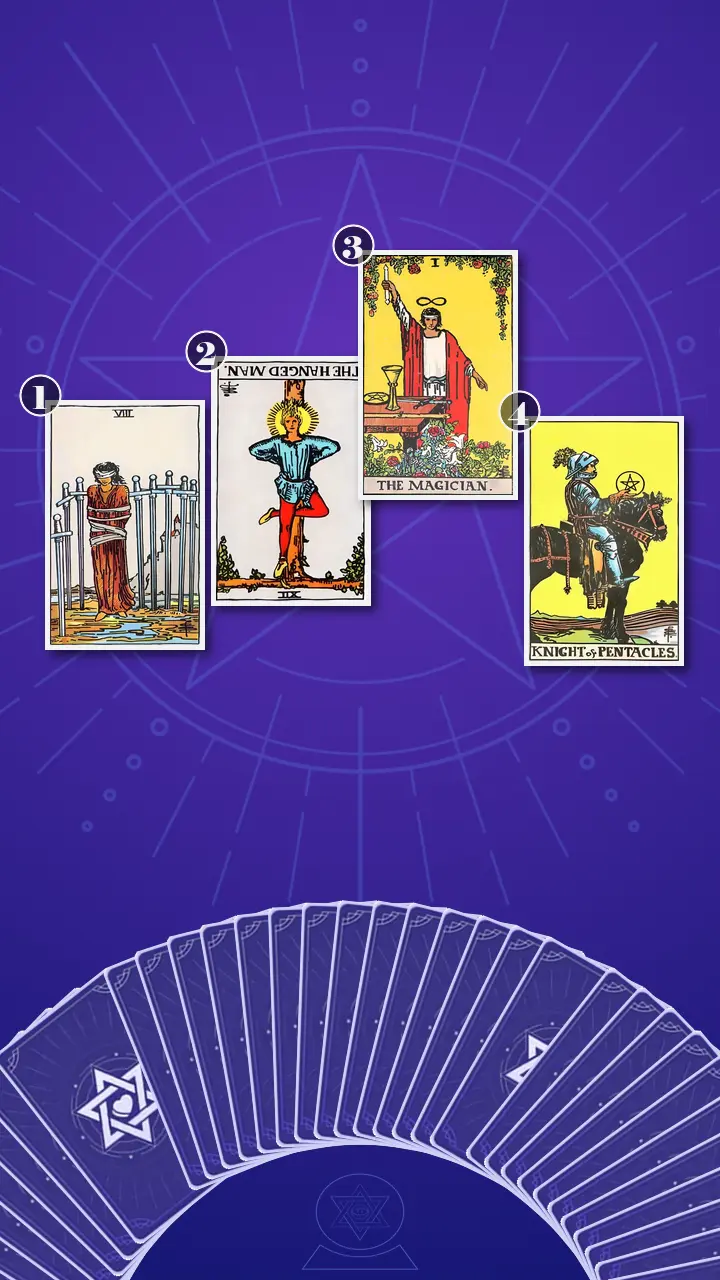
The Eight of Swords: The Present Knot
“Now I am turning over the card for the present knot: the observable routine delay, the planning behavior, and the moment you wait for accountability before acting.”
The card was The Eight of Swords, upright.
I connected it to the scene at Alex's hybrid-work desk: open Figma tabs, Slack reminders, a color-coded calendar, and a carefully formatted tracker surrounding one untouched two-minute task. The blindfold became the rule that the Community Accountability Trial had to initiate the change. The crossed swords became the competing plans that enclosed the present action. Her hands were still editing the system, but her chest tightened whenever the system asked her to begin.
This was Air in a contracted state: an excess of analysis and self-protective rules, with agency narrowed until one external condition looked like the only safe route. The bindings in the image are loose, but that does not mean the situation is easy. It means the card invites a precise question: which part of the delay is an actual constraint, and which part is a rule Alex could test with a smaller move?
I asked her what she usually did after a difficult morning. She listed the familiar sequence: move the reminder, open another productivity video, check the group thread, and improve the tracker. I did not call those actions pointless. They were attempts to create enough order to feel able to start. But they were also keeping the first experiment outside the frame.
Alex did not nod. Her breath paused, her thumb stopped worrying the edge of her phone, and her eyes fixed on the crossed swords as if the card had replayed a private screen recording. Then she gave a small, bitter laugh. “That is too accurate,” she said. “Almost cruel.”
“I hear the cruelty in the pattern, but I do not see a cruel person in it,” I replied. “The point is not to prove that you are incapable. The point is to notice that planning has been doing two jobs: organizing your life and protecting you from finding out whether you can begin without a witness.” Her shoulders stayed raised, but her gaze moved from the card back to me.
The Hanged Man Reversed: The Underlying Loop
“Now I am turning over the card for the underlying loop: the way procrastination turns the Community Accountability Trial into a prerequisite and keeps the routine suspended.”
The card was The Hanged Man, reversed.
I brought in the Sunday kitchen-table scene. Alex had described sitting in her Toronto apartment at 6:12 PM, dragging colored blocks around Google Calendar while rain ticked against the window. The kettle clicked off. The laptop fan hummed. Her wrists grew tense and her legs felt heavy, yet the plan became more elaborate. The next community check-in sat in the future like a starting line, while the current week remained physically still beside it.
Upright, The Hanged Man can make a pause meaningful. Reversed, the pause has become a blockage: a loading screen that has turned into the entire workflow. Alex is still seeking insight through planning, but the planning is no longer generating new information because she has not tested the smallest version of the routine. The bound ankle resembles a reminder tied to a future date; the halo shows that awareness can be present without yet becoming behavior.
I asked, “When you tell yourself you will start after the next check-in, what are you hoping the group will provide: motivation, proof that you are serious, protection from failure, or permission to choose?”
Her fingers tightened around the coffee cup. For a moment, she stared past my shoulder at the rain-dark window, as though watching the calendar move without her. Then she let out a long breath and loosened her grip. “If I start now and miss one day, then I have to face what that means,” she said. “If I wait, I can still say I am preparing. I know that sounds ridiculous.”
“It sounds protective,” I said. “A pause can offer relief without offering direction. Support is not the same as permission, and preparation is not the same as avoidance, but the difference becomes visible only when you observe what the pause produces.” I watched her move the routine reminder on her phone, then stop before saving the new date. That small hesitation was the first sign that the future check-in might be allowed to change jobs.
When The Magician Put the Tools Back on the Desk
The Magician: The Transformation Key
The room grew quieter when I reached the central card. Even the soft clink of the spoon against the coffee cup seemed to fall away.
“Now I am turning over the card for the transformation key: the self-directed shift that can loosen the need to wait while keeping community support available.”
The card was The Magician, upright, the antidote in this reading.
The Magician's raised wand and lowered hand made the movement plain: intention had to meet a practical act. On the table sat the wand, cup, sword, and pentacle, and I translated them into resources Alex already had: a decision, emotional willingness, a clear thought, and one physical cue. Her phone timer, a handwritten sentence, a glass of water, and an open document could all be enough to make a first rough frame. The community chat could remain nearby as feedback. It did not have to be the hand that moved first.
This was balanced agency rather than forced independence. The energy shifted from Air caught in restriction into deliberate initiation. The Magician does not ask Alex to master healing, design a perfect routine, or prove that she will never miss a day. The card asks her to coordinate one available resource with one chosen action.
I then used the diagnostic lens I call Daily Clutter Deconstruction. I do not treat a messy desk, a crowded browser, or a forest of reminders as a moral score. I read physical disorder as a map of psychological noise. Alex's open Figma tabs, Slack badges, saved videos, draft commitment messages, and rewritten trackers were not evidence that she lacked tools. They were the tools scattered across the table, each one asking for attention while none of them completed the routine.
I followed with a quiet Energy Extraction Audit. Moving a reminder, checking a progress thread, and rebuilding a tracker each took a small amount from her baseline energy, but returned no lived information. They created delayed-return anxiety: the promise that the effort would pay off later, after the check-in, after the perfect plan, after she felt more ready. “Self-trust gets a data point in the unobserved minute,” I told her. “That is what has been missing.”
At 8:47 PM on that Tuesday, on Toronto's Line 1, Alex had scrolled through the group's progress posts with a warm phone in a tense palm and moved the routine to the next check-in. The plan became more detailed; the start remained outside the frame. I asked her to imagine the same moment from another angle: the phone timer on the desk, one written cue, one practical object, and the community chat still closed.
Stop treating the reversed Hanged Man's waiting as preparation, and use The Magician's tools to begin a small routine experiment before the next check-in.
Alex's thumb stopped above her phone. For one second, her breath held and her fingers pinched the edge of the card. Then her gaze lost focus; I could see the Line 1 carriage replaying in the tiny reflection of her screen, all that motion around a start she had kept outside the frame. Her jaw worked once. Finally she exhaled, not quite a laugh and not quite a cry, and her shoulders dropped. The release left her briefly unsteady, as if clarity had removed a railing she had been leaning on. Her eyes shone. “So I can still ask for support,” she whispered. “I just cannot make support responsible for moving my hand.” I let the silence stay kind. I asked her to choose one routine within ten minutes, write its smallest version on paper or in her phone, and set a six-minute timer. The action could be two minutes, or thirty seconds if needed. No announcement. No character test. One neutral note about what made it easier or harder. “Now,” I said, “use this new view to remember last week: where could that one private move have changed the moment?”
She looked down at the Magician again, and I watched her face hold both relief and responsibility. This was not a dramatic escape from uncertainty. It was the first bridge from frustrated permission-seeking toward grounded self-trust. The community would still matter, but it would review lived experience rather than authorize the beginning.
The Knight of Pentacles: Grounded Integration
“Now I am turning over the card for grounded integration: the small, repeatable routine experiment that can carry this shift into ordinary life before the next check-in.”
The card was The Knight of Pentacles, upright.
I connected it to a quiet weekday in Alex's Toronto workday. The laptop opens. The same note sits beside the keyboard. Before Slack or the community chat, she completes the smallest version of the routine. The horse in the card is stationary, but I did not read that as failure to move. It was Earth in balance: deliberate pacing, a held pentacle, and a cultivated field that becomes visible through repetition.
“This card is not asking for a perfect streak,” I said. “It is asking for a fixed cue and a modest version you can repeat, observe, and adjust. A missed day is information, not a verdict.” The point was not to transform a two-minute action into another performance standard. The point was to make contact with the routine often enough that the next check-in had something real to examine.
Alex stopped trying to calculate what a successful week would look like. Her eyes moved from the held pentacle to the cultivated field. “I could bring the group the actual friction,” she said. “Not the polished plan. Just what happened.” Her mouth softened into a cautious smile, and her hand, which had been hovering over the tracker, placed one small dot beside the next available morning.
From Planning to Lived Information
The four cards told one coherent story. A difficult morning had narrowed Alex's attention until the next check-in looked like the only starting signal. The Hanged Man reversed showed why the pattern persisted: waiting brought short-term relief from testing self-trust, so the unchanged routine was later used as proof that external structure had been necessary. The Magician revealed the available resources already on the desk, and the Knight of Pentacles gave them a quiet rhythm.
The cognitive blind spot was not a lack of care or discipline. It was the assumption that a better plan would protect Alex from the uncertainty of beginning. The key shift was simple: start one deliberately small routine change before the next check-in, then use accountability to reflect and adjust rather than authorize the first step. The emotional transformation would not be instant certainty. It would be a movement from planning as permission-seeking to action as information, and from outsourced initiation to grounded consistency.
I told Alex that accountability was allowed to remain part of her support system. She did not have to abandon the group to prove independence. The group could function like a design review: useful after a version existed, capable of offering perspective, but not responsible for making the first mark. The querent, not the cards or the community, remained the author of the next move.
The One-Corner Experiment
I gave her three small next steps. Each one was designed to be useful even if the full routine never appeared, because the goal was contact with reality rather than another impressive plan.
- Make the first move private.On one weekday morning, before opening Slack, Discord, or the community chat, write one sentence: “For two minutes, I will...” Set a phone timer and complete only that version. Then record one neutral observation in the existing tracker, such as what made starting easier or harder.If two minutes feels too demanding, use a thirty-second version. Keep the first attempt private if that lowers performance pressure; the group does not need to define the pace.
- Create a cultivated baseline.Within the next forty-eight hours, use my 15-Minute Physical Anchor Experiment: reorganize one minimal physical corner of the desk, place one visible routine cue there, and stop after fifteen minutes. Attach the same cue to opening the laptop or closing a design file, then repeat the smallest routine version three times before the next check-in.Do not reorganize the whole apartment. A laptop corner, a water glass, or one clear square of desk is enough. Mark completion with a simple dot, not a percentage or a streak count.
- Bring lived data to the check-in.At the next meeting, use a neutral review: “I tried this version, this was the actual friction, and this is the smallest adjustment I am considering.” If one day was missed, record it without moving the entire routine into the future.Treat the check-in as a feedback appointment, not a launch event. Share only the level of detail that feels appropriate, and let the group respond to what you actually tested.

A Dot, Not a Verdict
Three days later, I received a message from Alex: “I did the two-minute version before Slack. The next morning I woke late and still wanted to move it to the check-in. I did the thirty-second version instead, then logged one dot. I was proud, and still a little scared.”
I read the message over my morning coffee and pictured the physical corner she had described: one cleared patch of desk, one note, one timer waiting without demanding a performance. The change was small enough to be almost ordinary. That was its strength. Alex had not solved her entire routine or guaranteed a perfect week. She had created evidence that a private beginning could exist before public accountability.
At the next check-in, she brought the friction instead of a polished commitment message. The group helped her adjust the cue. The conversation had changed because she arrived with lived information. The cards had not made her act. They had helped her see the difference between support and authorization, and she had chosen what to do with that distinction.
When a missed morning leaves your limbs heavy, it can feel safer to keep the routine beside the calendar and wait for someone to witness the start. A private two-minute beginning can be data, not a performance; the check-in can be a mirror, not a starting gun.
If your next check-in were simply a place to bring what you noticed, what tiny beginning would you be curious to make privately before then, with one ordinary cue and no perfect story to perform?