The Plus-One Box at 11:58 p.m.
That plus-one box doesn’t feel like logistics; it feels like a spotlight—like everyone will notice what you don’t have.
Taylor said it the second we sat down on the call, like she’d been holding it in her teeth all week.
She was in her Toronto condo, hoodie on, hair still damp from a shower she took “to reset.” It was nearly midnight. The only real light in her living room was the blue-white phone glow bouncing off her cheekbones. She toggled between the wedding website RSVP page and Instagram Stories—engagement reels, ring close-ups, one of those “we bought a house” posts that always seems to show up right after you open an invite. The brightness made her eyes look sore.
Her hands kept doing this small, jittery thing—thumb tapping, then hovering, like her nervous system couldn’t decide whether to hit “Accept” or throw the whole phone across the room. Every time her gaze landed on the RSVP deadline, her throat tightened. Not metaphorically. You could hear it in the way her voice went thinner.
“It’s just an invite,” she told me, and it sounded like she was trying to convince a jury. “So why does it feel like a performance review?”
I let that land. As a radio host, I’m trained to hear what’s underneath the sentence—the rhythm, the catch in the breath. Taylor’s words were fast, but her body was even faster: tight chest, warm phone in her palm, stomach dropping like an elevator when the plus-one field appeared.
“You can be happy for them and still feel weird,” I said. “That doesn’t make you unkind. It makes you human. Let’s treat this like a ‘Journey to Clarity’—not to force a vibe, but to understand what old story the invite is pressing on, and what your next step actually is.”
Choosing the Compass: How Tarot Works with a Celtic Cross Spread
I asked Taylor to take one slow breath—not as a mystical ritual, just as a nervous-system handoff. Then I shuffled, the soft snap of cards steadying the pace of the conversation the way a metronome steadies a song.
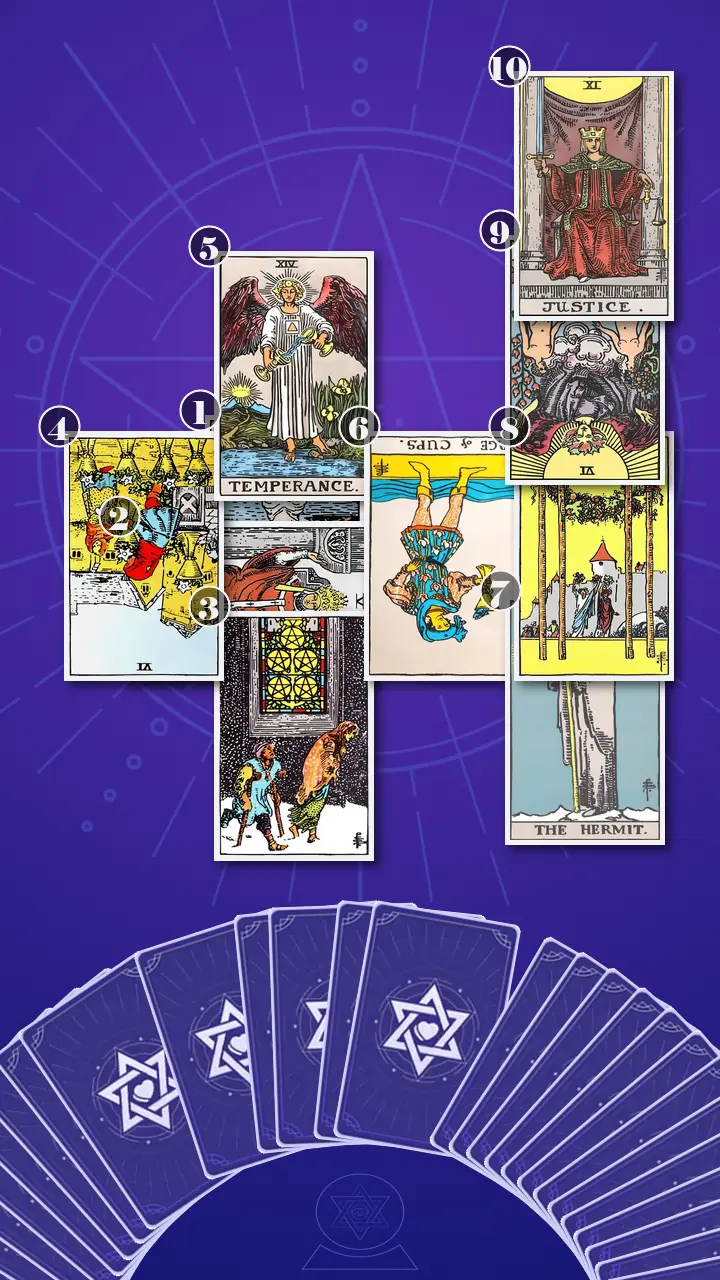
“Today,” I said, “we’ll use the Celtic Cross.”
When people ask me how tarot works, I tell them the most practical truth: a good spread is a map. It’s a structured way to separate what’s happening now from what’s being triggered, what’s old from what’s current, and what’s fear from what’s values. Taylor didn’t need a prediction about whether the wedding would be ‘good’ or ‘bad.’ She needed to see the chain: why does this particular envelope set off timeline panic, decision fatigue, and that sudden urge to overhaul her entire life?
The Celtic Cross is perfect for that because it doesn’t pretend your future is fixed. It shows you: the presenting symptom, the immediate pressure, the deeper root, the recent conditioning, the conscious aim, the near-future emotional pattern, and then—crucially—an integration path. It’s a way to get actionable advice and next steps without making the wedding the villain.
“We’ll start with the center,” I told her. “Card 1 is what your panic looks like in real life the moment the RSVP demands an answer. Card 2 crosses it—what pressure or ‘should’ gets laid right on top of you. Then we’ll drop to the root and climb toward a decision you can respect.”
Reading the Map: The RSVP Spiral in Real Time
Position 1 — Presenting symptom: the moment your thumb freezes
“Now flipping,” I said, “is the card that represents how the panic shows up behaviorally the moment you face the invite.”
Two of Swords, reversed.
In the classic image, someone sits with a blindfold on, swords crossed over the heart, water behind them—still on the surface, but heavy with what’s not being said. Reversed, that calm stalemate doesn’t stay calm. It leaks. It turns into overwhelm.
“This is like when you have the RSVP page open on your phone while your brain runs two competing scripts—‘go and prove you’re fine’ vs ‘don’t go and avoid being seen’—and the stillness turns into pressure,” I said.
I watched Taylor’s face change in a way that was almost automatic: a tiny, tense laugh that broke into a long exhale. “Oh my god,” she said, half amused, half wrecked. “That’s… kind of brutal.”
“It’s honest,” I told her gently. “And it’s not a character flaw. It’s a protection strategy.”
Reversed Two of Swords is an Air energy excess: too much thinking, not enough settling. It’s the feeling of reopening the invite, typing and deleting a response, asking friends what they’d do, and still not choosing—because every option feels like it exposes you.
“When this card shows up reversed,” I added, “there’s also an overcorrection risk. You might snap-RSVP just to be done, then overcommit socially. Or you might decline and then isolate. Either way, it’s a decision made to end discomfort—not to support you.”
Position 2 — Immediate challenge: the invisible rulebook
“Now flipping is the card that represents the external script or pressure the invite activates—the ‘should’.”
The Hierophant, upright.
“This is the Rulekeeper,” I said. “Tradition. Institutions. Milestones. The whole unspoken vibe of ‘there is a correct timeline, and everyone else got the memo.’”
I used an image Taylor would recognize instantly. “This is like when you read the RSVP and suddenly feel you’re being graded by an invisible panel on whether you’re ‘doing adulthood right,’ even if nobody actually said that out loud.”
And then I did what I often do on-air when a guest is spiraling: I named the split-screen.
“On the left side of the screen,” I said, “you’ve got the RSVP page. Cursor blinking. Deadline highlighted. The plus-one box sitting there like a required form field that doesn’t fit your actual life—like software forcing a dropdown when your answer is a paragraph.”
“On the right side,” I continued, “you’ve got The Hierophant voice: ‘Be normal. Be approved. Don’t make anyone uncomfortable. Don’t show up without proof you’re on track.’”
In my head I could hear the Toronto layering that makes this worse: Slack notifications that don’t stop, the group chat with polls about outfits and hotel blocks, someone talking about “three weddings this summer” like it’s a sport, the late GO train home where you scroll because you’re too wired to sleep. Pressure compounds pressure.
“So your choice gets distorted,” I said. “It stops being ‘What supports me?’ and becomes ‘What will look acceptable?’ That’s compliance energy. Not connection.”
Position 3 — Root cause: the old belonging wound under the panic
“Now flipping,” I said, “is the card that represents the older belonging/worth story the trigger hooks into.”
Five of Pentacles, upright.
There’s a reason this card makes people swallow hard. It’s two figures outside in the cold while there’s light and warmth behind glass. It’s not just loneliness. It’s the felt distance between you and warmth.
“This is like the ‘outside looking in’ moment—standing in winter outside a lit restaurant where you can hear laughter through the glass,” I said. “And your body decides, before your brain does: ‘I don’t have a place.’”
Taylor went very still. The kind of stillness that isn’t calm—it’s a freeze. I saw her throat work like she was trying to swallow something bigger than words.
“This isn’t about the wedding,” I said, careful and steady. “It’s about the fear of not having a place.”
Five of Pentacles is Earth energy in deficiency—the nervous system scanning for safety and coming up empty. It’s the stomach-drop when you picture walking into the venue alone and your brain narrates, ‘Everyone has a place except me.’ Even if, in real life, you have friends and community. Being included doesn’t always feel like belonging—and that gap matters.
“Where did you first learn that being ‘without’ means being less-than?” I asked her.
“I… don’t know,” she said, but her voice softened, which told me she knew more than she wanted to say out loud yet.
Position 4 — Recent past: the old romance template that’s getting outdated
“Now flipping is the card that represents the earlier conditioning that’s being reactivated or questioned.”
Six of Cups, reversed.
“This one is subtle,” I said. “It’s not nostalgia as comfort. Reversed, it’s nostalgia as pressure.”
“This is like when you think, ‘If I were lovable enough, I’d already be there,’ which is less about today’s dating reality and more about an older rule you absorbed.”
Six of Cups reversed is a Water energy blockage—sweetness becoming a measuring stick. It can also trigger the classic overcorrection: fast-tracking intimacy, saying yes to dates you don’t want, performing happiness online, trying to recreate a ‘perfect timeline’ so you can feel caught up.
Taylor pressed her lips together. “I downloaded Hinge last night,” she admitted, like a confession. “Not even because I wanted to date. Just… to feel like I was doing something.”
“That makes sense,” I said. “Your system is trying to get back in control.”
When Temperance Poured Between Two Playlists
Position 5 — Conscious aim: what you’re reaching for
I let my hands rest on the deck for a second. Even over video, I could feel the atmosphere shift—like when a room goes quiet right before a song’s chorus hits.
“We’re turning over the most important bridge in this reading,” I told her. “The card that shows what you’re consciously aiming for—what you think you should do or feel, and the ideal you’re reaching toward.”
Temperance, upright.
Temperance is an angel making a steady pour between two cups. No drama. No performance. Just measured integration—one foot on land, one in water, a path leading toward a rising sun.
“This is like when you stop asking ‘What should I feel?’ and instead ask, ‘What would help me feel steady if I choose to go, and what would help me stay connected if I don’t?’” I said.
Setup (the stuck moment): Taylor was caught in that exact scene: envelope open, RSVP link staring, her body dropping while her brain negotiated with the plus-one box like it was a referendum on her entire adulthood. In that moment, her mind tried to force a single mood—either cheerful, or detached—because mixed feelings felt unsafe.
Delivery (the sentence that changes the frame):
Stop treating the RSVP like a verdict on your worth; start blending truth and tenderness like Temperance’s steady pour, and let that be how you choose.
I didn’t rush past it. I let the silence do what silence is meant to do: make room.
Reinforcement (the body catches up): Taylor’s reaction came in a small chain, like three beats in a song you can’t un-hear. First: she froze—breath held, eyes fixed on the card as if the image had just said her name. Second: her gaze went a little unfocused, like she was replaying a memory, scanning for every time she’d treated a social milestone like a test. Third: her shoulders dropped, not all at once, but in two soft releases—one shoulder, then the other—as if she’d been carrying grocery bags she didn’t realize were digging into her palms.
“So I don’t have to be… either totally fine or totally spiraling,” she said. Her voice wobbled on the last word, and then she gave a shaky laugh that wasn’t funny—it was relief meeting grief.
“Exactly,” I said. “Temperance is the skill of holding two truths without punishing yourself for having them.”
This is where my own work—sound energy research, music psychology—becomes more than a vibe. I hear Temperance the way I hear a mix: two tracks that don’t need to compete.
“Think of your nervous system like a commute playlist,” I told her. “If you only blast hype music to outrun what you’re feeling, you arrive shaky. If you only play sad songs, you sink. Temperance is mixing two playlists on purpose—one for steadiness, one for courage—so you’re not forcing yourself into one mood.”
Then I brought in my Space Tuning lens—my signature way of reading environments as emotional acoustics. “When you open the invite,” I asked, “where are you usually sitting?”
“On my couch,” she said. “Or in bed.”
“Okay,” I said. “That space has learned the sound of spiraling—phone buzz, tabs flipping, the silence after scrolling. Tonight, before you touch the RSVP again, we’re going to retune the space. Not spiritually—acoustically. Put your phone face down. Turn on one steady sound: a low-volume brown noise track or a slow ambient playlist. The point is to give your body a consistent baseline so your thoughts don’t run the whole show.”
And because her symptoms were so physical—tight chest, tight throat—I added a simple Chakra Sound Therapy tool without turning it into mysticism. “If your throat tightens,” I said, “hum gently on an ‘mmm’ for three slow exhales. Feel it in your lips and chest. That vibration is a direct cue to your vagus nerve: ‘We’re safe enough to choose.’”
Then I asked her, “Now—using this new perspective—can you think of one moment from last week when this insight would’ve made you feel different?”
She looked down at her phone like it was suddenly less powerful. “Thursday,” she said. “I opened it, saw the plus-one box, and immediately went to Instagram. If I’d… blended truth and tenderness, I would’ve just admitted, ‘This makes me feel exposed.’ And then chosen from that, instead of trying to fix my whole life at midnight.”
That was the shift happening in real time: from panic and comparison toward naming the old script with tenderness. From treating the invite as a verdict toward treating it as a prompt for values and self-respect. That’s what finding clarity actually looks like—small, bodily, specific.
Position 6 — Near future: the tender feeling you’re tempted to dismiss
“Now flipping,” I said, “is the card that represents the next emotional pattern likely to arise.”
Page of Cups, reversed.
“This is like when you feel a sudden sting of envy or loneliness and instantly tell yourself you shouldn’t feel that way,” I said, “which makes the feeling louder rather than clearer.”
I described the micro-moment close-up I see all the time in modern dating and milestone pressure: “A sting hits. Then the immediate self-talk: ‘Stop being dramatic.’ Then the rebound behavior: opening Hinge, over-editing a profile prompt, or texting three friends to see who else is going.”
Page of Cups reversed is Water energy in distrust. Not that your feelings are wrong—more that you don’t trust them to be valid unless they’re socially acceptable. So you try to perform composure. And then you wonder why you feel disconnected.
Taylor nodded once, slowly. “I do that,” she said. “I mock myself, and then I’m shocked that I feel worse.”
“Right,” I said. “Your turning point isn’t more thinking. It’s emotional literacy.”
Position 7 — Self stance: the part of you that needs quiet more than advice
“Now flipping is the card that represents how you’re positioning yourself internally—your self-talk and identity lens.”
The Hermit, upright.
“This is like when you turn your phone off for an hour and suddenly know what you want to do,” I said, “not because the fear vanished, but because the noise stopped.”
The Hermit is Earth balanced with Air: solitude with purpose. It’s the opposite of crowdsourcing your decision in the group chat, the opposite of letting the algorithm feed your insecurity once you watch one engagement reel and suddenly your phone serves you fifty more. The Hermit says: you don’t need a hotter take. You need your own lantern.
“Your panic softens when you stop outsourcing the answer,” I told her.
Position 8 — Environment: the social reality (and why it feels so visible)
“Now flipping is the card that represents the social context actually around you.”
Four of Wands, upright.
“This one is almost literal,” I said. “It’s genuinely a communal celebration.”
“This is like when you know you’re invited and included, but the public nature of the event makes you feel exposed, as if everyone can see what you worry you lack.”
Four of Wands is Fire energy in brightness. Warmth, music, photos, toasts. It’s beautiful. And it can also turn up the temperature on comparison. This card matters because it shows the mismatch: externally, there is belonging. Internally, Five of Pentacles tells a story of exclusion. That mismatch is what makes the invite feel like a spotlight even when it’s meant as warmth.
Position 9 — Hopes and fears: longing versus the fear of losing yourself
“Now flipping is the card that represents what you secretly long for—and what you fear it will cost.”
The Lovers, reversed.
“This is bigger than the wedding,” I said. “It’s about values-based commitment—not just to a person, but to a path.”
“This is like when you aren’t only deciding about one event; you’re silently deciding whether you believe love is a place of freedom or a test you have to pass.”
Lovers reversed is Air and Fire out of alignment. It can feel like: If I’m chosen, I’ll have to compromise myself. If I stay true to myself, I’ll be alone. It’s the emotional knot behind timeline anxiety: the fear that belonging requires self-abandonment.
“Temperance says you don’t have to choose between connection and self-respect,” I reminded her. “You can practice both.”
Position 10 — Integration: the clean, self-respecting choice
“Now flipping,” I said, “is the card that represents the healthiest way to hold this trigger and make a self-respecting choice.”
Justice, upright.
Justice sits with scales and an upright sword. Balanced evaluation, then a clean cut. Not harsh—clear.
“This is like when you stop asking, ‘What will people think?’ and start asking, ‘What’s the most honest choice for me—and how do I communicate it cleanly?’”
Justice is Air energy in balance. Not the frantic, leaking Air of Two of Swords reversed. This is Air that can write one respectful sentence and hit send without reopening it twelve times after.
“Clean boundaries beat perfect vibes,” I said. “Your goal isn’t to feel flawless. Your goal is to choose something you’ll respect yourself for.”
The One-Page RSVP Clarity Plan (Truth + Tenderness + a Clean Cut)
I brought the whole spread together for her like a story you can finally follow.
“Here’s the chain,” I said. “The invite hits, and your mind freezes (Two of Swords reversed) because it thinks a wrong choice will expose you. The social rulebook voice gets loud (Hierophant), so the RSVP becomes compliance instead of choice. Under that is an old ‘outside looking in’ imprint (Five of Pentacles) that tells your body belonging is conditional. An outdated romance template flares (Six of Cups reversed), so you try to fast-track proof. Temperance offers regulation—the middle path, the blended playlist—so your feelings can be heard without running the show. Then Justice takes that steadiness and turns it into one clean, self-respecting decision.”
“Your blind spot,” I told her, “is treating the RSVP like a courtroom. Like you owe a defense. But the transformation direction here is simple: regulate first, then choose. The invite is not a verdict. It’s a choice prompt.”
Then I gave her actions—small enough to do on a Tuesday night, specific enough to break the loop.
- The 20-Minute “Temperance Pour” ResetSet a 20-minute timer. In your Notes app, make two headings: “If I go” and “If I don’t go.” Under each, write only two lines: “I want to feel ____.” and “I will protect that by ____.” Do this before you look at the RSVP page again.Expect the thought “This is dumb, I should just decide.” That’s the Two of Swords reversal. Keep it tiny: 20 minutes, not an all-night spiral. If your chest tightens, pause for three slow breaths with a hand on your sternum.
- Pick One Middle-Path Boundary (Not a Fantasy Boundary)Choose one boundary you will actually keep: arrive after the ceremony, leave by 10:30, budget for a rideshare, take a five-minute bathroom break if you get flooded, skip alcohol if it spikes your anxiety, or coordinate with a supportive friend to check in.“Don’t decide while you’re flooded—regulate first, then choose.” If you’re dysregulated, your boundary is to close the tab and come back later.
- The Justice Text: One Clear Sentence + One Warm SentenceSend the RSVP or text with clean communication—no paragraphs, no apology spiral. Example yes: “Thank you so much for inviting me—I’d love to celebrate you. I’ll be there, and I’m planning to head out around 10:30.” Example no: “I’m so grateful you included me—I won’t be able to make it, but I’m cheering you on and would love to take you out for a toast after.”If you’re prone to over-explaining, draft it, wait 10 minutes, then send it with zero extra justification unless it makes it simpler.
And because sound is my native language, I offered one optional layer that matched her body symptoms without adding pressure: my 21-Day Sound Bath strategy.
“For the next three weeks,” I said, “do a daily three-minute sound reset before you open anything wedding-related. Put on one grounding track—slow ambient, gentle piano, or brown noise. While it plays, hum softly on your exhale. You’re teaching your body a new association: the invite doesn’t equal danger.”
“That’s… doable,” Taylor said, and I heard something new in her voice: not hype, not perfection—just steadiness.

A Week Later: Ownership, Not Certainty
A week later, Taylor texted me a screenshot: her RSVP confirmation, sent without the usual hour of rewriting. Under it she wrote, “I’m going. I’m leaving by 10:30. And I already budgeted a rideshare so I don’t have to do the TTC-spiral on the way home.”
Then, almost as an afterthought: “I still woke up this morning with ‘what if I look pathetic?’ in my head—but I didn’t obey it. I put on the playlist, did the humming thing, and it passed.”
That’s what a real Journey to Clarity looks like. Not the absence of fear—just the first quiet proof of self-trust. A clean choice. A boundary you’ll actually keep. A nervous system that learns you won’t abandon it.
When a wedding invite hits your inbox and your chest tightens, it’s not because you’re ‘bad at being happy for people’—it’s because part of you is terrified that being seen without a neat timeline means you don’t truly belong.
If you treated the RSVP as a chance to practice self-respect (not self-proof), what would your most honest yes—or your cleanest no—sound like this week?
This story is adapted from psychological research, written so that those in a similar struggle can see their own pattern in it — and find their next step clearly.These insights are not a substitute for professional psychological, medical, legal, or financial advice.
Learn more about our Journey to Clarity.
How did this insight land for you?
🫂 This Resonates Deeply
🌀 Living This Story
✨ Now I See Clearly
🌱 Seeing New Possibilities
🧰 Useful Framework
🔮 The Confirmation I Needed
💪 Feeling Empowered
🚀 Ready for My Next Step
Author Profile
 AI
AI“Through ten years of sound energy research, I’ve found that when we struggle, it's usually just our internal rhythm falling out of sync under pressure. I know firsthand the frustrating helplessness of wanting to move forward but feeling paralyzed. Without overwhelming theories, I want to be the soothing background track that helps you recalibrate, turning your heavy burdens back into a light, effortless, and harmonious melody.”
In this Personal Growth Tarot Reading :
Core Expertise
Service Features
Also specializes in :
Explore Related Patterns:
Boundary DiscernmentTaylor's final RSVP includes a concrete boundary: she is going, leaving by 10:30, and budgeting a rideshare so the night does not take over her nervous system. The choice is not perfect confidence; it is a structure she can actually keep. That boundary separates connection from self-abandonment. You can celebrate someone else without letting the event dictate your timeline, your relationship status, or your capacity for the whole evening. Boundary Discernment is the skill of choosing a clean yes or a clean no with enough protection to respect yourself afterward. The old story loses power when the decision is no longer about proving you are fine, but about acting in a way you can stand behind.
Comparison TrapThe RSVP page sits beside Instagram Stories full of rings, engagement reels, and house posts, so the invite arrives inside a comparison chamber. Your attention is not just on the wedding; it is on a feed that makes other people's milestones look like evidence that your life is behind. The cognitive distortion is selective measurement. The mind takes curated moments from other people and uses them as a scoreboard for your own belonging, desirability, and progress. Comparison Trap turns celebration into self-audit. The old story under the panic is that someone else's visible certainty makes your unfinished timeline look like failure.
Exclusion SpiralThe plus-one box feels like a spotlight because it activates the image Taylor names through the Five of Pentacles: being outside the warmth, looking in. Even though the invite is evidence of inclusion, your body can still read the setting as proof that everyone else has a place and you are arriving without one. The mechanism is a belonging filter. Present facts get pulled through an older imprint of exclusion, so the wedding is no longer just a celebration; it becomes a scene where you imagine your lack will be noticed before your presence is welcomed. Exclusion Spiral is the loop where inclusion does not feel real enough to interrupt the fear of being outside. The panic is old-story energy: not 'I am not invited,' but 'I can be invited and still feel like I do not belong.'
Relationship PerformanceThe plus-one field turns relationship status into something Taylor imagines everyone can see. The panic spikes because the RSVP no longer asks only who is attending; it seems to ask whether you can present a socially legible version of love, progress, and being chosen. That pressure creates a performance stance. Going can become a way to prove you are fine, while declining can become a way to avoid being seen without the proof you think the room expects. Either move is shaped less by desire than by the imagined audience. Relationship Performance names the pattern of treating intimacy as public evidence rather than private reality. The old story is that love has to be visible and approved before you are allowed to feel secure in yourself.
Social Clock ComplianceThe RSVP page, the plus-one field, and the engagement-heavy Instagram feed turn a simple wedding invite into a social timeline audit. The pressure is not only whether to attend; it is whether you can appear to be at the expected adult checkpoint when the room looks full of couples, plans, and visible proof. That is why the invite starts to feel like a performance review. The mind shifts from 'What choice supports me?' to 'What choice will make me look acceptable?' and the nervous system treats the deadline as if it were a verdict on your maturity, desirability, and belonging. Social Clock Compliance shows up when an external milestone becomes louder than your actual values. The old story underneath the panic is not that you dislike weddings; it is that being off-template can feel like being publicly graded.
Emotional RegulationTaylor's shift begins when she stops trying to force herself into one clean mood and starts making room for mixed truth. She can be happy for the couple, feel exposed by the plus-one box, and still make a grounded decision. The breath, playlist, humming, and 20-minute notes exercise all serve the same function: they move the decision out of panic chemistry and back into reflective choice. You are not trying to delete the feeling; you are giving it enough containment that it does not run the whole RSVP. Emotional Regulation is the pattern that turns the invite from a threat signal into a choice prompt. The old story may still speak, but you do not have to obey it before your body has had a chance to settle.
Emotional GatekeepingTaylor names the sting of envy or loneliness and then immediately tells herself she should not feel that way. The feeling itself is not the whole problem; the second hit is the internal rule that only socially acceptable emotions are allowed. That creates a split between emotional truth and performed composure. You try to seem generous, detached, or fine before the feeling has been listened to, which makes the emotion louder rather than clearer. Emotional Gatekeeping is the habit of screening your own feelings for acceptability before granting them legitimacy. The old story is that certain emotions make you unkind, dramatic, or exposed, so you police them instead of using them as information.
Reactive OvercorrectionTaylor downloading Hinge at midnight is the clearest signal: she does not actually want to date in that moment; she wants to feel less behind. The action is less about desire and more about regaining control after the invite makes her feel exposed. The same mechanism appears in the risk of snap-RSVPing just to end discomfort, overcommitting socially, declining and isolating, or fast-tracking intimacy to manufacture proof. These moves temporarily reduce panic while pulling you away from what you actually want. Reactive Overcorrection is what happens when the nervous system mistakes movement for alignment. The old story says 'fix the gap immediately,' so you reach for a dramatic corrective action instead of a grounded choice.
Analysis ParalysisTaylor's thumb hovering over the RSVP captures the whole loop: the body wants relief, the mind wants certainty, and every possible answer feels like it exposes something. The page stays open because choosing yes or no has become emotionally loaded beyond the actual logistics. The defense here is more analysis. Reopening the invite, typing and deleting, asking friends, and scanning for the correct response all promise safety, but they keep the nervous system inside the same threat frame. Analysis Paralysis appears when thinking becomes a way to delay the vulnerability of choosing. The old story is that a wrong move will reveal you, so the mind keeps searching for an option that carries no emotional risk.
Explore Related Struggles:
Clarity-Exposure SplitThe RSVP page sits open while Taylor reopens, types, deletes, asks friends, and still does not choose. The website is not the hard part. The hard part is that either answer seems to make something private visible, so even clarity starts to feel risky. You stay in the loop because delay gives temporary cover. A clean decision would end the spiral, but it would also make your position legible: going, not going, alone, visible, explainable. The struggle is the moment self-trust gets tangled with exposure, and the mind keeps postponing the answer to avoid being seen by it.
Identity Verdict LockTaylor says it is just an invite, but her body reacts as if she has been called into a performance review. The RSVP page becomes a courtroom, the plus-one box becomes evidence, and even a yes or no starts to feel like it will reveal whether she is passing adulthood. You get locked when a practical choice is forced to carry an identity verdict. The panic is not coming from the wedding itself; it comes from the belief that the choice will prove something final about your worth, desirability, or progress. Until that verdict-making frame is seen clearly, every option feels too exposed to choose cleanly.
Outsider Identity LockTaylor is genuinely invited, but the image that lands hardest is not the venue or the RSVP deadline; it is the feeling of standing outside the warmth while other people seem to have a place inside. The plus-one box presses on a story where being without something visible starts to feel like being without belonging. You can be included on the list and still feel outside the glass. That is the lock here: the outer world offers entry, but the body keeps scanning for proof that entry is conditional. The wedding invite triggers panic because it turns an old belonging wound into a live social scene where you might have to be seen before you feel securely placed.
Social Clock EntrapmentThe invite appears alongside engagement reels, ring close-ups, and house posts, so the RSVP stops being a calendar item and becomes a timeline audit. Taylor is not only deciding whether to attend a wedding; she is suddenly being measured against an invisible rulebook of adulthood. You feel trapped when a social milestone starts acting like a deadline for your own life. Under that pressure, the question shifts from what would support me to what will look acceptable. The old story is not simply that other people are ahead; it is that there is a correct pace, everyone else knows it, and falling outside it makes your life feel publicly unfinished.
Visibility-Isolation SplitTaylor's thumb hovers because both paths carry a cost: go and be seen, or do not go and avoid the spotlight. The wedding is warm on the outside, but its public brightness makes the private fear louder, especially around arriving without the proof she thinks people will notice. You are caught in a split when visibility feels like exposure and withdrawal feels like disappearance. The invite triggers panic because there is no neutral social position inside that old story. Showing up risks being inspected, while staying away risks confirming the very isolation you were trying to protect yourself from.
Belonging-Authenticity SplitThe wedding invite opens into a larger question when Taylor names the fear beneath it: if she is chosen, she may have to compromise herself; if she stays true to herself, she may end up alone. That is why the RSVP feels bigger than one event. It touches the belief that belonging always asks for a piece of the self as payment. You are trying to find connection without abandoning your own pace, boundaries, or truth. The panic sharpens when the social rulebook makes those needs look incompatible. The deeper work is not to force yourself into confidence, but to notice where your old story treats love as a test instead of a place where self-respect can remain intact.
Explore Related Emotions:
Belonging ShameThe strongest image in Taylor’s reading is being outside in the cold while warmth and laughter sit behind glass. Even though she has been invited, her body tells a different story: everyone has a place except me. You can hear Belonging Shame in the gap between external inclusion and internal exile. The wedding says come celebrate, but the plus-one box presses on an older belief that belonging is conditional, that being without a partner means being without proof, and that being without proof makes you smaller in the room. The old story is not that you are alone; it is that being visibly without something makes you less worthy of warmth. Naming that distinction matters because it lets you challenge the shame directly instead of treating the whole wedding as the enemy.
Rulebook ShameThe invite activates an invisible rulebook: be normal, be approved, do not make anyone uncomfortable, do not show up without proof that you are on track. Taylor never says anyone at the wedding explicitly demands this, but her body responds as if the rule has already been posted on the wall. You can recognize Rulebook Shame in the shift from What supports me? to What will look acceptable? The problem is not tradition by itself; it is the way the social script turns a celebration into a compliance test and makes self-respect feel like a risky deviation. The old story says there is one approved version of adulthood, and being outside that version deserves embarrassment. Once that story is visible, you can choose from your actual values instead of performing for an imaginary panel.
Social Exposure DreadThe plus-one box feels to Taylor like a spotlight, and her thumb hovers because pressing Accept seems to make her visible in a way she cannot control. The wedding is warm on the outside, but inside her body it becomes a room where everyone can supposedly see what she worries she lacks. You are looking at Social Exposure Dread when being invited does not register as simple inclusion. The public setting, the photos, the tables, the couples, and the implied plus-one all turn visibility into inspection, as though showing up alone would give the room permission to read your private life. The old story here says that being seen without the right proof is unsafe. Once that story is named, the wedding can stop being an imagined audit of your value and become a real event with real choices, boundaries, exits, and moments of support.
Timeline PanicThe RSVP deadline makes Taylor’s throat tighten, and the plus-one field hits her body like a drop through the floor. What looks like a simple form becomes a compressed timeline check, where attending alone seems to expose not just her relationship status but the pace of her entire adulthood. You can see Timeline Panic in the way the invite instantly widens into Hinge downloads, Instagram comparisons, and the thought that she should fix her whole life before midnight. The panic is not random; it is the body reacting as if one social milestone has become evidence that she is behind, visible, and running out of time. The old story underneath is that life has a correct schedule and falling outside it makes you less legitimate. Naming that gives you room to separate an RSVP deadline from a life deadline, so the next choice can come from self-respect instead of emergency self-proof.
Verdict DreadTaylor calls the invite a performance review, and later the reading names the RSVP as a courtroom where she feels she owes a defense. That language matters because her body is not treating the question as Do I want to go? It is treating it as What will this prove about me? You can feel Verdict Dread in the typing, deleting, reopening, and mentally rehearsing every possible response. The pressure comes from the imagined ruling attached to each option: accept and be seen, decline and look avoidant, go alone and appear exposed, bring someone and perform being fine. The old story says choices are not choices; they are evidence. Seeing that structure returns some agency, because a clean RSVP does not have to be a closing argument for your worth.
Cautious Self-TrustA week later, Taylor sends the RSVP without the usual hour of rewriting, chooses to leave by 10:30, and budgets for a rideshare so the way home does not become another spiral. The fear still shows up the next morning, but she does not organize her whole day around obeying it. You can see Cautious Self-Trust in that detail: she does not need total confidence before acting. She trusts herself in a practical, limited, believable way by setting a boundary she can keep and using the playlist and humming when the old thought comes back. The old story says safety comes from being approved by the room. The new evidence says safety can also come from staying loyal to yourself before, during, and after the choice.
Comparative JealousyTaylor toggles from the RSVP page to Instagram Stories, where engagement reels, ring close-ups, and house posts appear right after the invite. The timing makes the screen feel loaded, as if every image is quietly asking why her life does not look like that yet. You can hear Comparative Jealousy in the sting she tries to dismiss as soon as it arrives. The feeling is not cruelty toward other people’s joy; it is the private ache of seeing visible milestones used as a mirror against your own life. The old story says other people’s happiness is evidence of your delay. Once that comparison is named, the sting can become information rather than a command to download an app, perform progress, or rush toward proof you do not actually want.
Grounded AgencyThe reading gives Taylor one clean sequence: regulate first, then choose. That reframes the RSVP from a verdict into a choice prompt, and the action becomes concrete enough to hold: one clear sentence, one warm sentence, one boundary she will actually keep. You can feel Grounded Agency in the move away from apology spirals and over-explaining. Taylor is no longer trying to earn permission from the imagined panel; she is making a decision that can survive contact with her real body, real limits, and real values. The old story says the room decides what your choice means. Grounded Agency says you can decide what your choice is for, communicate it cleanly, and let that be enough.
Hard-Won ComposureTaylor’s shoulders drop in two small releases after she hears that she does not have to be totally fine or totally spiraling. The shift is physical first: breath, shoulders, voice, the phone suddenly feeling less powerful in her hand. You can feel Hard-Won Composure in the way steadiness arrives without erasing the trigger. She still has mixed feelings, but the Temperance frame lets truth and tenderness sit together, giving her enough room to choose without forcing a perfect mood. The old story loses some control when the body no longer has to rush into proof, avoidance, or performance. Composure here is not a polished mask; it is the earned ability to stay present with discomfort long enough to hear what you actually need.
Choice Paralysis OverwhelmThe RSVP page stays open while Taylor’s mind runs two competing scripts: go and prove you are fine, or do not go and avoid being seen. Her thumb hovers, the tabs keep switching, and even asking friends does not create a choice that feels clean. You can see Choice Paralysis Overwhelm in the mismatch between the form and the feeling. The website wants a dropdown answer, but her inner reality is a paragraph full of exposure, comparison, old belonging pain, and fear of choosing wrong. The old story underneath says every option carries a hidden cost. Breaking the loop starts when the decision is made smaller again: not Who am I in everyone’s eyes? but What can I choose and still respect myself for tomorrow?
Solitary ClarityTaylor is asked to turn the phone off, stop outsourcing the answer, and step away from the group chat, the algorithm, and the endless second opinions. The quiet is not framed as disappearance; it is the first place where her own answer can become audible. You can recognize Solitary Clarity when naming This makes me feel exposed replaces scrolling, Hinge, and over-editing. The clarity does not come from having no fear. It comes from removing enough noise to tell the difference between fear, values, and performance. The old story says the answer lives outside you, in what other people would do or think. Solitary Clarity gives the answer back to your own lantern, one steady choice at a time.
Explore Related Contexts:
Couple Performance PressureThe plus-one field makes Taylor’s relationship status feel visible before anyone at the wedding has said a word. The pressure is not simply that she may attend alone; it is that the format seems to turn couplehood into a public credential. The surrounding environment reinforces that cue: engagement reels, ring photos, wedding logistics, group chatter, and the bright social stage of the celebration. In that setting, partnership can appear to carry social proof, while arriving without it can feel like arriving without the expected badge. Couple Performance Pressure fits because the external demand is performative: look paired, look settled, look like your life is progressing in the recognizable way. You do not have to accept that metric, but naming it helps you stop treating the RSVP as a referendum on your desirability or adulthood.
Quarter-Life CrisisTaylor’s reaction expands far beyond one RSVP: the invite sets off timeline panic, decision fatigue, and the sudden urge to overhaul her entire life. That scale matters because the wedding is acting as a young-adult checkpoint, not just a social event. The story gathers several pressures into one screen: the plus-one box, Instagram milestones, house-buying posts, the idea of being graded on adulthood, and the fear of being seen without a neat timeline. Together, those pressures create the feeling that a single choice is exposing a larger life-stage gap. Quarter-Life Crisis fits because Taylor is confronting the collision between public milestones and a less linear personal path. You do not need to solve your whole life from an RSVP page; the useful move is to separate the actual decision from the broader stage-of-life audit it has activated.
Rigid Life Script Lock-InTaylor names the invite as feeling like a performance review, and the reading frames the pressure as an invisible rulebook: be normal, be approved, do not show up without proof that you are on track. That is a social script, not a private flaw. The wedding invite becomes loaded because it sits inside a narrow template for adulthood where partnership, milestones, and public ease are treated as signs of correctness. When the RSVP asks for a clean answer, the surrounding script asks for something much larger: evidence that her life follows the expected sequence. Rigid Life Script Lock-In fits because the old story being triggered is not only about romance; it is about a prescribed path that makes off-script adulthood feel exposed. You regain leverage by recognizing the script as external, then choosing from values rather than from the demand to look approved.
Social Clock PressureTaylor is staring at a wedding RSVP near midnight while the plus-one box makes her feel measured by what her life does not currently display. The invite is not functioning as simple event logistics; it is acting like a social timestamp, asking whether her relationship status, adulthood markers, and public presentation line up with the timeline around her. The pressure intensifies because the story places the RSVP beside engagement reels, ring close-ups, and a house-buying post. Those are not private doubts appearing in isolation; they are visible milestone signals circulating through her social field, turning one wedding into a wider comparison structure. Social Clock Pressure fits because the conflict is organized around a culturally enforced sequence: partner, plus-one, wedding season, home, proof of progress. You are not being asked to believe that timeline is true; the point is to notice how strongly it can distort a practical choice when the external world keeps presenting it as the normal route.