Three Rereads, Two Renamed Folders, Then One Question Sent to a TA

Finding Clarity in the 8:40 p.m. Tab Switch
I knew the pattern before Jordan (name changed for privacy) named it: if most of your studying happens between a shared apartment and a busy campus library, and the first confusing paragraph sends you into file-cleaning, class-chat checking, or a "study with me" video, you know productivity procrastination from the inside.
At 8:40 p.m. on a Tuesday, Jordan appeared on my screen from their shared Toronto apartment. Their assigned reading glowed beside a color-coded weekly plan. A roommate's dishes clinked in the kitchen, and the laptop fan warmed the skin beneath Jordan's wrists.
They had reread the same paragraph three times, renamed two folders, checked the class group chat, and moved the study block to tomorrow. "I want to study consistently," they said, "but I keep preparing to study instead of actually studying. I should understand it before I ask anyone."
The frustration hung from their shoulders like a wet winter coat. Each time the cursor approached the unclear paragraph, a restless pull seemed to drag their hand toward an easier tab. I told them, "I am not here to grade your discipline or predict your academic future. I want us to find the exact point where the work changes from difficult to avoidable, then draw a map through it."

Choosing a Ladder Through the Fog
I invited Jordan to take one slow breath and hold a single question in mind: "What happens in the thirty seconds before I leave difficult work?" I shuffled slowly, using the pause as a transition from self-judgment into observation. Nothing about the ritual required belief in fate. Its purpose was to narrow the field of attention.
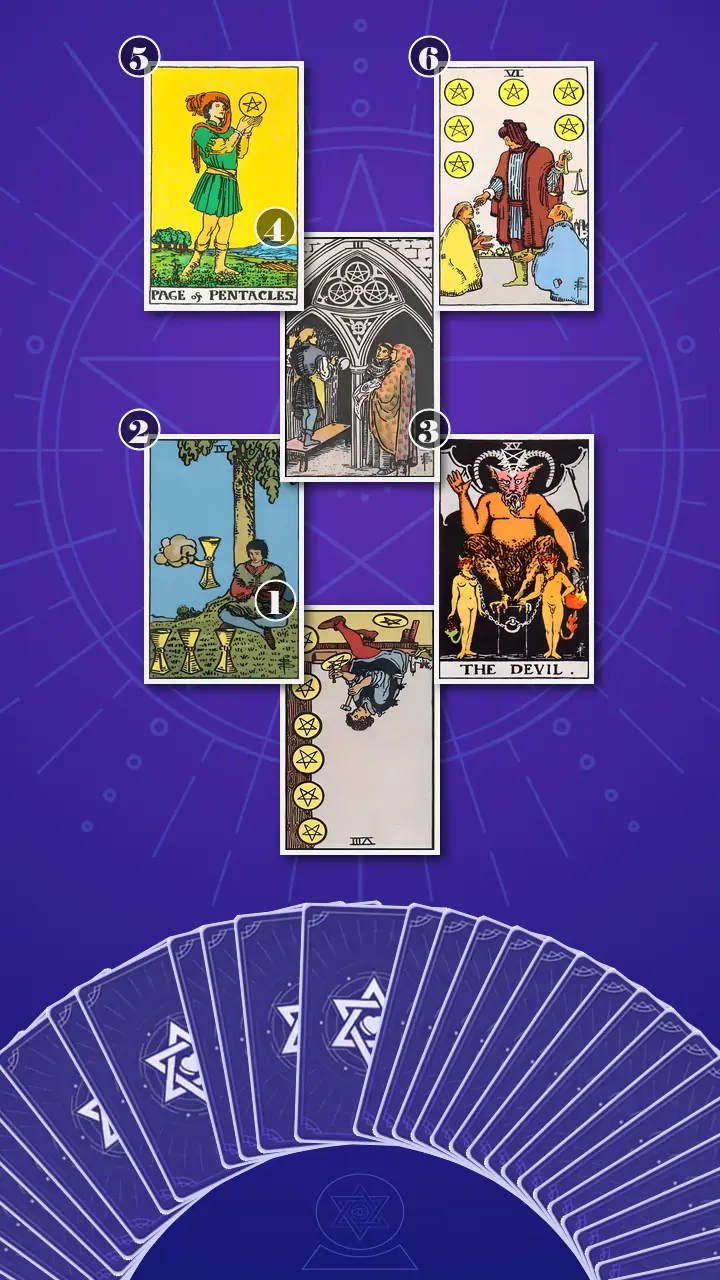
I chose the Four-Layer Insight Ladder · Context Edition, a six-card tarot spread for study procrastination, academic support, and focused practice. I explained to the reader in me, as much as to Jordan, why this structure mattered: a broad spread would produce more material than this focused problem needed, while a purely shadow-oriented spread might reveal the fear without showing how to redesign the response. This ladder could trace the whole system without pretending to predict a grade.
I placed the first card at the bottom for the observable study-delay behavior. Above it, I set two root cards: one for the help Jordan was not registering and one for the repeating mechanism that kept the delay in place. The center card would identify the leverage point. The final pair would show how to combine one focused independent action with proportionate support.
This is how tarot works in my practice: the cards turn a fast, emotionally loaded sequence into a visible arrangement. Card meanings in context give us something objective enough to examine together. Jordan would remain free to accept, challenge, or revise every interpretation.
The Workbench Beneath the Productivity Theatre
Position 1: The Work That Looked Ready
I began with the position representing Jordan's observable study-delay behavior: substituting organization, scrolling, and rescheduling for direct contact with difficult academic work. I turned over the Eight of Pentacles, in reversed position.
The upright card usually depicts the patient repetition through which skill becomes competence. Reversed, its workbench looked exactly like Jordan's 8:40 p.m. study block: the assignment stayed open while headings were adjusted, folders were renamed, and tomorrow's timetable became more polished. The activity was real, but it stopped precisely where learning required an uncertain attempt or a named question.
I read the reversed Earth energy as a blockage made from two imbalances: an excess of preparation and a deficiency of direct practice. Jordan was not doing nothing. They were putting effort into tasks that created the appearance and temporary feeling of readiness without producing information about the difficult paragraph.
"The thought underneath it sounds like, 'If I can just fix the setup, then I will be ready to start properly,'" I said. "The setup is not pointless. It lowers the pressure for a moment. But looking prepared and building the skill are different jobs."
Jordan gave a short laugh that carried no amusement. Their thumb pressed into the edge of their mug. "That is so accurate it feels a little brutal."
I slowed down. "Then let us keep the accuracy and remove the brutality. This strategy has been protecting you from the exposed feeling of not knowing. We can respect why it developed while still measuring its cost." I asked what they had done immediately after reaching the first sentence they could not work through. Jordan looked at the reading tab and answered, "I opened Notion."
Position 2: The Support Tile Outside the Frame
I moved to the first root position, which reveals the academic resource blind spot beneath the delay: Jordan's attention remained fixed on unfinished work and self-judgment while available help failed to register as relevant. I turned over the Four of Cups, upright.
I pointed to the figure staring at three cups while a fourth is offered from outside their narrowed field of vision. In Jordan's study session, the three familiar cups were the unfinished assignment, the revised schedule, and the comparison feed. The fourth was the tutoring link, office-hours post, feedback channel, or class contact sitting in the course portal at the same time.
"Help exists," Jordan said quietly, finishing the thought before I could, "but it probably is not for a problem this basic."
I read the Water energy here as withdrawal in excess and receptivity in deficiency. The card did not claim that every institutional resource would be useful, accessible, or well matched. It showed that Jordan's crossed-arm stance was preventing evaluation from happening at all. The offer was not necessarily absent; it had been psychologically screened out.
Their hand stopped moving around the mug. Their eyes shifted toward another part of the screen, where I suspected the course portal was still open. Then their shoulders rose slightly, as if the tutoring tile itself had become something that could see them back.
"You keep treating a missing explanation like a missing work ethic," I said. "Which support page has been visible for so long that you no longer properly see it?"
"The writing centre," they answered. "And my TA posted office hours twice."
When the Easier Tab Became the Loop
Position 3: The Chain With Room to Loosen
I turned to the second root position, representing the binding belief and defensive loop that maintained the pattern: confusion led to postponement, postponement brought relief, and the later cost became evidence for harsher self-judgment. I revealed The Devil, upright.
I never use The Devil as a threat or a verdict. In this reading, the card did not say Jordan was doomed, weak, or secretly self-destructive. I focused on the visibly loose chains around the two figures. They showed a learned sequence that felt compulsory because it happened quickly, not an identity that could never change.
I described the sequence in observable beats. Jordan reached a confusing sentence. A message notification appeared. They opened the easier tab. Their shoulders dropped with an immediate exhale. Hours later, the deadline felt closer, their jaw tightened, and they called themselves undisciplined. The next study block then carried the weight of both the original knowledge gap and the new identity verdict.
"The relief after closing the tab is part of the loop, not proof that the task can wait," I said.
I framed it as a personal algorithm trained by immediate clicks. Each time confusion appeared, the easier tab delivered a small reward: pressure dropped. The system learned to recommend escape faster the next time. A Notion dashboard could show a full week of activity while the one task capable of changing the project remained at zero percent.
The energy here was blockage through an excess attachment to short-term relief. Jordan's agency was not gone; it was obscured by speed and repetition. The loose chain became visible at the instant they could say, "I am not choosing this tab because it matters more. I am choosing it because the pressure drops for a minute."
I watched Jordan inhale high into their chest, hold it, then release it slowly. "That second of relief is real," they said. "I thought it meant I needed a break. Then later I hate myself for taking it."
"A break can be legitimate," I replied. "The useful distinction is whether you are choosing a restorative pause or being carried into an unnamed escape. What was the immediate payoff last time, and what cost arrived later?"
Jordan looked down. "I stopped feeling stupid for about twenty minutes. Then I stayed up until one making a recovery schedule I did not follow."
When the Three of Pentacles Put the Real Plan on the Table
Position 4: Collaboration as the Bridge
The apartment seemed to quiet as I reached the central card. The dishes in the kitchen stopped clinking, and a streetcar bell sounded once beyond the window. I turned the card representing the leverage point that could interrupt both procrastination and the resource blind spot. It was the Three of Pentacles, upright.
I showed Jordan the craftsperson speaking with two other figures beneath three carved pentacles. A plan was visible between them. In Jordan's life, that plan became a rough paragraph, an attempted calculation, a marked-up reading, or a screenshot of the instruction where understanding stopped. The work did not need to be finished before it became useful material for dialogue.
I read the Earth energy as balance returning through collaborative competence. The card replaced the private test of worth with a bounded exchange around something concrete: "I can follow the task until this step. I do not understand why the method changes here. Could we look at that point?"
This was where I brought in what I call Institutional Resource Leverage. I do not mean networking theatre or handing responsibility to someone with a title. I mean identifying the right part of an institution, presenting one visible blockage, requesting the smallest useful input, and keeping the next move in your own hands.
The card pulled me briefly back to my Wall Street years. On a serious desk, an unnamed broken assumption could become expensive because nobody could route or test it. Once the exact failure point was placed on the table, uncertainty became manageable information. The same commercial logic felt gentler here: a TA, tutor, instructor, librarian, or writing-centre adviser was not a courtroom. They were part of the learning infrastructure Jordan had been trying to operate without.
I brought us back to the setup: the reading was open at 8:40 p.m., the same paragraph had been read three times, and the tutoring bookmark was one tab away. Jordan's hand reached for the weekly planner because redesigning tomorrow felt safer than naming what they did not understand.
You are not proving incompetence by showing unfinished work; you are building competence by placing the real plan on the table with the collaborators of the Three of Pentacles.
I let the sentence remain between us for a moment. Then I added, "You do not have to solve the blockage before you deserve help; one unfinished attempt and one precise question are already enough to begin collaborating."
Jordan's breath stopped first. Their fingers froze halfway around the mug, and their pupils widened before their gaze slipped out of focus, as if they were replaying every deleted email and abandoned office-hours draft. Then their jaw hardened. "But does that not mean I have been doing it wrong this whole time?" they asked, the words sharper than anything they had said so far. I answered, "It means the strategy once reduced the risk of being seen while uncertain, and now it costs more than it protects. That is data, not a prosecution of your past self." Their lower eyelids reddened. The hand around the mug opened, one finger at a time; their shoulders descended; a long breath left their chest with a slight tremor. For a second, they looked almost unmoored, as though setting down self-blame had exposed the responsibility of making a different choice. I asked, "Now, with this new perspective, think back: was there a moment last week when this insight could have made you feel different?"
Jordan told me about drafting a question on a southbound Line 1 train after a classmate said office hours had cleared up the reading. They had deleted the draft before the next stop. "I thought I needed to make it sound smarter," they said. "I could have shown where I lost the thread instead."
I sketched a ten-minute Stuck-Point Capture. For eight minutes, Jordan would open the actual assignment and locate the first sentence, instruction, or step where understanding broke. They would write: "I tried ___; I understand ___; I lose the thread at ___; could you clarify ___?" The remaining two minutes were for opening one official support channel and deciding whether to send or save the question. Jordan controlled how much context to share and could stop if the exercise became too uncomfortable. The minimum version was copying the confusing line into a note titled "Question to ask."
I named the deeper shift plainly. This was not merely a better study tactic. It was one step from shame-driven delay and unsupported self-reliance toward grounded confidence through supported practice. Confidence would not need to arrive before the question. It could be built by repeating the sequence of naming, asking, applying, and returning.
Two Footholds Above the Loop
Position 5: One Learnable Target
I moved to the first action position, which translates the new perspective into the smallest practical experiment: one concept, one question, and one limited period of practice instead of a complete productivity reset. I turned over the Page of Pentacles, upright.
The Page held a single pentacle at eye level. I translated it into one concept written on a plain note while the productivity-dashboard tabs stayed closed for ten minutes. Jordan could attempt one part of the actual assignment, record the next Stuck Point, and stop when the timer ended without turning the session into a referendum on the whole semester.
The Page's Earth energy was balanced because its ambition was deliberately modest. It did not demand a new personality by Monday. It asked for practical curiosity: one honest attempt, one observable result, one next question. Where the reversed Eight had scattered effort across the setup, the Page concentrated attention on the place where learning could actually occur.
"One precise question can do more than another perfect weekly plan," I said.
Jordan glanced at the blocks of color beside their reading and gave a smaller, less bitter laugh. "Ten minutes sounds almost suspiciously manageable."
"Good," I replied. "Manageable gives us evidence. Heroic gives us another story to fail."
Position 6: The Scales of Calibrated Support
I opened the final position, representing the exchange and boundaries that would sustain the change over time. The card was the Six of Pentacles, upright.
I focused on the scales in one hand and the measured distribution of coins in the other. In ordinary study life, the scales became three questions: What have I tried? What amount of clarification do I need? What will I do independently with the response?
I read this Earth energy as balance rather than dependence. Jordan could attend office hours with one specific question, receive a bounded explanation, and apply it to the next example alone. They could request a written explanation, decline irrelevant advice, try another support channel, or leave a conversation that became dismissive. Receiving help did not erase choice.
"Support is a study skill, not a verdict on your independence," I said. "The Six is not asking you to hand over the assignment. It is asking you to request enough useful input to make the next independent move."
Jordan's shoulders lowered again. They wrote four words beside the weekly plan: attempt, name, ask, apply.
Turning the Ladder Into a Supported Practice Loop
I gathered the cards into one coherent story. Jordan had been walking the same lap around a library without entering the room where the needed book was kept. The reversed Eight showed busy footprints around that lap. The Four of Cups showed the doorway falling outside a gaze narrowed by unfinished work and comparison. The Devil revealed why circling felt safer for a minute and punishing later. The Three placed the actual blockage on a shared table. The Page and Six then supplied two stable footholds: focused personal practice and proportionate support.
The old influence beneath the pattern was the rule that competent students should manage alone. The present symptom was productivity procrastination. The inner conflict was not simply motivation versus laziness; it was the wish to study consistently colliding with the fear that clarification would expose low worth. The available resource was not a burst of discipline. It was the capacity to make the knowledge gap specific and route it to an appropriate person without surrendering agency.
I pointed out Jordan's cognitive blind spot: they believed help became legitimate only after every solo method had been exhausted. That rule ensured the request would always arrive late, overloaded with shame, or not at all. The transformation direction was simpler: treat the first repeated delay as a cue to name the exact point of confusion and request one specific form of academic help within twenty-four hours.
The spread was dominated by Pentacles, which told me this change had to happen in material behavior, not through more abstract thinking. The missing Air had to be introduced by wording the question. The missing Fire had to be introduced by one small act of opening or sending it. Jordan did not need a dramatic motivational breakthrough.
Through my Academic ROI Auditing lens, I asked which activity produced actual learning yield. Forty minutes of reformatting might create visible activity but no clarification. Ten minutes locating a Stuck Point could produce a question that changed the next hour of practice. The relevant return was not a guaranteed grade. It was usable understanding per unit of effort.
The Research Sunk-Cost Audit for a Stalled Study Session
I adapted my Research Sunk-Cost Audit into a compact decision rule. Time already spent struggling alone did not create an obligation to keep using the same method. After the same delay occurred twice, Jordan would ask: What has the current approach actually produced? Which exact gap remains? What is the smallest input that could make the next attempt more informative?
- Run the Ten-Minute Stuck-Point Capture. During the next stalled study block, open the actual assignment. Spend eight minutes locating the first sentence, concept, or operation where understanding breaks, then write: "I tried ___; I understand ___; I lose the thread at ___; could you clarify ___?" Use the final two minutes to open one official support channel. Tip: The minimum version is marking one confusing line and saving it in a plain "Stuck Points" note. Stop when the timer ends unless continuing feels genuinely workable.
- Make the One-Question Hand-Off within twenty-four hours. Send the template to a TA, tutor, instructor, writing-centre adviser, course forum, librarian, or trusted peer. Attach one unfinished artifact, such as a rough paragraph, attempted calculation, highlighted passage, or screenshot, and add a boundary: "I want clarification on the method, not the answer to the whole assignment." Tip: You do not owe anyone a confession about procrastination, grades, or self-worth. If the first contact cannot help, treat it as a routing problem and ask which resource fits.
- Use a fifteen-minute Calibrated Help Check. After one weekly study block, review the Stuck Points note and route one question. Before and after the exchange, fill in three phone-note columns: "What I tried," "What I need," and "Next independent step." Apply the clarification to one adjacent example for fifteen minutes. Tip: Keep only support channels that produce a relevant next step. Replace or drop channels that add pressure without clarifying the work; regular support should increase agency, not absorb it.
I reminded Jordan that these were experiments, not new rules for proving worth. A missed day would not require restarting the week. A saved draft still counted as making the gap visible. Sending the question would remain Jordan's decision.

A Week Later, One Confusing Line Reached the Table
Six days later, I received a short message from Jordan: "I did the ten-minute thing. The reading lost me where two terms suddenly looked interchangeable. I sent the TA the sentence and what I thought each term meant. I did not explain my whole life."
The TA replied the next morning with a bounded clarification and pointed Jordan to one example from the lecture. Jordan spent fifteen minutes applying it to the next paragraph. The assignment was still unfinished, but the cursor had crossed the point where it usually disappeared into another tab.
That night, Jordan slept through until morning. Their first thought was still, "What if the question was stupid?" They told me they smiled at it, then opened the reply anyway.
I did not treat that message as proof that tarot had solved Jordan's study procrastination. The Four-Layer Insight Ladder had done its job as a cognitive map: it made the sequence visible. Jordan created the change by choosing one precise question, one unfinished attempt, and one bounded exchange. Their confidence was cautious because it was new, but it was grounded in something they had actually done.
I know how quickly a confusing line can make shoulders grow heavy and send a hand toward an easier tab. The hardest turn may be how fast "I need an explanation" becomes "I am not capable enough to ask." Noticing that turn does not finish the assignment, but it means the old loop is no longer completely invisible.
If unfinished work could become the shared plan on the Three of Pentacles' table instead of evidence against you, which single confusing line might you be willing to place there?