Perfectionism-Driven Assignment Procrastination: One Ten-Minute Start

The 10:18 p.m. D2L Spiral
I have seen a particular kind of student procrastination many times: the course portal is open, several items are marked incomplete, and the hands start building a cleaner system instead of touching the work.
Jordan (name changed for privacy) came to me from Toronto with the question, “Why do I keep letting assignments pile up before I start?” I listened as they described a Tuesday night in their small bedroom: D2L Brightspace open to a 1,500-word paper, a hard yellow desk lamp cutting a circle into the dark, and a laptop fan humming through the silence. They had reread the rubric twice, renamed a folder from Final Draft to Final Draft 2, and found their phone warm in their palm.
“I keep thinking the right plan will make starting easy,” they said. “Then another assignment appears, and the whole pile feels ridiculous.”
I could see the pattern in the restless tapping of their fingers and the way their chest seemed to stay lifted rather than letting out a full breath. Their dread was not an abstract cloud. It was like trying to move through a room where the floor had turned to cold syrup: every small motion felt expensive, and the phone offered the nearest solid surface.
Jordan wanted to start, so they prepared. Preparation gave brief relief, so the queue grew. The larger queue then made the first sentence feel more dangerous. This was perfectionism-driven assignment procrastination, not a character verdict and not proof that they were lazy.
“You are not waiting for time,” I told them. “You are waiting for the first move to feel safe enough to say nothing about your worth. Let’s make a map for that moment, and see where clarity can begin.”

Choosing a Map for the Study Avoidance Loop
I asked Jordan to take one quiet breath, hold the question in mind, and shuffle with no need to make the moment mystical. For me, this pause is useful because it moves a person from the blur of self-criticism into observation: what happens, exactly, between opening the brief and beginning the draft?
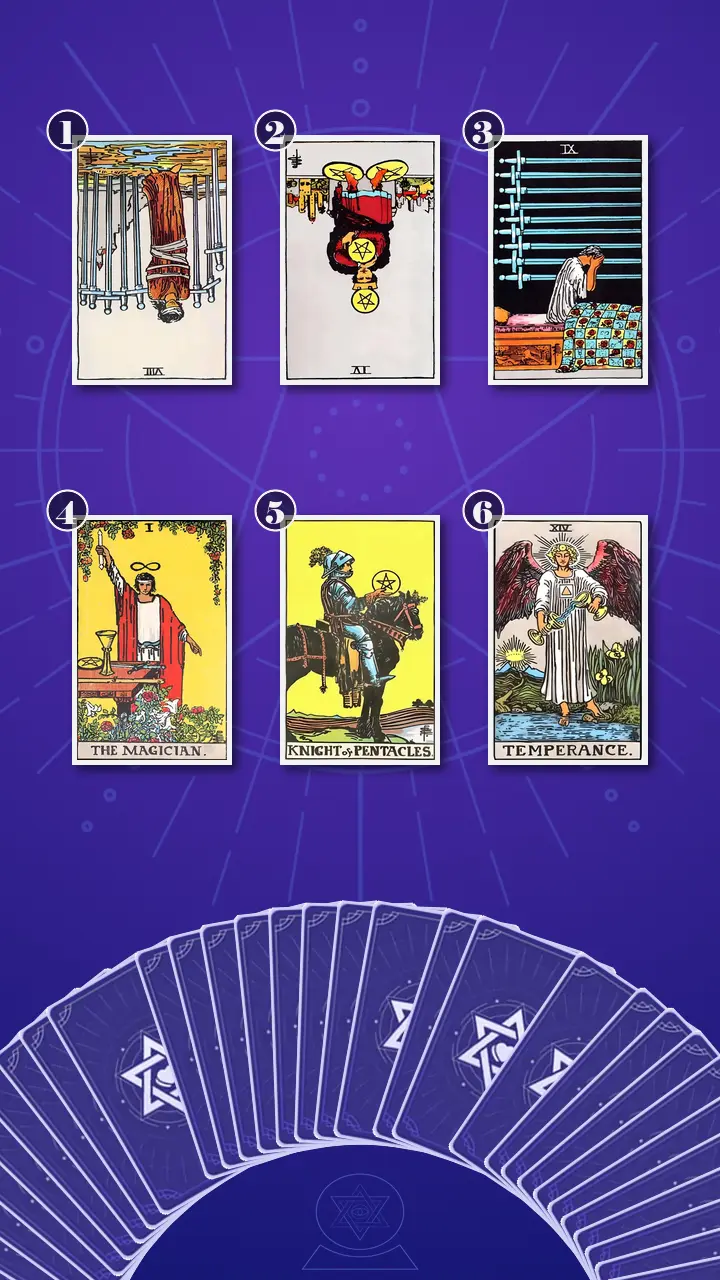
I chose the Transformation Path Grid (6) · Context Edition, a six-card tarot spread for assignment procrastination and perfectionism. I did not need a broad prediction about Jordan’s future. Their problem was a self-reinforcing behavior cycle, and this spread could show the visible pile-up, the control strategy beneath it, the root fear, the smallest interruption, the practical routine, and the way those pieces could integrate.
The top row would diagnose the loop. The bottom row would offer experimentation rather than a demand for a total personality overhaul. I told Jordan that the fourth position, the turning point, mattered especially: it would ask what small action could interrupt the cycle before another planning ritual took over.
Reading the Map, One Reach for the Phone at a Time
The Loose Bindings at the Blank Document
I turned over the first card. “Now I’m opening the card that represents the diagnosis of the visible pile-up: the behavior that replaces drafting just before you begin.”
It was the Eight of Swords, reversed.
I pointed to the blindfold and the bindings that were never as fixed as they first appeared. “This is the D2L moment you described. You read the brief until every instruction feels loaded, decide there is no acceptable first move, close the document, reorganize the task list, and reach for the phone. The pressure is real. The card is not saying you invented it. It is showing that uncertainty has begun to look like a total lack of options.”
The reversed energy suggested a restriction beginning to loosen, but only once Jordan could name it. Their mind was treating a reversible starting problem as a locked door, even though the handle was already loose. I asked what happened in the first five minutes after they opened an assignment. Jordan gave a short laugh that held more wear than humor.
“That is so accurate it is almost rude,” they said. “I genuinely think I’m getting organized.”
“The relief is genuine,” I said. “And it can still be part of the loop.” I watched their thumb stop tapping against the phone case.
The Dashboard That Keeps the Work Untouched
I turned to the second card. “This represents the self-reinforcing blockage: the protective strategy that gives you relief now and leaves a larger queue later.”
It was the Four of Pentacles, reversed.
I described the image’s tightly closed figure and then brought it into Jordan’s Sunday afternoon at Robarts Library: colour-coding four deadlines in Notion, shifting tasks from Today to This Week, adjusting the folder structure while the actual document remained at zero words. The screen became more orderly. The word count did not move.
“A cleaner system can still be a way of keeping the assignment untouched,” I said. “This reversed card shows control no longer creating safety. It is becoming emotional bubble wrap around one vulnerable first paragraph.”
The energy here was blocked Earth: practical tools such as calendars and folders had become overused as protection. Jordan’s inner logic was painfully coherent: If I fix the system, then I can begin. If I begin before the system is fixed, I might discover I cannot do this.
Jordan’s eyes dropped to the card. Their fingers curled around the edge of the chair, then slowly released. “I make a whole new study plan when I miss one block,” they said. “Then I act like the plan failing means I failed.”
I let that land. Organization can support work, but it cannot substitute for contact with work.
The Nighttime Verdict
I opened the third card. “This represents the underlying fear: the private belief that gives the delay so much force.”
It was the Nine of Swords, upright.
The figure sat upright in bed with their head in their hands, while nine swords held their fixed line above the darkness. I saw Jordan recognize the scene before I said a word.
“This is 1:12 a.m.,” I said. “The brief is glowing at the edge of the bed, the streetcar sound rises and fades outside, Discord keeps lighting up, and a paragraph that does not exist yet is already being judged. Not because you do not care. Because you care so much that a rough opening has started to feel like evidence about your competence.”
The Nine of Swords held overactive Air: anticipation had turned into mental rehearsal, and mental rehearsal had turned tomorrow’s work into a verdict before any work had been attempted. I have spent enough nights in high-stakes rooms, including years when every screen seemed to demand an answer at once, to recognize that feeling. The apparent emergency is not always the task. Often, it is the meaning a person has attached to getting the task imperfectly wrong.
“What would a weak first draft prove about you?” I asked.
Jordan stared beyond my shoulder, as if replaying a familiar late-night argument. Their breath paused. Their gaze lost focus for a moment. Then their mouth tightened before they answered.
“That I’m not actually capable,” they said quietly. “That everyone else can just do this, and I’m still trying to find the right system.”
“One unfinished paragraph is data about the task,” I said, “not a verdict on the person writing it.”
When the Magician Put Four Tools on the Desk
The Bridge Between Fear and a First Move
The room felt quieter as I reached for the fourth card. This was the turning point: the bridge between explaining the loop and changing one part of its architecture.
It was The Magician, upright.
“Now I’m opening the card that represents the key interruption: the smallest shift that challenges waiting for readiness and opens a route into action.”
I placed the card where Jordan could see the raised wand, the directing hand, and the cup, sword, pentacle, and wand arranged openly on the table. “This is not a promise that you will suddenly feel inspired. It is a practical image of agency. Brief. Laptop. Timer. One rough idea. The tools are already available.”
I watched Jordan look at the Magician, then at the phone still resting near their hand. At 10:18 p.m., with the folder renamed twice and the brief open, their mind had made the queue enormous because no imperfect move had been permitted to exist. They had been trying to solve the entire route before leaving the apartment, like waiting for Google Maps to reveal every transfer and final parking spot before taking the first step outside.
Stop waiting for readiness to guarantee a perfect result; use the tools already on the table to make one deliberate first move, as the Magician turns scattered resources into focused action.
I left a beat of silence after the sentence.
Jordan’s first response was not relief. Their eyebrows drew together and their shoulders rose toward their ears. Their hand hovered above the phone without taking it. “But doesn’t that mean I’ve been doing this wrong the whole time?” they asked, and there was heat under the question, not defensiveness alone. “I’ve been trying so hard to get organized.”
I nodded. “It means the strategy made sense when it first tried to protect you. It gave you a way to avoid the sting of an unfinished draft. We do not need to shame the strategy. We need to check whether it still delivers the return it promised.”
That was where I used the lens I call Academic ROI Auditing. I did not treat Jordan’s planning as a moral failure. I treated it as an investment of limited student energy. Thirty minutes of color-coding, renamed folders, and another study-with-me video could look productive, but its strategic yield was zero if it bought no contact with the assignment. A ten-minute rough draft might feel less polished, yet it could produce an outline, a question, a source gap, or a next action. That was information with usable return.
Jordan’s face changed in a sequence I could almost see arriving. First, their breathing stopped for a fraction too long. Then their eyes widened and went glassy, as though an old memory of every blank document had been pulled forward at once. Finally, they exhaled from deep in their chest, low and shaky, and their shoulders dropped.
“So the draft doesn’t have to earn anything yet,” they said.
“Exactly. The first draft only has to be visible enough to give you information.”
They gave a small nod, then looked briefly unsettled by the space that opened up after the old rule loosened. Letting go of a rule can feel light, but it can also leave a person standing in unfamiliar responsibility. The Magician did not remove Jordan’s workload. It returned the next choice to them.
“Now, with this new perspective,” I asked, “think about last week. Was there a moment when one rough heading or three bad bullets could have made you feel differently?”
“Tuesday,” Jordan said. “I could have written the question in my own words before I opened Instagram.”
That was the shift: from dread, shame, and readiness-based avoidance toward curiosity, grounded control, and steady self-trust through imperfect action. Readiness may be the result of contact with the work, not the ticket required to enter it.
The Quiet Horse and the Repeatable Return
I opened the fifth card. “This represents the actionable route: how the insight becomes a behavior that can survive an ordinary week.”
It was the Knight of Pentacles, upright.
The knight held one pentacle at eye level. The horse was still, the field carefully ploughed. “This is not the card of a heroic all-nighter,” I told Jordan. “It is the card of returning to one named assignment at a planned time, touching one small section, and counting that contact as meaningful.”
The energy was balanced Earth: patient, grounded, and repeatable. The Knight asked Jordan to stop measuring every session against the entire backlog. One section touched today was not a promise that every deadline would disappear by midnight. It was evidence that the task could become more familiar through contact.
Jordan frowned. “But I honestly cannot always fit in ten minutes. Some days I get home late, I have work stuff, and then I’m wiped.”
“Then we do not turn the calendar into another performance test,” I said. “A five-minute version is still a return. The point is not to force productivity through exhaustion. It is to give yourself a smaller, deliberate option than avoidance.”
I suggested using two short calendar appointments as deliberate resource leverage: not because an app could rescue them, but because naming one course and one next visible section would reduce negotiation at the moment resistance arrived. The reminder would not say study. It would say Thursday, 7:30 p.m.: Sociology paper, write three bullets for section two.
Temperance and the Queue That Is Not a Scoreboard
I turned the final card. “This represents integration: how you can relate differently to unfinished work as this pattern changes.”
It was Temperance, upright.
The angel poured steadily between two cups, with one foot on land and one in water. “This is the middle path between doing nothing until panic arrives and trying to repair your entire semester in one punishing night,” I said. “Discomfort and action can sit in the same room.”
Temperance carried balanced movement. Jordan could draft for a measured period, take a three-minute reset away from the screen, and adjust the plan without treating one awkward session as a reason to quit. It was like editing a study playlist while still listening: the method could change without abandoning the work.
The queue, I explained, was not a scoreboard of their worth. It was a set of tasks that could be opened, clarified, drafted, paused, and returned to. That language mattered. It made room for energy limits, real competing responsibilities, and the possibility that some days required a smaller action rather than more pressure.
The Ten-Minute Imperfect Start
I gathered the reading into one story. The reversed Eight of Swords showed Jordan mistaking uncertainty for confinement. The reversed Four of Pentacles showed planning becoming protection, a polished system that kept vulnerable work safely untouched. The Nine of Swords revealed why: an imperfect paragraph had been asked to carry an impossible meaning about personal worth.
The Magician offered the interruption, the Knight of Pentacles made it repeatable, and Temperance gave it a sustainable pace. The blind spot was not that Jordan lacked discipline or needed a more elaborate productivity setup. It was that they had been treating preparation as proof of readiness, even when preparation prevented the evidence that could actually make the assignment clearer.
“Your transformation direction is simple, though not always easy,” I said. “Move from asking, ‘How can I feel completely ready?’ to asking, ‘What is the next visible action I can take with what I already have?’”
- Set the Magician’s table.Before Friday evening, choose one unfinished assignment and put only the brief, the document, a pen or notes app, and a ten-minute timer in front of you. Read the brief once, write the question in your own words, and add three rough bullet points before opening another tab.Keep extra research tabs closed for this first pass. The minimum version is one heading and one bad sentence. You may stop when the timer ends.
- Run a data-not-verdict review.At the ten-minute mark, write one line titled What became clearer and one line titled Next visible action. Do this in the document or a note on your phone before deciding whether to continue.Use factual words such as opened, drafted, clarified, paused, or needs a source. Leave out good, bad, smart, behind, and lazy.
- Book the steady return.Choose two ten-minute entry points this week, such as Tuesday and Thursday at 7:30 p.m., and attach each to one named assignment and one small section.On a crowded or low-energy day, deliberately use five minutes rather than canceling. Move a missed block on purpose; do not make it evidence that the whole routine is ruined.

A Week Later, the Quiet Proof
A week later, I received a message from Jordan. It was not a dramatic declaration that every overdue task had vanished. They had opened one paper on Thursday, written three rough bullets, and stopped after ten minutes. The next morning, the first thought was still, What if this is wrong? But they smiled a little, opened the document again, and wrote the heading for the next section.
That was the proof I cared about. Jordan had not waited for fear to disappear. They had made one deliberate move while fear was still present, and the assignment gave them information instead of silence.
In my work, tarot does not take authorship away from the person across the table. It gives us a clear structure for seeing the system at work, so that person can choose what to change. Jordan’s Journey to Clarity was not a promise of perfect study habits. It was the beginning of a steadier relationship with their own capacity to begin.
When you want to start but keep reaching for your phone, the tight chest and growing queue may be the cost of protecting your self-worth from an imperfect result while quietly making the task feel even more impossible.
When your own blank document starts to feel like a locked door, what imperfect ten-minute action would you be curious to place on the table first?