Leaving the Desk Lamp Slightly Wrong: Starting Before Feeling Ready

The 8:47 p.m. Study Setup Spiral
I know this pattern: if coursework has to fit around paid shifts, a precious evening study block can disappear into renaming folders, changing timers, and fixing the desk. The less time remains, the more urgent it feels to make every remaining minute perfect.
Jordan (name changed for privacy), a 23-year-old university student in Toronto, described one Tuesday at 8:47 p.m. in their small Parkdale apartment. They opened Quercus intending to read Chapter 6, noticed a crooked charging cable, and began reorganizing course folders into a new colour system. The radiator clicked behind them, yesterday's coffee smelled faintly bitter, and the laptop fan warmed their wrists while they adjusted the desk lamp for the second time.
“I'm doing useful work. I'm almost ready,” Jordan remembered telling themself. Twenty-four minutes later, the dashboard looked better and the chapter remained unopened.
I heard the contradiction clearly: Jordan wanted to study, yet they had made a perfect setup the price of admission. I could see the frustration in the restless movement of their hands and the way their shoulders rose toward their ears. It was like watching someone optimize a transit route while every available train left the platform.
“Preparation can be real effort and still be the wrong task,” I said. “That doesn't make you lazy, and it doesn't make the effort fake. It means the way you're trying to protect the study block is consuming it.”
I told Jordan that I was not going to predict their grades or hand down a verdict about their discipline. I wanted us to identify the pattern, uncover the rule holding it in place, and find one experiment small enough to return choice to their hands. Our Journey to Clarity would be less like receiving an answer from above and more like drawing a reliable map through the clutter already on the desk.

Choosing the Four-Layer Insight Ladder
I invited Jordan to take one slow breath and hold a single question in mind: “Why do I keep perfecting my study setup instead of studying?” I shuffled at an unhurried pace, using the pause as a transition from reacting to observing. It was a focusing exercise, not an incantation.
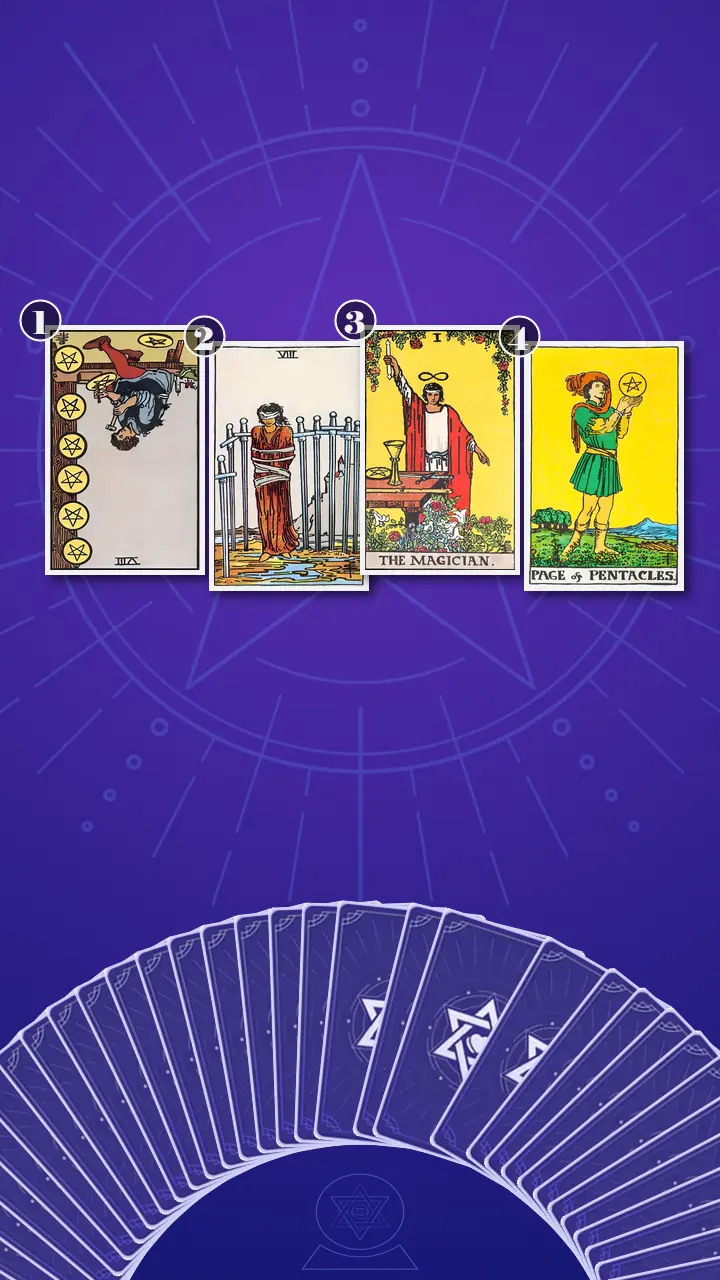
I chose the Four-Layer Insight Ladder · Context Edition, a four-card tarot spread designed to move from visible habit to hidden belief, then from a transformational resource to a practical next step.
I use this compact structure for an inner excavation because card meanings in context are more useful here than a broad prediction. Jordan did not need a timeline, an external outcome, or ten competing influences. They needed to see how reorganizing notes instead of learning could be genuine effort, protective avoidance, and a changeable behaviour at the same time.
I explained the map before turning over a card. The first position would show the current surface pattern: what Jordan actually does when study time begins. The second would uncover the private rule that makes an imperfect start feel threatening. The third, our central hinge, would identify the resource capable of interrupting the loop. The final position would translate that shift into one grounded experiment. Tarot would provide the structure; Jordan's lived evidence would decide whether the interpretation held.
When Effort Polishes the Wrong Surface
Position 1: Eight of Pentacles Reversed at the Workbench
The card I turned over represented the current surface pattern: perfecting the study apparatus while postponing the first learning task. It was the Eight of Pentacles, reversed.
I pointed to the craftsperson bent over the workbench and the row of completed pentacles displayed nearby. Upright, this card often speaks of patient practice and skill built through repetition. Reversed in this position, the same concentration had been redirected sideways. Jordan was still working, but the work kept landing on folder names, cable alignment, timer comparisons, Notion properties, and another version of the weekly plan. The apparatus became more polished while the chapter that could build knowledge remained beyond the workbench.
I read this as blocked Earth energy: an excess of maintenance paired with a deficiency of direct practice. The setup was supposed to support contact with the subject, but it had become an onboarding flow that never ended. Jordan kept choosing preferences and permissions without entering the part of the app they had opened it to use.
For a moment, I remembered an archaeological trench where a well-intentioned student kept cleaning the same edge because they wanted the section to look immaculate. A trench can be overworked until context is lost. Attention is not automatically useful simply because it is meticulous; its value depends on whether it is directed at the layer that can answer the question.
“During that Tuesday session,” I asked, “what was the first course task, and what sequence ran through your head while you reorganized?”
Jordan gave a short, bitter laugh. “Read two pages. Then it was: I'm being productive, I'm almost ready, and finally, I've already lost too much time to start properly. That's too accurate. Honestly, it's almost cruel.”
I let the laugh settle before answering. “The card isn't accusing you. It is separating effort from relevance. You were trying to create safety, and that strategy gave you a few minutes of relief. We can respect why it developed while still noticing its cost.”
Position 2: Eight of Swords and the Ring of Requirements
The next card represented the underlying mechanism: the self-limiting rule and self-worth fear that make an imperfect beginning feel unacceptable. I turned over the Eight of Swords, upright.
I asked Jordan about the last time a harmless imperfection had stopped a workable session. They described sitting on the fourth floor of Robarts Library at 4:18 p.m. They had written one uneven heading, noticed a classmate's cleaner notes across the table, and closed the notebook. Fluorescent lights buzzed overhead, a printer released warm paper nearby, and their mouth had gone dry before they opened Pinterest to search for a better note-taking layout.
I treated each sword around the blindfolded figure as one conditional requirement: the right time, the right desk, the right method, the right amount of energy, the right first page. The open ground between the swords mattered just as much. The situation might be inconvenient, late, noisy, or visually untidy, but a small route to the material could still exist.
This was an excess of Air becoming a blockage. Analysis had stopped helping Jordan distinguish options and had started drafting regulations: “If this condition is missing, the session will fail. If the session fails, it will prove something about me.” A preference for workable conditions had hardened into a browser permissions window where every optional setting was mentally marked Required.
“Your setup is support, not an entrance exam,” I said. “Necessary accommodations, food, medication, rest, physical safety, and access needs belong in a different category. We are not dismissing real constraints. We are testing the optional rules that fear has promoted into laws.”
I watched Jordan's jaw tighten, then their eyes move away from the cards, as if replaying the library scene. Their fingers curled against the edge of the desk before loosening.
“It's not really the crooked heading,” they said quietly. “It's that if I start badly and still don't understand the topic, I won't have the setup to blame.”
“Exactly,” I replied. “The feared outcome isn't merely an uneven session. It is the feeling that the session has exposed you as incapable. Every setup change brings brief relief from that exposure, so the brain learns to recommend another change the next time studying feels uncertain. That is a learned loop, not a permanent identity.”
When The Magician Put One Tool in Motion
Position 3: The Transformational Lever
A bank of cloud shifted beyond my Cambridge window as I reached the third position, and a clean rectangle of afternoon light fell across the table depicted on the card. The room seemed to grow quieter around the image.
This position represented the transformational lever: the shift from waiting for complete readiness to directing available resources toward one deliberate action. The card was The Magician, upright.
I showed Jordan the cup, sword, pentacle, and wand already laid out before the figure. The Magician was not shopping for a fifth tool or redesigning the table. One hand raised intention; the other grounded it. In Jordan's life, this looked like keeping the current notes, using the default phone timer, choosing one question from the practice set, and beginning for five minutes before confidence arrived.
I read the card as balanced, focused Fire. It did not promise effortless concentration. It represented the ability to select one move while discomfort was still present. Instead of treating the rough attempt as a public verdict on intelligence, Jordan could use it as information: this paragraph is unclear, this example helped, this is the question I need to ask next.
I reached for the diagnostic lens I call Academic Stratigraphy. On an excavation, I do not judge a site from its most recent debris; I read the layers and their relationships. Jordan's surface layer was constant setup adjustment. Beneath it sat the reward of immediate relief. Under that was the fear that unfinished work would expose a deficient self. But the enduring layer below all three was easy to miss: Jordan cared about learning and already possessed the capacity to choose, observe, and revise.
At 8:47 p.m., the lamp had finally reached the right angle, the Notion page had new icons, and the chapter was still unopened. Jordan's shoulders were tight because the setup looked ready, yet starting still did not feel safe. The missing ingredient was not another tool. It was permission to direct one existing tool toward real material.
Perfect preparation will not make the first move for you; use the tools already on the table and let action create clarity, as The Magician does.
I left a few seconds of silence after the sentence.
I watched Jordan's inhale stop halfway. Their fingertips, which had been tapping beside the laptop, hovered above the desk and went still. Their gaze drifted beyond the screen, unfocused, as if the last several study sessions were replaying behind their eyes. Then their jaw shifted. Their eyebrows drew together, and the first release was not relief but irritation. “But doesn't that mean I was wrong this whole time?” they asked, their voice sharper than before. “I've spent so much time trying to fix this. If the tools were already enough, I wasted all of it.” Their eyes reddened slightly as the anger gave way to a more vulnerable pause. Their shoulders lowered, but the new space seemed to make them briefly unsteady. Clarity had removed an excuse, and with it came the unnerving realization that the next choice would belong to them.
“No,” I said. “It means an old protective strategy made sense for a while and now costs more than it gives you. Understanding that is not an indictment of your past. A rough start is evidence that you started, not evidence that you are incapable. You are allowed to learn from the pattern without putting your former self on trial.”
I leaned slightly closer to the screen. “Now, using this new perspective, think back: was there a moment last week when this insight could have made you feel differently?”
Jordan remembered a quiz night when they had closed the notebook after making a crooked heading. “I could have answered Question 1 before deciding whether the whole setup worked,” they said. The words came slowly, followed by a long breath from somewhere deep in their chest. “I didn't need to feel ready to find out what I knew.”
I proposed a ten-minute experiment, not a new standard. Jordan would spend no more than five minutes getting water, opening the required material, and choosing one writing tool. When the timer rang, they would touch one tiny task for the remaining five minutes without changing tools. They could reduce the task to thirty seconds or stop if it became too much; essential access and safety needs would always come first.
This was the hinge from tense perfectionistic preparation, shame, and urgency to grounded learner self-trust built through small, ordinary study actions. It was not instant confidence. It was the smaller and more durable shift from “I must prove I can do this before beginning” to “I can begin, gather evidence, and decide what to adjust.” One tool. One task. One start.
The Page and the Ordinary Ten Minutes
Position 4: Page of Pentacles as a Grounded Experiment
The final card represented the grounded experiment: a repeatable behaviour through which practical self-trust could develop. I turned over the Page of Pentacles, upright.
I drew Jordan's attention to the Page holding one pentacle at eye level. The figure was not juggling every available method or performing the identity of a finished scholar. The Page was absorbed in one tangible object, standing in a cultivated field where results would grow through repeated contact rather than immaculate presentation.
I translated the image into a deliberately ordinary campus session: one chapter open, one practice question attempted for ten minutes, the same basic timer, a squeaking chair, and no cinematic “locked in” glow. The heading could remain crooked. Afterward, Jordan would record three plain lines: what they touched, what they learned, and one adjustment supported by evidence.
This was balanced Earth energy restored. The reversed Eight of Pentacles had spent Earth on maintaining the workbench; the Page invested it in the craft itself. The task was modest enough to repeat and concrete enough to generate feedback. “Let the session produce the feedback the setup cannot predict,” I said.
Jordan looked at the single pentacle for several seconds. Their shoulders stayed lower now, though one thumb still rubbed anxiously along the edge of their sleeve. “Ten minutes feels almost too small to count,” they said.
“That is the performance rule trying to grade the experiment before it happens,” I replied. “Small is a feature here. The Page is not asking you to become the finished student tonight. The Page is asking whether you are willing to gather one piece of evidence as a learner.”
Jordan nodded once. It was not the emphatic nod of someone newly certain about everything. It was quieter: the recognition that one imperfect question could count because learning, rather than appearance, was finally the measure.
The Workbench-to-Workbook Shift
I gathered the four cards into one account of why the loop had become so persistent. Its past influence was not a single event but a learned relief cycle: reorganizing reduced the vulnerability of beginning, so the mind remembered setup changes as protection. In the present, the reversed Eight of Pentacles showed real effort trapped in maintenance. The Eight of Swords revealed the inner rule beneath it: an imperfect session might become a verdict on personal worth. The Magician returned agency by using available tools before certainty. The Page of Pentacles gave that agency a stable form through beginner-minded repetition.
The central blind spot was that Jordan credited successful sessions to the perfect setup while overlooking the simpler cause: they had stayed in contact with the material. That attribution kept preparation expanding. Through my Research Bottleneck Analysis, I reframed the unopened first paragraph as a signal requiring a small intellectual excavation, not proof of personal failure. A bottleneck asks for the minimum evidence needed to make the next decision; it does not demand a new identity or a complete productivity system.
The transformation direction was therefore precise: replace the rule that the setup must be perfect with a five-minute setup cap, then begin one deliberately small coursework task using what is already available. The setup could remain supportive, but it could no longer act as the gatekeeper of Jordan's permission to learn.
Two Experiments for the Next Study Block
- The Five-Minute Setup Gate At the next post-shift study block, Jordan will start a five-minute phone timer before touching the desk layout or opening a productivity app. Those five minutes are only for water, the required course material, necessary accommodations, and one writing tool. On scrap paper, they will write one verb-and-object task, such as “Read two paragraphs” or “Answer Question 1.” When the timer rings, they will do that task for ten minutes without changing the timer, playlist, app, or note format. Treat this as a one-session experiment. If ten minutes feels too exposed, use two minutes of setup and three minutes of coursework. Pain, safety, rest, and access needs are never classified as optional imperfections.
- The Thesis Stratigraphy Mini-Log After the ten-minute task, Jordan will use a stripped-down version of my Thesis Stratigraphy Framework on plain paper. The bedrock line is “What I touched.” The evidence layer is “What I learned.” The surface line is “One adjustment supported by evidence.” They will limit the log to sixty seconds and repeat the same basic timer and task format twice before evaluating the system. Keep each layer to one sentence and never backfill a missed entry. Any new setup idea goes into a note called “Later” until ten minutes of real coursework have passed.
I asked Jordan to treat both actions as reversible field tests. They could stop, shrink, or change them if work, health, or access needs required it. The purpose was not perfect consistency. It was to let real contact with the material create better information than another imagined optimization could provide.

A Week Later: The Quiet Proof
Six days later, I received a photo from Jordan. It showed a crooked heading, the default phone timer at 00:00, and a rough answer beneath Question 1. They had continued for thirteen minutes, then written the three-line log in plain pen. No colour coding, no new app, no redesigned dashboard.
Their message read, “I still wanted to fix the lamp first. I left it slightly wrong and started anyway. The first answer was incomplete, but now I know which concept I need to review.”
The next morning, their first thought was still, “What if this stops working?” Jordan told me they smiled at the thought, left the folder names unchanged, and opened the page. The uncertainty had not vanished; it had simply lost its authority to close the book.
I did not regard that week as proof that tarot had solved Jordan's study life. The cards had made the pattern visible and organized it into a map. Jordan created the evidence by choosing one ordinary action. That distinction matters: tarot can illuminate the workbench, but the person sitting at it remains the author of the next move.
When an ordinary first page makes your shoulders climb toward your ears, perfecting the desk can feel safer than finding out whether your effort is enough. If that struggle is familiar, noticing the setup becoming a gate already places your hand on The Magician's first available tool.
If your setup were allowed to be merely usable for five minutes, what tiny piece of the actual work would you place at eye level, like the Page's single pentacle, and feel curious enough to touch first?