Moving the Lamp Three Times, Then Attempting the First Question

The 8:47 P.M. Study Setup Spiral
I have learned to recognize a very specific form of perfectionism-driven procrastination: if a university student is balancing coursework with part-time shifts in Toronto, the approach of a deadline can create an urgent need to move the lamp, rename a folder, or find a better focus app before studying can begin. That was the loop Jordan (name changed for privacy) brought to me.
At 8:47 on a Tuesday evening, Jordan joined my video consultation from the compact bedroom of a shared Toronto apartment. A paused lecture sat at zero minutes beside a blank Google Doc. The fluorescent desk light buzzed through my headphones, and the radiator clicked beneath the window while Jordan shifted the lamp for the third time. They told me their phone felt warm after twenty minutes of comparing focus apps. Their shoulders had crept toward their ears, their restless fingers kept returning to the playlist, and their jaw tightened each time the untouched lecture caught their eye.
“I want to study and make progress,” Jordan said, “but before I can begin, I need to get the conditions right. Otherwise, if I start badly, it might prove I'm not as capable as people think.”
I heard the central contradiction clearly: Jordan wanted to learn, yet perfecting the study setup had become the price of admission to studying. The pressure in their body seemed like a metronome wound several clicks too fast, each beat landing behind the jaw while their hands tried to slow it by straightening another object.
“I don't think this is a laziness problem,” I told them. “There is real effort here. We are going to look at where that effort is going, what it may be protecting, and how to redirect a small amount of it without forcing you into an equally unhelpful, chaotic session. Our Journey to Clarity is not about predicting your academic future. It is about making the pattern visible enough that you can choose your next move.”

Choosing the Narrow Staircase
I asked Jordan to place both feet on the floor, take one unforced breath, and hold the question in mind: “Why do I keep perfecting my study setup instead of studying?” I shuffled slowly. I use this brief ritual as a psychological transition from reacting to observing, not as a performance of mystery.
I chose the four-card Shadow Spread. For readers wondering how tarot works in a situation like this, I use the cards as an organized reflection tool: the images separate a tightly knotted behavior into parts that can be examined without shame. This spread was especially suitable because Jordan's question did not require a prediction or the broad scope of a Celtic Cross. It required a clean descent from visible behavior to hidden pressure, followed by a climb back toward agency and grounded practice.
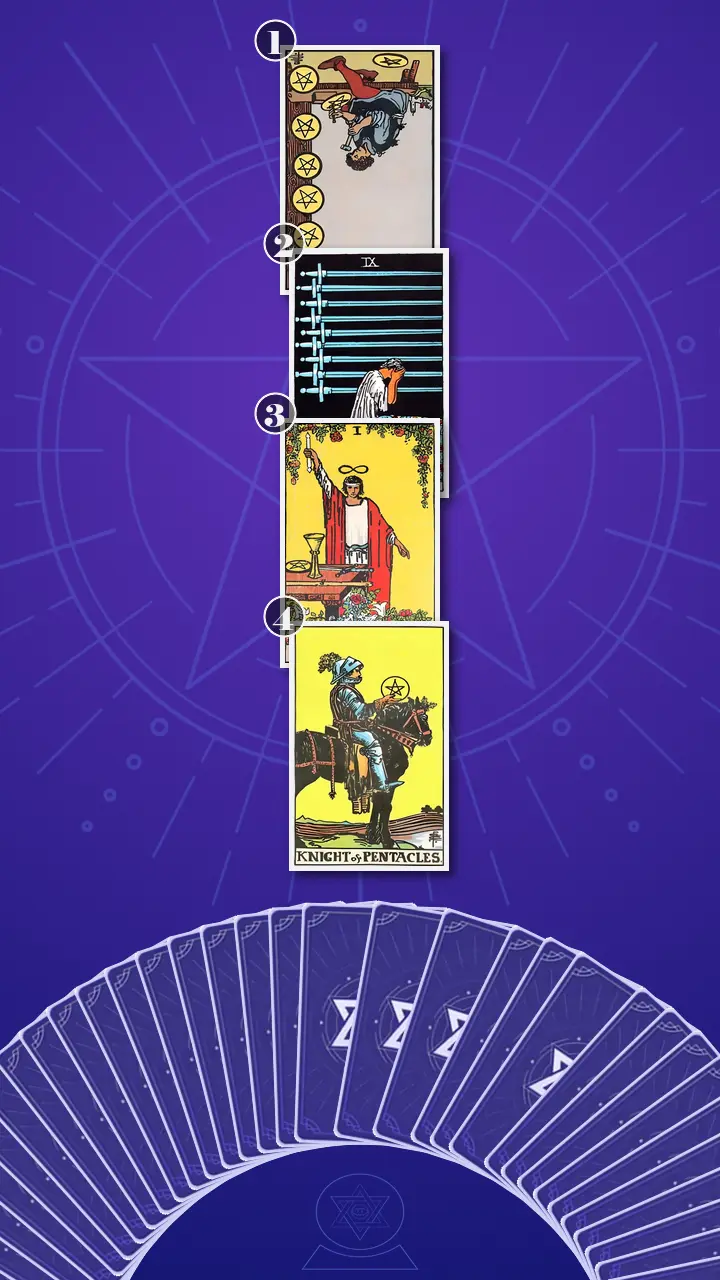
I arranged the cards in a vertical line like a narrow staircase. The first position would show the observable setup ritual. The second would reveal the fear and limiting belief underneath it. The third, the threshold of the reading, would identify the integrating resource capable of interrupting the loop. The fourth would turn that resource into a small, repeatable study behavior. The structure kept the card meanings in context and gave us a practical map for finding clarity.
When Careful Work Goes Sideways
Position 1: The Work That Looks Responsible
“The card I'm turning over now represents the observable shadow pattern: the specific study-setup behaviors that replace studying while creating a brief sense of control,” I said.
I revealed the Eight of Pentacles, reversed.
In the upright image, a craftsperson bends over one pentacle after another, building skill through bounded repetition. Reversed, that Earth energy had not disappeared. It was blocked and redirected. Jordan was still applying patience, precision, and labor, but the craft receiving all that care was the setup rather than the course material.
I brought the card directly back to Tuesday night. During a planned forty-five-minute block, Jordan might move the lamp, rename lecture folders, compare focus apps, and restart a Spotify playlist. Each adjustment produces a small, visible result. The desk looks better. The folder becomes tidier. The playlist starts at the perfect track. Relief arrives for a moment because something has been completed, but the assigned reading remains unopened.
“The inner argument often sounds reasonable,” I said. “It says, ‘I am doing something practical, so I am not avoiding the work.’ But the quieter and more vulnerable task is still waiting: attempting one question without knowing how well it will go. You are not short on effort; your effort is going to the launchpad. A polished setup can still be a postponed beginning.”
Jordan gave a short laugh, but it carried no amusement. Their fingers stopped against the phone case.
“That's so accurate it's kind of rude,” they said. “I can list everything I did last night except the studying.”
I did not treat the laugh as resistance. I heard recognition arriving with a sting. “Then we have found an allocation problem, not a character flaw,” I said. “Your eye for environmental friction is a real strength. It simply needs a boundary. The answer is not to ban all preparation and make yourself work in conditions that genuinely hurt your concentration. It is to complete one clearly defined practice task before another adjustment gets the rest of the session.”
Position 2: The Private Courtroom Behind the Desk
“The card I'm turning over now represents the underlying fear and limiting belief: what an imperfect beginning might seem to reveal about your performance and self-worth,” I said.
I revealed the Nine of Swords, upright.
The card showed a figure sitting upright in bed beneath nine swords suspended across a dark wall. The physical room was still, but the mental scene was crowded. I watched the reflection of Jordan's laptop screen darken in the apartment window, briefly laying pale horizontal lines across the glass like the swords in the card. The environment seemed to underline the point for us.
Here, Air energy was in excess. Analysis had become rehearsal for a verdict that did not yet exist. Before opening a textbook, Jordan could already imagine failing the course, disappointing other people, or discovering that classmates with polished notes were genuinely more capable. An Instagram study recap became the trailer for someone else's finished film while Jordan's own first scene remained unrecorded. The desk ritual postponed that imagined judgment by keeping actual performance out of view.
“Preparation feels safe because it leaves your ability untested,” I said. “The setup does not only support you. Sometimes it protects you from receiving evidence that might be messy, incomplete, or ordinary.”
I asked, “When you picture starting with the current desk and unfinished notes, what is the harshest conclusion you fear the first attempt might prove?”
Jordan's breath paused. Their eyes lost focus as if an old memory had begun playing behind the screen. Then they rubbed one thumb slowly across the other palm.
“That people have overestimated me,” they said. “If I don't understand the lecture quickly, maybe I'm not actually good at this. Everyone else seems to have a system, and I'm still fixing mine.”
“That is a painful standard to carry into an ordinary study block,” I replied. “A difficult first pass is information about the material, not evidence about your worth. The Nine of Swords does not prove the feared judgment is true. It shows how loudly an untested judgment can speak in isolation.”
When the Magician Gave Every Tool a Job
Position 3: The Threshold Between Readiness and Action
The room became unusually quiet before I turned the third card. Even the radiator had stopped clicking.
“The card I'm turning over now represents the integrating resource and key shift: the capacity that can interrupt setup perfectionism and direct existing tools toward one imperfect study action,” I said.
I revealed The Magician, upright.
The Magician stood before a table holding a cup, sword, pentacle, and wand. I translated that table into Jordan's study desk. The cup was the feeling being managed. The sword was the thought capable of choosing a specific task. The pentacle was the laptop, textbook, or notes already present. The wand was attention given a direction. The raised wand did not summon another tool; it assigned a purpose to what was already there.
This energy was neither excessive nor deficient. It was balanced agency that had been available but underused. In practical terms, The Magician did not offer Jordan a better desk, a new Notion template, or a more impressive productivity stack. It showed Jordan leaving the setup exactly as it was, opening the existing problem set, and using the current notes and timer for one focused attempt.
At that point, I used the lens I call Cognitive Tempo Calibration. Through years of sound-energy research, I have learned to listen for the mismatch between a task's demanded rhythm and the rhythm a person can access under pressure. Jordan's instruction to “study the lecture” landed like one long, unresolved bar with no clear ending. Moving the lamp or renaming a folder offered a short beat with an immediate resolution. Under strain, their attention kept choosing the beat it could finish.
The insight was not that Jordan needed to overpower their natural tempo. The Magician invited us to give the actual coursework a smaller beat: one paragraph summarized, one problem attempted, or three rough notes captured. That made the next action neurologically and emotionally easier to enter without pretending the discomfort had vanished.
I returned Jordan to the Tuesday-night scene. It was 8:47. The lamp had moved three times, the lecture folder had a better name, the playlist had restarted, and the focus app was open. The desk looked ready, yet the blank notes still waited while Jordan's mind searched for one more adjustment.
Do not wait for a perfect setup to prove that you are ready; use the tools already on the table and let one focused action create evidence of readiness, as the Magician turns gathered implements into deliberate practice.
I let the sentence remain between us.
Jordan stopped moving. Their inhale caught high in their chest, and two fingers hovered over the edge of the phone as if the next setup search had been interrupted in mid-gesture. Their eyes left the card and settled on the blank Google Doc. I watched their gaze soften and lose focus, as though the previous Tuesday were replaying in the pale screen. Then their jaw loosened. Their shoulders dropped, but the release was followed by a small, disorienting stillness, the kind that can arrive when a familiar explanation falls away and choice suddenly feels exposed.
“But doesn't that mean I've been doing it wrong this whole time?” Jordan asked. Their voice was sharper than before. Their eyes had reddened slightly, and they released one unsteady breath.
“It means the strategy had a protective logic,” I replied. “It gave you control when studying felt like a private trial. Recognizing its cost does not make your past self foolish. It means you can keep the useful care and change the rhythm in five-minute increments. The setup is a tool, not a verdict.”
I asked, “Now, using this new perspective, think back to last week. Was there a moment when this insight could have made you feel different?”
Jordan looked toward the lamp. “After my closing shift,” they said. “I had forty-five minutes, and I spent most of it preparing tomorrow. I could have watched five minutes of the lecture and taken three terrible notes. That wouldn't have fixed everything, but it would have been real.”
I nodded. “Exactly. The discomfort does not have to disappear before the next action becomes available.”
I then made the exercise concrete. At the next study block, Jordan would leave the lamp, playlist, folders, and focus app untouched for five minutes. They would place the current lecture or problem set in front of them and produce one visible artifact: one attempted answer, one summarized paragraph, or three rough notes. When the timer ended, they could stop, continue, or make a genuinely practical adjustment. If five minutes felt too intense, one sentence would count. The choice would remain theirs.
I named the shift I could see beginning. This was not a leap from anxious control to permanent confidence. It was one step from shame-laced setup control toward self-trust built through deliberately imperfect practice. Jordan was moving from asking the environment to certify readiness toward letting one ordinary action create usable evidence.
The Knight Who Took the Same Route Tomorrow
Position 4: Completion Before Optimization
“The card I'm turning over now represents the grounded next step: a small, repeatable study behavior that can carry this insight into ordinary life without requiring an ideal environment,” I said.
I revealed the Knight of Pentacles, upright.
The Knight sat on a still horse and held one pentacle carefully in front of him. Behind him, the field had been cultivated row by row. Nothing in the image suggested a dramatic productivity makeover. Its Earth energy was balanced: patient, bounded, and dependable.
I explained that Jordan could choose one repeatable reading or problem-set block at roughly the same time, keep the setup functional, and record completion in one plain line. The Knight evaluates a method after practice has produced information. He does not redesign the field every morning before tending the first row.
I thought of the TTC route Jordan took home from work. The same train was not glamorous, and no one would turn it into a seven-hour StudyTok recap, but its value came from carrying a person somewhere through repetition. The Knight offered the same behavioral rhythm: return, hold one task, complete what is manageable, and come back another day.
“The first five minutes belong to The Magician,” I said. “They begin the action. The Knight protects the return. Together, they replace the excitement of building a new system with the quieter evidence of having touched the actual material.”
Jordan picked up a plain paper notebook instead of opening another app. Their fingers hesitated above the page, then wrote: “Tuesday: attempt question one.” I saw a small smile appear, followed by a wince.
“That looks almost too basic,” they said.
“Good,” I replied. “Basic is harder to hide inside. It leaves more room for the work.”
From a Polished Launchpad to a First Step
I drew the four cards together into one story. Jordan's care and discipline had narrowed into the reversed Eight of Pentacles, where visible preparation absorbed the energy intended for learning. Beneath that behavior, the Nine of Swords turned an ordinary first attempt into an imagined judgment about ability and worth. The Magician gathered feelings, thought, materials, and attention onto one table, then directed them toward a bounded task. The Knight of Pentacles carried that first act into a repeatable rhythm.
I also pointed out the spread's quiet emotional clue. No Cups card had appeared, but a cup stood on The Magician's table. Jordan's feelings did not need to be eliminated before studying. They needed to be acknowledged as one part of the available field rather than allowed to conduct every other instrument.
The cognitive blind spot was the assumption that the urge to adjust something must mean the environment was not ready. Sometimes that urge was a dissonant chord created by approaching performance exposure. Another setup change briefly resolved the tension, so it felt practical even when it maintained the loop.
The transformation direction was therefore precise: begin one deliberately imperfect, time-limited study task before making any further change to the setup. Jordan did not need less care. They needed to move that care from controlling the environment to directing attention, and from conditional readiness to practiced self-trust.
Because Jordan's evenings had to fit around part-time shifts, I kept the next steps small. I adapted my Syncopated Study Session into two plain measures:
- The Five-Minute Syncopated Study Session At the next study block at the Toronto desk, Jordan will leave the current lamp, playlist, folders, and focus app untouched. Before opening any new productivity tool, they will write one concrete task on paper, such as “summarize pages 12-13” or “attempt question one.” They will use the existing timer for five minutes and produce one rough artifact with the materials already open. Tip: if the mind insists that one setup issue must be fixed first, the boundary applies for only five minutes, not forever. One sentence, one worked line, or three rough notes is a valid smaller beat. At the timer, Jordan remains free to stop, continue, or make a practical adjustment.
- The Completion-Before-Optimization Log At the end of each small block, Jordan will write one line in the paper notebook: the date and the task touched, even when the answer is incomplete or the notes are messy. After three entries, they will review those lines before deciding whether the study system genuinely needs to change. Tip: no mood scores, aesthetic redesign, hour tracking, or perfect streak. If the log starts becoming another setup project, Jordan will keep one handwritten line and skip the app entirely.
I told Jordan that these were experiments, not commandments and not guarantees of academic success. Tarot had helped us identify the mechanism and design actionable advice, but the cards could not study on Jordan's behalf. Jordan remained the author of the next action, the person entitled to adjust the plan, and the only one who could decide what a sustainable rhythm felt like in their actual life.

A Week Later: Three Rough Notes
Five days later, I received a message from Jordan with a photo of the plain notebook. One line read, “Tuesday: watched six minutes, took three rough notes.” Another read, “Thursday: attempted question one before moving lamp.” The entries were uneven, short, and real.
Jordan told me the first session had not felt effortless. The lamp still bothered them. Their hand had reached for the playlist twice, and the lecture had remained difficult. But the five-minute boundary gave their attention a beat it could enter. On Tuesday they continued for one extra minute; on Thursday they stopped at five and went to bed. Both counted.
They also wrote, “I still woke up thinking, What if this isn't enough? Then I saw the three rough notes and laughed.” The fear had not vanished; it had simply stopped conducting the whole session.
I considered that the quiet proof of our Journey to Clarity. The spread had not delivered certainty or transformed Jordan into a different person. It had helped them hear where their effort was falling out of sync, then return the rhythm to their own hands. Self-trust had begun as one imperfect mark on a page.
I would offer the same recognition to anyone whose shoulders rise when the desk is imperfect and whose hands reach for one more adjustment. Polishing the conditions can preserve hope because it postpones the risk of a verdict about ability. Noticing that protective rhythm without judging it already creates a small space in which another beat can be chosen.
If the current desk could be good enough for one quiet, imperfect attempt, what is the smallest piece of real work you would feel curious enough to place on the Magician's table?