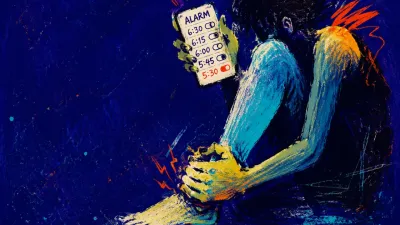
Finding Clarity in the 8:36 a.m. Café Line
“You’re 27, good at your job, and still your throat locks up when a barista asks your name—like you’ve time-traveled back to middle school in a Toronto café line.”
I said it gently, not as a diagnosis—more like offering the exact sentence that had been sitting in the room with us the whole time.
Taylor gave me a look that was half relief, half “how did you know?” She was calling in from Toronto, the kind of neighborhood where there are three coffee shops in a four-block radius and every morning feels like a soft competition to look unbothered. I was in Tokyo, on my night schedule—planetarium hours and all—my desk lamp dimmed, a small star projector throwing slow-moving constellations across the wall like a patient metronome.
She described Monday at 8:36 a.m.: wet coats pressed close in line, the espresso machine hissing like a steam vent, her phone warm in her palm with the mobile-order screen open “just in case.” The barista looked up, bright and neutral, and said, “Name?”
“It’s just my name,” Taylor told me, swallowing hard. “But my throat locks like I’m twelve again. I can feel my face get hot before I even answer.”
I could almost feel the moment in my own body—like your internal Wi‑Fi drops the second you’re perceived, even though the signal is actually fine. And then the worst part: the line behind you. People shifting their weight. That tiny percussion of imagined impatience.
“Why do I freeze when someone asks my name?” she asked, and the question landed with that specific kind of irritation—because it’s so small, and it hijacks everything anyway.
I nodded. “We’re not here to make you into someone who never flinches. We’re here to help you find clarity inside the flinch—so you can get your voice back in the moment, and stop carrying a two-second exchange like it’s court evidence for the rest of the day.”

Choosing the Compass: A Six-Card Tarot Ladder for Shame Triggers
I asked Taylor to take one slow inhale—not as a mystical ritual, but as a threshold. A way to tell her nervous system: We’re looking at this now, on purpose, safely.
I shuffled while she held the question in mind: that specific public micro-moment shame surge when a barista asks her name. The cards made that soft papery sound I’ve come to associate with transitions—like turning a page in a story that’s been stuck on the same paragraph for years.
“Today I’m using my own spread,” I said, “called the Four-Layer Insight Ladder · Context Edition.”
For you reading along: this isn’t a predictive spread. It’s a pattern spread—built for situations where the problem isn’t a decision or a forecast, but a rapid inner takeover. It moves in layers: what happens on the surface, what happens in the first few seconds in the body, what old imprint is being replayed, what belief keeps it looping, and then—crucially—the one high-leverage shift and the smallest possible next step you can repeat.
“We’ll start with what you do in the exact moment you’re put on the spot,” I told Taylor. “Then we’ll go down to the middle-school imprint underneath it. Then we cross over to the belief that keeps re-triggering it. And the last two cards—those are our way out: the key transformation, and the grounded practice you can actually do this week.”
Reading the Map: From Freeze, to Replay, to the Inner Jury
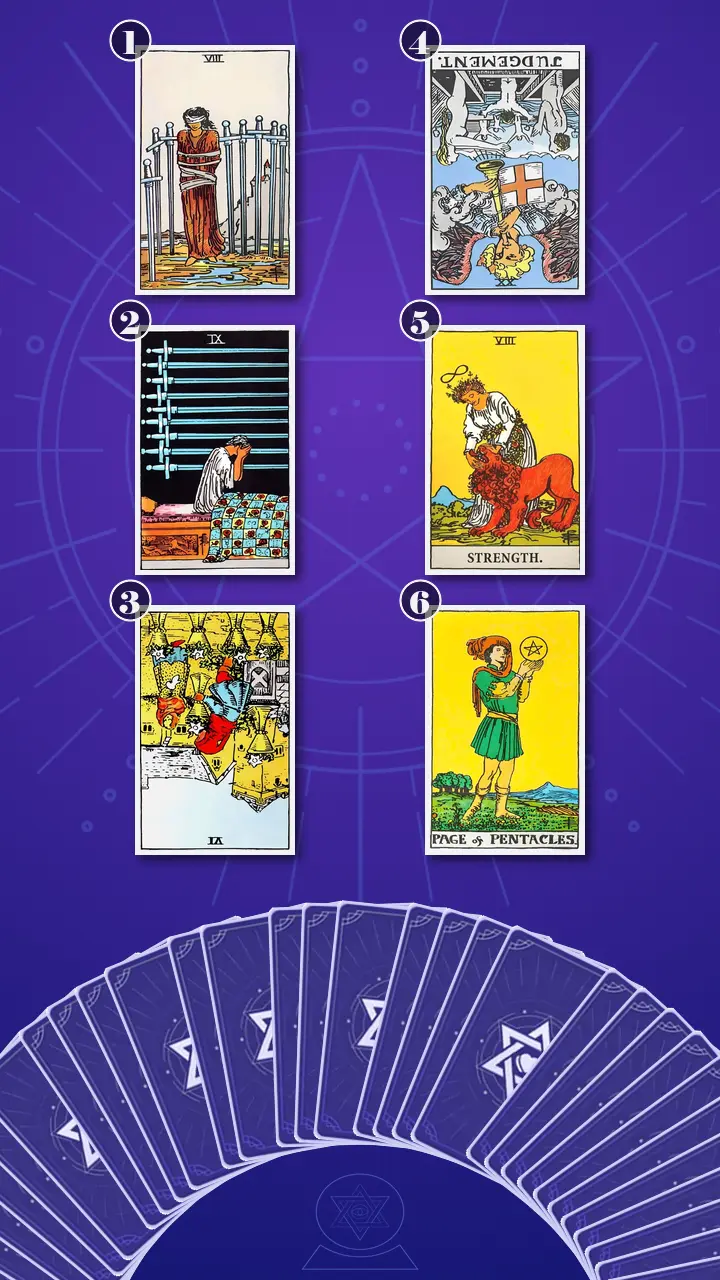
Position 1 — The present-day symptom: the exact café-line freeze
“Now we turn over the card that represents the present-day symptom—what you do in the exact moment the barista asks your name,” I said.
Eight of Swords, upright.
“This is so literal it’s almost rude,” I added, and Taylor let out a small, bitter laugh.
“Yeah,” she said. “It’s… too accurate. Like, it’s kind of brutal.”
I kept my voice calm. “That reaction makes sense. The Eight of Swords is the ‘I can’t’ feeling that’s real in your body even when the situation is actually flexible.”
I pointed to the blindfold and the bindings. “In modern life, this is the exact second the barista says ‘Name?’ and your whole system constricts. You’re standing there with Apple Pay ready, and yet your mind goes blank like someone hit mute on your voice. You can feel options—say it slowly, repeat it, spell it—but your body behaves like there’s only one acceptable outcome: say it instantly, perfectly, and never look awkward.”
“The trap isn’t the café,” I said, “it’s how your attention narrows until you can’t access your normal adult self.”
Energy-wise, this card is Air in excess: thoughts tightening into a cage. Not because you’re dramatic—because your system is trying to prevent humiliation. It’s a protection strategy that happens to be outdated.
Taylor’s shoulders rose toward her ears, then dropped a millimeter, like her body had been waiting for permission to call this a real thing.
Position 2 — The immediate trigger response: the first 3–10 seconds
“Now we turn over the card for the immediate trigger response—what your mind and body do in the first 3–10 seconds,” I said.
Nine of Swords, upright.
“This is the mental replay loop,” I told her. “Three seconds after you answer, your brain starts a rapid audit: Was my voice weird? Did my mouth do something awkward? Did they pause because they think I’m stupid?”
“It’s like you’re already watching a replay before the receipt even prints,” I continued. “Your face stays warm, your stomach drops, and you start collecting ‘evidence’ from the barista’s expression—even though they’ve already moved on to the next order.”
Energy-wise, this is Air in overdrive—the mind trying to regain control through analysis. The Nine of Swords isn’t the moment itself. It’s what happens when your brain opens 27 tabs and every tab is titled: Did I sound weird?
Taylor’s eyes flicked down and to the side the way people do when they’re rewatching something internally. Her thumb worried the edge of her phone case.
“And then you scroll,” I said, not accusing—just naming the pattern. “Not because you don’t have discipline. Because you’re trying to escape the feeling.”
She nodded once. Tight. Accurate.
Position 3 — The origin layer: the middle-school imprint underneath
“Now we turn over the card for the origin layer—the middle-school imprint your nervous system is replaying,” I said.
Six of Cups, reversed.
“Adult setting, adolescent shame response,” I murmured, and I felt my own chest tighten with recognition. I’ve watched thousands of people in my planetarium dome—grown adults—go quiet and small when the lights go down, as if darkness equals danger even when it’s safe and curated. The body keeps old associations on file.
“In modern terms,” I told Taylor, “your adult self is at the counter in a normal Toronto morning rush—but internally it’s like a middle-school version of you steps forward and takes the mic.”
“The memory doesn’t have to be a clear flashback,” I said. “It can be a body feeling: If I get this wrong, they’ll laugh. You smile too hard, rush your name, and then feel that familiar hallway humiliation even though nothing objectively happened.”
Energy-wise, this is Water blocked: old vulnerability trying to move, but it shows up sideways—as heat, tightness, and an urge to disappear behind your phone.
Taylor swallowed. “It literally feels… younger. Like my face does the thing it used to do.”
“Your body isn’t being dramatic,” I said, letting the sentence land, “it’s being consistent with an old lesson.”
Position 4 — The hidden belief: the Inner Jury rule that keeps it repeating
“Now we turn over the card that represents the hidden belief—the internal rule about being seen and ‘getting it wrong’,” I said.
Judgement, reversed.
This one always changes the temperature in the room. Even over Zoom, I felt it: that click from “awkward moment” to “system-level pattern.”
“Okay,” I said softly. “Here’s the engine.”
I leaned in. “This is the hidden rule running in the background: being seen equals being graded.”
And I described it the way it actually operates—fast, theatrical, unfair.
The café counter becomes a witness stand. The line behind you becomes an imaginary jury. The barista’s neutral face becomes a verdict screen.
Say it right. Say it fast. Don’t be weird.
Don’t hesitate.
If they mishear you, you’re done.
That trumpet on the Judgement card? Reversed, it’s not intuition. It’s an internal alarm bell that says: Evaluation happening now.
Taylor’s reaction came in a chain—exactly the way shame hits:
First, a tiny freeze: her breath caught, like her body had been tapped on the shoulder.
Second, a faraway look: her eyes unfocused for a beat, as if replaying a dozen old scenes at once.
Third, a release she didn’t seem to expect: her shoulders dropped, and she exhaled through her nose like, “Oh. Yeah.”
Then she said, very quietly, “That’s it. It feels like a verdict.”
I gave her the interrupting sentence—simple enough to carry into a noisy café line:
“A barista asked my name; that is not a grade.”
Judgement reversed is the major blockage because it keeps the Eight and Nine of Swords alive. If the moment is a courtroom, your mind will keep trying to win it through perfect performance. And perfect performance is a losing game—because the Inner Jury never stops moving the goalposts.
When Strength Spoke: The Calm Hand on the Lion
Position 5 — The key transformation: the antidote that restores choice
“We’re turning over the key transformation now,” I said. “This is the card that interrupts the shame script and gives you choice back in the moment.”
The room felt unusually quiet. Even my building’s usual night sounds—pipes settling, distant traffic—seemed to step back, like an audience that finally stopped shuffling.
Strength, upright.
“Oh,” Taylor whispered, and her voice did something different—lower, steadier, like it had more room in her throat just seeing the image.
I didn’t rush. “In modern life,” I told her, “instead of trying to bulldoze the shame with performance, you treat the surge like a startled animal: real, loud, and workable. You notice the tight throat, take one breath, and say your name anyway—without rushing to prove you’re fine.”
Energy-wise, this is Fire in balance: courage that doesn’t burn you up. Strength isn’t hype. It’s steadiness.
Setup: You’re in line with people behind you, the espresso machine is loud, and the barista says “Name?”—and suddenly your throat tightens like you’re twelve again. Your brain tries to solve it the old way: perform perfectly, immediately, so you can escape the spotlight. You can feel the Inner Jury reaching for the gavel.
Delivery:
Stop trying to ‘beat’ the shame with perfect performance, and practice gentle bravery—like Strength’s calm hand on the lion—so your name can simply be said, not defended.
I let a small pause sit after it. Like waiting for a planet to clear the edge of the horizon.
Reinforcement: Taylor’s face shifted in layers. Her eyebrows lifted first—surprise. Then her jaw unclenched, like she’d been holding tension there for years without noticing. Her eyes went shiny, not in a dramatic way—more like the nervous system version of a pressure valve releasing.
She looked down at her hands. One of them was clenched into a fist without her realizing. She opened it slowly, fingers unfurling as if she’d been gripping an invisible railing. Her shoulders softened, then she sat up straighter—still cautious, but less braced.
“But if I’m not trying to sound normal…” she said, and there was a flicker of anger under the vulnerability, “doesn’t that mean I’ve just been failing at this? For years?”
I nodded, honoring the feeling. “That’s the Inner Jury trying to turn insight into a new charge.”
I shifted into the language I use at the planetarium when someone’s afraid of the dark: practical, embodied, non-shaming. “Strength doesn’t accuse the lion for being loud. It doesn’t argue with it. It just stays present.”
Then I brought in my own framework—the one that’s become my signature because it makes self-regulation feel less like self-help and more like physics.
“I call this Pulsar Breathing,” I said. “In space, pulsars are these incredibly steady stars that pulse like clocks. When everything feels chaotic, that rhythm is something you can sync to. In your body, one quiet inhale is your pulse. Not a big dramatic breath—just one steady beat. It’s you telling your nervous system: we’re here, we’re safe enough, we can speak.”
I watched her try it—just once. Her ribs expanded subtly. Her breath lowered from her chest into something steadier.
“Now,” I said, “use this new angle and think about last week. Was there a moment where this would have changed the outcome—not the barista’s behavior, but your internal experience?”
She blinked, eyes unfocused, then nodded. “Thursday. They asked me to repeat it. And I… apologized like five times.”
“Right,” I said. “Strength would do it differently. Repeat once. No apology unless you genuinely want to. Your name can be said, not defended.”
This was the shift in motion: from ‘being seen feels like a public verdict’ to ‘being seen feels tolerably human and manageable’. Not perfect. Not painless. But workable.
Position 6 — The grounded next step: practice reps that build self-trust
“Now we turn over the card for the grounded next step—a small, realistic practice you can try this week,” I said.
Page of Pentacles, upright.
“This is the beginner who isn’t ashamed to be a beginner,” I told her. “In modern life, you treat the ‘name moment’ like a trainable micro-skill, not a personality defect.”
Energy-wise, this is Earth in balance: repetition, steadiness, measurable progress. Less ‘personality makeover,’ more Duolingo—tiny reps that add up.
“It’s boring on purpose,” I said, and Taylor’s mouth twitched into the first real smile of the session.
“Good,” she said. “I need boring.”
From Insight to Action: Actionable Advice for the Next 48 Hours
I zoomed out and told her the story the spread had drawn—clean and connected.
“Here’s what I see,” I said. “In the present, you freeze (Eight of Swords) because your mind narrows your options down to one demand: be instantly perfect. Then, the moment you speak, your brain launches the replay (Nine of Swords) to try to regain control. Underneath, the nervous system age-shifts—adult body, middle-school vulnerability (Six of Cups reversed). And the belief holding it all together is Judgement reversed: that being seen equals being evaluated.”
“That’s the cognitive blind spot,” I added. “You think you’re reacting to your name. But you’re reacting to an internal grading system that turns visibility into a verdict.”
I let that sink in, then gave her the transformation direction in one line: “We’re moving from performance-based safety—‘I must sound perfect’—to regulation-based safety—‘I can breathe, be seen, and still be okay.’”
Then I made it practical. Small enough to actually do. The Page of Pentacles demands reps, not speeches.
- The “Not a Grade” Reframe (10 seconds)Before you enter the café, open your Notes app and read one line: “A barista asked my name; that is not a grade.” Then put the phone away and step into line.If your brain says “this is cringe,” label it: “Inner Jury.” You don’t have to believe the sentence for it to work—just read it once.
- One-Breath Name (the whole rep)In real life, do one rep: inhale quietly (Pulsar Breathing—one steady beat), then say “Taylor” slower than your panic prefers. If they ask again, repeat it once, calmly—no apology unless you truly want to.Make success tiny: “I took one breath.” Not “I sounded cool.” One breath. Then your name. That’s the whole rep.
- Neutral Recap Reset (30 seconds)After one interaction this week, write a 3-line note: (1) what happened (facts), (2) what you did (facts), (3) one neutral sentence: “That was a normal human moment.”If your nervous system is still loud, try my “Washing Machine Cosmos” trick: do the recap at home with any steady background sound (laundry, fan, white noise) to give your brain something non-judgmental to sync to. Neutral recap beats self-cross-examination.
Taylor hesitated, then voiced the most honest obstacle: “But I feel like I don’t even have five minutes. My mornings are… chaos.”
“Then we keep it honest,” I said. “We’re not building a new you. We’re building a new response. The whole practice can be under a minute total.”
“And if you skip it,” I added, “that’s not a moral failure. That’s just data. The Page of Pentacles doesn’t shame you for missing a rep. It just asks you to come back.”

A Week Later: The Quiet Proof
Six days later, I got a message from Taylor while I was walking into the planetarium for an afternoon show. The lobby smelled like rain on coats—always—and a school group was buzzing like static before the dome lights dim.
Her text was short: “Did the One-Breath Name today. They misheard me. I repeated it once. No apology. My face still got hot, but it didn’t ruin my whole morning.”
I imagined her afterward—maybe sitting alone for a minute with her coffee, not euphoric, not magically transformed… just a little more present in her own skin. Clear, but still tender. That’s how real nervous system change looks: small, specific, quietly brave.
This is what a Journey to Clarity often is. Not a sudden personality rewrite—but a shift in rhythm. From fighting yourself to syncing with yourself. From trying to win the moment to staying with your breath long enough to have a choice.
And if you’re reading this because a simple “Name?” makes your throat go tight and your face go hot, it’s not because you’re incapable—it’s because some part of you still thinks being seen comes with a verdict.
If you didn’t have to win the moment—just stay with yourself for one breath—what would your ‘name moment’ look like this week?
(If you want to explore your own pattern, you can try the Four-Layer Insight Ladder · Context Edition tarot spread for shame triggers in everyday social micro-moments—six cards, layered honestly, focused on actionable next steps rather than prediction.)
This story is adapted from psychological research, written so that those in a similar struggle can see their own pattern in it — and find their next step clearly.These insights are not a substitute for professional psychological, medical, legal, or financial advice.
Learn more about our Journey to Clarity.
How did this insight land for you?
🫂 This Resonates Deeply
🌀 Living This Story
✨ Now I See Clearly
🌱 Seeing New Possibilities
🧰 Useful Framework
🔮 The Confirmation I Needed
💪 Feeling Empowered
🚀 Ready for My Next Step
Author Profile
 AI
AI“After a decade of guiding people through the stars, I’ve come to see life much like the orbits of planets: everything has its inevitable cycles. When you feel lost, please don't blame yourself; you might just be in a natural low tide. I’m here to sit under the night sky with you, offering a gentle cosmic perspective to distinguish temporary pain from the beautiful breakthroughs just around the corner.”
In this Personal Growth Tarot Reading :
Core Expertise
- Cognitive Spiral Mapping: Validating that feeling 'stuck' is often just a necessary orbital slingshot phase before a major intellectual breakthrough.
- Gravity Well Identification: Diagnosing the obsolete habits or environments exerting a downward pull on your personal evolution.
Service Features
- The Orbit Expansion Strategy: A macro-perspective exercise to map the precise trajectory and momentum needed to escape your current cognitive gravity well.
Also specializes in :
Explore Related Patterns:
Freeze ResponseTaylor's throat locks when the barista asks for her name, and her mind goes blank even though she knows the answer. Her face gets hot, her breath catches, and the ordinary options available to her adult self suddenly feel inaccessible. That is a defensive body response, not a character flaw. The nervous system reads the moment as social threat, then protects against humiliation by narrowing speech, attention, and movement. You are watching a protective strategy become outdated: it once tried to prevent exposure, but in the cafe line it steals her voice when she needs it most. Freeze Response fits because the story repeatedly shows temporary immobilization under perceived evaluation. The key detail is that Taylor does not simply dislike the interaction; her body behaves as if choice has been removed, then later regulation gives choice back.
Visibility Shame LoopTaylor's cafe counter becomes a witness stand the moment the barista says "Name?" The line behind her turns into an imaginary jury, and the barista's neutral face starts to feel like a verdict screen, even though the actual exchange is routine and brief. The psychological mechanism is not that the name itself is dangerous. It is that visibility gets fused with evaluation, so being perceived activates an old shame circuit and then demands proof that nothing awkward happened. You can see the loop in how the moment keeps expanding after it ends: the voice check, the facial heat, the evidence collecting, and the rest-of-day replay. Visibility Shame Loop fits because the trigger is public exposure plus internal grading. The pattern keeps asking you to win a social trial that no one else knows is happening, which is why a two-second interaction can feel emotionally oversized and hard to put down.
Emotional RegressionTaylor is 27, capable at work, and standing in a normal Toronto cafe line, but her body reacts as if she is twelve again. The story names the split clearly: adult setting, adolescent shame response. The mechanism is a state shift where an older emotional imprint takes over the present moment. The body does not need a clear memory scene to replay the old lesson; it can replay the heat, tight throat, urgency to disappear, and fear of being laughed at. You are not seeing immaturity here, but a younger self-state being activated by public exposure. Emotional Regression fits because the reaction is not proportionate to the present-day cafe context. The intensity comes from the past entering the room through the body, making a neutral prompt feel like a middle-school hallway again.
Perfectionism-Driven AvoidanceTaylor keeps the mobile-order screen open "just in case," then feels her body demand one acceptable outcome when the barista asks her name: say it instantly, perfectly, and never look awkward. When she is misheard, she apologizes five times, as if a normal communication repair has to be overpaid. The coping mechanism is perfection used as social protection. If sounding flawless equals safety, then any hesitation, repetition, or mishearing becomes a threat to manage. You can see how the avoidance is not about avoiding coffee; it is about avoiding the shame of being visibly imperfect. Perfectionism-Driven Avoidance fits because Taylor tries to outrun embarrassment through speed, apology, and backup plans. The pattern promises safety through perfect performance, but it keeps the nervous system locked onto the possibility of getting it wrong.
Spotlight EffectTaylor hears the tiny percussion of people shifting behind her and starts feeling watched. The barista's pause, the line's movement, and her own facial heat become evidence that everyone is noticing her more intensely than they likely are. The cognitive mechanism is a visibility distortion: attention turns inward while also exaggerating the audience outside. You can see how the mind builds a stage out of ordinary details, then places the self under a harsh spotlight that makes every micro-expression feel meaningful. Spotlight Effect fits because the emotional charge depends on overestimating how much the public moment matters to strangers. The cafe line is not actually a performance venue, but the pattern makes it feel like one.
Self-Judgment LoopTaylor's brain starts the audit almost immediately after she answers: was the voice weird, did her mouth look awkward, did the pause mean something. Later, even a useful insight nearly becomes another accusation when she wonders whether she has been failing at this for years. The defense is an internal grading system that tries to regain control through judgment. Instead of letting the interaction close, the mind reopens it as a case file and keeps searching for the exact moment that proves something went wrong. You may recognize the trap: self-analysis starts as protection, then becomes prosecution. Self-Judgment Loop fits because the story shows repeated self-cross-examination, not just brief embarrassment. The pattern keeps moving the goalposts, so even doing better can be converted into a new charge unless the internal court is interrupted.
Emotional RegulationTaylor practices one quiet inhale before saying her name, then later repeats it once when she is misheard and does not apologize. Her face still gets hot, but the interaction no longer ruins her whole morning. The mechanism is not forcing calm or pretending the shame is gone. It is regulating enough to stay in contact with choice while the surge is still present. You can see the shift from trying to defeat the feeling to giving the body one steady cue: safe enough, speak anyway. Emotional Regulation fits because the story shows a concrete change in how Taylor handles activation. The trigger still exists, but her response becomes more flexible, which is the practical marker of regulation returning.
Secure VisibilityTaylor receives the sentence, "A barista asked my name; that is not a grade," and it gives the moment a cleaner boundary. The barista can ask, she can answer, and being seen does not have to become a verdict. The psychological movement is from performance-based safety to regulation-based safety. Instead of earning the right to be visible by sounding perfect, Taylor practices being visible while still human, still warm-faced, and still allowed to repeat herself. You can feel the difference in the final text: misheard, repeated once, no apology, morning intact. Secure Visibility fits because the repair is not disappearance and not overperformance. It is the capacity to remain present while being perceived, without turning ordinary attention into a trial.
RuminationTaylor starts replaying the interaction before the receipt even prints. Her mind opens 27 tabs, all asking whether she sounded weird, whether her face looked wrong, or whether the barista's expression meant something. The cognitive mechanism is repetitive post-event analysis that tries to manufacture certainty after a shame trigger. It feels productive because the mind is searching for the mistake, but the search keeps the body inside the moment long after the moment is over. You can see the cost when a two-second exchange becomes something she carries for the rest of the day. Rumination fits because the story shows analysis turning into a loop rather than insight. The problem is not thinking itself; it is the mind using review as a control strategy when the real need is nervous system closure.
Explore Related Struggles:
Approval-Safety FusionTaylor’s body treats the barista’s question as if there is one safe answer: say the name instantly, clearly, smoothly, and without any visible awkwardness. The pressure is not just to communicate; it is to perform normalcy fast enough that nobody notices the flinch. You are seeing safety get fused with approval. If the barista understands her immediately, if the line does not shift impatiently, if her voice sounds right, then the moment feels survivable; if any part wobbles, the whole scene starts to feel like exposure. Approval-Safety Fusion names the trap beneath the perfect-performance demand. Taylor keeps trying to earn calm through flawless delivery, but the real shift comes when safety is moved back into the body: one breath, one name, one repeat if needed, without turning the interaction into a referendum on her acceptability.
Inner Tribunal LockThe café counter stops being just a counter the moment Taylor is asked for her name. The barista’s neutral face, the line behind her, and the tiny pause after she speaks all get pulled into a courtroom shape, where every detail can be used as evidence against her. You are watching an ordinary social cue become an internal verdict system. The struggle is not that Taylor lacks a name or lacks social skill; it is that visibility instantly activates a private judge, so her body prepares to defend itself before anything has actually gone wrong. That is why the shame takes over so quickly. A two-second exchange becomes something she has to win, replay, and survive, because the internal rule is not “answer the question.” It is “prove you are acceptable while everyone is watching.”
Social Collapse ImprintTaylor is twenty-seven in a Toronto café line, but her body responds as if a middle-school hallway has opened inside the moment. The scene does not need an actual classmate, a laugh, or a clear memory flash; the tight throat, hot face, and urge to disappear carry the old social template forward. You are watching a present-day interaction get routed through an older collapse point. The adult context says coffee order, but the body file says public exposure, possible laughter, and the need to get small before anyone can notice too much. Social Collapse Imprint fits because the shame is not random. It has a stored shape. Once Taylor can identify that shape, the goal stops being to shame herself for reacting and becomes more precise: to keep the adult self present long enough that the old hallway does not get to run the whole café line.
Voice-Visibility LockTaylor is ready to buy coffee, pay, and move through the morning, but the word “Name?” hits the exact place where voice and visibility meet. Her throat tightens, her face gets hot, and the simple act of saying her own name becomes loaded with the risk of being seen doing it wrong. You can feel the lock in the body of the scene: options are technically available, but the voice does not experience them as available. Speaking slowly, repeating herself, or spelling the name are all possible, yet the publicness of the moment makes the smallest sound feel exposed. This is Voice-Visibility Lock because the struggle gathers around one narrow gate: being heard while being observed. Taylor does not need a new identity in that café line; she needs enough inner space to let her voice exist without treating visibility as a threat.
Rumination EntrapmentAfter Taylor says her name, the interaction does not end inside her. The receipt may be printing and the barista may already be moving to the next order, but her mind reopens the scene and starts inspecting every micro-detail for proof that she sounded wrong. You can see the loop trying to protect her by creating certainty after the fact. It audits the voice, the mouth, the pause, the facial expression, and the imagined impatience behind her, but the review process never produces rest because the standard keeps moving. Rumination Entrapment is the aftershock of the name moment. The struggle is not simply overthinking; it is being caught in a mental replay system that treats analysis as safety while keeping the body tied to a social moment that has already passed.
Explore Related Emotions:
Micro-Performance ShameTaylor is only being asked for her own name, but the interaction becomes a tiny stage: say it fast, say it clearly, don't hesitate, don't make the line wait. The smaller the exchange looks from the outside, the more isolating it becomes from the inside, because there is no obvious reason for the heat in her face to feel so large. Micro-Performance Shame captures that exact mismatch. You are not dealing with a big public speech; you are dealing with a two-second social task that suddenly feels like it has a standard, an audience, and a penalty for getting it slightly wrong. The repeated apologies after being misheard show how much extra payment the moment demands from her. A name should be offered, not defended, yet the story shows her trying to protect herself from being read as awkward before anyone has actually accused her of anything.
Performance FreezeThe barista asks "Name?" while wet coats press close, the espresso machine hisses, and Taylor's throat locks before she can answer. Nothing in the cafe requires perfection, yet her body treats the moment like a narrow passage where one wrong sound could expose her. Performance Freeze names the felt shutdown inside that tiny public demand. You can have the words, the payment, and the adult competence ready, while the body still behaves as if speaking must be delayed until it can be guaranteed safe. The story keeps returning to this split: the situation is flexible, but her attention collapses into one impossible instruction, say it instantly and don't look awkward. That is why the freeze feels so frustrating; the adult part knows it is small, while the body experiences it as immediate and total.
Verdict DreadThe cafe counter becomes a witness stand, the line behind Taylor becomes an imaginary jury, and the barista's neutral face becomes a verdict screen. The story makes the hidden rule explicit: being seen equals being graded. Verdict Dread is the fear-texture underneath the freeze. You are not simply worried about a name being misheard; you are bracing for the moment to become evidence about your whole self, even when the other person has already moved on to the next order. This is why the exchange carries a courtroom feeling long after it ends. A neutral public request gets loaded with old hallway logic, where one stumble seems to prove something humiliating and final, even though the present moment is still ordinary and adjustable.
Adult Child PanicTaylor is 27 and good at her job, but the word "Name?" pulls a middle-school version of her to the front of the line. Her adult body is in a Toronto cafe, while her face, throat, and urgency react as if an old hallway scene has reopened. Adult Child Panic names that age-shifted inner weather. You are not losing your competence; a younger layer of self is briefly carrying the microphone, trying to prevent being laughed at, misread, or made visible in the wrong way. The story does not need a clear memory to make this real. The evidence is in the body timing: heat before the answer, a rushed delivery, a too-hard smile, and the sense that a tiny mistake could bring back an older kind of public exposure.
Cautious Self-TrustSix days later, Taylor is misheard, repeats her name once, and does not apologize. Her face still gets hot, but the heat no longer owns the whole morning. Cautious Self-Trust grows in that exact space between discomfort and choice. You do not need to feel perfectly calm before trusting yourself; the trust is built by doing one small repeat while the old reaction is still present. The story makes this trust practical rather than grand. One breath, one name, one repetition, no automatic apology: the proof is quiet because the goal is not to become untouchable, but to stay with yourself long enough to respond.
Grounded AgencyThe practice stays deliberately tiny: read one line, take one breath, say the name, repeat once if needed. Taylor is not asked to become a different person in the cafe; she is given one usable move inside the moment that used to take over. Grounded Agency is the feeling of having a handle on the experience without pretending the surge has disappeared. You can let the barista ask, let the line exist, let your face get hot, and still keep the interaction inside normal human scale. The week-later text is the clearest evidence: they misheard her, and she still had a choice. That choice is small, but it changes the emotional architecture of the morning from public verdict to workable exchange.
Self-Audit AnxietyThree seconds after Taylor answers, the receipt has not printed and the replay has already started: Was my voice weird, did my mouth do something awkward, did that pause mean they think I'm stupid? The barista has moved on, but her attention stays behind, searching the scene for proof. Self-Audit Anxiety describes the mind trying to regain control by reviewing every tiny social cue. You are not just remembering what happened; you are cross-checking your own presentation as if catching the error will prevent the feeling from returning. The phone matters here because it becomes an exit from the audit and a fuel source for it at the same time. Scrolling offers a place to look, but the internal review keeps running underneath, turning a normal interaction into a private performance report.
Shame ReliefWhen the exact sentence is named gently, Taylor's look is half relief and her shoulders drop by a millimeter. The reaction becomes visible without being turned into a flaw, and that shift gives the room a little more air. Shame Relief is the exhale that comes when the experience is finally described accurately. You are not being told to stop flinching; you are being allowed to understand the flinch without letting it run the whole story. The portable line, "A barista asked my name; that is not a grade," gives that relief a shape she can carry. It separates the cafe fact from the old verdict feeling, which lets clarity arrive without requiring instant transformation.
Explore Related Contexts:
Evaluation Pressure LoopAt the cafe counter, the barista asks for one ordinary piece of information, but Taylor's surroundings turn into an evaluation scene: the line behind her, the neutral face, and the pressure to answer immediately. You can see how a service script gets converted into a grading system when the rule underneath is that being seen means being assessed. The external pressure is not that the barista is hostile. It is that a public micro-moment gives her almost no privacy, no pause, and no visible room to be awkward. That makes a two-second exchange feel like evidence that has to be reviewed for the rest of the morning. Evaluation Pressure Loop fits because the situation keeps reopening around public visibility and imagined assessment. The useful shift is to separate the real social demand from the extra courtroom Taylor's system builds around it, so You can respond to the actual request instead of defending your whole public self.
Social Performance LoopMonday at 8:36, Taylor is not only buying coffee. She is standing in a compressed public script where coats are pressed close, the machine is loud, and everyone is expected to look unbothered. The name request becomes a cue to perform the right version of normal in front of strangers. The social structure is subtle but real: urban micro-interactions reward speed, composure, and frictionless self-presentation. When You believe the only acceptable version of the exchange is effortless, even being misheard can feel like a public failure to perform normal. Social Performance Loop names that recurring external script. It is the pressure to make everyday visibility look seamless, then to replay the moment when the performance does not feel clean enough.