Finding Clarity in the 10:52 p.m. Submit Spiral
It’s the night before the deadline, the Submit button is right there, and you still open the doc again—classic application spiral meets Sunday Scaries energy.
Alex said it like she was confessing a crime. She’d come into my little Italian café in Toronto on a rainy Saturday, the grinder whining behind the counter, her table wobbling just enough to make her knee bounce harder. She set her laptop down anyway, like it weighed as much as her whole future.
As she opened it, I could almost see the weeknight she described: 10:52 p.m. in a condo living room, harsh screen-glow against a black window, fridge humming like a metronome. Two Google Docs side-by-side. Suggesting mode on. The same intro sentence highlighted pink in Draft A, yellow in Draft B. Delete three words. Undo. Retype. Toggle. Toggle.
Her jaw was tight in a way you don’t notice until someone points it out—like she was trying to hold in steam. Shoulders lifted, breath shallow, a buzzy urge in her hands to “just fix one line.” Pressure, not as a feeling, but as a physical clamp.
“I don’t want to overshare,” she said, voice low. “But I also don’t want to sound like a robot. And I keep thinking if I pick the wrong tone, that’s it—game over.”
I nodded, slow and steady, the way you do when you’re trying to help someone’s nervous system stop sprinting. “You’re not choosing between two drafts—you’re choosing between being seen and being safe.” I watched her swallow at that. “Let’s make this less of a verdict and more of a map. Our whole journey today is about finding clarity—so your next step is something you can actually do.”

Choosing the Compass: The Decision Cross Spread
I asked Alex to put her phone face-down and take one breath that went all the way down—like she was smelling coffee for the first time that day, not just using it as fuel. While I shuffled, I kept it practical. Not mystical. The point of the ritual is focus: it moves your brain from spiraling into observing.
“For this,” I told her, “I want to use a spread called the Decision Cross.”
To you reading this: the reason I chose it is simple. When someone is stuck between two personal statement drafts—honest vs safe—it looks like a writing problem. But it’s usually a clarity problem driven by tone anxiety and fear of judgment. The Decision Cross is the smallest structure that still shows: what’s keeping you stuck, what each option protects, what you need to integrate, and the most actionable next step. It doesn’t try to predict a fixed outcome. It’s a decision tool.
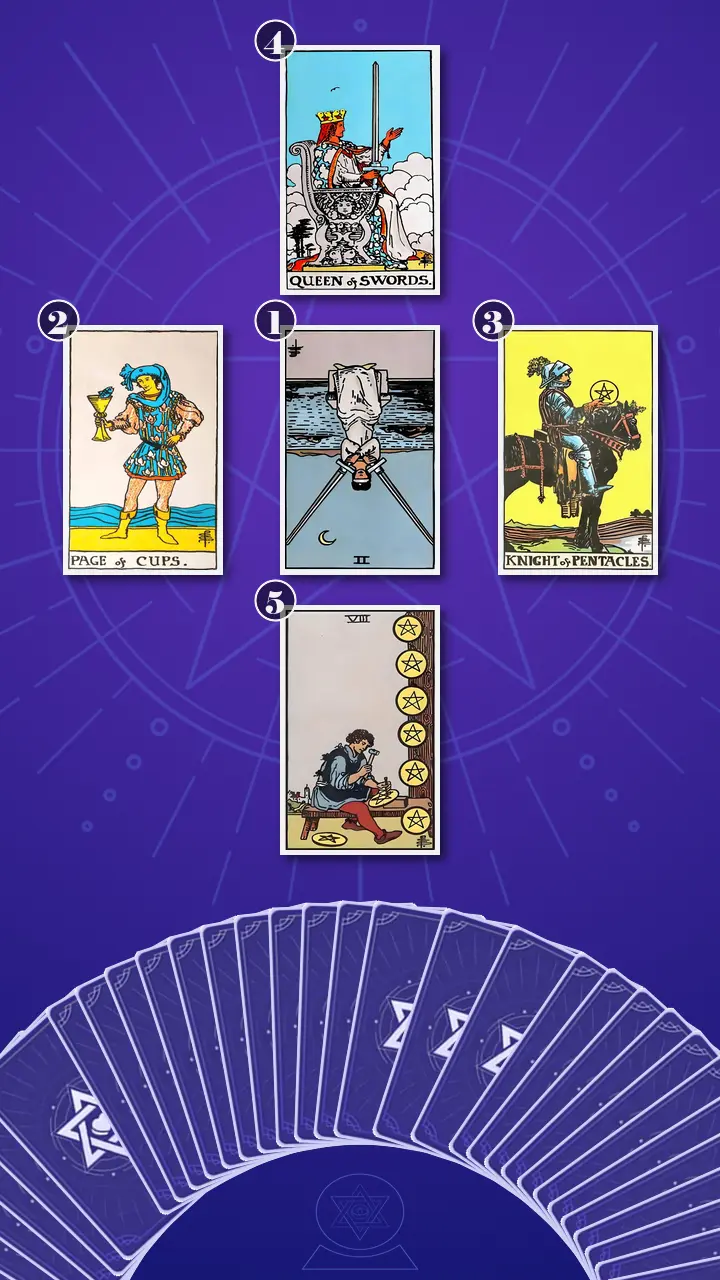
I pointed to the layout as I placed the cards. “The center is your current stuck loop. Left is Path A—the honest draft. Right is Path B—the safe draft. Above is what you integrate—the mindset and criteria that make the choice coherent. Below is your next step this week, so you can stop re-litigating and actually finish.”
Reading the Map: Card Meanings in Context
Position 1: The Loop That Looks Like ‘Being Responsible’
“Now flipped over,” I said, “is the card that represents the current stuck point: the observable behavior and inner posture that keeps you toggling between drafts instead of committing.”
Two of Swords, reversed.
I didn’t even have to reach for poetry. This one was literal. “This is you on a weeknight after work,” I said, “with two Google Docs open side-by-side, Track Changes on, highlighting the same intro in two colors. You keep toggling because choosing one voice feels like choosing which version of you gets judged.”
Reversed, the energy isn’t calm indecision—it’s a blocked kind of Air: overactive thinking with nowhere to land. “You’re tone-policing,” I told her. “Like every sentence needs legal review. You’re treating your draft like a risk dashboard—red/yellow/green—rather than a story.”
Alex gave a short laugh that had no humor in it. “Okay,” she said, almost wincing. “That’s… brutal. But yeah.”
I stayed gentle but precise. “This is why you feel stuck even though you’re ‘working.’ The loop is: deadline triggers the belief there’s one correct version that won’t get judged → you cope by endless polishing and removing emotionally specific lines → you get ten minutes of relief because it feels controlled → and then you feel erased, so you start again.”
I tilted my head. “When you open the doc, what do you do first—rewrite the intro, open the other draft, ask for feedback—and what feeling are you trying to get rid of in that moment?”
Her fingers worried the edge of a napkin. “The exposed feeling,” she admitted. “Like… if I make it cleaner, they can’t use it against me.”
“Polishing isn’t progress when it’s just fear in nicer font,” I said, and I saw her nod—sharp, uncomfortable, then relieved. Named is not shamed.
Position 2: Path A — The Honest Draft, the Line You Keep Treating Like Contraband
“Now we’re looking at Path A — the honest draft: what it gives you, what it risks, and what part of you it wants to express.”
Page of Cups, upright.
“This is the honest draft where one specific, slightly vulnerable detail makes the whole statement sound like an actual person,” I said. “It’s the line you write and immediately think, ‘Is this too much?’—and also, ‘If I delete this, it turns into a template.’”
This card’s energy is Water in balance: sincerity that doesn’t need to over-explain itself. “The Page isn’t oversharing,” I told her. “It’s letting one true motive be felt without pre-defending it. Like the one unpolished voice memo at 1:12 a.m. that finally sounds human.”
I glanced at Alex, then back at the card. “Which sentence in your honest draft makes you feel more like yourself—and also makes you immediately want to soften it?”
She stared at the tabletop a second too long. Then: “There’s a line about my mom’s hospital room. It’s… the reason I care about this field. I keep deleting it.”
I watched her face—fear and relief side-by-side, like she’d opened a window in a stuffy room and immediately worried about the cold. “That’s your fish in the cup,” I said. “Surprising. Memorable. And exactly the thing your anxiety wants to cut because it’s ‘weird’ or ‘messy.’”
Position 3: Path B — The Safe Draft, the Reliable Suit That Can’t Breathe
“Now we’re looking at Path B — the safe draft: what it protects, what it costs, and what part of you it tries to control.”
Knight of Pentacles, upright.
“This is the draft that reads like a reliable, well-structured application package,” I said. “Polished. Methodical. Credential-forward. It proves you can do the work.”
The energy here is Earth in excess—stability so controlled it risks becoming anonymous. “It can start sounding like you’re answering a prompt from HR,” I said, “or like a performance review: technically correct, emotionally flat.”
Alex’s shoulders dropped a millimeter. Not relief—recognition without self-attack. “Yeah,” she said. “It’s the one I show people because it feels… respectable.”
“And that makes sense,” I told her. “Playing it safe isn’t a character flaw. It’s a protective strategy. The question is cost: if you submit the safe draft as-is, what do you gain—credibility, calm, control—and what would you quietly grieve losing?”
She didn’t answer right away. Her eyes flicked to her laptop, like she could see the words she’d flattened. “I’d lose… stakes,” she said. “It wouldn’t sound like I actually care.”
Position 4: When the Queen of Swords Put Down the Blindfold
I let the café noise soften around us: the hiss of the espresso machine, the tiny clink of cups, a lull in the grinder. “We’re turning over the core of this reading now,” I said. “This card shows what to integrate: the decision criteria and mindset that transform this from a binary choice into a coherent statement.”
Queen of Swords, upright.
“This is the moment you stop trying to sound uncriticizable and start writing to be clearly understood,” I said. “You choose criteria—what’s relevant, what proves fit, what’s specific, what’s unnecessary. Then you cut with self-respect: you remove filler, apology language, and vague ‘I’m passionate’ fog.”
Alex’s face tightened again, like she was bracing for the part where I’d tell her to just ‘be authentic.’ I didn’t.
“Here’s the editorial truth,” I said. “Your honesty doesn’t need to be risk-free; it needs to be intentionally edited.”
The Aha Moment: Clean Truth, Not Less Truth
It was easy to imagine her at 10:47 p.m.—both drafts open, shoulders up by her ears—rewriting the first paragraph like it’s the only part that counts, trying to find the one tone that can’t be criticized. That’s the trap: treating clarity like something you earn by removing all risk.
Stop trying to disappear behind a “safe” voice—choose the Queen of Swords’ clear blade and cut toward a story that’s both honest and deliberate.
The sentence landed and just… sat there between us, louder than the espresso machine. Alex’s reaction came in a chain: first, a small freeze—her breath paused, fingers hovering above the trackpad like they’d forgotten what to do. Then her eyes unfocused, as if she was replaying every night she’d deleted the hospital-room line and replaced it with something “appropriate.” Then her mouth pulled into a tight, sudden frown.
“But if I do that,” she said, and there was heat in it—brief, honest anger—“doesn’t that mean I’ve been doing it wrong? Like… all this time?”
I kept my voice even. “No,” I said. “It means you’ve been protecting yourself with the only tool that felt available: control. The Queen isn’t here to shame you. She’s here to give you a better tool: discernment.”
I tapped the card lightly. “Think of how coffee filters work. They don’t erase the coffee. They separate. Grounds stay out. The good stuff comes through. That’s what we’re doing with your story: letting the honest essence through, filtering out defensive fog. Clarity is what makes honesty feel safe—not less truth, just cleaner truth with proof and purpose.”
Her shoulders sank on a long exhale, like she’d been holding a bag of groceries in midair. She blinked fast, once, eyes bright but steady. The café window behind her showed the rain thinning, streetlights softening into halos. “Okay,” she whispered. “So… criteria first. Not tone first.”
“Exactly.” I leaned in a little. “Now, with this new perspective, think back to last week. Was there a moment—one edit, one sentence—where this would’ve changed how you felt?”
She nodded, slow. “The moment I replaced the hospital line with a generic ‘I’ve always been passionate.’ I hated it as soon as I wrote it.”
“That’s you moving from deadline pressure and approval-seeking tone-policing to grounded confidence through clear criteria,” I said. “Not by being louder. By being cleaner.”
Position 5: The Eight of Pentacles and the Finish-Line Mindset
“Now we turn over your next step: the most actionable move you can take this week to finalize, not re-litigate, your statement.”
Eight of Pentacles, upright.
“This card is craft,” I said. “Not adrenaline. Not vibes. It’s the apprentice at the bench, doing the same action on purpose until it’s solid.”
And the modern translation was painfully perfect: “Instead of rewriting your intro for the fifteenth time, you treat finishing like a workflow. Three passes—on purpose—and only those: clarity/structure, evidence/proof of fit, voice/line-level polish. You stop when the pass ends. You rename the file something ridiculous like ‘FINAL_final_ACTUALLY.pdf,’ read it out loud once, run a typo sweep, and submit.”
I watched her eyes as she pictured it: the quiet after you close the tab, the sudden absence of the blinking cursor. Motivation, but calm.
“Do passes, not rewrites: clarity pass, evidence pass, voice pass—then you’re done,” I said. “Completion is part of the skill.”
The One-Page Queen Edit: Actionable Advice for Two Personal Statement Drafts
When I looked at the whole spread, the story was clean: Two of Swords reversed showed the present loop—draft-switching and tone anxiety masquerading as productivity. Page of Cups showed the living core you keep sanitizing. Knight of Pentacles showed the competent structure you’re afraid to lose. Queen of Swords bridged them: strategic framing, boundaries, and clear criteria. Eight of Pentacles grounded it: disciplined craft so you can actually hit submit.
The cognitive blind spot was the one Alex had been living inside: she thought she was deciding between two drafts. But she was really deciding between two editing motives—editing to be clearer vs editing to be less visible.
“Write to be understood by the right reader, not liked by every reader,” I told her. “That’s the Queen’s boundary. And it’s how you stop writing for the imaginary comment section in your head.”
Then I slid her a napkin and a pen—because in my café, plans should fit next to a cup. “Here’s your next 48 hours,” I said. “Small, strict, doable.”
- The One-Sentence Thesis Test (30 minutes)Open a new doc and write at the very top: “I’m applying because ____, and I’m ready because ____.” Set a 30-minute timer. When the timer ends, pick the draft that supports that sentence with the fewest edits, and paste it into a new file titled: “Statement — Working Master.”If your brain screams the thesis is “too simplistic,” treat that as tone anxiety, not insight. Keep it simple anyway.
- The Queen Criteria Checklist (10 minutes)Create a 3-bullet checklist in the doc header: (1) Relevant to the program, (2) Specific (not generic), (3) Proof of fit (a concrete example). Anything that doesn’t hit at least one bullet gets cut or rewritten—no negotiating.This is my “Knowledge Filtration” lens: like a coffee filter, you’re not erasing your story—you’re separating grounds (defensive filler) from the drinkable truth (clear point + evidence).
- Passes-Not-Rewrites Workflow + a Submission WindowDo three timed passes this week: Pass 1 (15–25 min): structure/clarity. Pass 2 (15–25 min): add/verify one proof-of-fit example. Pass 3 (15–25 min): voice/line polish. Then schedule a submission window (example: Thursday 7:30–8:00 p.m.). After a final read-aloud and typo sweep, submit and close the tabs.Use my “Focus Period Diagnosis”: if late-night coffee makes you jittery and extra nitpicky, do Pass 1 in the morning (or go half-caf after 3 p.m.). For the submission window, build an “Exam Emergency Kit”: water, a steady snack, and a coffee that keeps you clear—not frantic.
Alex stared at the list, then laughed—this time with relief. “It’s weird,” she said. “This feels… finishable.”
“That’s what structure does,” I said. “It turns a career crossroads into next steps.”

A Week Later: Ownership, Not Certainty
Six days later, during my morning rush, my phone buzzed between cappuccinos. Alex’s text was short: “Did the three passes. Kept the hospital line. Added one framing sentence right after it. Submitted Thursday at 7:42. Closed the tabs. I’m shaking a little but I did it.”
I pictured her afterward: not fireworks, not a movie montage—just her alone in a café corner with a cooling drink, staring at an empty browser bar for three quiet minutes, surprised by the space where the spiral used to live.
That’s the real Journey to Clarity I see again and again: not certainty, but ownership. A coherent story you can stand behind, built by clear criteria and disciplined craft—so your honesty reads as competence.
And if tonight you’re feeling that specific kind of pressure when the submit button is right there—and suddenly every honest sentence feels like it could be used as evidence that you’re “not enough,” so you keep rewriting to disappear and still be chosen—let me leave you with the same compass I gave Alex.
If you let yourself aim for being clearly understood (not perfectly approved), what’s one line you’d keep exactly as it is—just long enough to build the rest of the story around it?
This story is adapted from psychological research, written so that those in a similar struggle can see their own pattern in it — and find their next step clearly.These insights are not a substitute for professional psychological, medical, legal, or financial advice.
Learn more about our Journey to Clarity.
How did this insight land for you?
🫂 This Resonates Deeply
🌀 Living This Story
✨ Now I See Clearly
🌱 Seeing New Possibilities
🧰 Useful Framework
🔮 The Confirmation I Needed
💪 Feeling Empowered
🚀 Ready for My Next Step
Author Profile
 AI
AI“For twenty years, I’ve listened to stories unfold over the warm aroma of coffee. I don’t believe life’s complexities always require grand theories to be solved; often, we just need a safe place to tidy up our reality. I don’t offer high-minded preaching—just grounded, heartfelt insights to help you regain your sense of control amidst the clutter of daily life.”
In this Study Tarot Reading :
Core Expertise
- Syllabus Deconstruction: Stripping the paralyzing dread from massive deadlines by reducing them to mechanical, emotionless daily tasks.
- Study Environment Auditing: Identifying physical clutter and disorganized systems that quietly drain your limited psychological bandwidth.
Service Features
- The Desktop Reset Ritual: A pragmatic 15-minute physical clearing exercise to instantly restore visual order and mental clarity before opening a textbook.
Also specializes in :
Explore Related Patterns:
Self-SilencingAlex says the hospital-room line is the reason she cares about the field, then keeps deleting or softening it. That contradiction is the center of the draft problem: the line that makes the statement sound alive is also the line that makes her feel most exposed. Self-Silencing names the defense where a person reduces their own specificity to stay acceptable. In this story, the safe draft is not just polished; it is emotionally flattened. It protects credibility and control, but it also removes the personal stakes that would let the reader understand why the application matters. The next step is to stop confusing self-protection with self-erasure. You do not need to publish every private detail, but you do need one true motive to survive the edit. The goal is a voice that is edited with self-respect, not muted by fear.
Strategic VulnerabilityAlex's final move is specific: she keeps the hospital-room line and adds one framing sentence after it. That matters because the solution is not raw confession and not a sterile performance draft; it is honest material placed inside a clear editorial frame. Strategic Vulnerability is the pattern of letting the true thing be visible without abandoning discernment. The hospital detail stays because it explains motive, but it is held by relevance, specificity, and proof of fit. This turns vulnerability from a loose emotional risk into a coherent part of the argument. For this decision, the useful question is not whether honesty is safe in the abstract. It is whether the honest line is doing a job in the statement. When it has purpose and framing, you can be personally real without handing control of the story to fear.
Visibility Shame LoopAlex keeps returning to the hospital-room line because it carries the real motive behind the application, but she also keeps treating it like contraband. The sentence is not random emotional detail; it is the part of the statement that makes her visible as a person with stakes, history, and care. Visibility Shame Loop captures the way that visibility starts to feel like evidence against the self. The imagined reader becomes an internal courtroom, and every honest line is scanned for how it could be misunderstood, judged, or used against her. To reduce that shame pressure, she edits herself down into a safer voice, then feels the cost of becoming generic and starts the loop again. The useful shift is not forcing total openness. It is learning that being seen can be structured. When you keep the honest line and frame it with purpose, you stop using invisibility as protection and start building a statement you can stand behind.
Analysis ParalysisAlex has the Submit button in reach, but her attention keeps bouncing between Draft A and Draft B, between one highlighted intro and another, between delete, undo, retype, and compare. The problem is not a lack of effort; the effort has become circular because each new comparison creates another reason not to choose. Analysis Paralysis shows up when thinking becomes a substitute for decision ownership. In Alex's case, the mind is trying to solve an emotional risk as if it were a technical puzzle: find the exact tone that cannot be judged, then submission will feel safe. But because no personal statement can be made criticism-proof, the analysis has nowhere stable to land. This pattern matters because the next step is not more global rethinking. It is a bounded decision process: criteria first, then three passes, then submit. You move out of the loop by replacing endless comparison with a clear enough standard that can hold the anxiety without obeying it.
Perfectionism-Driven AvoidanceAlex's repeated toggling between two Google Docs, the highlighted intro sentence, and the urge to fix one more line show a pattern where editing becomes a defense against exposure. The work looks productive on the surface, but the function of the behavior is to postpone the moment when a real, specific version of her has to be submitted and judged. The perfectionism here is not just about clean prose. It is a safety strategy: if every sentence is polished enough, neutral enough, and hard enough to criticize, then maybe the exposed feeling can be controlled. That is why the hospital-room line feels dangerous even though it also gives the statement its motive and emotional coherence. Perfectionism-Driven Avoidance names the mechanism behind the submit spiral: high standards are being used to delay visibility. You are not choosing between honest and safe as fixed identities; you are learning to separate useful editing from fear-based erasure, so the draft can become clear without becoming anonymous.
Values-Based Decision MakingAlex's relief begins when she says, "criteria first, not tone first." That sentence marks a real cognitive shift: she stops asking which draft will make her least criticizable and starts asking which version best communicates purpose, fit, specificity, and evidence. Values-Based Decision Making gives the choice a stable center. Instead of letting fear of judgment define the edit, she uses the actual values of the application: why she is applying, what she is ready for, and what concrete proof supports that claim. The decision becomes less about managing every possible reaction and more about aligning the draft with the story she can own. This pattern directly answers the next-step question. You do not need another round of vague weighing between honest and safe. You need a criterion-based pass that protects the point of the statement, cuts defensive filler, and lets the final draft be clear enough to submit.
Explore Related Struggles:
Clarity-Exposure SplitAlex keeps returning to the same document with the Submit button already in reach, not because the draft has no path forward, but because each clearer sentence makes her feel more visible. The hospital-room line carries the actual reason she cares about the field, yet it is also the line she keeps deleting, softening, and replacing with something more generic. That creates the core split: clarity would make the statement stronger, but clarity also exposes a version of her that can be judged. You can see the struggle in the physical loop of delete, undo, retype, and toggle. The work looks like editing, but the deeper friction is between being understood and staying protected. Clarity-Exposure Split fits because the story turns a writing choice into a visibility threshold. The next step is not to become more raw or more polished by default; it is to hold the honest line long enough to frame it with purpose, so visibility becomes deliberate rather than uncontrolled.
Competence-Narrative SplitAlex's safe draft does real work: it is polished, methodical, credential-forward, and respectable enough to show other people. At the same time, the honest draft contains the hospital-room detail that explains why the application matters, the part she recognizes as alive even while she worries it may be too much. The conflict is not honesty versus competence in any simple sense. It is the feeling that competence must sound flattened, while a real motive might make her look less controlled. That is why the generic sentence, “I’ve always been passionate,” feels safer and wrong at the same time. Competence-Narrative Split fits because Alex is trying to prove fit while accidentally removing the narrative that proves fit most clearly. The stronger path is the integrated one: keep the competent structure, but let one specific lived reason carry the stakes, so the application reads as both capable and human.
Inner Tribunal LockAlex is not only editing for the admissions reader in front of her; she is editing for every imagined objection that might arrive after the reader sees her clearly. The draft becomes a courtroom-like space where each sentence needs legal review before it is allowed to stay. That pressure changes the purpose of revision. Instead of asking whether the line is relevant, specific, and supported by proof of fit, she asks whether it can be criticized. The imagined comment section becomes louder than the actual application brief, and the safest wording starts to outrank the clearest wording. Inner Tribunal Lock fits because the judging audience has moved inside the drafting process. You can see the lock in the way Alex tries to become uncriticizable before she lets herself be understood. The way out begins when she replaces imaginary approval tests with chosen criteria, so the reader becomes real again and the internal trial loses authority.
Explore Related Emotions:
Approval AnxietyAlex keeps treating each sentence like it needs legal review, because the draft is no longer only being written for an admissions reader. It is also being written for the imagined comment section in her head, the part that might call her too much, too flat, too messy, or not polished enough. Approval Anxiety names the inner weather behind that constant tone-checking. You are not just trying to make the statement stronger; you are trying to make it impossible to reject on emotional grounds. That search for universal approval traps the writing in a narrow corridor, where every honest sentence has to prove it will not be used against you before it is allowed to stay.
Cautious VulnerabilityAlex keeps the hospital-room line, adds one framing sentence, and submits while still shaking a little. The line is not dumped onto the page raw, and it is not deleted for safety; it is held inside a deliberate frame that gives it purpose. Cautious Vulnerability captures that exact emotional balance. You are allowing one true motive to be seen without handing over every tender detail for inspection. The caution matters because it protects your boundaries, and the vulnerability matters because it keeps the statement from becoming anonymous. Together, they let honesty read as competence rather than exposure.
Visibility PressureThe hospital-room line sits in the honest draft like the one detail that makes the statement breathe, and it is also the line Alex keeps deleting. When she replaces it with a generic 'I've always been passionate,' the draft becomes safer on the surface but loses the pulse that made it feel like hers. Visibility Pressure is the feeling of wanting the right reader to understand you while also wanting to hide the part that would make you recognizable. In this story, the pressure is not about oversharing everything; it is about the cost of letting one true motive be visible. You are trying to disappear enough to be protected and remain present enough to be chosen, which is an exhausting place to write from.
Clarity ReliefAfter the Queen of Swords moment, Alex stops asking which tone is uncriticizable and says, 'criteria first. Not tone first.' Her shoulders drop on a long exhale because the problem has finally changed shape: it is no longer a vague demand to be perfectly safe, but a concrete edit toward relevance, specificity, and proof. Clarity Relief fits the moment when the draft becomes a map instead of a courtroom. You do not need to delete the truth to make it usable; you need a filter that separates the defensive fog from the point that belongs on the page. The relief is not certainty that everyone will approve. It is the felt space that opens when the next move becomes clear enough to do.
Deadline Doom SpiralAt 10:52 p.m., the Submit button is already there, but the two Google Docs stay open side by side while the same intro sentence gets deleted, restored, and rewritten again. Your body is not treating this like normal editing; it is treating the deadline like a pressure clamp, with a tight jaw, shallow breath, and hands that keep reaching for one more tiny fix. That is why Deadline Doom Spiral fits this story. The deadline does not simply ask for completion; it amplifies the belief that one wrong tone could make everything collapse. The loop gives a short hit of control, then returns you to the same edge of submission, where finishing feels less like sending a file and more like stepping out from behind the draft.
Grounded AgencySix days later, Alex's text is short and concrete: she did the three passes, kept the hospital line, added one framing sentence, submitted Thursday at 7:42, and closed the tabs. Nothing about that update sounds like perfect certainty; it sounds like ownership. Grounded Agency belongs here because the story moves from trying to control every possible reaction to choosing a process Alex can stand behind. You are not waiting to become fearless before acting. You are building a decision that has enough structure, evidence, and self-respect to carry your honest voice across the finish line.
Self-Betrayal AcheWhen Alex replaces the hospital-room line with a generic 'I've always been passionate,' she hates it as soon as she writes it. That reaction is important because the safe sentence does not just weaken the essay; it makes her feel the loss of her own stake in the story. Self-Betrayal Ache names the quiet hurt that follows when protection starts costing you your voice. You are not wrong for wanting the draft to be respectable, but the story shows how repeated sanding-down can begin to feel like erasure. The ache comes from knowing which line is alive and watching yourself cut it anyway, hoping safety will feel like peace.
Wrong Choice PanicWith the same intro highlighted pink in Draft A and yellow in Draft B, the choice stops feeling like an edit and starts feeling like a test of which self is allowed to speak. The toggling matters because it keeps postponing the one act that would make the decision real. Wrong Choice Panic fits because Alex is not weighing two normal options with ordinary uncertainty. She is treating tone as if one version could secure her and the other could expose her. You can feel the panic in the phrase 'game over,' where a writing decision gets inflated into a verdict on the whole application and, briefly, on the self behind it.
Disciplined CalmThe Eight of Pentacles next step turns the finish into three timed passes: clarity, evidence, and voice. That structure matters because it gives the work a beginning, a middle, and an end instead of letting the draft reopen every time discomfort spikes. Disciplined Calm is the steadiness that comes from bounded craft. You are not calming yourself by pretending the application does not matter; you are calming the process by giving each edit a job and giving completion a window. In this story, calm is not passive. It is the decision to stop rewriting the whole self when one clean pass is enough.
Explore Related Contexts:
Academic Legitimacy ScrutinyAlex is writing a personal statement that has to prove fit, readiness, and seriousness to an unseen academic reader. The safe draft proves she can do the work, while the honest draft carries the specific reason she cares about the field. Academic Legitimacy Scrutiny is the pressure of being evaluated not only for skill, but for whether your story sounds admissible, mature, and appropriate. You are not just submitting a document; you are presenting evidence that you belong in the next academic space. That is why the honest line feels so charged. It is a real motive, but it also enters a gatekeeping format where motive has to be framed as competence, not left as raw disclosure.
Academic Performance PersonaThe safe draft reads like a reliable, well-structured application package, polished, methodical, and credential-forward. Alex even says it is the one she shows people because it feels respectable, while also recognizing that it no longer sounds like she actually cares. Academic Performance Persona appears when the application starts rewarding a version of you that is legible, impressive, and low-risk, but too flattened to carry real stakes. The hospital-room line is replaced by a generic passion sentence, so the draft performs competence while thinning out motive. For you, the question is not whether professionalism matters. It is whether the performance of professionalism has started crowding out the evidence that makes your statement memorable and coherent.
Review Criteria Black BoxAlex says that if she picks the wrong tone, that is game over, and the draft starts being handled like every sentence needs legal review. The evaluator is not physically in the room, but the imagined review standard is controlling the page. When the criteria are unclear, your mind tries to manufacture certainty by over-editing. Relevance, specificity, and proof of fit only become available later as external rules you can actually use, which shows how much of the spiral came from trying to satisfy an invisible rubric. Review Criteria Black Box names the pressure of writing for a gatekeeper whose standards feel unreadable. The useful move is to build a small set of visible criteria, so the statement can answer the application rather than chase every possible objection.
Safe Visibility TrialAlex eventually keeps the hospital-room line, adds one framing sentence after it, submits Thursday at 7:42, and closes the tabs. The important detail is that the honest material is not dumped onto the page without structure; it is held, edited, and connected to fit. Safe Visibility Trial names the moment when being seen becomes something you can design rather than something you have to avoid. You allow one true motive to stay visible, then give it enough context that a reader can understand why it belongs in the statement. This is the practical middle path between oversharing and disappearing. The honest detail stays, but it is protected by framing, relevance, and purpose.
Strategic Academic CrossroadsAlex has two Google Docs open side by side, the honest draft and the safe draft, and the submit button is already close enough to make every edit feel consequential. The visible choice is about wording, but the real external stage is an academic application fork where each draft offers a different way to be read. The honest path carries specificity through the hospital-room line. The safe path carries polish through a credential-forward package that sounds respectable. You are being asked to choose not just which draft is cleaner, but which version of your applicant story can survive contact with an evaluator. That is why this fits a strategic academic crossroads. The next step is not more toggling; it is deciding what the application needs to prove, then choosing the draft that can carry that proof with the least self-erasure.
Tone PolicingAlex keeps removing the line that sounds most like her, then replacing it with language that is cleaner but more generic. The hospital-room sentence is not rejected because it is irrelevant; it is treated as dangerous because it makes the applicant visible. That is the social pressure inside Tone Policing. You are not only editing grammar or flow; you are managing how acceptable your voice will sound to someone with decision power. The page becomes a compliance space where honest language has to pass a respectability check before it can stay. The story shows why endless polishing does not create clarity by itself. When tone control becomes the main goal, the statement can become technically safe while losing the specific reason the application matters.
Decision Criteria ResetAlex lands on the sentence criteria first, not tone first, after seeing how much time was being spent trying to sound uncriticizable. The next move is concrete: write a one-sentence thesis, choose the draft that supports it with the fewest edits, then run three bounded passes. Decision Criteria Reset turns the application from a vibe check into an editorial system. You stop asking which draft makes you safest and start asking which draft proves the point the application needs to make. That reset gives the next step its power. Once the criteria are visible, finishing becomes a sequence of decisions with stop rules, not another night of reopening the same draft to negotiate with imagined judgment.