Vague Rubric, Nearly Empty Draft: Testing a Paragraph Before Certainty

Finding Clarity in the 10:40 p.m. Rubric Spiral
If you are a second-year student balancing essays with a weekend retail shift, a rubric that says “critical analysis” without showing what it looks like can turn one planned writing night into three hours of productive procrastination.
At 10:40 p.m. on a Tuesday, Jordan, a 21-year-old student in Toronto, joined my video call from a downtown university library. They tipped the webcam toward a three-colour rubric, four high-scoring essays, and a perfectly formatted title page floating above one provisional heading. The fluorescent lights buzzed; their laptop fan pushed warm air over their hands, and a sip of cold coffee made them wince.
“The rubric somehow says everything and nothing,” Jordan said. “I know how to work hard when I know what I am aiming at. But if I start before I understand what excellent means, I could build the whole thing wrong.”
I watched their jaw tighten as they glanced at the phrases “depth,” “originality,” and “critical engagement.” Their apprehension felt less like ordinary nerves and more like a guitar string being tightened behind the jaw, one turn at a time, until even touching the blank document seemed likely to make it snap. They wanted to complete the assignment promptly, but they also feared that any provisional interpretation might fail an invisible standard.
“You are not avoiding the work because you do not care,” I told them. “You are avoiding the moment your interpretation becomes judgeable. The more you care about getting it right, the longer you keep the work somewhere it cannot receive feedback.”
Jordan looked at the immaculate title page, then at me. I said, “I am not going to use tarot to predict your grade or pretend the rubric is clearer than it is. I want us to use the cards as an external map of what happens between reading the brief and postponing the first paragraph. Our journey is to find enough clarity for one honest next move, not certainty about the whole road.”

Choosing the Map for Vague-Rubric Procrastination
I asked Jordan to place both feet on the floor, let their hands rest away from the trackpad, and take one unforced breath. I shuffled slowly on my side of the call. The pause was not a mystical performance; it was a way to move their attention from the browser noise toward the question we were actually examining.
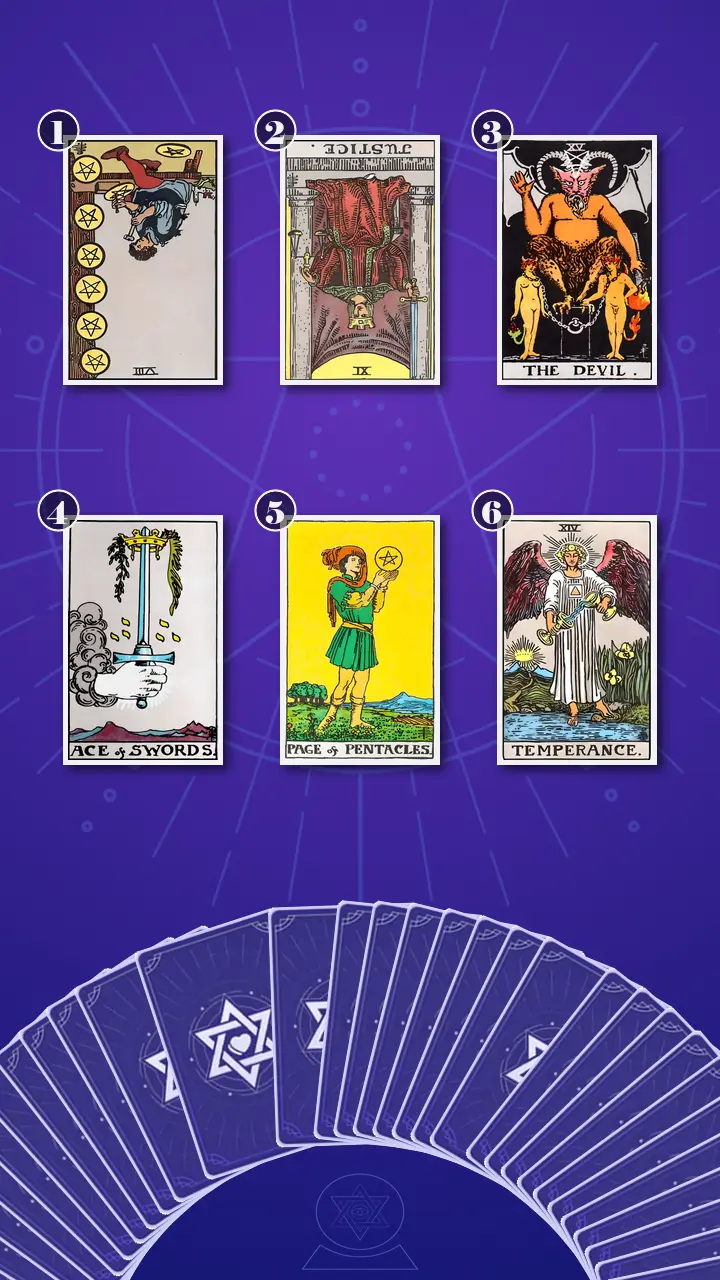
I chose the Transformation Path Grid · Context Edition, a six-card tarot spread arranged in two rows of three. The upper row would diagnose the stuck system: the visible preparation ritual, the immediate obstruction created by unclear grading criteria, and the deeper rule that kept the procrastination cycle repeating. The lower row would answer it with a leverage point, one material action, and an integrated feedback practice.
For anyone wondering how tarot works in a situation like this, I use card meanings in context as structured prompts for observation. Jordan was not choosing between two careers, and they did not need an outcome prediction. They were caught in a repeatable sequence: vague phrase, body tension, comparison, temporary relief, lost drafting time, deadline rush. This spread was the smallest map that could display that sequence and then rebuild it without treating Jordan as defective.
I explained that Position One would show the work-like activity absorbing the writing session. Position Three would reveal the contract linking certainty, evaluation, and self-worth. Position Four, directly below the first card, would locate the smallest interruption capable of changing the pattern. After reading across the upper row, I would move to the lower row and then compare the vertical pairs: blocked effort with clear thought, opaque standards with tangible evidence, and compulsive repetition with measured calibration.
“So the cards are not telling me whether I am going to mess it up?” Jordan asked.
“No,” I said. “They are helping us see where your choices become narrow and where they can become wider again. You remain the person who decides what to draft, what to ask, and which advice fits your course and boundaries.”
The Upper Row: When Care Cannot Reach the Page
Position One: Eight of Pentacles Reversed and the Work Before the Work
The first card I turned occupied the position that shows the observable presenting problem: the work-like preparation Jordan repeats while the assignment itself remains unwritten. It was the Eight of Pentacles, reversed.
In the Rider-Waite-Smith image, a craftsperson repeats a skilled motion while finished pentacles accumulate nearby. Reversed, the workshop resembled Jordan's screen at 10:40 p.m. They had spent ninety minutes colour-coding the rubric, renaming outline sections, checking APA formatting, and arranging four sample essays across the browser. The document looked professionally organised, but below the title page sat only one provisional heading.
I described this as a blockage of practical Earth energy. The effort was real, but its target had shifted. Instead of producing material that could be inspected and improved, Jordan was perfecting the conditions under which writing might eventually feel safe. The card was not criticising diligence. It was showing diligence caught in a repetitive setup montage that never reached the central task.
“During your last planned writing session, what was the final preparation task you began before postponing the first original paragraph?” I asked.
Jordan glanced sideways at the open tabs. “I changed the citation settings. Then I checked the title page against a sample. I told myself it was responsible because I had technically been working for hours.”
A short, bitter laugh escaped them. Their shoulders rose, their mouth pulled briefly to one side, and then they rubbed a thumb over the cold coffee cup. “That is too accurate. Honestly, kind of brutal. I have been working for hours, so why is there still nothing I can revise?”
“Recognition can sting without becoming a judgement,” I said. “This card does not call you lazy. It separates care from progress so you can redirect the care. The useful question is not whether preparation is bad. It is which preparation task begins immediately before the draft disappears again.”
Position Two: Justice Reversed and the Unreadable Scale
The card I turned for the immediate environmental and cognitive obstruction, where opaque grading criteria prevent energy from moving forward, was Justice, reversed.
I pointed to the scales, the upright sword, and the veil between the pillars. Those symbols ordinarily suggest that evidence can be weighed according to a visible principle. Reversed, they mirrored a rubric containing “original insight” and “critical engagement” without showing what observable feature would move a paragraph from one side of the grading scale to the other.
Jordan could not tell whether the assignment required them to compare sources, challenge assumptions, evaluate methods, or do all three in every paragraph. Because the standard did not translate cleanly into an observable move, each possible thesis felt capable of failing a rule that might become visible only in the marker's comments. Jordan responded by collecting more interpretations instead of choosing one provisional reading.
I had a quick professional flashback to calibration displays from my years of sound energy research. A meter can carry precise labels and still be unusable if nobody defines the threshold between signal and noise. Justice reversed did not prove that every future grading decision would be unfair. It showed blocked discernment: the structure existed, but Jordan could not yet connect its language to evidence on the page.
“More examples do not always create more clarity,” I said. “Sometimes they create more standards to fear. Which exact rubric phrase sent you into extra-tab mode tonight?”
“Critical engagement,” Jordan answered immediately. Their jaw tightened again. “One sample compares theories. Another critiques methodology. The class chat has six other opinions. If the real standard can only be seen after grading, every direction feels risky before submission.”
I nodded. “That is a reasonable response to genuine ambiguity. We do not need to pretend the ambiguity is imaginary. We only need to ask whether solving the entire grading system is the only possible response to it.”
Position Three: The Devil and the Ten-Minute Relief Contract
The third card represented the root mechanism linking evaluation, self-worth, short-term relief, and the repeated procrastination cycle. I turned over The Devil, upright.
I told Jordan immediately that I did not read The Devil as a frightening prediction, a sign of personal weakness, or evidence that something bad was destined to happen. I centred the loose chains around the two figures. The binding looked compulsory, yet the collars were wide enough to be examined and loosened.
In Jordan's life, that chain appeared as a browser loop: rubric, sample essay, class chat, revised outline, then back to the rubric. Jordan already knew another example could not guarantee the grade, but opening it provided ten minutes in which no original interpretation had to be exposed. The cycle worked like an infinite-scroll feed. Every new item promised closure, delivered a brief hit of relief, and then generated another reason to keep scrolling.
I used my Focus Disruption Auditing lens and named the dissonant chords one by one: a broad criterion, a sample tab, a classmate's “mine is basically done” message, a comparison spike, an outline reset. Each chord shattered the possibility of deep work before Jordan's attention could settle. The audit showed that the primary interruption was not a lack of focus. It was the rule operating underneath the focus: “I cannot expose a draft until I have removed every chance of misunderstanding.”
That was an excess of attachment to certainty. It protected Jordan temporarily, but it also removed drafting and feedback time. Deadline pressure eventually became stronger than the fear of being wrong, so Jordan wrote in a rushed burst. The exhausting result then seemed to confirm the belief that vague criteria made good work impossible, creating pressure to prepare even more next time.
“What does the extra preparation protect you from feeling for those ten minutes?” I asked. “And what does the grade seem capable of proving about you?”
Jordan's fingers stopped moving. Their gaze lost focus as if they were replaying a Sunday night at the apartment desk. Then their chest sank with a quiet exhale. “It protects me from being wrong while the document is still private,” they said. “And if I get a disappointing grade after choosing the wrong interpretation, part of me thinks it means I am not as capable as everyone else. I am not avoiding the assignment because I do not care. I am avoiding finding out that I misunderstood it.”
“That distinction matters,” I said. “A grade can evaluate features of one assignment. It cannot responsibly carry the job of certifying your worth or your right to belong. Naming the relief is how we begin loosening the chain. It turns a vague accusation like laziness into a sequence you can observe and interrupt.”
When the Ace of Swords Cut a First Line Through the Fog
Position Four: The Key Card of Bounded Clarity
Before I turned the lower-left card, the library ventilation clicked off. For one beat, the fluorescent hum disappeared from Jordan's microphone, and the silence felt almost physical. I turned the card representing the smallest leverage point in the pattern: converting broad uncertainty into one precise, testable question. It was the Ace of Swords, upright, the key card of the reading.
A single sword rose from cloud, crowned but still suspended above rugged mountains. I read that image as clarity with difficulty still present. The card did not promise to reveal the lecturer's mind or remove every ambiguity from the rubric. Its balanced Air energy offered disciplined clarity, intellectual self-trust, and the willingness to make one clean distinction that could be drafted, tested, or clarified.
I asked Jordan to imagine closing three sample tabs and writing one sentence at the top of the Google Doc: “For this draft, critical analysis will mean comparing the assumptions and evidence used by sources A and B.” From that working definition, they could write five rough sentences and discover a real uncertainty: “Would this comparison demonstrate criterion two, or should I also evaluate each source's method?” The grading landscape would remain incomplete, but the fog would have produced one answerable question.
This was where I applied Cognitive Tempo Calibration, my diagnostic method for noticing when task demands have fallen badly out of sync with a person's workable neurological rhythm. Jordan had forced one study beat to carry four jobs at once: decode every criterion, predict the marker's judgement, construct an excellent argument, and protect personal worth. Their mind was not refusing effort. It was trying to process a whole evaluative system before receiving the concrete information that only a draft could generate.
The Ace changed the tempo without lowering the academic standard. One criterion. One provisional definition. One paragraph. One bounded question. Clarity no longer had to arrive as a complete download before work began; it could develop in small exchanges between thought and evidence.
Jordan's jaw was still tight, their immaculate title page still sat above a provisional heading, and three rubric colours crowded the screen. Their mind continued to frame the assignment as a single high-stakes demand: understand everything correctly now, or risk building the whole essay wrong.
I said, “The rubric can stay incomplete; your next move does not have to. Turn one vague criterion into one testable paragraph and one precise question.”
You do not need perfect certainty before you begin; choose one testable interpretation, ask one precise question, and let the Ace of Swords cut a workable first line through the fog.
I stopped speaking and let the sentence stay in the newly quiet room.
For one beat, Jordan's breathing stopped. Their right hand hovered above the trackpad, fingers curved but motionless. Then their eyes widened slightly and drifted away from the card, as though they were replaying every evening spent trying to solve a rubric before writing. Their lower eyelids reddened. One shoulder dropped first, then the other, and the fist resting beside the coffee cup opened slowly against the table. A long breath left them with a faint tremor, but relief did not arrive alone. Their mouth tightened, and a flash of anger crossed their face. “But doesn't that mean I have been doing it wrong this whole time?” they asked. Their voice began low and defensive, then thinned into something more vulnerable. “I have lost so many nights to this.” After the release, they looked almost unsteady, as if setting down a heavy bag had left their body briefly unsure how to stand without it.
“No,” I said. “It means your old strategy gave you short-term protection when evaluation felt unsafe. It made sense as protection, and it also became expensive. Seeing the cost now is not a verdict on the person who used it before. It gives the person sitting here more choices for the next assignment.”
I leaned closer to the camera. “Now, with this new view, think back to last week. Was there a moment when this insight could have made the experience feel different?”
Jordan looked toward the rubric. “Sunday at 6:18. I searched Reddit for what critical engagement means instead of writing. If I had made one test paragraph, I might not have known the whole answer, but I would have known what I actually needed to ask.”
I offered an eight-minute version while the insight was still concrete. For two minutes, Jordan chose one phrase and completed: “For this draft, critical engagement will mean comparing the assumptions and evidence of two sources.” For five minutes, they wrote three rough sentences to test it. In the final minute, they drafted the either-or question about comparing sources versus evaluating their methods.
I made the boundaries clear. Jordan did not have to send the question during our session, disclose anything personal, or continue if the exercise became too activating. They could use an instructor, teaching assistant, approved writing centre, course platform, or private revision check, depending on what felt appropriate and available. The minimum version was one provisional sentence saved in the document.
I named the shift I had just watched: not from uncertainty to certainty, but from contracted apprehension and certainty-seeking overpreparation toward measured confidence in drafting, clarifying, and revising while uncertainty remained. Jordan still cared about the grade. What had changed was the belief that care required paralysis.
One Small Paragraph and Two Measured Cups
Position Five: The Page of Pentacles Holds One Real Thing
The fifth card occupied the position that translates clarity into an actionable academic step: producing one provisional piece of work before seeking more certainty. I turned over the Page of Pentacles, upright.
The Page held one pentacle with sustained attention while a cultivated field stretched behind them. I contrasted that single object with the repeated pentacles of the first card. The reading did not reject Jordan's diligence; it changed the scale at which diligence operated. Instead of managing four examples, the whole rubric, every possible thesis, and the imagined marker at once, Jordan could study one piece of evidence created by their own hand.
Jordan set a twenty-minute timer for the next morning's library block and named the paragraph “Criterion 2 test: comparing assumptions.” They planned to write one rough analytical paragraph before opening another high-scoring example, underline the sentence doing the comparison, and add a Google Docs comment where the criterion still felt unclear.
This was practical Earth energy restored to balance. The paragraph would not be polished, submitted, or treated as proof of ability. It would be a beta version, small enough to revise but real enough to generate information that planning alone could not supply.
“A rough paragraph is not a verdict,” I told Jordan. “It is a question with evidence attached.”
They reread the three sentences created during the eight-minute exercise. Their forehead creased, but their fingers no longer fled toward the sample tabs. “It is rough,” they said. Then, after a pause: “But now I can see the exact place where I do not know whether comparing is enough. Before, everything just felt unclear at once.”
“That is the Page's form of confidence,” I said. “Not feeling certain in advance. Paying careful attention to one real learning object and letting it reveal the next question.”
Position Six: Temperance Rewrites the Repetition
The final card represented the cognitive integration of a healthier process, where drafting, clarification, feedback, and revision replace the old delay loop. I turned over Temperance, upright.
Water moved between two cups while the figure kept one foot on land and one in water. I translated the image into a modest academic rhythm: draft a paragraph, check one criterion for five minutes, ask or infer one focused question, revise one observable feature, then return to drafting. The developing essay and Jordan's understanding of the rubric could update each other.
This was balance rather than control. Temperance did not ask Jordan to tolerate endless ambiguity or surrender their judgement to every piece of feedback. It asked them to use measured calibration. The process resembled Google Docs version history or GPS recalculation: an adjustment was part of navigation, not evidence that the first move had failed.
After ten years of listening for rhythm under pressure, I have learned that a stuck process often contains a repeated beat that is carrying too much weight. Jordan's old rhythm was rubric, comparison, relief, panic. Temperance offered a new one: define, draft, question, revise. The repetition remained, but its function changed from avoidance to learning.
I watched Jordan's shoulders soften. They placed both palms on the table, looked at the lower row, and said, “I do not have to finish understanding before I start writing. Each can update the other.”
I pointed out the spread's elemental movement. Reversed Earth had begun as practical effort unable to settle into useful form. Justice and The Devil had shown judgement and attachment distorting thought. The Ace restored clear Air, the Page restored usable Earth, and Temperance introduced flexible Water. No Wands had appeared. I did not treat that absence as fate; I treated it as a behavioural invitation. Jordan would supply the missing Fire through the modest act of beginning before certainty arrived.
The Syncopated Study Session: A Rhythm for the Next Draft
I placed the cards back into their two-row grid and read the full story across them. Repeated rushed submissions had taught Jordan to seek even more certainty before the next assignment. In the present, real diligence was being absorbed by formatting, examples, and comparison. Unclear grading criteria activated the fear of an invisible verdict, and the deeper conflict arose when that limited academic judgement was allowed to carry meaning about personal worth. The lower row showed Jordan's available resources: precise thought, grounded curiosity, willingness to ask a bounded question, and the capacity to adjust without abandoning their own judgement.
The cognitive blind spot was that more preparation appeared to reduce the risk of misunderstanding. After a certain point, it did the opposite. It removed the paragraph that could reveal the real uncertainty, consumed the time available for feedback, and made deadline panic the only force strong enough to start the draft.
The transformation direction was therefore specific: move from waiting for a complete interpretation of the rubric to creating a provisional paragraph-level definition, writing a short test draft, and asking one bounded clarification question based on actual text. The goal was not certainty before action. It was a shorter distance between attempt and feedback.
To turn that insight into actionable advice, I adapted Temperance into my Syncopated Study Session. I call it syncopated because the process does not force concentration into one long, heroic push. It uses small, deliberately different beats so that interpretation, writing, and checking support one another without competing for the same moment.
- The One-Criterion Cut At the start of the next campus library or home study block, open the assignment document before any sample paper. Spend two minutes completing: “For this draft, [criterion] will mean [observable move in the paragraph].” Attach that definition to one proposed claim or three-sentence excerpt. Then spend one minute drafting an either-or question for the instructor or teaching assistant through the course's approved email or learning-platform channel. Treat the sentence as a temporary working definition, not a claim that you have decoded the marker's mind. Keep the question to one criterion and one excerpt. The minimum version is writing one observable feature beneath the criterion and saving it.
- The Twenty-Minute Provisional Draft During one library or home session this week, set a twenty-minute phone timer. Use two minutes to choose and label the criterion, fifteen minutes to write one rough analytical paragraph, and three minutes to add only two comments: “What this already demonstrates” and “What I still need to clarify.” Do not change formatting, rebuild the outline, or open another example during the timer. Finish by recording one visible next action. If twenty minutes feels too heavy, use a five-minute version: one claim, one piece of evidence, and one sentence explaining the connection. Park distracting links and broad uncertainties in a single “Not solving in this session” note, and stop if the exercise becomes too activating.
“These are experiments, not commandments,” I told Jordan. “You can keep what produces useful information and adjust what does not. Tarot has shown us the rhythm of the loop, but you decide how the next study block is scored.”
A Week Later: The First Note Held
Six days later, Jordan messaged me as pale winter light crossed their library desk. They had drafted 312 rough words, sent one bounded question to their TA, and left for their retail shift without checking the group chat. They still thought, What if it's wrong? Then they revised one sentence.
I did not read that message as proof that every future assignment would be easy. I read it as the first evidence of a different relationship with uncertainty. Jordan had not solved the whole grading system. They had shortened the distance between interpretation, evidence, and feedback.
The cards did not write the paragraph, send the question, or guarantee a particular grade. Jordan did those things. Tarot gave us an externalised cognitive map, making the hidden sequence visible enough to change. Their Journey to Clarity ended not in perfect certainty, but in ownership of the next move.
When a rubric says everything and nothing, many of us know the tight-jawed feeling of working harder around an empty document because choosing one imperfect direction feels dangerously close to letting a grade decide what we are worth. If that is your familiar rhythm, noticing the moment preparation turns into protection means you are already hearing the dissonant chord.
If your first paragraph were allowed to be a question in document form rather than evidence of your worth, which one small claim would you let it test as the first clear note in your own draft-question-feedback rhythm?