Perfect-Moment Procrastination: From Verdict to a Pitch That Can Learn

The Pitch That Kept Waiting for the Perfect Moment
I often meet this pattern at exactly this point: a junior creative strategist in London is staring at the first three slides of the same pitch while a short internal review window closes around them. That is perfect-moment procrastination, not a lack of ideas.
At 9:40 p.m., Alex, 27, joined my video call from the shared kitchen of their London flat. Blue light from the laptop flattened the room into cool rectangles. The kettle clicked off behind them, their phone had gone warm beneath one palm, and their other hand kept switching between two nearly identical Figma slides marked deck v12 and deck v13.
On the shared screen, I watched them drag a calendar reminder from Thursday morning to Friday afternoon. The movement took less than a second. The silence afterward carried much more weight.
Alex worked as a junior creative strategist at a mid-sized agency, where a short window had opened for new campaign concepts. The central idea was coherent. The deck already had a problem, an audience tension, and a creative direction. What it did not have was an audience. Alex wanted more creative ownership, but the stability of the current role mattered too, so one visible professional risk had begun to feel like a career crossroads.
“I keep saying I need one more clean pass, but the pass never feels final,” they told me. “I want to send it while the window is open. I just don't want the timing to make a good idea look weak. If I send it now, I lose the comfort of believing it could have been great.”
I could see the contradiction in their body before I named it: their jaw held like a stage-door latch, their breath paused behind it, and their shoulders became the weight of a curtain nobody had asked them to lift alone. They wanted the idea to enter the room while the opportunity was alive, but every possible weakness became another reason to keep it backstage.
“I don't hear laziness in this,” I said. “I hear a serious person trying to protect both an idea and their sense of professional worth. We are not going to predict whether someone will approve the pitch. We are going to make the pattern visible, separate evidence from imagined judgment, and find a next step that still belongs to you. Let's draw a map for this fog.”

Choosing the Crossroads: A Five-Card Shadow Spread
I asked Alex to place both feet on the floor and take one unforced breath. I shuffled slowly while they held a single question in mind: “Why do I keep waiting for the perfect moment to pitch my idea?” The brief pause was not a mystical performance. It was a way to move attention from ten competing thoughts toward one examinable pattern.
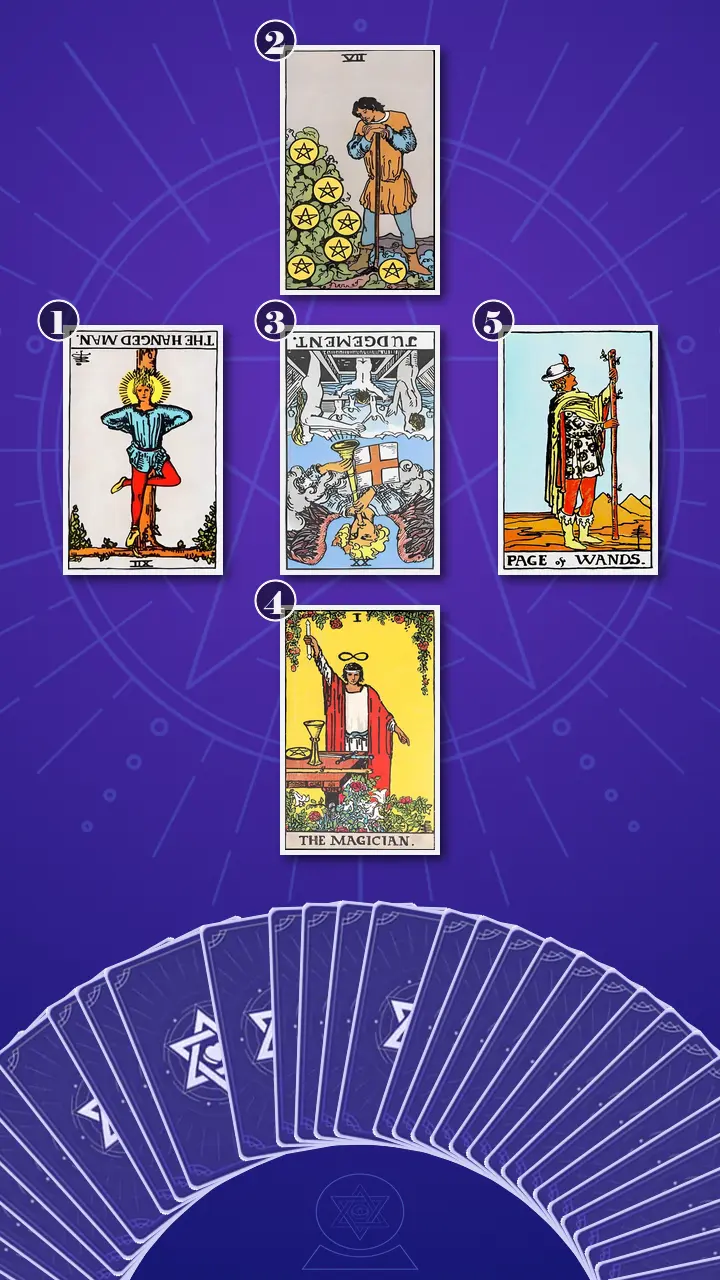
I chose a five-card Shadow Spread. I use this inner-excavation tarot spread when a visible behavior keeps repeating even though the person understands, at least intellectually, that it is not helping. A ten-card Celtic Cross could have divided this focused issue into more categories than it needed. The Shadow Spread follows the causal chain directly: symptom, protective habit, hidden fear, available resource, practical integration.
I laid the cards in a compact cross. The first position, on the left, would show the visible expression of the shadow, specifically the revision and rescheduling loop. The second, above the center, would identify the reasonable-looking habit that protected the delay. The central card would expose the private belief giving the loop its force. Beneath it, the fourth card would reveal an unclaimed resource. The fifth, on the right, would translate that resource into communication.
This is how tarot works for me: the images create enough distance for a person to examine their own pattern without being swallowed by it. Card meanings in context are not verdicts, instructions, or guarantees. They are structured prompts that help intuition and observable facts meet on the same table.
Where Preparation Became Suspension
Position One: The Deck Stuck in Review Mode
“I am turning over the card for the visible expression of the shadow,” I said. “In this case, that means the diagnostic symptom: repeatedly revising and rescheduling after preparation has stopped producing meaningful clarity.” The card was The Hanged Man, reversed.
The Rider-Waite-Smith figure hangs by one foot, body inverted, while a bright halo shows that awareness is already present. Upright, the card can describe a purposeful pause that changes perspective. Reversed here, its energy appeared as Blockage: the useful pause had hardened into movement withheld after the insight-gathering phase was complete.
I pointed back to the screen Alex had shared. At 9:40 p.m. in their flatshare, the pitch was still labelled as being in review, but the same opening slides and timing questions were circulating without new evidence. Figma's version history showed activity, yet no new person had seen the idea. The suspension was no longer helping Alex understand the concept. It was preserving the draft from the discomfort of a real response.
“One more edit can be preparation, or it can be the hiding place,” I said. “The distinction is not how busy the edit makes you. It is whether it produces a new perspective. Which condition for readiness has changed more than once?”
Alex gave a short laugh, but it caught bitterly at the end. “The opening. Then the proof. Then the day I send it. That's too accurate. It feels a little brutal.” Their fingers stopped rubbing the trackpad, and their eyes moved away from the deck.
“Accuracy is not an accusation,” I replied. “The card is showing where a protective strategy stopped paying you back. It is not shaming you for needing protection. It is also warning against the opposite extreme: an all-night revision sprint, an overlong deck, and a crisis-level send. Ending suspension does not require punishing yourself for having paused.”
Position Two: The Harvest Date That Kept Moving
I turned the next card for the trigger and protective response feeding the shadow. In Alex's case, this position represented further audience research, quality checks, and waiting for a supposedly better opening. The card was Seven of Pentacles, upright.
The worker in the image leans on a tool and studies pentacles growing on a cultivated vine. The card respects patience, care, and the desire to protect a meaningful investment. Its energy begins in Balance, but in this pattern it had tipped into Excess: assessment had become indefinite inspection because nobody had defined a harvest criterion.
Alex described asking three colleagues for feedback. One wanted a sharper commercial angle, another wanted more cultural context, and a third wanted fewer slides. Alex had copied every note into Notion, felt briefly safer because more checking was happening, and then begun a fourth revision without choosing which question the pitch actually needed answered.
“That is the modern Seven of Pentacles,” I said. “Audience research, slide quality, peer notes, and calendar timing are all being inspected as if one more pass will reveal the exact point of readiness. The idea has reached a testable stage, but the project remains permanently marked in progress because the finish condition keeps changing.”
I asked, “What single piece of evidence would make this version ready enough to test? Not flawless. Testable.”
Alex looked at the first slide for several seconds. Their shoulders rose, held, then lowered by half an inch. “The core idea is understandable, and the reviewer knows what I want feedback on.”
“Good,” I said. “That is a harvest criterion. Once it is met, another preference can be noted without automatically becoming another gate.”
The Trumpet Inside a Slack Notification
Position Three: When Feedback Became a Trial
I moved to the center card, the position for the hidden belief or fear beneath the visible pattern. Here, its role was to reveal why an imperfectly timed pitch felt capable of proving inadequate creative worth. The card was Judgement, reversed.
As I placed it down, an ordinary notification sounded from Alex's phone. The small chime crossed the quiet kitchen with unusual sharpness. On the card, an angel raises a trumpet while figures are called to rise. In the room, the sound seemed to collaborate with the image: a routine request had acquired the volume of a summons.
After ten years of sound-energy research, I have learned that a signal does not need to be loud for pressure to amplify it. A Slack message can contain seven neutral words while the nervous system supplies a full orchestral verdict. I thought of the creative lead's actual request: “Can you send a first pass before Friday?” I also thought of the much larger sentence Alex had heard underneath it: “Prove you deserve to be here.”
Judgement reversed showed Blockage through self-doubt and an Excess of internal evaluation. Alex was rehearsing criticism nobody had made and rewriting the deck to defend against it. The professional question, “What needs strengthening in this concept?” had become the identity question, “If this lands badly, what does that prove about me?”
“If the creative lead's response disappointed you, what would you fear it said about you beyond this deck?” I asked.
Alex's breath paused. Their fingers hovered above the warm phone; then their gaze lost focus, as if they were replaying every peer launch they had seen on LinkedIn. Finally, their hand opened on the table. “That I'm not actually a serious creative thinker. That other people moved before certainty because they belong in the room, and I don't.”
I let the answer sit without trying to brighten it. “The perfect moment is carrying a verdict it was never built to hold,” I said. “A response can show you what to clarify, but it cannot establish your legitimacy. Feedback can update the pitch without defining the person who made it.”
Alex swallowed and looked back at Judgement. Their eyes had softened, but there was grief in the recognition too. Protecting the draft had preserved an imagined future self who might still make something brilliant. Letting the idea meet reality meant accepting that development would be visible, ordinary, and incomplete.
When the Magician Reset the Tempo
Position Four: The Tools Already on the Table
The room grew still enough for me to hear the radiator tick. I turned the fourth card, representing the unclaimed capacity available for integration. In this reading, its role was to uncover the resource Alex needed for the key shift: coordinating the concept, communication skills, and current opportunity without requiring certainty first. It was The Magician, upright.
The Magician stands rather than waits. One hand lifts a wand; the other directs intention toward the ground. A cup, sword, wand, and pentacle are already arranged on the table. The energy here was Balance: emotion, language, practical material, and initiative gathered into deliberate use.
I asked Alex to look at their literal table. Figma was open. Their existing concept notes sat beside the deck. A Slack draft waited in another window, and they could already name one relevant reviewer. The modern-life meaning was almost exact: select the strongest slides, write one clear request, and make a defined version available to one person. The point was not to remove every weakness. It was to create the evidence that waiting could not provide.
By then, the setup was painfully ordinary: 9:40 p.m., two almost identical slides, the kettle silent, Thursday moved to Friday. Alex was not missing an idea. They were searching for a version so protected from dismissal that pressing Send could no longer feel dangerous.
This was where I used what I call a Tempo Misalignment Audit. I asked two questions: What psychological BPM was Alex demanding from this one action, and what tempo could their daily executive capacity realistically sustain? The send had been assigned an impossible rhythm. It was expected to prove an entire creative identity in one career-defining crescendo. At that hour, Alex's real capacity could support three strong slides, one clear question, and one reviewer.
When ambition demands a stadium finale but the body has capacity for one clean opening bar, execution often freezes. That does not indicate a deficiency of talent. It shows a tempo misalignment. My Execution Rhythm Calibration did not lower Alex's creative standard; it reduced the amount of identity one professional message had been forced to carry. Good enough is not the opposite of serious. It is how serious ideas meet reality.
I said, “The pitch is a test of the idea's next step, not a verdict on whether you deserve to be in the room.”
A perfect moment is not the price of legitimacy; direct the tools already on the Magician's table into one bounded pitch and let action create the next piece of clarity.
I stopped speaking. The radiator clicked once more, then the kitchen settled around the sentence.
For one beat, Alex's breath stopped. Their fingertips stayed suspended above the trackpad, and their pupils widened as if the card had pulled the screen into focus. Then their gaze slipped past me toward the Thursday reminder; I could see them replaying each harmless Slack line as a career tribunal. Their fist loosened, their shoulders dropped, and a breath came from deep in their chest, but relief did not arrive cleanly. “But doesn't that mean I've been wrong this whole time?” they said, sharper than before; then their voice thinned and their eyes reddened. I answered, “No. It means a protective strategy was useful, then outlived its purpose. The pause gave perspective; repeated suspension stopped giving evidence.” Alex looked almost weightless for a second, then slightly unsteady, like someone stepping off a moving walkway and remembering the ground asks them to choose a direction. They nodded once, still vulnerable, but no longer pinned.
I waited, then asked, “Now, using this new perspective, think back to last week. Was there a moment when this insight could have made you feel different?”
“When my lead asked for the first pass,” Alex said. “I could have heard it as a request for information. Instead, I heard a performance review about my whole career.”
I named the crossing clearly. This was not sudden fearlessness. It was one step from apprehension, perfectionistic delay, and fear of creative judgment toward grounded curiosity, bounded participation, and steadier self-trust through real feedback. Alex was moving from “I need the version that cannot be dismissed” to “What can this version learn?”
I made the insight practical without taking away their choice. “Within the next ten minutes, open the deck and write one sentence naming what this version is ready to test. Then draft a message with one specific ask and set your own firm send boundary before you edit. If that feels too exposed, stop at the subject line and the ask. You remain free to choose whether and when to send it.”
Alex physically straightened the laptop, selected the strongest three slides, and typed: “This version is ready to test whether the central campaign tension is clear before slide three.” Their confidence was not complete. Their action had simply become small enough to coexist with uncertainty.
The First Message Beyond the Draft
Position Five: The Version That Could Learn
I turned the final card for the practical expression of integration. Its role was to translate recovered agency into a bounded next step: sharing a concise, good-enough pitch with a clear request and using the response as information. The card was Page of Wands, upright.
The Page studies a living wand in an open landscape. The figure is attentive rather than all-knowing, and the wand carries a creative spark without pretending to be a completed structure. Here, fire returned in Balance. The idea could move outward as an exploratory message instead of erupting as a pressured final performance.
I showed Alex how this card translated into agency work: a concise concept deck and one question attached, such as, “Does the central campaign tension land before the third slide?” The pitch could function like a beta invitation for an idea, clear enough for a real person to test and open enough to learn from contact.
“So I don't ask, 'What do you think?' and invite feedback on every atom of it,” Alex said.
“Exactly,” I replied. “You choose one recipient, one purpose, and one question. That boundary protects the experiment without hiding the idea. The Page is not promising applause. It is showing a professional exchange that can produce direction.”
Alex read the draft message aloud: “I have a focused concept I would value your take on. Could you tell me whether the central idea is clear and what you would strengthen first?” Their voice wavered on “send,” but the sentence itself stayed intact.
“Send the version that can learn,” I said.
The Three-Day Syncopation Reset
I gathered the five cards into one coherent account. Alex's patient cultivation had been a genuine strength; it helped create a sound central idea. In the present, The Hanged Man reversed showed that this strength had become suspension. The Seven of Pentacles explained the respectable logic maintaining it: more checking appeared to protect the investment. Judgement reversed exposed the inner conflict underneath, where one response had become a verdict on belonging. The Magician recovered authorship, and the Page of Wands gave that authorship a form small enough to travel.
The spread's core metaphor was a backstage performer adjusting the lighting after the audience had already arrived. Alex's cognitive blind spot was assuming more preparation must be the opposite of delay. It was not, if both were organised around avoiding the same imagined judgment. The transformation direction was precise: move from waiting for confidence in perfect timing to choosing a bounded, good-enough pitch, then treat the response as information about the idea rather than evidence about personal worth.
I translated that direction into The Syncopation Reset, a three-day tempo adjustment experiment. Instead of forcing research, revision, courage, exposure, and self-worth into one unbearable downbeat, I separated them into three manageable beats. These were actionable next steps, not a command to override Alex's boundaries.
- Day One: Close the Revision Loop.In a 30-minute calendar block at the flat or agency desk, make exactly three Figma edits: clarify the opening, remove one unnecessary slide, and sharpen the final ask. Write the readiness condition beside the timer: “The core idea is understandable, and the reviewer knows what feedback I want.”When a new research question appears, put it in a parking note and return to the deck. Do not turn the question into a fourth edit.
- Day Two: Build the One-Ask Draft.Using only the existing concept notes, strongest visual, and current deck, create the smallest complete pitch: the problem, the idea, and one decision or question. Address a Slack message or email to one relevant creative lead or reviewer, but keep the audience closed to that one person.If the exposure feels too large, draft only the subject line and the ask. Preparing a choice is still useful; sending remains yours to decide.
- Day Three: Open One Conversation.At the self-set send boundary, decide whether to share the concise version with the named reviewer. Ask one limited question, such as, “Does the central campaign tension land before the third slide?” After a response arrives, write: “Feedback could teach the idea...” and “Feedback could never prove that I am...”Request a ten-minute reaction or one written answer if a meeting feels too large. Use only the feedback relevant to the question you asked.
The rhythm mattered. Day One ended a pause that had stopped producing perspective. Day Two coordinated the tools already on the table. Day Three allowed curiosity to carry the idea outward. The experiment did not demand effortless confidence. It made room for discomfort without giving discomfort control of the calendar.

Three Days Later: The Quiet Proof
Three days later, I received a message from Alex. They had stopped the final pass at 30 minutes, exported three slides, and sent them to one creative lead before the internal window closed. For ten seconds afterward, they told me, every muscle in their body wanted to recall the message. They left it alone.
The response was not a cinematic triumph, and that was useful. The reviewer said the central tension landed by slide two and asked Alex to strengthen the bridge to the commercial outcome. One real question had replaced a week of imagined objections. Alex knew what to revise next, and none of the feedback answered the false question of whether they deserved a creative career.
That night, Alex slept through. Their first morning thought was, “What if I got it wrong?” They smiled, opened the single feedback note, and left the old reminder exactly where it was.
I did not see tarot press Send or guarantee an outcome. I saw five images make a protective loop objective enough to examine. Alex chose the scope, the reviewer, the question, and the moment. The cards offered a map; the authorship of the journey to clarity remained theirs.
When I see someone hold their jaw tight over one more slide, I understand why protecting an idea's imagined future can feel safer than risking a present response that seems capable of measuring personal worth. I also remember that noticing the rhythm change is already a movement away from the starting point.
If your idea could leave backstage on one small, syncopated beat instead of waiting for perfect lighting, what is the one clear question you would let it carry?