Six Open Tabs, Self-Help Choice Overload, Then a Seven-Day Test

The 10:45 p.m. Tab Spiral of Self-Help Choice Overload
I have learned to recognize self-help choice overload by the glow of an untouched task beneath six open tabs, especially when a Sunday reset has become a two-hour comparison of incompatible productivity systems.
That was how I met Maya, a 28-year-old product designer in Toronto. When our video call connected at 10:45 on a Tuesday night, I could see an untouched sketchbook beside a mug of cold coffee. A productivity podcast murmured through tinny laptop speakers until she muted it; the laptop fan kept humming, three habit-tracking apps glowed against the dark window, and a streetcar bell sounded below.
Her fingers moved restlessly across the trackpad. She told me, "I know what I want until someone with a framework explains what I should want. Then I'm rewriting tomorrow instead of doing the twenty minutes I actually cared about."
She had begun that morning wanting to develop an accessibility design concept. By night, a career newsletter, a creator's morning routine, and a podcast about deep work had each made her original plan seem less qualified. Her self-doubt felt, as she described it, like a smoke alarm chirping whenever her hand came close to the sketchbook: not a full emergency, but persistent enough to make stillness impossible.
"Why do I keep following self-help advice over my own direction?" she asked. "I'm scared that ignoring good advice means I'm choosing badly."
I told her I did not hear a lack of ambition or discipline. I heard a conflict between acting on her own direction and borrowing a more authoritative-looking direction whenever uncertainty appeared. "We are not going to ask the cards to choose for you," I said. "I want to use them as an objective map of the loop, so we can find the point where your own judgment stops getting a vote. The clarity we are looking for is not perfect certainty. It is enough authorship to run one honest test."
Choosing a Compass Instead of Another Perfect Map
I invited Maya to place both feet on the floor, take one unforced breath, and hold the question without trying to improve its wording. I shuffled slowly. I treat this brief ritual as a transition of attention, not as a performance of mystery: it gives the mind a moment to stop gathering and start observing.
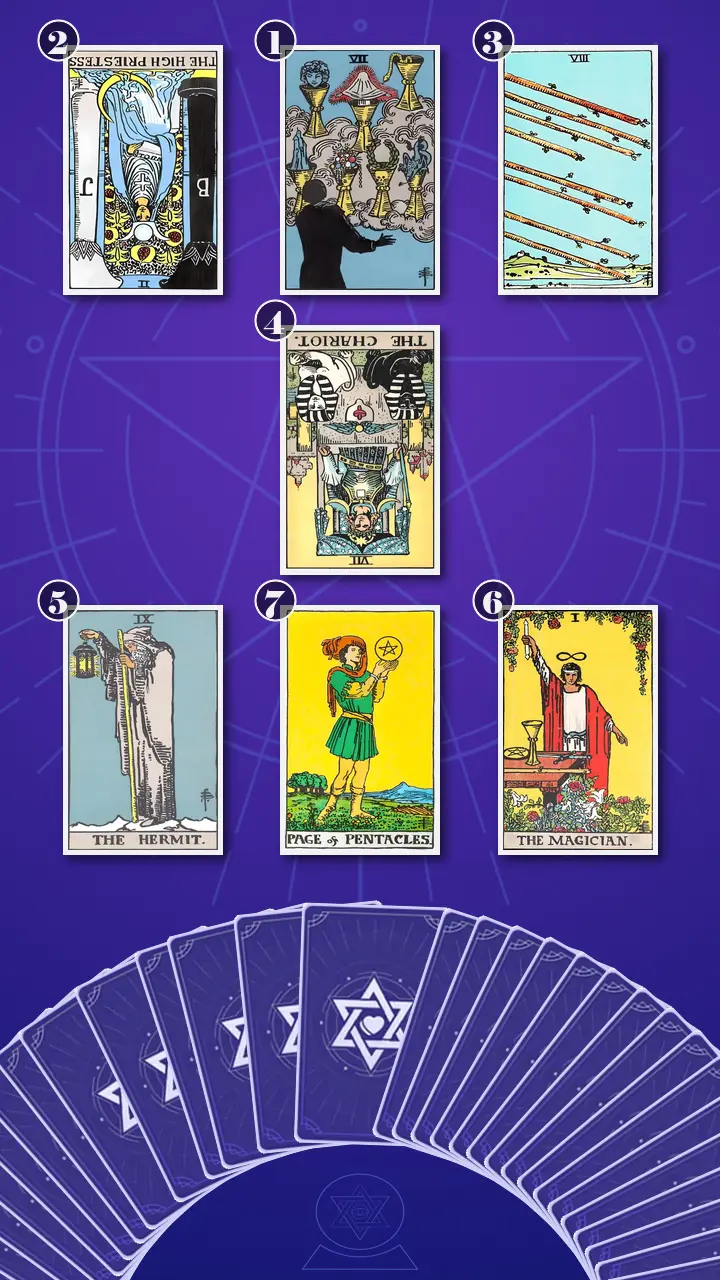
I chose the seven-position Energy Diagnostic Map tarot spread. I use this spread when a problem is maintained by several interacting forces rather than one isolated belief. Maya's surface behavior, mistrusted preference, incoming advice, divided direction, available discernment, agency, and practical next step each needed a separate place on the table.
For readers wondering how tarot works in a situation like this, I do not use the cards as predictive authorities. I use card meanings in context as structured prompts. The images separate parts of an overloaded system that otherwise arrive as one undifferentiated feeling in the chest. Maya then decides what fits her lived experience, what does not, and what she wants to test.
I arranged the cards like a compass narrowing toward a path. The first three positions would show the visible comparison behavior, the private signal beneath it, and the external stream entering the system. The fourth would hold the central blockage: the intuition-execution split. The fifth would identify an existing resource, the sixth would reveal the bridge into self-authorship, and the seventh would ground the reading in an observable seven-day practice.
"This is a causal map," I told her. "It will not declare which project is destined to succeed. It can show us why your energy keeps stalling before any project has enough time to answer you back."
Seven Cloud-Borne Promises and One Untouched Sketchbook
Position 1: The Feed Full of Better Lives
I turned the card representing the observable self-help comparison, routine-switching behavior, and chaotic energy shaping Maya's question. It was the Seven of Cups, upright.
I pointed to the back-turned figure facing seven cups suspended in clouds. Each cup offers a different treasure, identity, or threat. In Maya's life, I read the display as her Sunday-night saved folders: the 5 a.m. creative, the disciplined athlete, the visible design leader, the minimalist planner user, and the perfectly balanced professional, all glowing from separate tabs as complete versions of a better life.
She could spend two hours comparing those promised futures and then close the laptop without touching the accessibility idea she had already chosen. Beneath the scrolling ran a familiar sentence: "Maybe this system is the one that will finally make me consistent, so I should not start until I compare it with the others."
I read the upright Water energy here as Excess. Maya was not short on imagination or options. Possibility had become so abundant that imagined optimization felt more urgent than one observable action. The blind spot was not that she had failed to locate the most authoritative cup. It was the assumption that one of the cups must contain authority greater than her own tested preference.
I asked, "Which project did you delay most recently while comparing ways to do it properly?"
Maya gave one short laugh, but there was no amusement in it. Her hand tightened around the cold mug, her gaze moved to the sketchbook, and only then did she exhale. "That is so accurate it feels a bit brutal," she said. "I made a whole Notion database for the project. I haven't drawn anything in it."
I did not rush to soften the recognition into a positive slogan. "Accuracy should not become accusation," I said. "The comparison gives you short-term relief because somebody else's rule carries the burden of choosing. We can respect why that relief works while still examining what it costs."
Position 2: The Preference Buried Beneath Expert Criteria
I turned the card representing Maya's internal pull toward personal intuition and the mechanism through which she discounted or overrode it. It was The High Priestess, in reversed position.
I drew her attention to the partly concealed scroll and the veil between the black and white pillars. I saw the scroll as the original note she had written on the Line 1 train: "I want to spend this month developing the accessibility concept." Before she reached the office, she had read a respected designer's career framework and buried that sentence beneath pages of criteria about visibility, thought leadership, and senior-level influence.
The inner monologue was quieter than the Seven of Cups, but sharper: "I knew what I wanted before I opened the article, but now my first answer feels embarrassingly subjective." The external framework had not yet been tested, but its polished language had already been promoted to fact. Her preference had not disappeared; she had stripped it of authority.
I read the reversed High Priestess as a Blockage of receptive discernment. I was careful not to tell Maya that intuition is infallible. A first preference can be incomplete, impractical, or wrong. The issue was procedural: she allowed outside advice to cross-examine her preference before experience had supplied any evidence for or against it.
"What was your first answer before the article entered the conversation?" I asked.
I watched her breathing pause. Her thumb stopped rubbing the mug handle; her eyes moved slightly out of focus as though she were rereading the note on the train; then her jaw released by a fraction. "I wanted to make something useful," she said. "The thought-leadership plan sounded smarter, but it didn't feel like mine."
"That distinction is information," I replied. "It is not yet a verdict. Your task is not to obey the first feeling. It is to record it before a louder voice edits the evidence."
Position 3: Advice Arriving Faster Than Relevance
I turned the card mapping the external stream of persuasive frameworks, messages, and optimization demands. It was the Eight of Wands, upright.
The eight wands cross an otherwise open sky with undeniable speed. I translated them into Maya's Monday commute: a Substack career newsletter, a muted morning-routine Reel, a colleague's course link, and a productivity episode arriving before the southbound train reached the next station. Each source might contain something useful in isolation. Together, their velocity made every recommendation sound urgent.
I gave the pattern its internal caption: "This sounds important, and if I ignore it, I might miss the smarter route." The question of relevance was being answered by arrival speed. The newest message became the next priority before the previous message had landed in the practical landscape of Maya's time, energy, and values.
I read this Fire energy as Excess. The Eight of Wands can support momentum, but here the momentum belonged to incoming information rather than to Maya's chosen work. Her recommendation algorithm kept serving complete versions of a better life because every anxious click trained it to send more. That did not mean the newest version fit her actual priorities.
"You are not short on methods," I said. "You are short on uninterrupted evidence from your own life."
Maya glanced at her phone as a notification lit the screen. I watched her reach toward it, stop with two fingers in the air, and turn it face down. "I don't think I've had a quiet commute in months," she said. "I listen at one-and-a-half speed because I feel behind."
I nodded. "That speed is not a moral failure. It is simply part of the system we are mapping. Information velocity has been setting priorities before relevance gets evaluated."
The Chariot Pulled Toward Two Destinations
Position 4: When Divided Steering Looks Like Bad Discipline
I turned the central card, representing the intuition-execution split and the self-reinforcing belief that direction required expert validation. It was The Chariot, in reversed position.
I centered the contrasting sphinxes and the stationary stone vehicle. I asked Maya to imagine two navigation apps running at once, each routing the same car toward a different destination. One voice told her to protect an evening creative block. Another told her that serious professionals should exercise early, publish thought leadership, network consistently, optimize sleep, and follow a deep-work schedule designed around someone else's life.
Her schedule stalled because it was trying to obey several destinations at once. She responded by rebuilding it with tighter controls, more color coding, and another tracker. Then came the verdict: "Why can everyone else stick to a system? I must need more discipline."
I read the reversed Chariot as the spread's major Blockage. Maya had considerable drive, but the drive was divided. Stronger control could not solve a problem created by competing destinations. Her ambitious schedule was not proof that she was lazy or incapable. It was a sprint board filled with tickets from three incompatible product strategies.
For a moment, I remembered the trading floor, where a fast execution against a contradictory mandate could magnify exposure rather than reduce it. I had seen intelligent people apply more force when the underlying instruction was incoherent. The lesson was never that effort did not matter. It was that effort needed one governing purpose.
"Borrowed certainty feels like movement, but it keeps resetting the destination," I told her.
Maya's shoulders rose before they fell. She looked at the fourth version of tomorrow's plan on her shared screen, then dragged the window aside. "So the stall isn't automatically proof that I'm undisciplined," she said, slowly. Relief entered her voice, but it was threaded with frustration. "I've been punishing myself for a traffic problem."
"That is how I read this position," I said. "You still have responsibility for choosing a route, but you do not need to invent a character defect to explain why two destinations could not become one journey."
Position 5: The Lantern That Lights Only the Next Few Feet
I turned the card representing Maya's existing capacity for quiet discernment, the resource capable of interrupting the advice-consumption loop without rejecting useful support. It was The Hermit, upright.
I held the card where she could see the lantern illuminating only a limited patch of the road. The Hermit does not receive a floodlit five-year plan. I read the lantern as a low-beam headlight in fog: enough visibility for the next move, without pretending to reveal the whole route.
In Maya's daily life, this looked ordinary. She could put her phone on airplane mode, close the advice tabs, and spend thirty quiet minutes with the sketchbook. No perfect answer needed to appear. The useful observation would be which project still mattered when nobody else was defining improvement for her.
I read the Hermit's energy as Balance created through a deliberate reduction in incoming stimulation. Airplane mode was not exile from mentors, books, or expertise. It was a temporary meeting-room door, closed long enough for one thought to finish. The goal was sufficient next-step clarity, not permanent isolation or total certainty.
"I do not need to know the whole path," Maya said, trying the idea aloud. "I only need to hear what still matters when the feed isn't answering for me."
I watched her exhale and set the phone farther from the mug. Her fingers opened on the tabletop. "Yes," I said. "You do not need to reject advice. You need to stop letting it reopen every decision."
As I prepared to turn the next card, I gave her the bridge in one sentence: "An imperfect choice can produce feedback. An untested perfect system can only produce another tab."
When the Magician Turned Permission Into an Experiment
Position 6: The Tools Were Already on the Table
The room seemed to grow quieter before I turned the card. Even the laptop fan clicked off. I revealed the position showing the pivotal transformation from collecting authoritative systems to coordinating existing tools around one self-chosen experiment. It was The Magician, upright.
I pointed to the four suit emblems arranged on the Magician's table and the gesture connecting intention with grounded action. I translated the image into what Maya already had: her current planner, sketchbook, timer, design skills, available evenings, emotional investment, and ability to observe a result. The card did not ask her to acquire a new identity. It asked her to coordinate existing resources around one purpose she consciously selected.
In practical terms, Maya could define three twenty-minute sessions for the accessibility concept and keep one feedback note. If the week became messy or the idea changed, the result would describe the experiment. It would not prove that she was incapable of directing herself.
I brought her back to 10:45 p.m.: the untouched sketchbook, another expert explaining the perfect routine, and her fingers opening a fourth planning app. The plan that had felt clear that morning now looked strangely unqualified because she was treating one imperfect choice as a verdict on her competence.
I used my Strategic Path Valuation lens to compare the two directions objectively. Continuing to collect frameworks offered an immediate return in emotional relief, but its long-term ROI was declining: every reset erased feedback, and nothing useful compounded. A self-authored experiment carried the discomfort of imperfection, but it produced reusable evidence about timing, energy, interest, and fit. That evidence could scale into better decisions.
I also applied Sunk Cost Decoupling. The hours Maya had spent learning productivity systems, the planners she had bought, and the professional status attached to expert advice were past investments. They did not create a debt that her future had to repay through obedience. She could keep any useful tool on the Magician's table without allowing that tool to choose the purpose.
You do not need another method to authorize you; use the tools already on the Magician's table to turn one inner signal into one deliberate experiment.
I let the sentence stand without filling the silence.
I watched Maya's breathing stop first. Her index finger remained suspended above the trackpad, and her pupils widened as if the screen had brightened. Then her gaze drifted away from me. I could see her replaying the accessibility note on the train, the deleted sketch sessions, and the four rebuilt schedules. Her eyes reddened slightly, but the first emotion in her voice was not relief. It was anger. "But doesn't that mean I've been doing this wrong for years?" she asked, each word clipped. I let the question settle before I answered. "It means the strategy protected you from the exposure of choosing. That protection had a cost. Recognizing the cost now does not make your earlier self foolish." Her clenched hand opened one finger at a time. Her shoulders lowered, followed by a long, unsteady breath. The release left her looking briefly unguarded, almost disoriented by the responsibility that came with having a choice again.
I asked, "Now, using this new perspective, think back: was there a moment last week when this insight might have made you feel differently?"
"Monday on the train," she said. "I could have kept my accessibility idea in the note and treated the newsletter as one opinion. I didn't have to erase myself before I even got to work."
"Your direction does not become trustworthy because an expert approves it; it becomes usable when you test one choice and let lived evidence answer back," I said. I named the shift clearly: this was movement from borrowed certainty and conflicted self-doubt toward self-authored experimentation and grounded confidence. It was not a permanent transformation completed by one card. It was the first moment in which direct experience could begin outranking borrowed permission.
I set an eight-minute timer and invited Maya to open a blank note. She wrote three lines: "For the next seven days, I want to test three short sessions on the accessibility concept. This matters to me because I want to make something useful. The smallest repeatable action is opening the sketchbook for twenty minutes after dinner." I asked her to create a Review After the Experiment folder for related advice. I reminded her that if the pause felt too uncomfortable, she could stop after the first line. This was an optional experiment, not a contract, and she retained the right to revise or leave it.
Position 7: One Pentacle Held Long Enough to Learn
I turned the final card, representing the immediate grounded action through which Maya could translate self-trust into a seven-day observable practice. It was the Page of Pentacles, upright.
I drew her attention to the Page's steady two-handed focus on one pentacle. The wider landscape remained visible, but it was no longer competing for control. I saw the card as a direct answer to the Seven of Cups: seven elevated promises had narrowed into one solid subject Maya could hold, study, and test.
In her life, this meant one twenty-minute design session on Monday, Wednesday, and Saturday. After each session, she would record what she did, what she noticed, and one possible adjustment. She would postpone changing the method until the seven days ended. The project was practical study, not a performance of expert-level certainty.
I read the Page's Earth energy as grounded Balance. The Page does not demand mastery before beginning. The card makes room for Deficiency in experience because experience is exactly what the beginner is there to build. Missing a session would create information about the experiment; it would not require Maya to reset the entire system or indict her identity.
"Treat the plan as a hypothesis, not a referendum on your worth," I said.
Maya touched the cover of the sketchbook. I saw recognition, reluctance, and curiosity move across her face in that order. "One week sounds almost too small," she said.
"Small is the control mechanism," I replied. "It keeps the choice reversible enough to test. You are not choosing your permanent identity. You are giving one preference enough contact with reality to produce evidence."
From a Pile of Maps to One Testable Path
I drew the whole diagnostic map together. Repeated exposure to polished systems had taught Maya to treat public certainty as safer than private preference. Comparing methods gave immediate relief from the burden of choosing, but every new framework reset the route. Without repeated action, no personal feedback accumulated. The missing feedback then seemed to prove that her judgment was unreliable, sending her back toward more advice. She had been holding a working compass beneath a pile of maps and blaming the compass for failing to move her.
The cards showed that her central problem was not insufficient motivation. The Seven of Cups described attractive possibility in excess; the reversed High Priestess showed an inner signal repeatedly demoted; the Eight of Wands revealed how content velocity manufactured urgency; and the reversed Chariot exposed divided steering. The Hermit supplied a temporary input boundary. The Magician reorganized existing tools around a chosen purpose. The Page of Pentacles gave that purpose a small physical form.
I named the cognitive blind spot: Maya had been treating an expert's confidence as evidence of relevance while treating her own preference as unreliable before either had been tested. The transformation direction was not blind self-belief or rejection of expertise. It was evidence before more advice: choose one internally meaningful direction, define a bounded experiment, record lived feedback, and consult outside guidance only when that feedback raises a specific question.
The 5-Year Horizon Stress Test and the Next 72 Hours
I introduced my 5-Year Horizon Stress Test with a deliberately blunt question: "If this research-and-reset pattern repeated for five years, would it compound portfolio evidence, practical knowledge, or usable self-trust?" Maya shook her head. I then reduced the horizon to a decision she could control. Within 72 hours, she could choose Hold or Pivot. Hold would mean consciously keeping the current advice-first pattern because it served a purpose she endorsed. Pivot would mean protecting one seven-day test before reopening the decision.
I emphasized that Pivot did not mean redesigning her life. It meant changing the order of operations for one week.
- Make the 72-hour Hold or Pivot decision. Within the next 72 hours, Maya would set an eight-minute timer in her existing notes app and write one working hypothesis: "If I sketch for twenty minutes after dinner on Monday, Wednesday, and Saturday, I will learn whether this timing supports the accessibility idea." She would schedule only those three sessions in her current calendar. No new planner, app, or course is allowed for setup. If three sessions exceed the week's energy budget, the minimum version is one five-minute session.
- Protect an advice-free runway. At the start of each scheduled session, Maya would put her phone on Do Not Disturb for twenty minutes, place the existing sketchbook, pen, and timer on the table, and begin before opening any related podcast, newsletter, course page, or social feed. Incoming recommendations would go into a browser folder called Review Friday. The boundary is temporary, not anti-expert. If twenty minutes feels too activating or impractical, she can use two quiet minutes and write only her first preference.
- Collect evidence before consulting advice. Immediately after each session, Maya would record three plain lines in the same note: what I did, what I noticed, and what I might adjust. On Friday evening, she would spend ten minutes identifying one pattern from direct experience before opening Review Friday, then choose at most one source that addressed a question the experiment had actually raised. The log is not a dashboard or a score of discipline. One sentence after one session is enough, and missing a session is information rather than a command to restart.
"The cards have not given you a new authority to obey," I told her. "They have helped us design a cleaner feedback system. You remain the person who decides whether the experiment fits, whether to stop, and what the evidence means."

A Week Later, the Quiet Proof
Seven days later, I received Maya's message: she had completed two sketch sessions and kept one method unchanged. She slept through the night, then woke thinking, "What if this is wrong?" She told me she smiled before opening the sketchbook anyway.
I did not read that message as proof that tarot had solved her direction. I read it as a modest sign that she had begun generating the evidence she used to search for elsewhere. Her confidence was still tender, but it was now connected to something she had actually done.
That was the heart of our Journey to Clarity. Maya did not leave with certainty about the next five years. She left with one self-chosen question, a protected interval in which to test it, and the right to interpret the result without putting her worth on trial.
I know how quickly a confident voice can make the plan in our notes feel naive, and how the chest can tighten when choosing for ourselves suddenly feels like making a public claim about who we are. I also know that noticing this moment creates a small space in which the Magician's table can replace the endless feed: existing tools, one chosen purpose, and no requirement to prove a permanent identity.
If your next choice could be a seven-day experiment rather than proof of who you are, which single tool already on your own Magician's table would you use to give one small direction a fair test?