The Slack Ping That Keeps Building the Wrong Career
When Jordan sat across from me, I recognized her question before she finished saying it. I know this pattern well now: the late-twenties agency worker in Toronto who answers a Slack quick ask with happy to help before checking her calendar, then spends Sunday night in the Sunday Scaries wondering whose future the week is actually building. She did not come to me asking for a grand prediction. She came asking a painfully modern question: why do I keep saying yes to extra work when I do not even want the career those yeses are building?
She described Tuesday at 8:47 a.m. from her shared hot desk downtown: Slack flashing, two half-finished decks open, a flat white gone lukewarm at her elbow, fluorescent lights giving off that faint electrical buzz office workers stop hearing until they are already tired. Before she had even finished reading the message from a senior teammate, she had replied. Then her jaw locked. She could already feel the evening being taken from her again.
Then she gave me the other scene. Sunday, 7:18 p.m., at her kitchen table. Google Calendar open like a wall of perfectly arranged Tetris blocks. The radiator clicking. The fridge humming. Blue winter dark pressed against the window. A full week of client calls, revisions, and internal check-ins, and not one clean block for the course, application, or portfolio work she kept telling herself mattered.
She said, very quietly, “Every yes makes sense in the moment, and then I look up and hate the direction.”
What sat in her was not simple stress. It was anxious resentment, and it felt to me like a phone vibrating nonstop under a stack of wet towels: the buzz never fully stopped, but everything around it had grown heavy and airless. I could see it in the tight jaw, the shallow breath, the little stomach-drop she described every time a new request landed.
I told her the truth as gently as I could. She was not weak, and she was not failing at adulthood. She had been rewarded for being reachable, not necessarily for being aligned. A fast yes can feel like relief and still cost you your future. “Let’s not make this a morality play,” I said. “Let’s make it a map. We’re here to find clarity, not to shame the part of you that learned how to survive.”

Choosing the Compass: A Five-Card Cross for Career Boundaries
I asked Jordan to put both feet on the floor and take one steady breath all the way down into her ribs. Then I shuffled slowly and asked her to hold one question in mind: not what will happen to me, but what exactly keeps choosing for me before I do. For me, this part is never about theater. It is a way of letting the nervous system arrive before the mind starts arguing.
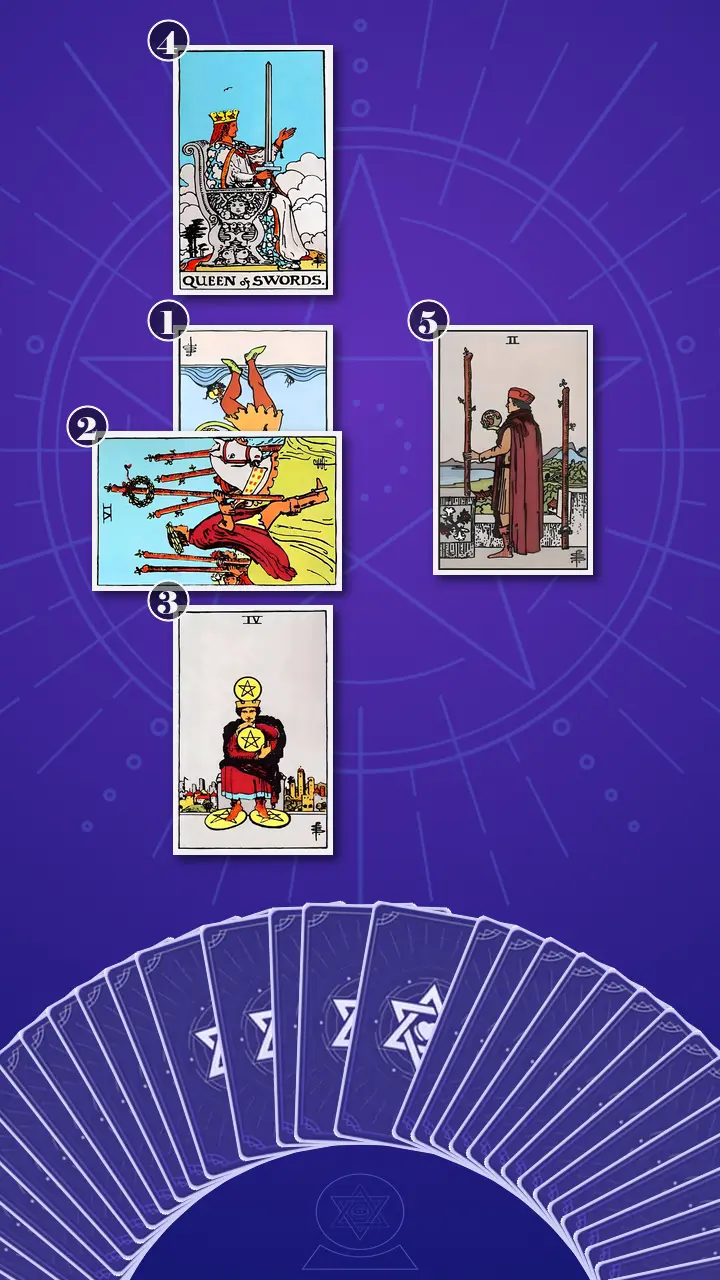
I told her I was using a Five-Card Cross, a tarot spread for work boundaries and career clarity that I trust when someone feels stuck in people-pleasing career drift. I use this spread because it is compact and honest. It shows the visible pattern first, then the force pressing against it, then the root under it, then the corrective principle, and finally the next practical step. In other words: symptom, maintaining force, core fear, key shift, forward action.
I showed her the shape of it with my hand on the table. The center card would name the present overcommitment pattern. The crossing card would show what keeps the pattern rewarding enough to repeat. The card below would reveal the deeper fear operating underneath. The card above would offer the guiding stance that could interrupt the cycle. And the card to the right would tell us what finding clarity looks like in action, not just in theory.
Reading the Crowded Center
Position 1: The Motion That Feels Like Responsibility
I turned over the first card. “This position shows the concrete overcommitment pattern,” I said. “And here we have the Two of Pentacles, reversed.”
I have always found this card painfully easy to translate into modern work life. In Jordan’s case, it was almost literal: Slack open, flagged inbox, two half-built decks, one more client deliverable arriving while she was still inside another task. The old image of the juggler with the infinity loop became endless tab-switching, answer-now culture, and the habit of agreeing in motion before deciding what deserved to stay alive.
In reversed form, I read this as blocked earth: too many practical demands, no stable center, and a nervous system mistaking movement for direction. It was not balance. It was overload wearing a competent outfit. Like having twenty-seven browser tabs open and still clicking a new one before the old ones finish loading, she was clearing incoming demands all day without asking which ones actually belonged to the future she wanted.
“You know how to be useful faster than you know how to choose,” I told her. “That does not make you irresponsible. It tells me your reflex is speed, not fit.”
Her breath paused. Her fingers stopped against the rim of her mug. Her gaze drifted away from me and fixed on some Tuesday morning only she could see. Then she gave a short laugh, edged with embarrassment and something sharper. “That is so accurate it feels a little rude,” she said.
I smiled. “That’s often how recognition sounds before it becomes relief.”
Position 2: The Applause Hidden Inside the Ask
I turned the second card sideways across the first. “This position identifies the immediate force that keeps the pattern alive, especially the pull of approval, visibility, and being seen as reliable. This is the Six of Wands, reversed.”
Now the issue sharpened. This was not only about too much work. This was about the kind of work that glows. The visible project. The client-facing piece. The assignment that might come up in a review cycle or get you named in a meeting. In Jordan’s world, the raised wand and watching crowd became leadership visibility, agency praise, and the little adrenaline hit that comes when someone senior trusts you in public.
Reversed, I read this as excess fire turned outward: ambition tangled with approval hunger, confidence outsourced to other people’s reactions. It is the part of a person that calls something strategic when, underneath, it is really asking not to be forgotten. Like letting LinkedIn reactions decide which work feels worthwhile, this card showed me how easily visibility had become confused with alignment.
I told her, “When the ask is flattering, the yes arrives even faster. Not because you are shallow. Because being seen as dependable has started to feel like protection.”
She pressed her lips together and nodded once. I could almost feel her remembering the walk to the TTC after some praised deliverable, replaying the compliment and feeling hollow instead of proud.
Position 3: The Grip Beneath the Yes
I turned the third card below the center. “This position reveals the deeper fear beneath the yes reflex: linking security and self-worth to staying useful and in control. The Four of Pentacles, upright.”
This card always slows a room down for me. I saw Jordan at her apartment table after rent and transit charges hit, opening the folder with saved courses, notes, and half-written applications, then closing it and going back to familiar client work because familiar work felt measurable, billable, safer. The coin pressed to the chest became competence used like armor. The rigid seated posture became those raised shoulders she had described, the body bracing against uncertainty before uncertainty had even entered the room.
Upright here, I read this as contraction. Not evil. Not stubbornness. Contraction. A protective grip so tight that stability had quietly started turning into self-confinement. It reminded me of gripping a TTC handrail so hard you forget you are allowed to get off at a different stop.
This was the moment I named one of my own diagnostic lenses. “I call this Environmental Friction Sensing,” I said. “When I see a card like this, I do not only ask what fear lives inside you. I ask what kind of soil keeps rewarding that fear. High Toronto rent. Hybrid office culture. Slack green-dot responsiveness. Quiet praise for being instantly useful. That is difficult soil for someone trying to grow a more self-authored future. So I do not read this as a character flaw. I read it as a human nervous system gripping the familiar because the environment has taught it that speed equals safety.”
Jordan went still again, but this time the stillness was heavier. First her chest tightened. Then a long exhale left her as though she had finally admitted something private. “That,” she said softly, “is the part I usually don’t say out loud. If I stop being the reliable one, what exactly am I bringing to the room?”
“There it is,” I said. “That is the knot. Public approval has been standing in for safety. And because of that, overcommitment keeps getting mistaken for professionalism instead of what it often is: fear-driven career drift.”
When the Queen of Swords Cut a Line Through the Noise
Position 4: One Sentence, One Sword
When I turned the fourth card above the center, the room changed. The rain at my window softened to a hush. Even Jordan seemed to sense the air clear. “This position offers the key corrective stance,” I told her, “the thing that interrupts the cycle and points toward discernment, boundaries, and self-authored criteria. The Queen of Swords, upright.”
Here was the antidote. Not rebellion. Not disappearing. Not becoming cold. The Queen of Swords gives me balance in air: discernment, truth, a clean line between what is mine to carry and what is merely incoming. In Jordan’s life, her upright sword became one short sentence in Slack or on a call: “Let me check current priorities and confirm by 2 p.m.” No apology essay. No padded friendliness. No automatic volunteering.
I felt my Highland bones stir at this card. Back home, late winter pruning was always done with a clean blade. Not because the plant was failing, but because dead growth steals spring from the living stem. In my work, I call this Seasonal Trajectory Alignment. Jordan had been trying to force a spring harvest inside a winter season of reevaluation. She had been judging herself by expansion, visibility, and blooming everywhere at once, when her actual season required pruning, selecting, and protecting warmth for what truly deserved to grow. Winter is not punishment. It is a wise refusal to waste roots.
I asked her to picture that Tuesday morning again: Slack blinking, coffee cooling, two decks open, and her fingers already typing yes before her brain had checked the rest of the day. The speed felt professional, but it was also where her future kept getting quietly signed away.
Stop confusing constant availability with value; like the Queen's raised sword, one clear boundary can cut away the work that is not yours to keep building.
I let the sentence rest between us for a few beats.
Jordan did not melt into instant relief. First her shoulders drew tighter, almost defensive. Then her eyes lost focus, as if she were replaying three scenes at once: the senior teammate’s message, the praise in a meeting, the Sunday calendar with no room left for her own life. Her mouth parted. “But if that’s true,” she said, and now there was a flicker of anger under the fear, “then I’ve been helping build the wrong thing.”
“You’ve been surviving inside the thing that rewarded you,” I said. “That is not the same as choosing it forever.”
I watched the reaction move through her in layers. The freeze first. Then the inward tilt of cognition, that strange faraway look people get when an old pattern finally reveals its wiring. Then the release: a breath from deep in the chest, her jaw loosening, one hand uncurling flat on the table. Light caught the Queen’s sword just then, and for one small second it looked less like a weapon than a line of clean weather.
I asked her, “Now, with this new perspective, can you think of one moment last week when this would have changed how you felt?”
She nodded immediately. “Thursday. I could have said I needed to check capacity. I knew it. I just didn’t trust it.”
That was the real threshold. Not certainty. Trust. This card marked the move from anxious resentment and fear-based overavailability toward selective commitment and steadier self-trust. I said the line I most wanted her to keep: “The goal is not to juggle better. It is to choose better.”
Position 5: The Calendar Opens to the Right
I turned the final card to the right. “This position grounds the insight in a practical future-facing move. It shows how to make room for work that actually matches the direction you want. Here we have the Two of Wands, upright.”
I love the honesty of this card in career readings. It does not ask, Can you manage more? It asks, Which track are you choosing by saying yes to this? In Jordan’s life, it looked like one unnecessary task delayed, declined, or scoped down, and the reclaimed block used not for collapsing or doom-scrolling, but for reopening a half-finished application, a course note, a portfolio paragraph. The globe in hand became authorship. The open horizon became a future measured against her own criteria rather than the nearest incoming request.
Here the fire was healthy again. Not performative. Intentional. Directional. This was the shift from inbox triage to roadmap. From managing more to choosing differently.
Jordan looked at that card for a long time. Her face softened, not into certainty, but into recognition. “So the future doesn’t come first,” she said. “The space does.”
“Exactly,” I told her. “Future direction is not separate from boundaries. It becomes available the moment not every urgent ask gets access to your time.”
The Hour You Get Back
By then the story of the reading was clear to me. The Five-Card Cross had not told Jordan to blow up her career. It had shown a much more precise sequence. First came the overcommitment loop: saying yes in motion. Then the visible reward: praise, usefulness, being seen. Beneath that sat the deeper grip: fear that without constant reliability she might become less safe, less valuable, easier to overlook. Above it all stood the Queen of Swords, not punishing her, but handing her back the right to decide what earns access to her life. And to the right, the Two of Wands reminded us why this matters: not to become less responsible, but to stop building the wrong future by default.
The blind spot was simple and brutal. She had been treating every incoming request as a referendum on her worth instead of a decision about direction. That is how a full calendar turns into the wrong career. The transformation direction was just as clear: shift from proving value through constant availability to testing value through selective, values-based commitment. Usefulness is real, but it is not the same thing as direction. Not every urgent ask deserves access to your future.
The Winter Dormancy Protocol
I did not give her a grand reinvention plan. That would have violated the season the cards were showing me. Instead, I offered what I call my Winter Dormancy Protocol: for one week, stop forcing directionless movement. Gather information. Create decision space. Protect warmth. Let the climate inside your body change before you demand a whole new life from yourself.
Jordan frowned a little and gave me the practical objection I half expected. “But I genuinely don’t have thirty free minutes every time someone pings me.”
“Thirty is ideal,” I said. “It is not sacred. Ten minutes counts. A timing promise counts. Drafting and not yet sending counts. We are retraining the reflex, not auditioning for perfect boundaries.”
- Boundary-First ReplySave one reusable line in Slack snippets or your Notes app: “Let me check current priorities and I’ll confirm by 2 p.m.” Use it on the next non-urgent ask, or say on a live call, “I want to check timeline and capacity before I commit.”The first wave may feel like guilt or fear of sounding difficult. Keep the script short, respectful, and non-defensive. You do not need a personal essay to justify a capacity check.
- The 30-Minute Yes BufferFor one week, wait 30 minutes before agreeing to any non-urgent request. During that pause, write one line: “Does this build the future I want, or just prove I’m available?” Then label the ask: urgent, visible, future-fit, or neither.If 30 minutes feels impossible, start with 10. Resist turning this into prettier calendar Tetris. The point is not better juggling. It is slower choosing.
- Visibility vs Value AuditFor one incoming task this week, ask before replying: “Is this important because it matters, or because it will be seen?” After a praise moment, jot down whether the work gave you energy, resentment, or simple relief at being approved. If LinkedIn comparison flares, mute it for one evening.Approval is human; it just cannot be your only filter. If the question feels too sharp, soften it to: “Would I still want this if nobody important saw it?”
I told her one more thing before we closed. If any one of those steps won her back even forty-five minutes, she was not to leave that time as an empty hole for work to reclaim. She was to assign it immediately to her next chapter: one application paragraph, one course module, one portfolio note. This hour does not have to prove anything. It just has to belong to the future she wants.

Ownership, Not Certainty
A week later, Jordan sent me a message. “I used the line. Got forty-five minutes back. Opened my application draft. I still woke up thinking, what if I’m wrong? But I laughed and kept going.”
That, to me, is what a journey to clarity usually looks like in real life. Not fireworks. Not instant certainty. A respectful no. A calmer jaw. One reclaimed pocket of time. The first proof that your future no longer has to be outsourced to the nearest demand.
If the next Slack ping lands and your jaw tightens before you even finish reading it, I hope you remember this: that feeling does not mean your worth is being tested in one tiny window. It means your nervous system has learned to confuse instant usefulness with safety, and that can be unlearned with gentleness and practice.
If one clear, respectful no opened a small pocket of space this week, what would you want that space to belong to?
This story is adapted from psychological research, written so that those in a similar struggle can see their own pattern in it — and find their next step clearly.These insights are not a substitute for professional psychological, medical, legal, or financial advice.
Learn more about our Journey to Clarity.
How did this insight land for you?
🫂 This Resonates Deeply
🌀 Living This Story
✨ Now I See Clearly
🌱 Seeing New Possibilities
🧰 Useful Framework
🔮 The Confirmation I Needed
💪 Feeling Empowered
🚀 Ready for My Next Step
Author Profile
 AI
AI“As the seventh generation of a Highland healing family, I see modern anxieties as a simple, temporary disconnection from nature's rhythm. I bring 67 years of lived seasons not to instruct you, but to hold space for you. Using tarot as a mirror, I want to gently guide you out of the chaos, helping you breathe deeply and rediscover the organic, steady heartbeat of your own life.”
In this Direction Tarot Reading :
Core Expertise
- Seasonal Trajectory Alignment: Diagnosing your deep sense of being 'stuck' as a structural mismatch—trying to force a spring harvest during a winter dormancy phase.
- Environmental Friction Sensing: Identifying the profound mismatch between your internal growth energy and the 'soil' of your current macro environment.
Service Features
- Winter Dormancy Protocol: A deliberate grounding ritual to actively pause, gather resources, and stop forcing directionless movement until the 'climate' aligns.
Also specializes in :
Explore Related Patterns:
Approval SeekingThe visible project, the client-facing assignment, and the senior teammate’s public trust all make Jordan’s yes arrive faster. The task does not only look useful; it glows with the possibility of being noticed, named, and remembered. Approval Seeking shows up here as a cognitive filter that confuses visibility with alignment. When praise becomes the signal that a task matters, confidence gets outsourced to other people’s reactions, and the nervous system learns to read recognition as protection. You are not simply choosing work; You are choosing the temporary safety of being seen as valuable. That is why the praise can feel hollow after the deliverable is done. The external reward confirms that Jordan was useful, but it does not confirm that the work belongs to her future. The pattern keeps repeating because approval gives quick relief while quietly postponing the harder question of what she actually wants to build.
Boundary DiffusionJordan’s calendar shows the boundary problem in physical form: client calls, revisions, and check-ins occupy the week, while the course, application, and portfolio work have no protected space. Her time is being entered by incoming requests before she has decided what belongs there. Boundary Diffusion appears when the line between “this is mine to take on” and “this is merely incoming” becomes too soft under pressure. The issue is not that Jordan has no values; it is that the decision gate is opening too quickly. You can have a real future direction and still lose it if every request receives access before your priorities are consulted. This pattern explains why a short capacity-check sentence feels so powerful in the story. “Let me check current priorities and confirm by 2 p.m.” is not just a workplace script; it rebuilds the psychological border between availability and value. The pause gives You back the right to decide what earns access to your life.
Conditional Self-WorthJordan’s quiet question, “If I stop being the reliable one, what exactly am I bringing to the room?” exposes the belief underneath the calendar problem. The issue is no longer just workload; it is the fear that her value might disappear if she stops being instantly useful. Conditional Self-Worth turns reliability into a self-worth contract. A request stops being a neutral work decision and starts feeling like a test of whether she deserves trust, visibility, and safety. You can know logically that a capacity check is reasonable while still feeling, in the body, that saying no might threaten your place. This explains why every yes makes sense in the moment but feels wrong in the aftermath. The moment rewards the identity of the dependable one; the aftermath reveals the cost of letting that identity choose on your behalf. The pattern asks You to prove value through availability instead of letting value exist before the request arrives.
People-PleasingJordan’s automatic “happy to help” lands before she has even checked her calendar, which shows the yes operating as a reflex rather than a chosen commitment. The behavior gives her immediate interpersonal relief: she stays useful, agreeable, and easy to trust, even as her jaw tightens because another piece of her evening has already been handed over. That is the core mechanism of People-Pleasing in this story. The yes is not just generosity; it is a defense strategy that protects her from the discomfort of being seen as difficult, unavailable, or less reliable. You can see the split between the short-term calm of compliance and the long-term resentment of realizing that every small agreement is building a career she does not want. The pattern becomes especially costly because it does not look dramatic from the outside. It looks professional, responsive, and collaborative. But internally, it trains You to treat other people’s requests as more urgent than your own direction, until the future gets built by whoever asks first.
Productivity as SafetyJordan keeps returning to familiar client work because it is measurable, billable, and immediately legible to the workplace around her. The course folder, the application draft, and the portfolio paragraph matter more to her future, but they do not offer the same instant proof that she is useful right now. Productivity as Safety is the mechanism that makes motion feel like protection. In this pattern, being busy is not only about output; it becomes a nervous-system strategy for staying secure, valued, and in control. You clear the inbox, answer the ping, and take the visible assignment because the familiar pressure feels safer than the open space where a more self-authored future would have to begin. The problem is that productive motion can imitate progress while leading in the wrong direction. Jordan is not lazy or incapable of discipline; she is disciplined toward the tasks that give immediate safety signals. The psychological shift is learning that safety cannot be built only through usefulness if the life being protected is slowly disappearing from the calendar.
Purpose OutsourcingJordan’s line, “Every yes makes sense in the moment, and then I look up and hate the direction,” names the central drift of the story. The individual decision feels reasonable, but the accumulated direction does not feel like hers. Purpose Outsourcing happens when external demands become the operating system for future-building. Instead of asking what kind of career a task supports, Jordan’s nervous system asks whether the task will keep her useful, visible, and safe. You end up with a calendar that looks responsible while quietly serving someone else’s roadmap. The pattern is painful because it does not require abandoning your goals outright. It only requires letting them remain less urgent than the next ping. By the time Jordan reaches Sunday night, the future she wants has not been rejected; it has been crowded out by decisions that were never audited against purpose.
Values-Based Decision MakingJordan’s reclaimed forty-five minutes goes straight into opening the application draft, which turns insight into evidence. The future does not arrive as certainty first; it starts as one protected block of time assigned to what she says actually matters. Values-Based Decision Making is the shift from “Can I fit this in?” to “Does this build the future I want?” That question changes the function of a yes. You stop using agreement to prove that You are reliable and start using commitment as a vote for direction. The pattern is upright because it gives Jordan a stable decision principle rather than another productivity hack. Delaying, declining, or scoping down one unnecessary task is not avoidance; it is alignment in action. The week begins to reflect her criteria instead of the nearest demand.
Boundary DiscernmentJordan’s corrective line, “Let me check current priorities and confirm by 2 p.m.,” creates a clean pause where the automatic yes used to be. It does not attack the requester, overexplain, or disappear; it simply gives her mind enough room to choose. Boundary Discernment is the adaptive version of the same boundary system that had been getting overrun. Instead of treating every incoming ask as an emergency, it separates availability from obligation and usefulness from value. You still get to be collaborative, but collaboration no longer requires handing over your calendar before You have consulted your own priorities. This is why the small sentence matters more than a dramatic career overhaul. It converts a vague desire for boundaries into a repeatable decision ritual. The boundary is not a wall against work; it is a filter that protects the future-building work that would otherwise stay invisible.
Urgency BiasJordan’s reply happens before the message has even fully landed in her mind. The Slack ping, the senior teammate, and the open decks create a pressure field where speed feels like competence and hesitation feels risky. Urgency Bias is the mental shortcut that makes the nearest demand look more important than it actually is. The bias narrows attention around what is flashing, visible, and socially immediate, while quieter priorities such as applications, courses, and portfolio work lose access to the week. You are not choosing the wrong future in one dramatic decision; You are letting repeated micro-urgencies make the decision for You. That is why the Sunday calendar feels brutal. It is the accumulated evidence of many tiny moments where urgency outran discernment. The antidote is not simply better time management; it is slowing the commitment reflex long enough to test whether the request is truly urgent or merely loud.
Explore Related Struggles:
Availability-Worth FusionJordan does not only say yes because the work exists. The yes speeds up when the request is flattering, visible, or tied to senior trust, because being dependable has become more than a professional trait; it has started to feel like proof that she belongs in the room. Availability-Worth Fusion names the moment where reachability gets mistaken for value. You can be highly competent and still become trapped in a system where every quick response feels like evidence that you are useful, safe, and hard to overlook. This is why the question cuts deeper than workload. If a request feels like a referendum on your worth, declining it can feel disproportionate, as if you are risking your standing rather than simply managing capacity. The work then keeps expanding because the real thing being protected is not the task list; it is the fragile equation between being constantly available and feeling valuable.
Urgency-Compass FusionJordan's Slack reply happens faster than her own calendar check. The request lands, the yes goes out, and only afterward does her body register the cost through the locked jaw, the shallow breath, and the sense that another evening has already been taken. That sequence is the core of Urgency-Compass Fusion: the nearest demand starts functioning like a compass, even though it only knows what is loud, visible, or immediate. You are not choosing the wrong future in one dramatic decision; the future is being built through tiny response windows where speed replaces discernment. The struggle sits in the gap between relief and direction. A fast yes can briefly quiet the pressure of being asked, but it also hands authorship to the next ping, the next review-visible project, the next person who needs something now. Clarity begins when the urgent ask has to wait long enough for your own criteria to enter the room.
Victory-Compass SplitJordan's yes gets stronger around the work that glows: the visible project, the client-facing deliverable, the assignment that might be named in a meeting or remembered in a review. Those moments offer a real reward, but the reward is not the same thing as a route. Victory-Compass Split appears when recognition starts giving directional signals it was never designed to give. You may be moving toward praise, trust, and proof of competence while drifting away from the work that would actually make your future feel self-authored. That is why every yes can make sense in the moment and still add up to a direction you resent. The win is immediate and socially legible, but the compass underneath is distorted. A career can look like it is advancing while the person inside it keeps losing contact with what the advancement is for.
Value-Action SplitJordan can identify the work that belongs to her next chapter: the course, the application, the portfolio paragraph. Yet her actual week fills with client calls, revisions, and internal check-ins until the future she wants is present as an idea but absent from the calendar. Value-Action Split captures that mismatch between named priorities and lived allocation. You know what matters, but your actions keep being routed through usefulness, visibility, and immediate approval before they reach the values you say you want to build around. The strain is not that you lack ambition or direction. The strain is that your direction has no protected pathway through the day. Each yes may be reasonable on its own, but together they create a life where your stated values remain private while your public commitments build something else.
Explore Related Emotions:
Approval AnxietyThe request becomes harder for Jordan to question when it comes from someone senior, when it might be visible, or when it carries the glow of being trusted in public. Her yes speeds up around praise because the ask is not only work; it is a possible signal that she is valued. Approval Anxiety names the pressure underneath that glow. You are not just wanting recognition in a normal human way. You are feeling the stakes rise whenever approval seems tied to safety, belonging, or being kept in the room. In this story, the emotional cost is that visibility starts impersonating alignment. A task can feel important because it will be seen, even when it quietly pulls you away from the future you are trying to build.
Boundary GuiltJordan already has the boundary sentence available: “Let me check current priorities and confirm by 2 p.m.” The problem is not a lack of language. It is the body-level recoil that appears before she lets the sentence stand on its own. Boundary Guilt captures that recoil. You can know a capacity check is reasonable and still feel as if the pause itself might make you difficult, selfish, or less dependable. The guilt shows up at the exact point where your time begins to become yours again. In Jordan’s case, this feeling is central because every automatic yes avoids the guilt for a moment while handing away another piece of the week. The work of clarity begins when the short, respectful pause becomes tolerable enough to use.
Cautious Self-TrustJordan’s shift is visible in small physical details: a deeper breath, a jaw loosening, one hand uncurling flat on the table. Nothing dramatic has happened, but her body registers the possibility that the automatic yes is not the only available move. Cautious Self-Trust names the early stage of that change. You do not need total certainty before you check capacity. You need enough trust in your own signal to let a pause exist before commitment. Her line about Thursday is the hinge: she knew she could have asked to check capacity, but she did not trust it. The new emotional ground begins when that knowing becomes usable in real time.
Directionless UrgencyJordan answers the Slack request before she has finished reading it, while two half-built decks are already open and her calendar has not been checked. The speed looks competent from the outside, but inside the story it works like a hand moving before the rest of her has been consulted. That is why Directionless Urgency fits the emotional logic of the case. You are watching urgency detach from direction: each yes reduces the immediate pressure of the ping, yet the accumulated effect is a week that serves someone else’s roadmap. The feeling is not laziness or failure. It is the inner static of moving fast while sensing that the movement is not taking you where you actually want to go.
Grounded AgencyJordan gets forty-five minutes back because she uses the line instead of surrendering the hour on reflex. That time does not remain a vague gap; she opens the application draft and gives the space a direction. Grounded Agency fits because the story’s power is practical without becoming shallow. You are not escaping responsibility. You are restoring the missing step between incoming demand and personal commitment. The feeling is steady rather than euphoric. A respectful pause, a clearer yes or no, and one reclaimed block of time become evidence that your future can be shaped by chosen criteria, not only by whoever asks first.
Resentful ExhaustionJordan’s jaw locks before the evening is even gone, because her body already knows what the yes will cost. The calendar confirms it later: client calls, revisions, and check-ins fill the week until there is no clean block left for the work she says matters. Resentful Exhaustion fits because the depletion is not neutral. You are tired, but you are also carrying the sting of having participated in the very schedule that drains you. The tiredness has a protest inside it. The story’s image of a phone vibrating under wet towels gives the feeling its texture. The buzz never fully stops, and the heaviness around it makes every new request feel less like an opportunity and more like another layer of air being removed.
Self-Betrayal AcheJordan keeps naming the course, application, and portfolio work as important, but her calendar shows a different allegiance. The week is not empty; it is full of proof that other people’s priorities have been given cleaner access than her own next chapter. Self-Betrayal Ache names the pain of seeing that mismatch. You are not simply annoyed at being busy. You are feeling the quiet bruise of watching your choices build a direction your deeper self does not consent to. This ache matters because it turns the question from time management into authorship. The calendar hurts because it is not just packed; it is telling a story about whose future keeps getting protected.
White-Knuckle SecurityJordan opens the folder with saved courses, notes, and half-written applications, then closes it and returns to familiar client work. Familiar work is measurable, billable, and easier to defend, even when it keeps her inside the same career track she is questioning. White-Knuckle Security describes the tightness of that trade. You are reaching for steadiness, but the grip is so hard that steadiness begins to shrink the room around you. Competence becomes armor, and armor is heavy when you have to wear it all day. The feeling is protective, not irrational. It shows how safety can become expensive when the only safe option your nervous system trusts is the one that keeps your future small.
Fear of Being ForgottenJordan’s strongest yeses gather around visible work: the client-facing piece, the project that might be mentioned in a review cycle, the task that gets her named in a meeting. Those assignments glow because they promise more than completion; they promise not being missed. Fear of Being Forgotten sits underneath the pull toward constant reliability. You are not only trying to do good work. You are trying to remain vivid in other people’s minds, as if being immediately useful is the safest way to keep your place. That is why her question, “If I stop being the reliable one, what exactly am I bringing to the room?” lands so heavily. It exposes the emotional bargain: stay available enough, and maybe you will not disappear from view.
Authorship AnxietyWhen Jordan realizes that “the future doesn’t come first, the space does,” the problem becomes more personal. The next chapter is no longer an abstract wish; it needs a protected hour, an opened application draft, and a decision that does not wait for outside permission. Authorship Anxiety fits the charged feeling that arrives when your own criteria finally enter the room. You get more agency, but you also lose the strange cover of automatic usefulness. Choosing for yourself can feel exposed because there is no incoming request to hide behind. The story does not frame this as instant confidence. It shows a smaller, more honest threshold: Jordan still wonders whether she is wrong, laughs, and keeps going anyway.
Hollow RecognitionJordan can receive praise for a deliverable and still feel hollow on the walk afterward. The compliment lands, but it does not settle into pride because the work being recognized is not necessarily connected to the direction she wants. Hollow Recognition names that split. You are being seen, yet the part of you that wants alignment is still untouched. The outside signal is positive, but the inside does not fully warm to it. This is one of the story’s most precise emotional clues. If praise keeps arriving from the wrong direction, it can start to feel less like nourishment and more like evidence that the wrong career is becoming better lit.
Clarity ReliefJordan’s recognition arrives in layers: first the freeze, then the faraway look of seeing the wiring, then the deep breath and the hand uncurling. The pattern stops being a vague personal flaw and becomes a sequence she can actually name. Clarity Relief belongs here because the relief does not come from pretending the problem is solved. It comes from seeing the shape of the loop: overcommitment, visible reward, protective grip, cleaner boundary, future-facing action. Once the map appears, the work is still real, but it is less foggy. You can stop trying to juggle better and begin asking which commitments deserve to exist at all.
Quiet Self-RespectJordan is not asked to vanish, rebel, or turn cold. She is asked to let one clear sentence stand without padding it with apology, over-explanation, or a performance of niceness. Quiet Self-Respect names the feeling inside that restraint. You are allowing your time to have weight without needing to make your boundary dramatic. The respect is quiet because it is measured in clean access: what gets your hours, what waits, and what does not belong to you. The calmer jaw and reclaimed pocket of time matter because they make self-respect physical. It is no longer just a value; it becomes a different way your body can sit inside work.
Explore Related Contexts:
Always On AvailabilityYou answer the Slack quick ask before checking your calendar, and the reply lands before your own load has been measured. The story also says reachability gets rewarded, which means the workplace keeps teaching you that being instantly available is part of staying useful. That is why this is a clear Always On Availability stage. The day is organized around interruptibility, senior asks, and the assumption that your attention is open for use. Once that norm settles in, a quick yes feels less like a choice and more like the default response the environment expects.
Praise as Performance ContractThe story says you were rewarded for being reachable, not necessarily for being aligned, and that reward keeps the yes reflex profitable. The visible ask, the senior teammate, and the chance to be seen as dependable all sit inside the same exchange. When approval starts functioning like payment, every quick yes carries its own small payout and trains the next one. In that setup, recognition stops being feedback and starts behaving like a contract for your time.
Work Life Boundary CreepYou are at the kitchen table on Sunday night with a week of client calls, revisions, and internal check-ins already filling the calendar, and there is not one clean block left for the course, application, or portfolio work. Earlier, the evening itself was already being taken from you again. That is Work Life Boundary Creep in plain terms. The job is not staying inside the workday; it is spilling into the hours that should have been available for the next step, so the boundary between paid labor and the rest of your life keeps thinning out.
Career Transition FogYou keep a course tab, an application draft, and portfolio work in view, but the week that actually arrives is already packed with client calls, revisions, and internal check-ins. The current role keeps consuming the hours that would let the next move become real. That is Career Transition Fog. The direction is visible enough to name, but not protected enough to execute, so the transition stays half-built while the present keeps setting the pace.