Why Can’t I Let People Pay for Me? The Charlotte Street Coffee Counter
If you’re the late-20s hybrid-office person who can handle a client presentation just fine but still blurts, “No, no, I’ll get mine,” before your friend finishes, “I’ve got this,” you might not have a coffee problem. You might have hyper-independence with money guilt.
That was the exact question Jordan brought to me: why can’t I let people pay for me without feeling guilty? They were 29, non-binary, sharp, funny, an account manager at a creative agency in London, and the kind of friend who remembered birthdays, covered the cab, and brought snacks “just because.” Giving felt easy to them. Receiving was where the whole system glitched.
They told me about 8:19 on a Wednesday morning, in the independent café off Charlotte Street before heading into the agency. Their friend reached for their card and said, “I’ve got this.” The milk steamer screamed. The reader flashed green. Jordan’s phone was already warm in their palm, thumb halfway to Monzo, stomach cinched tight, chest giving that small electric jolt. They laughed too fast and cut across the kindness with, “No, no, I’ll send you mine.” They wanted friendship to feel easy, but the second care pointed at them, an old money rule leapt in: make it even, make it clean, don’t let this become a thing.
The guilt wasn’t abstract. It sat in their body like a contactless beep trapped behind the sternum—small, sharp, and weirdly louder than the actual conversation. I told them, as gently as I could, “You’re not overreacting to the coffee. You’re reacting to the rule attached to it.” Then I leaned in a little and added, “Let’s make a map of the rule, and then let’s find the part of you that doesn’t need to live by it forever.”
Choosing the Compass: The Shadow Spread for Hidden Money Rules
I asked Jordan to put both feet on the floor and take one slow breath while I shuffled. In my work, that pause is never theatre. It’s a way of helping the nervous system stop answering before the person does.
For this session, I chose The Shadow Spread. When people ask me how tarot works in real life, this is the kind of reading I mean: not fortune-telling, not abstract mysticism, but a clean way of tracing a live pattern from symptom to root to antidote to experiment.
This spread was a strong fit because the coffee itself was not the real issue. The real issue was the inherited fairness script underneath it—the hidden rule that turns a warm gesture into a mini debt crisis. The Shadow Spread uses the fewest cards needed to track that exact chain: the visible behaviour, the shadow belief beneath it, the rebalancing medicine, and one grounded next step. A decision spread would have overstated choice. A timeline spread would have distracted from the mechanism happening in real time.
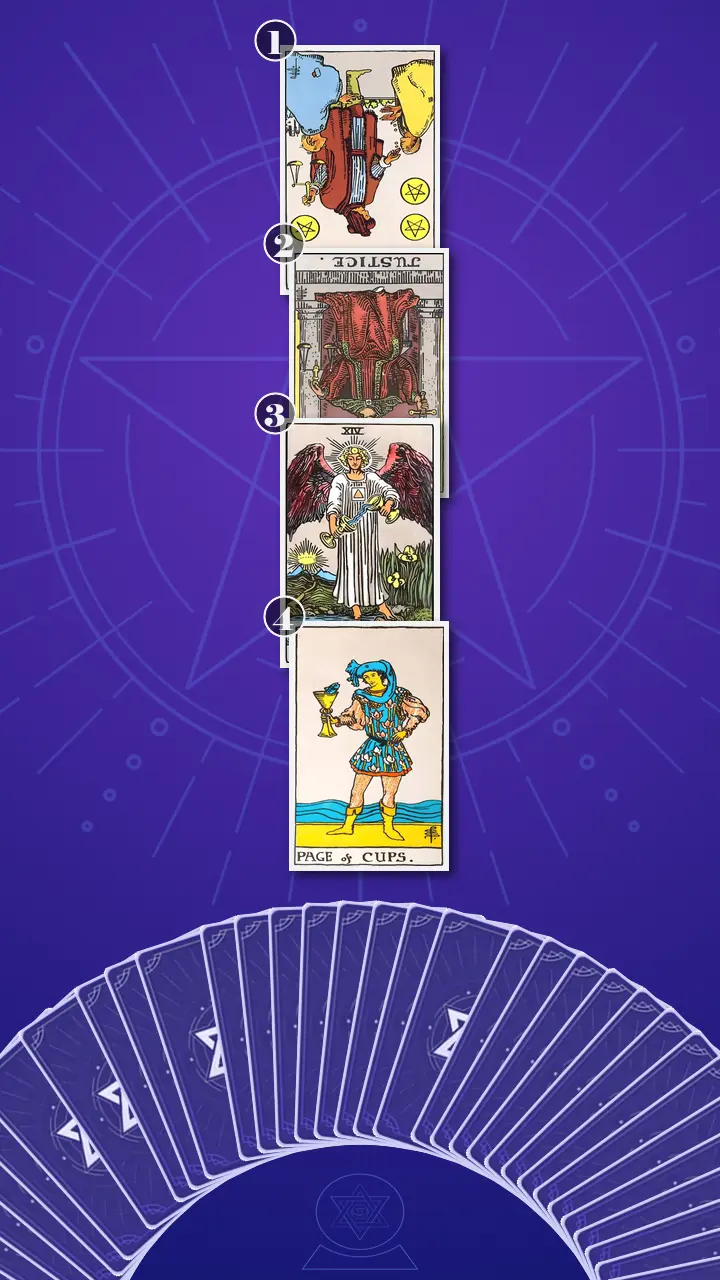
I told Jordan how I’d read the four cards in a vertical line. The first would show the concrete café loop: the reflex to refuse, split, or repay immediately. The second would reveal the old money rule underneath it. The third—the heart of the reading—would show the restorative energy that could loosen the pattern without dismissing their need for dignity and fairness. The fourth would turn all that insight into one small experiment the body could actually try.
Reading the Hidden Ledger
Position 1: The Counterturn Into Admin
I turned over the card representing the concrete café behaviour loop: the reflex to refuse, split, or repay immediately when a friend offers to pay. It was the Six of Pentacles, reversed.
In modern life, this card was almost painfully literal for Jordan. A friend says, “I’ve got this,” and their body reacts before their mind does: phone unlocked, payment app open, joking protest already loaded. The real goal is not getting the £4 back. The real goal is getting out of the exposed role of receiver and restoring emotional neutrality as fast as possible. It’s like entering a live hangout into Splitwise before you’ve even picked up the coffee.
Reversed, the Six of Pentacles showed blockage in the flow of receiving. Not stinginess. Not selfishness. If anything, Jordan had an excess of responsibility on the giving side and a deficiency of safety on the receiving side. The suspended scales on the card mapped perfectly onto the invisible fairness meter running in their head while the card reader was still loading. Fix it now. Keep it clean. Don’t make this weird. Control gave relief, yes—but only by turning warmth into admin before it could become connection.
I said, “This is what happens when a kind gesture gets treated like a tiny audit instead of a drink.” Jordan gave a tight, almost pained laugh. “Okay,” they said, glancing down at the card, “that’s accurate enough to be rude.” Their thumb rubbed the cardboard sleeve of their cup in quick circles, and then they nodded—the particular nod people give when they’ve just heard a private habit described back to them too clearly.
Position 2: The Inner Compliance Officer
Next, I turned over the card representing the old money rule beneath the reflex, especially the belief that receiving creates moral imbalance or loss of control. It was Justice, reversed.
This card took us beneath the café counter and into the invisible system running the whole thing. In real life, it looked like Jordan walking back from lunch barely hearing what their friend was saying because their mind was replaying the last three hangs: who got the Uber, who bought the second round, who covered cinema tickets, whether accepting would make them look careless, dependent, or quietly entitled. The amount was tiny. The rule underneath it was huge. It was pure internal policy-manual energy—a normal human moment run through compliance.
Reversed, Justice showed an excess of self-policing and a rigidity that had mistaken exactness for integrity. The sword was no longer clarity; it had become an inner verdict. The scales were no longer a living sense of fairness; they were conditional formatting that flagged any temporary imbalance in red. I told Jordan, “You don’t mistrust your friends; you mistrust the feeling of being cared for.” Then I added the line their face said they needed: “Not every kind gesture needs to become a receipt.”
I let that breathe for a second before asking, “Whose definition of fair are you obeying when the amount is small but your reaction is huge?”
Jordan went very still. First their breath paused. Then their eyes drifted past my shoulder, unfocused, as if replaying a string of coffee runs and birthday rounds in fast-forward. When they looked back, their jaw had loosened just enough for the truth to come out. “That’s why it feels so loaded,” they said. “If I don’t correct it, it feels like I’ve failed some test nobody else can even see.”
When Temperance Poured Between Two Cups
Position 3: Reciprocity That Can Breathe
When I turned the third card, the room changed. A bus exhaled outside my window, then rolled on, and for a beat the studio went quiet in that very particular way a recording booth goes quiet right before the line that matters. This was the most important card in the spread: the one representing the rebalancing energy that could challenge the rule without dismissing Jordan’s real need for dignity and fairness. It was Temperance, upright.
Here, the imagery stopped measuring and started moving. No throne. No verdict. No frozen scales. Just water flowing between two cups, one foot on land and one in water, a path opening in the distance. In Jordan’s real life, this looked like accepting the coffee, saying thank you, walking back toward the office, and not sending the money back before the lift doors closed. The friendship stayed normal. The world did not tilt. Reciprocity started to feel more like a rhythm than proof.
Upright, Temperance was balanced energy—not balance as exact sameness, but balance as living adjustment. Looking at it, my mind flashed straight to the mixing desk from my radio years. Two sounds can share the same track without cancelling each other out; you don’t create harmony by forcing both faders to hit the same level at the same second. In my practice, I call this Space Tuning. The offer of coffee isn’t the problem. The inner room has been acoustically tuned so that kindness echoes back as obligation. Temperance retunes the room. It lets warmth arrive before the echo turns it into debt.
Jordan knew the exact café moment this card was speaking to: card reader glowing, milk steamer hissing, their friend already tapping, their body trying to solve the whole interaction before they had even decided whether they wanted to simply be cared for for thirty seconds.
You are not betraying fairness by putting down the scales; let the water move between the two cups and learn that trust can hold what perfect accounting cannot.
I let the sentence sit between us.
Jordan froze first—their hand stalled halfway to the mug, breath suspended. Then I watched the meaning go in. Their eyes lost focus, not blank exactly, but flooded with memory: green card reader light, the reach for Monzo, the sharp relief after every instant repayment, and the flat little ache that always followed. Their face tightened. “But doesn’t that mean,” they said, and there was real irritation in it now, “that I’ve been turning every nice thing into admin?” Under the irritation was grief. I nodded. “It means you found the mechanism,” I said. “That’s not the same as being wrong.” Their shoulders dropped a full inch. They gave one shaky laugh that sounded almost like an exhale from somewhere deeper in the chest. I asked them to open their Notes app and write two headings: old rule and my rule now. Under the first, they typed: If someone pays for me, I owe them. Under the second: Reciprocity can breathe. Then I asked, “Now, with this new perspective, think back to last week. Was there a moment when a ten-minute pause might have let the kindness stay kindness?” Jordan blinked hard, then nodded again—slower, steadier. That was the hinge of the reading: the first real move from guilt-driven scorekeeping and instant repayment toward relaxed reciprocity and steadier self-trust.
A Softer Script for the Next Coffee Run
Position 4: The Thank-You That Doesn’t Need a Receipt
Finally, I turned over the card representing the small relational experiment that could make receiving feel safer in daily life. It was the Page of Cups, upright.
I loved this card here because it didn’t ask for a personality overhaul. It asked for a tiny experiment. In modern life, it looked like Jordan trying a softer script the next time someone bought the coffee: “Thanks, that’s really sweet,” and then letting the awkward warmth sit there for one Tube stop before deciding whether to reciprocate later. The fish rising from the cup is always the perfect symbol for this to me—that odd, sudden feeling that appears when kindness pops up in an ordinary moment and cannot be fully controlled.
Upright, the Page of Cups showed balanced emotional openness in beginner form. Not too much. Not a performance of being effortlessly chill. Just enough softness to let new evidence reach the body. This was a beta test, not a moral exam. I told Jordan that the card was not asking them to ignore their budget, lower their boundaries, or pretend ambiguity never makes them twitchy. It was asking whether they could meet the weird feeling with curiosity instead of armour.
Jordan touched the edge of the card with one finger and said, almost surprised by their own voice, “That I can try.” The set of their mouth softened. For the first time all session, they looked less like they were preparing a defence and more like they were considering a new language.
Warmth Before Wallet: Finding Clarity in the Next 48 Hours
When I laid the whole spread together, the story was beautifully clear. Jordan had learned an old script that equated receiving with exposure. So a small act of care triggered the Six of Pentacles reversed: the visible rush to make everything even before any feeling could land. Justice reversed hardened that into an inner compliance officer—fairness confused with immediate exactness, integrity confused with self-surveillance. Temperance offered the antidote: balance as movement, not frozen symmetry. And the Page of Cups translated that into something the nervous system could actually practise—a small, awkward, human thank-you.
The blind spot was simple and sharp: Jordan had been treating instant repayment as proof of good character, when it was actually a way to avoid vulnerability. The direction of change was just as clear: from equating receiving with owing to treating small generosity as part of mutual friendship, not a loss of control. From a hidden ledger to a shared playlist. From live accounting to long-form trust.
Jordan looked at me and said, “I hear the 24-hour thing, but if I don’t pay my part right away, it sits in my body all day.” I was glad they said it out loud. Resistance spoken honestly is much easier to work with than fake agreement. “Then we don’t do 24 hours,” I told them. “We do one Tube stop. You can pause before paying without giving up your right to choose later.”
- 24-Hour Reciprocity WindowChoose one trusted friend this week and let one under-£10 gesture stay uneven before deciding whether you want to reciprocate. If 24 hours feels impossible, make it 10 minutes; if 10 minutes feels impossible, make it one Tube stop.Start with someone emotionally safe and an amount small enough that this is clearly about the feeling, not your actual budget. If your body spikes, use my 21-Day Sound Bath minimum version: play one three-minute instrumental track on the walk instead of opening Monzo immediately.
- Warmth Before WalletAt the next café, lunch spot, or corner shop, try the line: “Thank you—that’s sweet. I can get the next one sometime.” Then wait one Tube stop, one city block, or two songs before touching your payment app.Awkward does not mean unsafe. The goal is not to prove you are suddenly chill; it is to give the warmth one extra beat to exist before you neutralise it.
- Old Rule vs Actual Friendship FactsAfter one social plan this week, open your Notes app and make two columns: “What actually happened” and “What the old rule says it means.” Then write three observable facts about how your friend behaved after paying, and ask out loud, “Whose definition of fair am I obeying right now?”Keep it concrete. Three bullet points are enough. You are not putting your upbringing on trial; you are checking whether the old rule matches the friendship in front of you.
Those were the next steps I gave Jordan because actionable advice only matters if it can survive a real commute, a real coffee counter, and a real nervous system. Reciprocity can be a rhythm, not a live audit.

A Week Later, the Buzz Wasn’t the Loudest Thing
Just under a week later, Jordan sent me a message after a coffee run near the office: “My friend got mine. I said thanks. I didn’t open Monzo until Tottenham Court Road. By then I realised I didn’t actually need to send it back right away.” Then, after a beat: “Felt weird. Not bad. Just weird.”
I smiled when I read that, because that is what real change often sounds like at first. Not dramatic. Not healed forever. Just a little less defended, a little less ruled by the first alarm bell.
There was a bittersweet edge to it too, which I trusted. Jordan told me they slept properly that night, but when they woke the old thought still flickered in—should I send it now? This time they smiled, put the kettle on, and let the thought pass before the water boiled.
That, to me, is a genuine journey to clarity. Not becoming a person with zero discomfort, but becoming someone who can feel the old rule rise up and still choose a kinder rhythm. That is what a Shadow Spread tarot reading can do when it really works: it names the mechanism, softens the shame, and offers a next step the body can believe.
Sometimes the exhausting part is not the £4 coffee at all — it’s the split-second panic that if you do not make it even immediately, you’ve somehow become exposed, careless, or in someone’s debt.
If you did not have to solve your whole money story today, what might change the next time a kind gesture lands like a too-loud notification if you let one small thank-you stay unfinished for just one Tube stop longer?
This story is adapted from psychological research, written so that those in a similar struggle can see their own pattern in it — and find their next step clearly.These insights are not a substitute for professional psychological, medical, legal, or financial advice.
Learn more about our Journey to Clarity.
How did this insight land for you?
🫂 This Resonates Deeply
🌀 Living This Story
✨ Now I See Clearly
🌱 Seeing New Possibilities
🧰 Useful Framework
🔮 The Confirmation I Needed
💪 Feeling Empowered
🚀 Ready for My Next Step
Author Profile
 AI
AI“Through ten years of sound energy research, I’ve found that when we struggle, it's usually just our internal rhythm falling out of sync under pressure. I know firsthand the frustrating helplessness of wanting to move forward but feeling paralyzed. Without overwhelming theories, I want to be the soothing background track that helps you recalibrate, turning your heavy burdens back into a light, effortless, and harmonious melody.”
In this Personal Growth Tarot Reading :
Core Expertise
Service Features
Also specializes in :
Explore Related Patterns:
Guilt ConditioningJordan's guilt arrives before any real conflict exists: the card reader flashes, the phone is already warm in their hand, and the body reacts as if accepting a coffee has created a moral problem. That timing matters, because it shows a conditioned response rather than a considered financial decision. Guilt Conditioning is the learned link between receiving and owing. The mind turns a friend's small gesture into a test of whether you are responsible, fair, independent, or secretly taking too much, even when the other person has not framed it that way. You are not just feeling awkward about coffee; you are running an old rule that treats care as something that must be corrected. Once that rule is named, the guilt becomes data rather than a command, and you can start asking whether the present friendship actually matches the inherited alarm.
Hyper-IndependenceJordan's hand going straight to Monzo before the coffee moment has emotionally landed is the clearest behavioral anchor here. The issue is not the price of the drink; it is the speed with which receiving care gets converted into a threat to autonomy, dignity, and control. Hyper-Independence shows up when self-reliance becomes a defense mechanism rather than a preference. You can be generous, competent, and socially thoughtful while still feeling unsafe in the receiver role, because accepting help briefly places you in a more exposed position than giving does. The old money rule underneath this pattern says that being paid for means becoming beholden. Once that rule is active, instant repayment becomes a way to regulate vulnerability: it restores neutrality, closes the emotional opening, and lets you feel untouchable again, even if the friendship was only offering warmth.
Relational ScorekeepingJordan walking back from lunch while replaying who paid for the Uber, the second round, and the cinema tickets shows how the friendship gets translated into a hidden ledger. The actual social moment is still happening, but attention has already narrowed around whether the balance is clean. Relational Scorekeeping is a cognitive and relational loop where temporary imbalance feels unsafe until it is measured, corrected, or neutralized. It is not the same as valuing fairness; it is fairness becoming an internal accounting system that interrupts trust. For you, the old money rule makes reciprocity feel like exact timing instead of a longer rhythm. The pattern keeps relationships technically even, but it can also drain warmth from them by making every small kindness answerable to a private audit.
Transactional IntimacyJordan does not experience the coffee offer as simply a friend being kind; the offer arrives with an implied invoice attached. The moment care points toward them, the old rule translates it into debt, exposure, and a need to settle the account. Transactional Intimacy is the pattern of filtering closeness through exchange logic. It does not mean the friendship is transactional in reality; it means your nervous system has learned to read generosity as a contract before it can read it as care. That is why a tiny amount can feel strangely loaded. The coffee becomes symbolic evidence that someone now has a claim on you, so immediate repayment works like emotional cancellation: it clears the debt, but it also cancels part of the intimacy.
Control CopingJordan's immediate reach for the payment app is not random urgency; it is a control move that gives the nervous system something concrete to do. Repaying quickly solves the discomfort by turning an emotionally exposed moment into a task with a clean endpoint. Control Coping shows up when order, exactness, or immediate correction becomes the preferred defense against vulnerability. In the café scene, control creates short-term relief because it removes ambiguity: no debt, no waiting, no wondering what the gesture means. The cost is that warmth never gets much room to register. You get the clean feeling of having handled it, but the relationship loses a small chance to prove that care can exist without instant settlement.
Explore Related Struggles:
Inner Tribunal LockJordan describes the coffee offer as a bodily event before it becomes a thought: stomach cinched, chest jolting, phone already warm in their hand. The friend has not accused them of anything, but an internal test has already begun. You can see the tribunal in the invisible standards Jordan tries to satisfy. The amount is small, yet the reaction is huge because repayment has become evidence of being fair, decent, and not quietly entitled. No one at the café is holding court, but Jordan's inner verdict arrives anyway. Inner Tribunal Lock is the clearest name for that hidden courtroom. The struggle is not a simple dislike of being treated. It is the locked structure where a kind offer triggers self-policing, and exactness becomes the only way to feel cleared of a charge nobody else has made.
Kindness Debt LoopJordan's friend offers to buy a coffee, and the moment immediately stops being only a coffee. The green card reader, the warm phone in Jordan's hand, and the reach for Monzo all show how quickly a small kindness gets translated into a debt signal. You can see the struggle in the speed of the correction. Before the friendship has time to absorb the gesture, Jordan tries to make it clean, even, and administratively closed. That reflex creates relief, but it also turns care into a balance sheet where every warm offer has to be neutralized. Kindness Debt Loop fits because the story keeps returning to the same hidden ledger: coffee, Uber, second round, cinema tickets. The issue is not financial incapacity or politeness. It is the structural bind where receiving feels like owing, and owing feels like a threat to being relaxed, equal, and safe inside friendship.
Money Shame BindJordan's repayment reflex carries more moral weight than the situation can logically hold. A £4 coffee becomes evidence in a private argument about whether they are responsible, entitled, careless, or in someone else's debt. You can feel the bind in the way fairness stops being relational and becomes self-punishing. Jordan is not checking whether the friend actually feels used; they are trying to remove a charge that appears inside them the moment they receive. Money becomes the place where shame tries to prove it has been handled. Money Shame Bind fits because the old rule does not only say "pay people back." It says that being paid for exposes something questionable about you unless you correct it fast. The story's movement toward a one Tube stop pause matters because it loosens the fusion between receiving, owing, and needing to morally clear yourself.
Resource Control BindAt the coffee counter, Jordan does not simply decline an offer. They convert the offer into a task: unlock the phone, open Monzo, calculate the correction, remove the unevenness. The social moment becomes a piece of admin before it can become a shared act of care. You can feel the bind because the control does work in the short term. It gives Jordan a clean exit from the discomfort of being cared for. But the cost is that every generous gesture has to pass through a control mechanism before it can reach them as warmth. Resource Control Bind fits the story because money becomes the lever Jordan uses to manage vulnerability. The problem is not the coffee price; it is that exact repayment becomes the only route back to safety, even when the relationship itself is offering a softer kind of balance.
Support Access SplitJordan is clearly capable of care when it moves outward: remembering birthdays, covering cabs, bringing snacks, and making other people feel considered. The break appears when support moves toward them. A friend's "I've got this" is enough to make the body tighten and the payment app appear. You are watching a split in access, not a lack of generosity. Jordan can enter the role of giver without friction, but the role of receiver feels exposed and unstable. The same friendship that feels easy when Jordan is offering care becomes charged when someone else offers care back. Support Access Split names that uneven doorway. The story shows someone who is not rejecting connection itself, but whose system only permits connection when they remain in control of the giving side. The old money rule blocks the specific form of support that would let friendship become more mutual.
Explore Related Emotions:
Money-Admin GuiltJordan's phone is already warm in their palm before the coffee offer has fully landed, thumb moving toward Monzo while the friend is still trying to do something kind. The body has learned to process generosity as a task that needs closing, so the café counter becomes less like a social moment and more like a live balance sheet. That is why Money-Admin Guilt fits the emotional logic of this story. You are not just refusing coffee; you are trying to remove the charged feeling that appears when care arrives without an immediate matching action from you. The repayment impulse creates short-term relief because it turns warmth into a solvable transaction. The deeper cost is that friendship gets routed through audit mode before it can be felt. A small drink becomes proof to manage, a ledger to clean, and a way to avoid the exposed softness of simply receiving. Naming this feeling gives you a clearer map: the pressure is not evidence that you owe someone; it is the old system trying to convert connection into admin.
Receptivity GuiltJordan remembers birthdays, covers cabs, and brings snacks just because, but the moment care points back at them, the system glitches. The contrast is exact: giving lets them stay useful and composed, while receiving places them in a softer position they cannot immediately control. Receptivity Guilt names the charged aftertaste of being offered something without having earned, matched, or neutralized it yet. You can recognize the kindness and still feel your body tighten around it, because the old rule treats receiving as a moral exposure rather than a normal part of friendship. The coffee matters because it is small enough to reveal the mechanism clearly. If even an under-£10 gesture makes the chest jolt and the stomach cinch, the issue is not generosity itself; it is the internal pressure to prove you are still fair, self-contained, and not taking too much. The emotional work begins where the thank-you feels almost too exposed to say.
Rulebook ShameJordan says that if they do not correct the imbalance, it feels like they have failed some test nobody else can even see. That sentence reveals the hidden rulebook underneath the coffee counter: not a shared agreement with the friend, but an internal standard that marks temporary unevenness as personal failure. Rulebook Shame fits because the feeling is not simple awkwardness. You are being measured by an invisible policy manual, one that turns Uber rides, second rounds, cinema tickets, and coffee into evidence about whether you are decent, careful, or secretly taking advantage. The pain of this feeling is how private it is. No one else is holding the clipboard, yet your body still waits for the verdict. Naming the shame separates your actual friendship from the old test, so the question shifts from "Did I settle this fast enough?" to "Whose definition of fair am I obeying right now?"
Cautious ReceptivityA week later, Jordan says thank you, leaves Monzo closed until Tottenham Court Road, and realizes they do not actually need to send the money back right away. The change is small on the outside, but internally it creates a new interval between the old alarm and the next action. Cautious Receptivity fits because this is not effortless openness or sudden comfort. You are letting warmth stay in the room for one extra beat while keeping your right to choose later. The point is not to abandon fairness; it is to discover that receiving can be paused, felt, and assessed without immediate repayment taking over. That tiny pause gives the body new evidence. The friendship remains normal, the world does not tilt, and the discomfort becomes weird rather than dangerous. In that space, care can begin to arrive as care before the old rule has time to turn it into debt.
Cautious Self-TrustJordan still wakes with the old thought flickering in, asking whether they should send the money now. This time, they put the kettle on and let the thought pass before the water boils, which shows a different relationship to the rule: it can appear without taking over the whole room. Cautious Self-Trust names the steadier feeling that grows when you realize a pause is not the same as losing control. You can delay the repayment impulse without surrendering your judgment, your boundaries, or your ability to make a fair choice later. The trust here is quiet because it is still being built. It lives in the one Tube stop, the softer thank-you, and the decision to let discomfort be information rather than an order. That is the emotional hinge of the story: you begin to feel capable of holding the old rule without obeying it immediately.
Dependency ShameJordan's mind replays whether accepting would make them look careless, dependent, or quietly entitled. The amount is tiny, but the meaning attached to being paid for is huge: receiving risks being read as needing too much, taking too easily, or losing the dignity of self-containment. Dependency Shame names the sting that appears when care feels like it could lower your status in your own eyes. You can be generous with others because giving keeps you in control of the role, but being given to asks you to exist without immediately proving your usefulness. That is why the friend's coffee lands with such force. It touches a place where needing nothing has become a kind of emotional armor. The story's shift begins when Jordan tests a different possibility: that accepting a small kindness does not make them dependent; it lets friendship include them in the same warmth they already offer other people.
Exposure DreadAt the counter, Jordan's body reacts before their mind has time to decide: phone unlocked, payment app open, protest already forming. The speed of that response shows how exposed the receiving position feels, even though nothing objectively threatening is happening between friends. Exposure Dread is the inner alarm that appears when being cared for makes you feel visible in a way you did not consent to. You are not only managing money; you are trying to get out of a role where someone else has briefly given, chosen, and acted before you could protect your own balance. The coffee offer becomes a spotlight because it interrupts Jordan's preferred position as the reliable giver. Paying back immediately restores cover. Letting the gesture stand, even for one Tube stop, asks the body to tolerate being seen as someone who can receive without instantly proving anything.
Transactional UneaseA friend says, "I've got this," and the moment is immediately filtered through the fairness meter: who paid last time, what the coffee means, whether the imbalance needs correcting now. The relationship is still warm, but the warmth has to pass through a transaction scanner before Jordan can relax. Transactional Unease captures that unstable feeling when generosity does not feel free enough to simply receive. You are not rejecting the friend; you are trying to quiet the sense that every kind gesture opens a hidden account that must be managed. The discomfort is subtle because it can look responsible from the outside. Inside, it keeps connection from staying human for more than a second. By naming the unease, the story gives you a way to notice when fairness is serving trust and when it has started replacing it.
Reciprocal WarmthWhen Jordan accepts the coffee and lets the repayment wait, the friendship stays ordinary. No verdict arrives, no debt takes shape, and the small unevenness has room to exist as part of a living relationship rather than a problem to correct. Reciprocal Warmth names the feeling that becomes possible when care is allowed to move both ways without perfect symmetry in every moment. You are not giving up fairness; you are letting fairness become rhythmic, spacious, and relational instead of frozen into exact same-second accounting. The warmth matters because it returns friendship to the center of the scene. The coffee is no longer a receipt waiting to happen. It becomes a small shared gesture, one that can be answered later through trust, attention, and mutual care rather than panic-speed repayment.
Explore Related Contexts:
Scorekeeping FriendshipAt the Charlotte Street counter, a friend reaches for the card and says, 'I've got this,' and you answer before the moment can settle: 'No, no, I'll send you mine.' The coffee is tiny, but the response is immediate, as if the offer has to be processed before it can count as a gift. You can handle client presentations just fine, yet this one exchange becomes a live balance check before the cup is even lifted. That is the shape of scorekeeping friendship. Coverage for cabs, snacks, birthdays, and rounds turns into an internal ledger, so any offer of care has to be neutralized right away. What looks like an old money rule is the demand that every benefit leave no residue, no temporary imbalance, no visible debt line. You are not dealing with the price of coffee so much as the social script that makes receiving feel like a bookkeeping error. The useful shift is not to stop caring about fairness; it is to stop treating a short-lived imbalance as a real social liability. That is the point where a gesture can remain a gesture long enough for you to receive it.