One More Comparison Column Gave Way to One Honest Calendar Hour

The 11:40 p.m. Loop of Off-Script Choice Paralysis
I met Avery, a 29-year-old customer success specialist in Toronto, over video on a Tuesday night. They had the stable tech job, the workable routine, and a Notion decision board detailed enough to brief a consultant. They could explain contract work, portfolio careers, and creative projects from every angle. They still had not tested one.
At 11:40 p.m., Avery sat at their kitchen table while the dishwasher hummed behind them. Cold, tannic tea waited beside three alternative-work articles, and the laptop warmed their forearms as a draft message to a possible collaborator remained unsent. I watched them add “future credibility” as another comparison column. A restless buzz moved through their chest like a phone vibrating under a stack of blankets; when the clock neared midnight, their shoulders dropped with the weight of another unchanged week.
“My life looks fine, which makes wanting something different feel hard to justify,” Avery said. “I can explain every option and still not choose one. What stops me from choosing an off-script path that actually feels like mine?”
I told them, “Your life can look fine and still give you no evidence about what feels like yours. I’m not going to ask the cards to predict whether you should quit your job. I want us to identify the mechanism that turns a low-risk experiment into something that feels like a permanent verdict. Let’s draw a map of that fog, then see where your own hand can make the next mark.”

Choosing the Compass Beneath the Career Crossroads
I invited Avery to take one slow breath and hold the question without improving or defending it. I shuffled as a focusing practice, giving the mind a clear transition from recursive research into observation. Nothing about the ritual required Avery to surrender judgment or believe that the cards controlled an outcome.
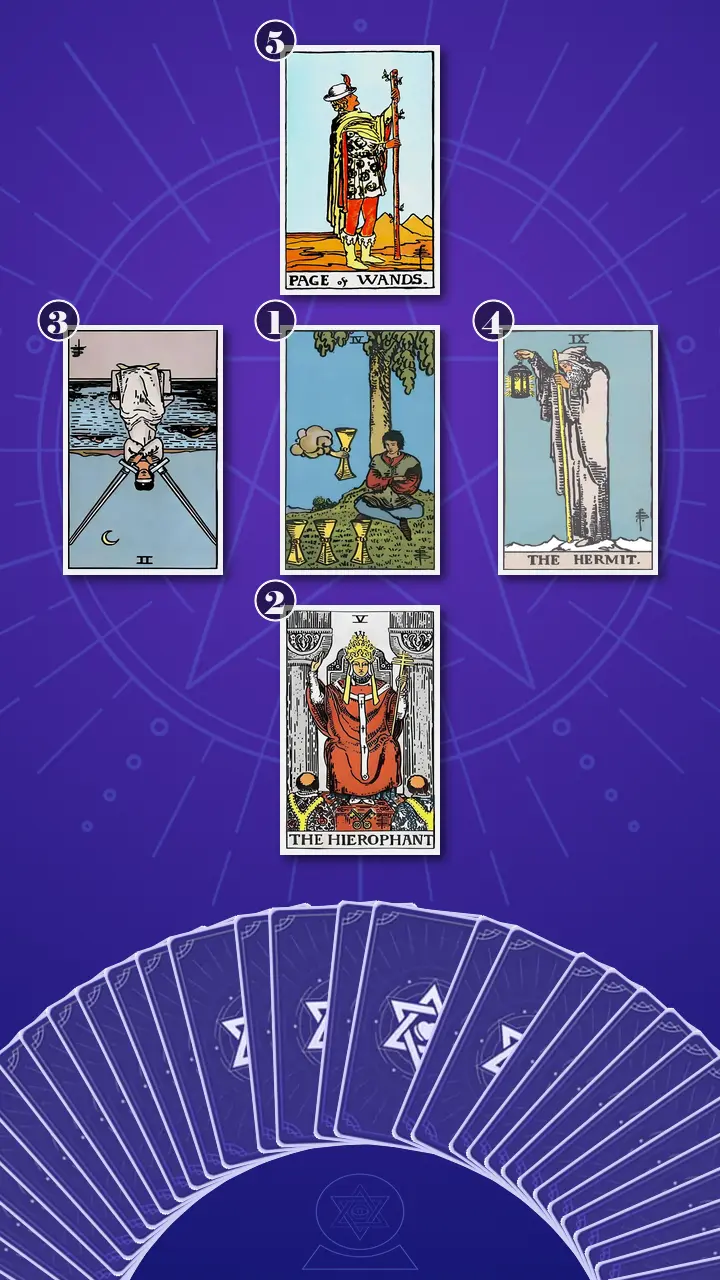
I chose The Shadow Spread · Context Edition, a five-card shadow tarot reading designed to trace a visible pattern into its hidden belief, protective defense, reclaimable resource, and practical integration. A larger spread would have created more material for an already overworked mind. This compact cross was better suited to uncovering what sat beneath Avery’s off-script decision paralysis.
I placed the visible behavior at the center, the hidden rule below it, the protective loop to the left, the inner resource to the right, and the real-world practice above. The result looked like a decision compass. This is how tarot works best in my practice: not as a verdict machine, but as a structured mirror in which card meanings become useful only when tested against context, behavior, and consent.
Reading the Scene That Would Not Move
Position 1: The Untouched Offer
I turned over the card occupying the position that revealed Avery’s observable fulfillment stasis: the research, contemplation, and explanation that never became a direct test. It was the Four of Cups, upright.
The seated figure’s folded arms immediately echoed the kitchen table. Three familiar cups resembled Avery’s salary, manageable role, and recognizable career structure. The fourth cup resembled the unsent message: available enough to inspect, but never close enough to experience. At 11:40 p.m., three articles and a private planning board had surrounded Avery while one small invitation to reality stayed untouched.
I read the card as a blockage of water. Their dissatisfaction was carrying information, but contemplation had become a closed posture. The card did not accuse Avery of ingratitude. A functional life can still leave part of the self offscreen, much like the work-life disconnection in Severance. I asked, “Which option do you keep evaluating intellectually without letting yourself experience it for even an hour?”
Avery gave one short, bitter laugh. Their fingers tightened around the mug, then released. “That’s too accurate. Honestly, it’s almost cruel.”
“Then we’ll be precise without being cruel,” I said. “The card is describing a posture, not your identity. A posture can change.”
Position 2: The Permission Gate
I turned to the position revealing the hidden rule beneath the stasis: the belief that a personal path had to satisfy an established standard before it could count as legitimate. The card was The Hierophant, upright.
I asked Avery to recall a Liberty Village networking event where someone had requested their five-year plan. They had given a smooth answer about progressing in customer success while the private wish for contract work and creative projects stayed offstage. Housing costs and predictable income were valid concerns, but those needs had fused with another rule: a life was not real unless its title, salary bands, and progression fit neatly into LinkedIn profile fields.
The Hierophant’s structured energy had moved into excess. Useful stability had become an internal permission gate. In my mind, I saw a split-screen from a film edit: on one side, a polished corporate sequence with an easy elevator pitch; on the other, a quieter criterion that had no profile field yet. Avery’s private sentence was clear: “I want a life that feels like mine, but I keep grading it by someone else’s rubric.”
I told them, “Legibility is useful; it is not permission. You do not have to reject salary, housing security, or supportive structure. You only need to notice when an algorithm trained on other people’s milestone posts starts recommending what your life should optimize for.”
Avery’s gaze shifted away from the screen. Their jaw softened, but their eyes looked briefly wet. “I think I’ve been trying to make the idea respectable before I let myself find out whether I even like it.”
Position 3: When Research Becomes the Alibi
I turned over the card showing how Avery protected themself from uncertain commitment through comparison, delayed action, and the attempt to think away every future doubt. It was the Two of Swords, reversed.
I connected the crossed swords to two incompatible browser windows. One asked, “What feels personally meaningful?” The other demanded, “Can I produce a defensible five-year forecast?” After seeing a peer’s promotion post, Avery would reopen the decision board, check salary data, ask two friends for opinions, and add “future optionality” as another weighted criterion. By midnight, the hour available for making a rough sample had disappeared.
Here, air had become excessive and congested. The inner sequence ran: “One more criterion, one more opinion, then I’ll know.” It ended with: “Why do I know more and trust myself less?”
I use Safe-Choice Sabotage Recognition for moments like this. I look for the exact frame where sensible caution stops protecting rent, rest, or income and starts protecting the story from its necessary inciting incident. Avery’s comparison system had once reduced risk. Now it enlarged a CAD 20 experiment until it felt emotionally identical to resigning from a salaried job.
“More research cannot produce evidence that only experience can give,” I said. “The question is not whether caution is bad. It is whether this extra tab protects an essential need or helps you avoid pressing Send.”
Avery’s breath paused. Their shoulders rose as if bracing against cold, their eyes lost focus while an old evening replayed, and then a low “Oh” escaped as their hands opened on the table.
When The Hermit Raised a Smaller Light
Position 4: The Authority Avery Had Not Claimed
The room seemed to narrow around the next card. Rain ticked against my window, then eased, leaving one clean streetcar bell audible in the distance. I turned over the position representing the quiet discernment and personally examined authority Avery could reclaim. It was The Hermit, upright, the pivotal card in the reading.
I focused on the lantern’s limited radius. It worked like a phone flashlight on a dark city walk: it could not reveal the entire route, but it could show enough real ground for the next deliberate step. The Hermit asked Avery to mute LinkedIn, Instagram, salary tabs, and advice messages for one focused hour, then identify one quality they wanted direct evidence about, such as autonomy, creative absorption, variety, or schedule control.
This was balanced, selective attention, restoring an inner guidance system that had been deficient beneath the noise. Outside opinions could return later as information. They no longer had to act as authorities granting permission.
I brought in my Narrative Fork Analysis and placed Avery’s options side by side as competing plotlines. In the first, the protagonist kept the stable job and waited for a complete, approved map before testing anything; each scene produced a better explanation but no new experience. In the second, the protagonist also kept the stable job, protected their budget, and ran one private experiment guided by a personal value. The second plotline was not morally superior because it was unconventional. It simply served Avery’s growth by allowing reality, rather than fear or fantasy, to contribute evidence.
I returned Avery to the setup they knew too well: the clock at 11:40 p.m., the planning board open, the draft still unsent, and one more comparison column appearing. They knew more than they had an hour earlier, but their actual week remained unchanged.
I said, “An off-script choice does not need a fully approved map. It needs one value-led test that lets your own experience become evidence.” Then I gave Avery the sentence I wanted them to keep:
You do not need a fully approved map before moving; choose one value-led experiment and let The Hermit's lantern illuminate only the ground you can test now.
I let the silence remain. Avery stopped breathing for a beat, their fingertips suspended above the trackpad. Their pupils widened, and their gaze slipped past me as if the last several months were replaying in quick cuts. Then their mouth tightened.
“But doesn’t that mean I’ve been doing it wrong this whole time?” they asked, sharper than before. Anger arrived first, then grief. Their eyes reddened. Their shoulders finally dropped, but they leaned back as though the new space inside their chest had made them briefly unsteady.
“It means you built a defense that made sense,” I said. “It gave you short-term relief from regret and helped you protect a workable life. It just cannot give you the evidence you need now. Recognizing its limit does not invalidate the intelligence that built it.”
Avery exhaled with a faint tremor. Their hands unclenched, although the relief carried a new vulnerability: if a complete map was unnecessary, the next small choice belonged to them. I asked, “With this new angle, think about last week. Was there a moment when this insight could have made the situation feel different?”
“Saturday at the coffee shop,” Avery said. “I had the message open. I could have treated it as one conversation, not a resignation letter.”
I set a seven-minute timer. Without opening another tab, Avery wrote one desired quality: creative absorption. Beneath it, they named a 60-minute experiment and placed a provisional block on Saturday’s calendar titled “Experiment 01, not a life decision.” I reminded them that the test required no resignation, public identity announcement, or spending beyond a limit they chose. They could shorten it to 15 minutes, revise it, or stop.
I watched the emotional shift become concrete: from restless, research-driven stasis toward grounded self-trust built through reversible experience. It was not certainty. It was the first usable form of ownership.
The Page of Wands Entered as a Beginner
Position 5: A Prototype, Not a Rebrand
I turned the final card in the position that translated the insight into one bounded, reversible experiment. It was the Page of Wands, upright.
The Page studied a sprouting wand with interest rather than mastery. I connected that image to Avery blocking 10:00 to 11:00 a.m. on Saturday, setting a CAD 20 ceiling, making one rough sample, and scheduling a 15-minute Sunday review. The Page offered balanced exploratory fire: enough curiosity to begin without pretending to know the ending.
No Pentacles had appeared in the spread, so practical earth was deficient. Avery had to supply it deliberately through a calendar entry, budget ceiling, definition of done, and review point. The Page of Wands was a beta release, not a rebrand. I told Avery, “You do not need a five-year story to book one honest hour. You are not declaring who you are forever. You are finding out what happens when you try this once.”
Avery looked at the new calendar block and smiled, then winced slightly. “That feels weirdly small.”
“Small is the feature,” I said. “It keeps curiosity reversible enough to become evidence.”
Supplying the Missing Earth
I drew the spread into one coherent storyline. The Four of Cups showed Avery staying in a painful but familiar scene after its information had already arrived. The Hierophant revealed the inherited script that made conventional legibility a permission test. The reversed Two of Swords showed research protecting Avery from imperfect commitment while quietly weakening self-trust. The Hermit returned authority to one examined value, and the Page of Wands turned that value into a testable scene.
The blind spot was not a lack of intelligence or seriousness. It was treating the absence of certainty as proof that the preference was illegitimate, then treating the absence of lived evidence as proof that their judgment could not be trusted. The direction forward was evidence before identity: choose one value, run one contained test, observe honestly, and revise without turning revision into personal failure.
Avery raised a practical objection: “Toronto rent means I can’t turn this into a cute leap-of-faith thing.”
“Agreed,” I said. “We are not staging a leap. We are building boundaries strong enough for one honest experiment.”
- Make the Legibility-Permission Split. Tonight, open a phone note with two headings: “Feels like mine” and “Sounds defensible.” For eight minutes, sort six phrases from the current decision board without searching for new information. If eight minutes feels too exposed, do three. The aim is separation, not a perfect values statement.
- Use the Protagonist Pivot Action. Within 24 hours, create “Experiment 01, not a life decision” on the calendar. Give it 60 minutes this Saturday, a CAD 0 to CAD 40 ceiling, one location, and one visible definition of done, such as drafting one page or sending one bounded message. Use the 15-minute minimum version if necessary. Keep the job, protect essential rest, and stop at the scheduled end time.
- Review Experience, Not Identity. Book 15 minutes on Sunday and score Energy, Curiosity, and Friction from 0 to 5. Choose one status only: repeat, adjust, or stop. Do not add research criteria before this review. Revision is not proof that you chose badly; it is what a reversible test is for.

Six Days Later, the Calendar Held
Six days later, I received a message from Avery. They had kept the Saturday block, drafted a rough one-page creative offer, and sent one low-pressure note to a possible collaborator. Their score was Energy 4, Curiosity 5, Friction 3. Their chosen status was adjust, not commit forever.
They had slept through the night afterward. Their first thought the next morning was still, “What if I’m wrong?” They told me they laughed once, made coffee, and left the next calendar block in place.
I did not see that as tarot predicting Avery’s future. I saw the five-card Shadow Spread doing its proper job: making a hidden loop visible, separating practical caution from borrowed permission, and returning the pen to the person whose life was actually in production. Avery had created the change by choosing, observing, and retaining the right to revise.
When a life looks fine on paper but does not feel like yours, I know the chest can buzz and the shoulders can go heavy while desire waits to become defensible enough to trust. Clarity may not be a completed map. Sometimes it is the moment the fog thins just enough for you to recognize your own outline and the next patch of ground.
If you needed only The Hermit’s phone-flashlight circle for one reversible hour, what would you be curious to try as yourself?