Mutual Burnout Disguised as Loyalty—From Rescue to Shared Care

The Quiet Evening That Felt Like Leaving
"You finally put your phone on Focus mode after a long TTC commute, then see the words \"I cannot handle this right now\" and reopen the chat, because mutual burnout has made a quiet evening feel like a risk rather than rest," I said. "That is caretaker burnout disguised as loyalty."
Jordan (name changed for privacy) was a twenty-nine-year-old nonprofit project coordinator in Toronto, sitting on the TTC Line 1 between Bloor-Yonge and St George at 8:47 p.m. Their phone felt warm in their palm beneath the fluorescent carriage lights. Before the train reached the next station, they had cancelled dinner, opened a notes app, and started typing a step-by-step rescue plan while their jaw locked and their shoulders rose toward their ears.
"Why do we keep rescuing each other instead of taking time to recover?" Jordan asked. Whenever their close friend sounded overwhelmed, Jordan offered advice, rearranged work, stayed online through the night, and said, "I'm fine," when their own body was asking for sleep. They wanted recovery for both of them, but feared that pausing would leave the other unsupported or make the bond sound abandoned.
I could see the guilt wrapped around the tenderness: it moved through Jordan's chest like a phone vibration that never quite stopped, even when the screen was dark. Their hands kept reaching for the device before their body had finished registering its exhaustion. Underneath it sat helplessness, then resentment, then the shame of noticing the resentment at all. We kept calling it loyalty when it was two exhausted people trading emergencies.
"I don't hear a lack of care here," I told Jordan. "I hear care trapped inside an emergency system. We can look at that system without blaming either of you. Today, our Journey to Clarity is simply to draw a map of the fog and find one small place where both of you can set the overloaded backpack down."

A Six-Card Map for the Rescue Loop
I asked Jordan to take one slow breath and name the question again without trying to solve it. I shuffled slowly, letting the small movement create a clean transition from the commute, the read receipts, and the cancelled dinner into focused observation. The cards were not a verdict or a forecast; they were a structured mirror for a pattern already happening in real life.
For this reading, I chose the Transformation Path Grid (6) · Context Edition. It is a six-card grid designed for a repeated relationship rescue loop: it moves from the visible symptom to the obstacle, then the hidden attachment, the turning point, the practical action, and the integrated lesson. That makes it useful when the question is not, "Will this relationship survive?" but, "How do we understand mutual burnout and choose a healthier next step?" That is also how tarot works at its most grounded: the symbols organize attention so intuition and observable behavior can speak to each other.
The top row would show how help replaces recovery, what burden keeps the cycle active, and the fear beneath the unspoken bargain. The turn into the lower row would hold the key question: what changes when rest is treated as care rather than abandonment? From there, the Two of Cups would translate insight into consent-based support, and Temperance would explore a sustainable rhythm rather than a dramatic all-or-nothing answer.
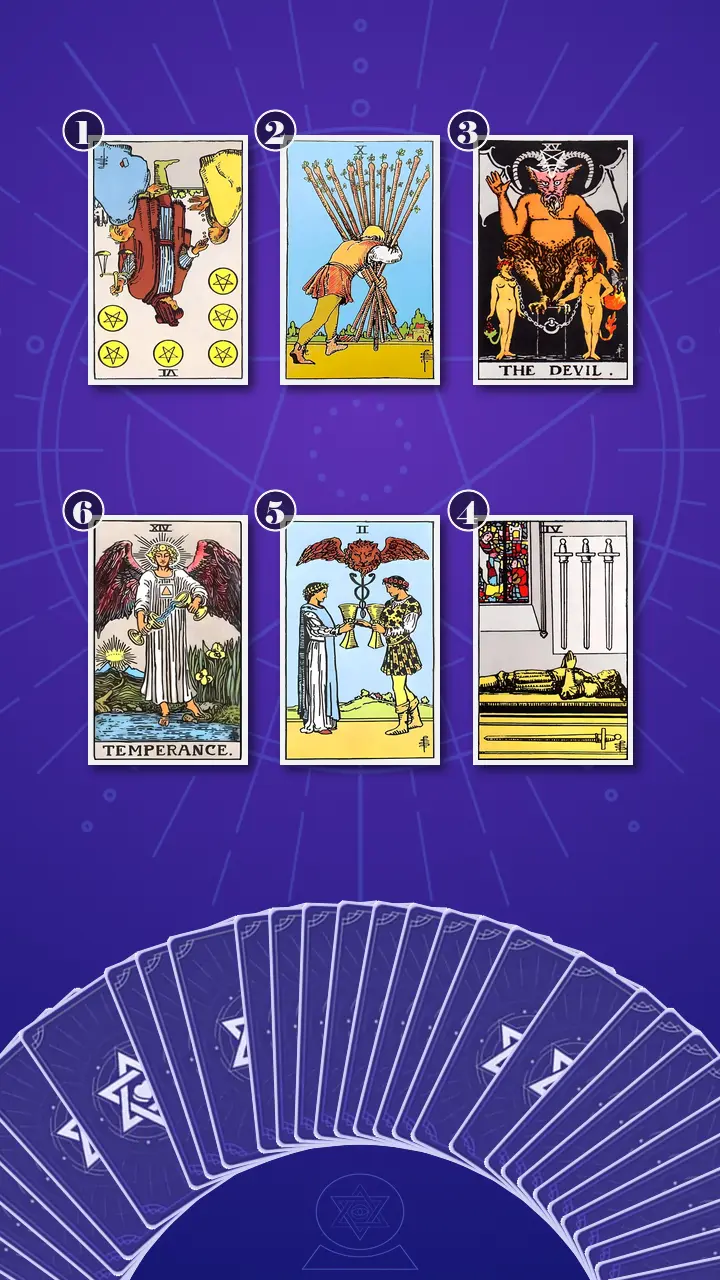
Reading the Rescue Loop in Real Time
Position 1: The Hand That Reached Before Asking
Now I turned over the card representing the observable rescue behavior that appears whenever either person becomes depleted, including the way help replaces recovery. In traditional terms, this was the present condition or visible symptom.
It was the Six of Pentacles, in reversed position.
Its modern scene was almost exact. At 9:14 p.m. in the Toronto apartment, Jordan read a friend's distress text, cancelled their own evening, sent three solutions, and replied, "No worries," when the friend thanked them. The next morning, Jordan felt indispensable and depleted at once, because the help had been offered before consent and now carried an invisible debt.
The reversed energy showed a blockage in reciprocity. The standing figure's weighted scales and open hand distributing coins made care look like something measured from above, while the two kneeling figures received from a lower position. Jordan was not simply giving too much; they were moving into the giver's role before either person had named what was wanted. The rescue briefly lowered guilt, but it also turned rest into something that seemed to require repayment.
"Before you send the plan, ask what support is actually requested," I said. "Do they want listening, practical help, or quiet? Then let the answer determine the smallest support you can give without cancelling your own recovery. Ask what is wanted before spending what is left."
Jordan gave a short laugh with a bitter edge. Their thumb stopped moving across the phone. "That's painfully accurate," they said. "I call it loyalty, but I decide what would help before they even finish telling me what happened."
I let the laugh remain in the room instead of trying to make it more comfortable. "The card is not calling you uncaring," I said. "It is showing a reflex. A reflex can be observed, interrupted, and replaced. You do not need to swing from rescuing to refusing every request; the useful middle begins with consent." Jordan looked down at the reversed card and rubbed the edge of it once, as if testing whether the image could hold a less punishing meaning.
Position 2: The Load That Hid the Face
Now I turned over the card representing how the Martyr Complex turns rest into guilt and keeps Recovery Avoidance active after the rescue begins. Its standard meaning was the obstacle or force currently obstructing movement.
The card was the Ten of Wands, in upright position.
By 11:38 p.m. on a Thursday, Jordan was carrying a nonprofit deadline, their friend's emotional processing, two practical follow-ups, and tomorrow's commute in the same mental load. Their shoulders felt heavy, their jaw was clenched, and the next notification seemed easier to identify than the need to stop. They kept adding tasks because endurance felt safer than admitting there was no recovery left.
The energy here was excess: relentless action had become the only visible proof that Jordan was still helping. The bent figure's face disappeared behind the bundle, just as Jordan could see the next message, errand, or deadline while losing sight of their own needs. I compared it to The Bear: everyone is trying to keep the room functioning through frantic competence, but urgency gradually becomes the only language of closeness. A project-management board had been built for both people's tasks, while the tab labelled "What do I need?" kept getting pushed out of view.
I asked Jordan to hear the inner monologue beneath the productivity: "If I carry this, at least they will not feel alone; if I put it down, what does that say about me?" The first sentence sounded like chosen support. The second sounded like an unspoken belonging contract. The distinction mattered because resentment was not proof that Jordan was a bad friend; it was information about a load being carried without a clear agreement.
Jordan's breath caught. Their fingers tightened around the mug on the table, then slowly released it. Their eyes moved from the bundle on the card to the work calendar open on their laptop, and for several seconds they looked as if they were replaying every late-night favour they had called manageable.
Position 3: The Terms of Service Nobody Wrote
Now I turned over the card representing the fear and relational bargain beneath the Mutual Survival Pact, especially the belief that usefulness secures belonging. This position holds the underlying cause, attachment, or unconscious pattern.
The card was The Devil, in upright position.
Its modern-life scene appeared on a rare Friday evening. Jordan had showered, ordered inexpensive takeout, and opened a streaming app. When the friend's chat stayed quiet for an hour, Jordan checked the last-seen status, reopened an old conversation, and drafted a new crisis plan no one had requested. The quiet did not feel peaceful; it felt like a test Jordan might fail by enjoying it.
I read the upright energy as an attachment block, not a prediction and never a sentence about either person. The loose chains around the two figures' necks suggested a habit that felt compulsory while still depending on repeated choices. The shared pedestal made the bargain visible: "You stay useful, therefore you stay safe." In modern terms, it was an auto-renewing subscription to emergency availability, paid for with sleep, plans, and unspoken resentment.
"If you did not answer immediately during a difficult night, what would you fear your friend might conclude about your place in the relationship?" I asked. Jordan stared at the raised torch on the card. Then they said, very quietly, "If I take a night off, they will hear it as me leaving. Being needed is the closest thing I have to proof that this bond is real."
I watched three small things happen. Jordan's breathing froze for a beat; their eyes lost focus as if the sentence had opened a replay of every delayed reply they had tried to explain; then their mouth tightened before a long breath moved through their chest. "I know I am exhausted," they added, "but I don't know who I am when I am not useful."
"That is the bargain we are examining," I said. "Not the value of the friendship, and not whether either of you deserves care. The question is whether usefulness has been asked to carry the entire meaning of belonging. A chain can be real without being permanent, and noticing the choice inside the habit is already a form of freedom."
When the Four of Swords Made Pausing Visible
Position 4: The Rest Stop at the Center of the Grid
Now I turned over the card representing what changes when taking time to recover is treated as a form of care rather than abandonment, directly answering why the rescue cycle continues. In the grid, this was the turning point or transformative insight. The room seemed to quiet around it.
The card was the Four of Swords, in upright position, the catalyst card and the spread's strategic Antidote. Its invoked energy was permission to pause, restorative solitude, non-reactive clarity, self-trust, and confidence that connection can include boundaries.
Its modern-life scene was Wednesday at 7:30 p.m. Jordan and their friend put both phones on Focus mode, agreed that ordinary messages could wait until morning, and took separate quiet time in the same small apartment. The silence felt uncomfortable for several minutes, but it was a planned pause, not a disappearance. At 10:00 p.m., the dim light, the clear response window, and the absence of performance gave both bodies room to register exhaustion.
The resting stone figure was not collapsed in defeat. The three swords mounted above and the single sword placed beside the body made the pause structured and conscious, with awareness still present. Constant availability proves urgency; protected availability proves capacity. The card did not ask Jordan to stop caring. It asked them to make recovery visible enough that neither person had to interpret it as goodbye.
This was where I used my signature Reciprocity ROI Analysis. I explained that I do not use it to reduce a friendship to a spreadsheet or keep score of who deserves more. I use it to examine whether a pattern returns care and capacity to both people, or whether it turns one depleted person into the other's permanent help desk. In this case, the emotional exchange was not failing because tenderness was absent; it was draining both people because rescue was happening before consent and before capacity was checked.
I also brought in Sunk-Cost Decoupling in Loyalty, a lens shaped by my years on Wall Street. I learned to separate what a position is doing now from what has already been invested in it. A bond is not a trade, but the principle helped here: years of care, shared rent, late-night voice notes, and past rescues could be honoured without treating them as a receipt for unlimited access tonight.
I could see the old loop gathering: the 8:47 p.m. TTC text, the warm phone, the cancelled plan, and the chest tightening before Jordan had checked what they needed. The rescue would lower guilt briefly, then steal the recovery both people needed. Jordan was still caught in the thought that one correct response could make the relationship permanently safe.
You do not have to remain permanently available to prove loyalty; let the Four of Swords make pausing a visible, shared act of care.
A protected pause is not proof that the bond is failing. It is the moment care stops being measured by emergency access and starts making room for two whole, recovering people.
Jordan went still. Their breath paused with one hand hovering above the Four of Swords, fingers suspended as if a notification might interrupt the sentence. Then their gaze lost focus; I could see last week's cancelled dinner, the unread work message, and the late-night voice note moving across their face. Their jaw tightened once, then released. A small, startled "Ah" came from the centre of their chest, followed by a shaky exhale. Their shoulders lowered, and the fist resting against their knee opened finger by finger. For a moment, the relief looked almost like vertigo: without the next emergency to organise, there was blank space, and blank space carried its own responsibility. Their eyes shone, but I was not asking for a perfect boundary. I let the silence hold. "Now, use this new perspective to remember last week: was there a moment when this insight could have made things feel different?" I asked.
Jordan nodded, though the nod was not triumphant. It was tentative, like someone testing a floor after a long time assuming it would give way. This was the first movement from guilt-driven hypervigilance toward trust-based reciprocity with protected recovery time: not a solved relationship, but a new meaning for the pause.
The Equal Cups in the Chat Window
Position 5: The Question Before the Fix
Now I turned over the card representing the small mutual behavior that lets each person name their capacity without becoming responsible for the other's entire emotional state. Its standard meaning was the practical action that gives the insight form.
The card was the Two of Cups, in upright position.
Its modern-life scene placed Jordan at Saturday brunch, asking, "Do you want listening, practical help, or quiet?" before suggesting a solution. Jordan then named what they could genuinely offer: fifteen minutes of listening, not an all-night plan. The friend could choose, Jordan could decline further labour, and care could remain present without either person producing a sacrifice receipt.
The balanced energy of the Two of Cups was mutual recognition. The two figures faced each other with their cups held at equal height, unlike the downward flow of the reversed Six of Pentacles. This was support built between equals: consent before advice, capacity before commitment, and an honest answer instead of mind-reading. The winged lion above them added warmth and courage, not a demand for permanent closeness.
"Ask what is wanted before spending what is left," I said. "You can ask one question, wait for the answer, and offer one specific thing. You can also say, \"I can listen for fifteen minutes, but I cannot plan this tonight.\" That is not a withdrawal. It is care with a shape."
Jordan's shoulders lifted as if bracing for an argument that did not arrive, then lowered. They wrote the three options in the notes app, not as a new emergency protocol but as a way to stop turning every vague distress signal into unlimited labour. I saw a small amount of relief cross their face when they realised the other person could participate in deciding what support meant.
Position 6: A Rhythm That Does Not Need a Crisis
Now I turned over the card representing what reciprocal support can look like when neither person has to earn belonging by staying on call. This was the integrated lesson or emerging way of relating, an invitation for reflection and practice rather than a forecast.
The card was Temperance, in upright position.
Its modern-life scene was Sunday afternoon. Jordan and their friend added one weekly check-in, one protected solo evening each, and a shared expectation that ordinary replies could take until morning. They would adjust the rhythm when work became intense instead of treating the plan as a permanent contract. Closeness and autonomy could coexist without waiting for another crisis to prove the bond was real.
Temperance brought balance through repeated adjustment. The angel blending two cups, one foot on land and one in water, made care look like pacing rather than sacrifice. I described it as a weekly bandwidth budget that included care, solo time, sleep, and permission to leave some requests for tomorrow. The path toward the distant light was not a promise that no difficult night would return; it was a reminder that a sustainable relationship is built through ordinary choices between difficult nights.
"What rhythm of check-ins, separate recovery time, and slower ordinary replies would let both of you stay connected without either person staying on call?" I asked. Jordan looked at the two cups they had drawn in the margin of their notebook, then at the window where Toronto's afternoon light was thinning. Their answer was simple: "A plan we can revise without treating revision as failure."
I placed the cards in a visual sequence for Jordan: first, one hand distributing coins downward; later, two people lifting equal cups toward each other. The deeper movement was not from caring to uncaring. It was from unasked-for sacrifice to reciprocal care with clearly named capacity.
A Care Rhythm With Room to Breathe
When I connected the grid, the story was clear. The reversed Six of Pentacles showed care becoming an uneven rescue exchange. The Ten of Wands showed the cost: work deadlines, errands, emotional processing, and sleep all bundled together until the load blocked Jordan's view of their own needs. The Devil named the hidden bargain beneath it: usefulness had become the price of belonging. The Four of Swords introduced the missing practice, and the Two of Cups and Temperance showed how a pause could become mutual, consent-based support and a sustainable care rhythm.
The blind spot was not that Jordan cared too much. It was that rescuing soothed guilt faster than it helped either person recover. Because the rescue briefly restored closeness, exhaustion was misread as evidence that constant vigilance was necessary. The transformation direction was a shift from proving loyalty through immediate rescue to treating planned recovery, clear limits, and honest capacity as shared care.
I was careful with the next tool. I call it the Friendship Downgrade Strategy, a calculated approach I usually reserve for a friendship that genuinely needs to move from toxic, high-intensity contact to a low-maintenance acquaintance. I would never quietly demote Jordan's friend or use a tarot reading to manufacture distance. Here, I borrowed the strategy's ethical discipline for a narrower purpose: downgrade the emergency channel, transparently and gradually, without downgrading affection. The goal was to reduce automatic access, preserve choice, and let ordinary connection replace crisis as the main proof of closeness.
The Recovery-Without-Abandonment Pact
I gave Jordan three small next steps. They were deliberately ordinary. Finding clarity did not require solving the whole friendship; it required testing a different response the next time the old loop appeared.
- Protect one recovery blockOn one day this week after work, add a twenty-minute appointment to Google Calendar, turn on Focus mode, place the phone across the room, and send the friend: \"I am offline for the next twenty minutes and will check messages afterward.\" Use the block for a shower, a walk, food, or quiet with no emotional labour.Start with five minutes if twenty feels too large. Make the response window specific rather than apologising for it. If a message suggests immediate danger, use appropriate local emergency or crisis support instead of trying to carry the situation alone.
- Ask before advisingAt the next non-urgent check-in, ask, \"Do you want listening, practical help, or quiet?\" Wait for the answer, then offer only one specific form of support. Name your real capacity in one sentence: \"I can listen for fifteen minutes, but I do not have the bandwidth to plan this tonight.\" Invite the other person to name one request.Use the smallest version: one question, one pause, one offer. The point is consent-based support, not a more polished rescue plan.
- Downgrade the emergency channelSet one recurring thirty-minute check-in for a day when neither person is already exhausted. Each person chooses one separate recovery activity, and both agree that ordinary messages may receive a reply by the next morning. Define urgent contact plainly, then review the arrangement after one week.Keep the rhythm revisable. A slower reply can be a boundary, not a disappearance, and changing the plan is information about capacity rather than proof that the bond has failed.

The First Quiet Night Wasn't a Verdict
Three days later, Jordan messaged me after work: \"I put the twenty minutes in my calendar. They asked for listening, so I listened for fifteen, then I slept. It felt weird, but nobody disappeared.\" The message was short, practical, and almost shy. I could hear the first evidence of trust in its plainness.
That night, Jordan slept a full night. In the morning, the first thought was, \"What if I get this wrong?\" They smiled anyway, sent the promised check-in after breakfast, and kept the phone on Focus mode for ten more minutes.
I do not measure a Journey to Clarity by whether fear vanishes. I measure it by whether a person can notice the fear, name their capacity, and choose without handing the decision to it. Jordan was still learning. The bond was still real, and it no longer needed a sacrifice receipt every night.
When someone you love texts in distress, your chest can tighten and your hand can reach for the phone before you have registered your own exhaustion. That reflex is not a moral failure; it is the old fear that resting might prove you belong only when you are useful.
If a quiet evening could be a Four of Swords pause - Focus mode on, the phone across the room, connection held by choice rather than emergency access - what might you notice in the first ten minutes of it?