Cold Tea and Red Forecasts: A Third Column Added One Route to the Map
When Two Bad Options Became the Only Options at 11:45 p.m.
When Morgan (name changed for privacy) joined my video call, I could see the blue rectangle of their laptop reflected in the window of a shared Toronto apartment. Morgan was 29, worked at a midsized digital marketing agency, and had spent another night trying to decide whether to stay miserable or quit without a plan. A cold mug of tea sat beside a spreadsheet renamed “Stay or Quit v6.” The radiator ticked behind them while red cells crowded both columns.
One tab held a draft message asking a former colleague for a 20-minute informational chat. Morgan moved the cursor toward it, then closed it.
“That conversation wouldn’t solve the real problem,” they said. “I can stay miserable or blow up my whole life. Every small step just feels like pretending those aren’t the actual choices.”
I watched their jaw tighten as a Teams notification appeared above a rent charge on their phone. Powerlessness seemed to sit in their body like a website modal with only two buttons, neither of which they could safely press. This was false-binary decision paralysis in its most convincing form: Morgan wanted a workable path beyond the binary, but their search method rejected anything that did not arrive as a complete, guaranteed route.
“Two frightening forecasts are not the same as two available options,” I said. “I’m not going to tell you that rent, debt, or burnout are imaginary. I’m also not going to predict which career path will succeed. Let’s use the cards to examine how this decision is being constructed, then see whether we can draw a map through the fog without forcing a life-changing choice tonight.”
Choosing the Decision Cross as a Map
I invited Morgan to put both feet on the floor, take one unforced breath, and hold one question in mind: “Why do I keep assuming two bad paths are my only options?” I shuffled slowly. I treat this pause as a way to move attention out of the browser-tab spiral and into one defined inquiry, not as a mystical test Morgan could pass or fail.
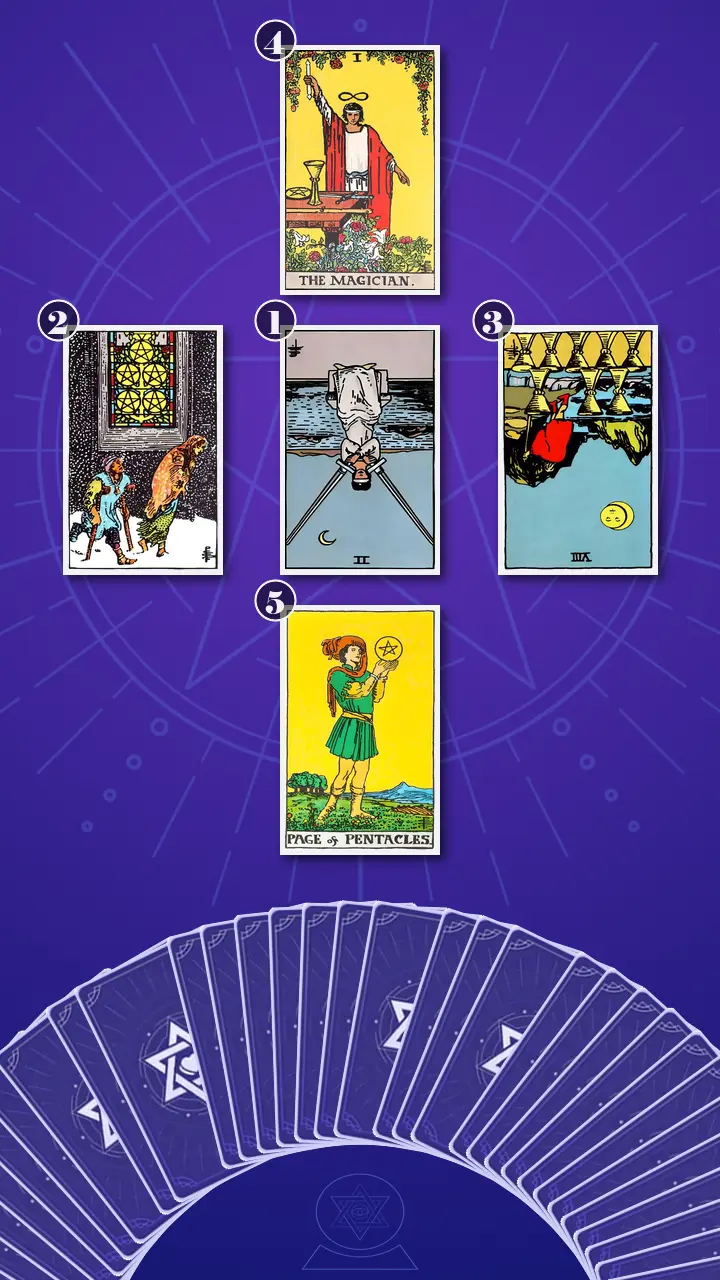
I chose a five-card Decision Cross tarot spread. I use this spread when a choice has hardened into two opposing branches because its structure can display the trap without pretending that either branch is destiny. A larger spread would have added more information to a mind already carrying too much. The Decision Cross was compact enough to examine the present frame, the fear attached to each path, the leverage being overlooked, and one practical next step.
I placed the first card at the center. The second and third went to the left and right, forming the two feared futures. The fourth sat above them, representing an overlooked resource or alternative perspective. The fifth rested below the center, where insight would have to become a grounded experiment.
This is how tarot works in my practice: card meanings in context become visual prompts for better questions. The horizontal line would show Morgan’s closed comparison. The vertical line would show whether agency could enter that frame and produce new evidence. The cards could reveal a pattern, but Morgan would remain the person deciding what to test, protect, revise, or decline.
Inside the Horizontal Trap
Position One: Two of Swords Reversed and the Closed Circuit
“Now I’m turning over the card that represents the present symptom,” I said. “This position shows how you narrow uncertainty to exactly two bad outcomes, cross them against each other, and postpone testing anything outside them.”
The card was the Two of Swords, reversed.
I pointed to the blindfold and the two swords crossed tightly over the figure’s chest. Upright, this card can show a tense attempt to suspend judgment. Reversed, I read its Air energy as blocked and overloaded. Thought is still active, but it has stopped gathering information. It circulates between two conclusions until repetition makes them feel verified.
“At 11:45 p.m., this is your Stay-or-Quit spreadsheet,” I said. “Both columns contain red worst-case forecasts. Your tea goes cold. A third tab offers a low-commitment conversation, but you close it because it cannot guarantee the answer. Then the unchanged situation becomes proof that no workable move exists.”
I placed my hands across my chest in the posture of the card. “If I stay, then I remain miserable. If I leave, then I lose my stability. Therefore, I cannot move. The swords look like two spreadsheet columns being held over the body as a barrier.”
Morgan gave a brief laugh, but there was no humor in it. Their fingers stopped against the mug. “That’s so accurate it’s almost cruel.”
“Cruel would be telling you that this means you’re incapable of making decisions,” I replied. “I see a method that once helped you create a sense of control. The method is now returning less and less value. Your analysis is not empty; it is just trapped in a closed circuit.”
Years earlier, on a Wall Street trading floor, I had watched intelligent people stare at increasingly elaborate models while avoiding the one call that could challenge their assumptions. More analysis looked responsible, but volume was not the same as signal. That memory returned as I looked at Morgan’s advice tabs.
“I use a diagnostic lens called Pseudo-Growth Eradication,” I told them. “The name is blunt because the audit needs to be honest. We strip away the self-help packaging and ask about actual return on investment. How many podcasts, Reddit threads, career-pivot videos, and versions of this spreadsheet have you consumed? How many have produced a question asked, a boundary tested, or a fact verified?”
Morgan looked away from the screen as if mentally counting. Their breath held for a second; their eyes lost focus; then their shoulders dropped by a fraction. “A lot of input,” they said. “Basically no execution.”
“That’s not a character verdict,” I said. “It’s useful data. Certainty-seeking has been replacing information-gathering. The reversal tells me the binary is becoming unstable enough for us to question it.”
Position Two: Five of Pentacles and the Bill That Has Not Arrived
“The next card represents the scarcity and exclusion fears projected onto the first imagined path,” I said. “It shows why quitting, retraining, or even exploring change gets coded as unacceptable before you gather evidence.”
I turned over the Five of Pentacles, upright.
The two figures moved through snow beneath an illuminated window. I acknowledged the hardship in the image before pointing to the support they were passing. This card did not predict deprivation. In Morgan’s reading, it showed Earth energy narrowed around anticipated loss: practical caution had become so dominant that an unverified expense was landing in the body like a charge already posted.
“You see rent, your PRESTO balance, and a student-loan payment in the same banking app,” I said. “Your stomach drops, and the first path becomes a guaranteed story of lost income, lost belonging, and depleted support. You haven’t priced the course, checked workplace flexibility, listed your transferable skills, or asked how someone else handled a transition. But you’re already budgeting for the absence of every possible support.”
Morgan pressed their palm against their abdomen and nodded once. “I tell myself I’m being realistic.”
“Some of your caution is realistic,” I said. “Toronto rent is not a mindset problem. The distinction is between a verified material constraint and a scarcity forecast. A banking app can project an overdraft from transactions that have not been scheduled. The projection deserves investigation, but it is not money already lost.”
I asked which part of the feared loss had actually been verified. Morgan opened their mouth, paused, and looked back at the card. “My fixed expenses are real,” they said. “The assumption that exploring anything will immediately threaten them isn’t verified.”
I saw a small drop pass through their expression before their fingers loosened around the mug. The card had not removed the financial constraint. It had separated the constraint from the catastrophic story attached to it.
Position Three: Eight of Cups Reversed at the Unsent Request
“Now I’m turning over the card that represents the attachment and transition fears projected onto the second path,” I said. “This position shows how familiar stagnation can begin to look safer than uncertain movement.”
The Eight of Cups appeared reversed.
I traced the deliberate gap among the cups and the cloaked figure whose departure had become suspended by the reversal. Water was blocked here. Morgan could feel what was missing from the current role, but emotion had not been translated into a boundary, request, or limited experiment.
“You know repetitive agency work is no longer giving you enough room to recover or develop,” I said. “Then you open a course page, a professional community, or a draft request to change one condition. Your cursor moves toward it and retreats. The internal line is: I know this isn’t working, but unless I can see the whole destination, moving at all feels reckless.”
I told Morgan that the card was not instructing them to leave. I was reading the reversal as a blockage around transition itself. Testing a boundary was not the same as resigning. Taking one sample lesson was not an enrollment contract. Asking what an adjacent role involved was not a promise to pursue it.
“It’s the Severance version of career thinking,” I said. “Either you split yourself completely from the work, or you make a total escape. Gradual role redesign and bounded experiments disappear because they do not feel dramatic enough to count.”
Morgan stared at the gap between the cups. Their thumb approached the edge of their phone and pulled back, repeating the motion they had made with the message tab. “I’ve drafted a request to protect one evening from late client edits three times,” they said. “I keep deleting it because one evening won’t fix the job.”
“It doesn’t have to fix the job to reveal whether one adjustable condition changes your energy,” I replied. “Familiarity and restoration are not always the same thing. A temporary boundary can gather evidence without turning departure into the supposedly correct answer.”
When the Magician Opened the Table
Position Four: The Resource Morgan Had Not Counted
The radiator clicked once and fell quiet. I reached for the card above the horizontal line, and the room seemed to make space around the movement.
“This position exposes overlooked leverage,” I said. “It asks how existing skills, questions, relationships, time, and constraints might be recombined into a reversible third move, rather than waiting for a perfect third answer to appear.”
I turned over The Magician, upright.
The contrast with the first card was immediate. The Two of Swords had used both arms to maintain closure. The Magician stood before an open table, one hand directing intention and the other grounding it. A cup, sword, wand, and pentacle were available together. I read that combination as balanced, practical agency: feeling, thought, initiative, and material reality exchanging information instead of competing for control.
“In your actual life, the table already holds digital-marketing skills, a former colleague, one free hour, a direct question, and a no-spend boundary,” I said. “None of those is a complete career path. Combined carefully, they can produce information your Stay and Quit columns cannot.”
I returned us to the 11:45 p.m. scene: cold tea, red forecasts, and a cursor above a message Morgan would not send. Both finished futures looked dangerous, while one small question seemed too insignificant to count because it could not settle the whole decision.
This was where I applied my Potential Actionability Assessment. I translate an inspiring idea into a strategic milestone and test it against three conditions: Can it create observable information? Can it be completed with disciplined limits? Can Morgan reverse it without violating their financial, professional, or personal constraints?
“Think about the A/B tests you run at work,” I said. “You don’t rebuild the entire campaign and then guess which change mattered. You adjust one variable, define the learning goal, and inspect the result. Your life is more complex than a campaign, but the strategic principle is useful. Maybe the third path is not something you failed to find. Maybe it is something you can assemble.”
You are not trapped between two finished futures; build a testable third move with the tools already waiting on the Magician's table.
I left the sentence alone for a moment.
Morgan’s breath stopped first. Their fingers hovered above the trackpad, still enough that I could hear the radiator settle behind them. Then their eyes moved away from the card and lost focus, as if they were replaying every small option they had dismissed over the previous month. Their brow tightened. “But doesn’t that mean I’ve been doing this wrong the whole time?” they asked, sharper than before. “That I wasted months?” The anger arrived before the relief, and I respected it. I told them that their old system had been trying to protect stability, not sabotage it; we were updating a strategy whose cost had begun to exceed its protection. Their jaw unclenched. One shoulder lowered, then the other. A long breath left their chest with a slight tremor. Their eyes shone, but their expression also held the blankness that can follow clarity: if a variable could be tested, responsibility was returning with agency. “Okay,” they said quietly. “That feels better. Also more real.”
“Now, using this new perspective, think back to last week,” I said. “Was there a moment when this insight might have made you feel different?”
Morgan mentioned the former colleague whose promotion post had appeared during a crowded Line 2 commute. They had assumed that contacting them would be pointless unless the conversation produced a job lead. With the Magician in view, Morgan could give the conversation a smaller purpose: learn what the adjacent role actually involved and what skill mattered most during entry.
I marked the shift carefully. It was not sudden certainty, and it did not erase the dread of making life worse. It was one movement from contracted powerlessness and catastrophic certainty toward cautious curiosity, evidence-based agency, and grounded self-trust. A third path may be built before it can be found.
Position Five: The Page of Pentacles and One Learnable Thing
“The final card translates renewed agency into one small practical experiment,” I said. “This position asks what you can test, observe, and integrate without committing to either original path.”
I turned over the Page of Pentacles, upright.
The Page studied one pentacle while a wide landscape and distant mountains remained unresolved. I read the card as constructive Earth in balance. The Page did not need to survey every future at once. The work was to examine one tangible opportunity with enough care to learn from it.
“In your week, this could be one free sample lesson, one 20-minute informational conversation, or one workplace boundary,” I said. “You define the question first, set a time limit, and record what actually happens before reopening the entire career debate. This does not have to be the answer; it only has to teach you something.”
Morgan chose the informational conversation. The test would not be “Can this person rescue my career?” It would be “Does the day-to-day work in an adjacent role contain more of the strategy and analysis I want, and what would I need to sample next?” Sending the message would remain Morgan’s decision.
I watched them write the question in a new note. Their shoulders eased, though their voice still carried caution. “I can do 20 minutes,” they said. “I don’t have to turn it into a referendum on my whole life.”
“Exactly,” I said. “The test does not need to save your life; it needs to teach you one true thing. A reversible move is still a real move.”
Building the Third Column
I drew the full spread together for Morgan. The Two of Swords reversed showed a mind using two catastrophic forecasts to maintain a closed decision frame. The Five of Pentacles revealed how real financial caution had absorbed unverified stories of inevitable deprivation. The Eight of Cups reversed showed how dissatisfaction and fear of transition kept Morgan approaching and retreating from the same small openings. The Magician restored the overlooked resource: Morgan’s capacity to ask, combine, limit, and test. The Page of Pentacles gave that capacity one measurable job.
I compared the pattern to a route-planning app with an old filter switched on. It kept displaying two delayed highways while hiding the local roads, walking links, and mixed-transit routes. Morgan’s blind spot was not a lack of intelligence or effort. It was the belief that only complete solutions deserved to appear on the map. Forecasts had been formatted like facts, and partial experiments had been deleted before they could return data.
“The transformation is not from caution to recklessness,” I said. “It is from choosing between two imagined total outcomes to designing one small, reversible experiment that can produce evidence about a third possibility. You’re not waiting for a perfect signpost now. You’re becoming the mapmaker.”
I gave Morgan two next steps. I kept them small because actionable advice should reduce friction, not create another ideal routine to fail.
- Run the 15-Minute Third-Column TestOn Monday evening, Morgan would add a third column to “Stay or Quit v6” called “Reversible Experiment.” They would divide a note into Facts, Forecasts, and Questions, place no more than three statements in each section, and turn one shared forecast into an action that costs little or nothing, takes 30 minutes or less, and commits them to neither staying nor quitting.If the exercise begins turning into another exhaustive system, stop after labeling one sentence as fact or forecast. The smallest valid version is one distinction and one unanswered question.
- Use the 30-Day Evolution KPIFor the next 30 days, Morgan would measure evidence cycles rather than career certainty. The target was two bounded experiments: a 20-minute informational conversation, free sample lesson, or seven-day workplace-boundary pilot. After each one, they would write five lines: what I expected, what I did, what happened, what remains unknown, and what I can adjust.The framework is strict about recording evidence and gentle about conclusions. Set a time cap, no-spend rule, privacy boundary, and exit point first. A five-minute sample counts when 30 minutes would overload the body.
I called the second practice the Evolution KPI Framework because a philosophical realization becomes useful only when it reaches observable behavior. The KPI was not confidence, productivity, or a dramatic resignation. It was whether Morgan completed a limited test and recorded reality before consuming more advice. That kept the discipline focused on agency while leaving every major life decision in Morgan’s hands.

A Route That Did Not Exist the Week Before
Six days later, I received a message from Morgan. They had added the third column, moved “Any exploration will threaten my income” from Facts to Forecasts, and sent the three-sentence note to their former colleague. The reply did not contain a referral or a life-changing offer. It contained a time: Thursday at 6:00 p.m.
After the conversation, Morgan learned that one part of the adjacent role could be sampled through a free analytics exercise. They scheduled 30 minutes for it and closed the job-listing tabs. That night, they slept through until morning. Their first thought was still, “What if I’m wrong?” This time, they noticed it, smiled slightly, and made coffee before answering.
I did not see that as tarot choosing a career for Morgan. The cards had made a hidden decision structure visible; Morgan had questioned it, respected their constraints, and performed the experiment. The proof was quiet but concrete: one sent message, one verified fact, and one route added to a map that had previously shown only danger.
That was Morgan’s Journey to Clarity. Clarity did not arrive as a guarantee that nothing would be lost. It arrived as the grounded recognition that uncertainty could be investigated without surrendering control of the whole future.
When both imagined futures make your jaw tighten and your breath go shallow, holding still can feel like the only way to protect your life, even while another part of you is desperate for movement. Simply noticing that your two columns contain forecasts as well as facts means the old filter is already visible.
If you did not have to choose a whole future today, which single tool would you place on your own Magician’s table, and what small piece of reality could you use it to test?