A Deleted Coworker Invite, Three Boundaries, and a Steadier Monday

The Coffee Invitation Caught Between Chemistry and Monday Morning
I met Alex, a 29-year-old non-binary product designer from London. The pattern they brought me was instantly recognisable: they could lead a product critique in a tech office, yet one low-key coffee invitation to a coworker on an adjacent team had become a full case of coworker crush anxiety.
At 6:10 p.m. the previous Tuesday, the Central line had pulled away from Liverpool Street while Alex edited the invitation for the third time. The phone was warm against their palm, the brakes squealed through the carriage, and damp coats brushed their sleeve as they changed “drink” to “coffee,” reopened Slack, and inspected one friendly reply for evidence hidden in its punctuation.
“A no could make Monday awkward,” Alex told me. “A yes could make every Monday complicated. Doing nothing keeps the possibility alive, but I know it is not making anything clearer. I want clarity without having to expose what I want.”
I heard the real conflict beneath the message draft: Alex wanted to explore the attraction, but they also wanted to protect the stable job that paid London rent and placed this person in recurring project meetings. The tension moved through them like one foot holding open a Tube door, unable to board fully or let the train leave. Their jaw stayed tight, their chest braced before shared meetings, and the hope in their stomach kept arriving at the same time as the warning.
“Of course the stakes feel real,” I said. “We are not going to shame your caution or turn the attraction into a prediction. We are going to tidy up what is actually here. Let us make a map of the fog, then see which part of the next move belongs to you.”

Choosing the Compass: A Five-Card Decision Cross
I invited Alex to take one slow breath and hold the question in plain language: “Why am I torn between dating my coworker and keeping work simple?” I shuffled while the smell of fresh coffee settled between us. I use that pause as a change of mental gear, not as theatre; it helps separate the question itself from the hundred imagined endings attached to it.
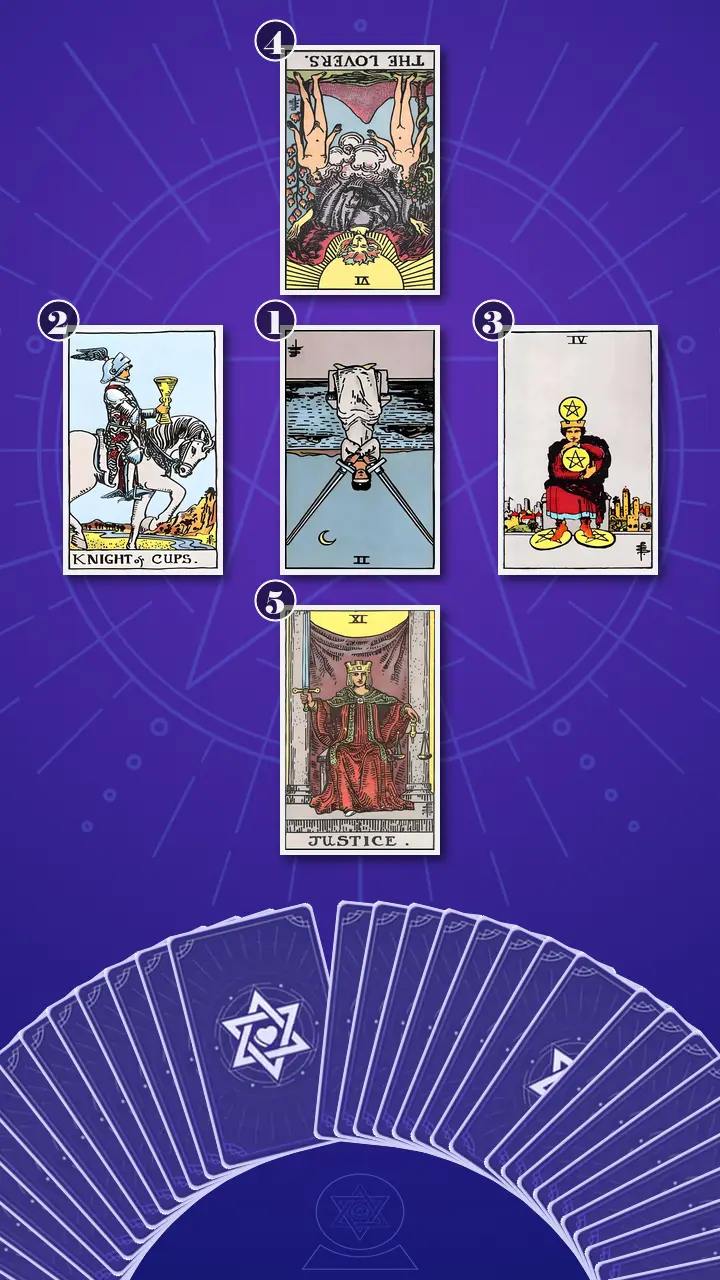
I chose a five-card Decision Cross because this was primarily a two-path decision with a deeper values conflict underneath it. A larger spread such as the Celtic Cross would have introduced background material that Alex did not need. This smaller structure could show the present knot, the emotional meaning of dating, the protection offered by keeping work simple, the hidden influence affecting both paths, and one grounded principle for deciding.
For anyone wondering how tarot works in a situation like this, I do not use the cards to announce whether a coworker secretly has feelings or whether a relationship is destined. I use card meanings in context as an objective recognition tool. The images help me place observable behaviour, emotional investment, practical constraints, and personal values where Alex can examine them without pretending any one of those things is the whole truth.
I placed the first card at the centre for the draft-delete-reread loop. The second went to the left for what dating represented emotionally; the third went to the right for what professional simplicity protected. Above them, the fourth would expose the hidden values split. Below them, the fifth would establish the evidence and boundaries Alex could use for one proportionate next step. The shape resembled a compass: competing paths across the horizontal line, hidden conflict above, grounded clarity below.
Where the Crossed Swords Kept the Train Waiting
Position 1: The Present Knot That Looked Like Research
I turned over the card representing the present knot: Alex drafting, deleting, decoding messages, and trying to preserve neutrality between attraction and professional simplicity. It was the Two of Swords, reversed.
I pointed to the loosened blindfold, the two swords crossed defensively over the figure's chest, and the unsettled water behind them. “This is the invitation and the professional defence being held active at the same time,” I said. “Reversed, the arrangement is no longer containing the tension. It is consuming you.”
On the Tube, Alex had edited a coffee invitation three times, deleted it, and reread old Slack messages for proof of mutual interest. By morning, they had sent only a clipped project update. The analysis briefly lowered the risk of exposure, but it created no new information. It also made ordinary collaboration feel less natural.
I described the card's energy as a blockage tipping into excess. Thought was meant to compare relevant facts, but here it had turned inward and multiplied hypothetical outcomes. As a product designer, Alex had effectively left two versions of the same Figma screen in permanent review because choosing either one would expose it to real user feedback. The files remained busy; the decision remained untouched.
“Ambiguity grows when analysis substitutes for new evidence,” I said. “If another hour of message review cannot create a new fact, it may organise your uncertainty, but it cannot resolve it.”
Alex did not nod. They gave one short, bitter laugh and looked down at the card. “That is exactly right. Honestly, it is a bit brutal.”
I kept my voice gentle. “Then let us be precise about what is brutal. It is not that you are careful. Your care makes sense. It is that the method you are using asks you to work every evening without giving you a decision, a boundary, or rest.”
Their thumb stopped rubbing the rim of the coffee cup. Their eyes remained on the crossed swords, but the defensive humour had softened into recognition. I asked what fact they hoped one more Slack reread would reveal. After a moment, they answered, “That I could act without either outcome changing work.”
Position 2: The Knight Who Offered One Ordinary Coffee
I turned over the card representing Path A, dating the coworker: what attracted Alex toward exploration and what this possibility represented inside a repetitive season. It was the Knight of Cups, upright.
The knight held out a cup while the white horse moved at a measured walk. I emphasised the pace. This was not a dramatic confession galloping into the office; it was the possibility of one honest, low-pressure invitation.
I brought Alex back to the pub near Old Street after the project deadline. The coworker had stayed beside them after others went to the bar and asked about their weekend. Music had vibrated through the floor, condensation had cooled Alex's fingers, and the conversation had made the week feel brighter. Alex had imagined one coffee outside work, then allowed that coffee to expand into weekends, intimacy, and an entirely less repetitive life.
The upright Knight carried balanced emotional movement, but its idealistic edge still needed context. I did not read it as a promise of romance. I read it as Alex's genuine capacity to acknowledge interest and approach another person honestly. The potential distortion was asking limited workplace chemistry to rescue an emotionally flat routine.
“Attraction is information, not an instruction,” I said. “It tells you that something in you is awake. It does not prove mutuality, compatibility outside work, or an obligation to ask.”
I asked, “When they laugh with you and the week feels less flat, do you want this specific person, or do you want movement?”
Alex exhaled through their nose. Their shoulders dropped by perhaps an inch, then lifted again as they considered it. “Both,” they said. “I do like them. But I have also made them the only colourful thing on a very grey calendar.”
I accepted both parts. Genuine curiosity did not become false merely because the routine had amplified it. It simply meant the attraction needed to be sized according to the evidence, not according to everything Alex wanted their life to become.
Position 3: The Stability Held Too Close to the Chest
I turned over the card representing Path B, keeping work simple: what professional stability protected and where a reasonable boundary might harden into rigid control. It was the Four of Pentacles, upright.
The figure clutched one pentacle against the chest while two more pinned both feet to the ground. A structured city stood at a distance. I could see why the image landed immediately. Alex's income, reputation, shared projects, commute, and rent were not imaginary stakes. The card honoured the material intelligence in wanting to protect them.
Alex described a Wednesday morning after a rent notification had arrived. In a glass meeting room, the projector fan whirred and burnt coffee sat beside their laptop. When the coworker asked an ordinary personal question before the project sync, Alex answered with sudden formality, avoided eye contact, and kept every later exchange task-focused. Their attempt to prevent awkwardness had made the atmosphere visibly stiffer before anyone had crossed a line.
I read the Four first as balanced preservation, then as an excess of holding. A professional boundary protects consent, concentration, policy, and fair collaboration. A control strategy tries to remove all visible warmth so that no vulnerable feeling can exist. The first creates structure. The second restricts normal movement.
“A boundary is not the same thing as a bunker,” I said. “You do not have to perform the compartmentalisation fantasy from Severance to be professional. Personal feeling can exist without being acted on, announced, or allowed to run the project.”
Alex slowly flattened both palms on the table. “I keep telling myself I am protecting work,” they said, “but sometimes I am just trying to make sure nobody can tell I care.”
I asked which concrete protection mattered most. Alex named the absence of a power imbalance, compliance with policy, the coworker's freedom to decline, and the ability to collaborate normally after any answer. Those were usable constraints. They were already more helpful than the vague command to keep everything perfectly uncomplicated.
Position 4: When the Standard Changed with the Weather
I turned over the card representing the hidden influence: the deeper values split through which attraction had become associated with aliveness, while work simplicity had become associated with safety and control. It was The Lovers, reversed.
I focused on the two vulnerable figures standing apart and the mountain between them. Reversed, the card did not tell me that a relationship would fail. It showed me that desire, professional identity, and personal integrity had not yet been brought under one shared standard.
I placed two moments side by side. After the easy Friday conversation, Alex had thought, “Maybe this is the thing that wakes me up.” After a tense Monday meeting, they had thought, “Maybe wanting this means I am risking everything stable.” No new evidence about mutuality or policy had appeared between those scenes. The decision metric had simply changed with the emotional weather.
I read the reversal as a blockage in values integration. Emotional aliveness was temporarily overruling caution, then control was overruling desire. Because each part took turns acting as judge, neither path could ever receive a consistent hearing.
“A coworker crush cannot fairly carry the job of making your whole life feel alive,” I said. “And professionalism cannot fairly require you to erase every private feeling. We need to ask what intimacy, integrity, and workplace responsibility each require, then test both options against the same answers.”
Alex's fingers curled briefly against the table. Their gaze moved past me, as if they were replaying the pub and the Monday meeting on adjacent screens. Then their hand opened. “I keep calling it a practical decision,” they said quietly, “but I am not being neutral. I change the rules depending on whether I feel hopeful or scared.”
I nodded. The brief tightening in their face was not a failure of the reading. It was the discomfort of seeing that the choice had been carrying more meaning than the relationship evidence could support.
When Justice Raised One Sword Beside the Scales
Position 5: The Boundary That Could Survive Yes, No, or Maybe
The room became unusually quiet as I reached the grounding position. A spoon touched a cup somewhere beyond the door, then even that small sound disappeared. I turned over the card representing the integrating principle: the evidence, boundaries, and standards Alex could use to choose a proportionate next step without demanding a guaranteed outcome. It was Justice, upright.
I showed Alex the level scales and the single sword held upright. The visual resolution was exact. The Two of Swords had shown two blades crossed defensively beneath a blindfold; Justice showed one coherent criterion beside open-eyed judgment. The answer was not another mental weapon. It was one visible standard.
In modern terms, Justice asked Alex to check workplace policy and reporting lines, distinguish observable reciprocity from hopeful interpretation, and write three boundaries they would maintain after a yes, a no, or an ambiguous answer. The card's energy was balance: emotion could be heard without deciding the case alone, while professional caution could set real limits without becoming total containment.
This was where I used my Analysis Paralysis Deconstruction. I stripped away the abstract futures Alex had been trying to pre-live and kept only present realities: policy, power dynamics, actual behaviour, recurring collaboration, and the conduct Alex controlled. Then I used Complexity Reduction to form one clean choice: do the current facts and boundaries permit one respectful invitation with an easy decline, or is work-only the fair boundary for now? Both answers remained legitimate.
I brought Alex back to 6:10 p.m.: the unsent coffee invitation open, one warm Slack reply enlarged into evidence, and Monday's meeting already playing in their head. They were still asking a few friendly words to guarantee that neither rejection nor reciprocation could disturb work.
Stop treating perfect certainty as the price of action; choose the boundary you can uphold, and let Justice's balanced scales replace inner conflict with accountable clarity.
I allowed the sentence to remain between us for a few seconds. Then I translated it into the simplest language I could give them.
You do not need a risk-free answer. You need a boundary you can still respect after a yes, a no, or an awkward maybe.
Alex's breath stopped. Their forefinger hovered above the edge of the Justice card, while the other hand tightened around the cold cup. At first their expression went blank; then their eyes lost focus, as though the Tube draft, Friday pub, and Monday meeting were replaying in quick succession. Their jaw shifted, and a flash of anger entered their voice. “But does that mean I have spent weeks doing this wrong? That I could have just decided?”
I kept my tone level. “No. It means you were trying to protect something real with a method that could never deliver the guarantee you wanted. Seeing that is not proof that you failed. It is the moment you can choose a different method.”
The anger held for one breath, then their fist slowly opened. Colour rose around their eyes. They let out a quiet, unsteady “Oh,” followed by a longer exhale that lowered both shoulders. Relief arrived, but so did a brief, exposed stillness: without endless analysis to hide inside, Alex could feel that the next proportionate decision would genuinely be theirs.
I asked, “Now, with this new perspective, think back to last week. Was there a moment when this insight could have made you feel different?”
“Friday,” Alex said. “I could have enjoyed the conversation without turning it into proof of a future. And on Monday, I could have stayed warm and professional without acting as if the only safe boundary was becoming a different person.”
The scent of coffee pulled me through a brief inner flashback across twenty years of readings. Again and again, people had arrived asking me to predict a result when what restored their footing was a standard they could carry out of the room. Justice did not make Alex safe from disappointment. It showed them where their authority actually lived.
“The question is no longer, ‘How do I guarantee this goes well?’” I said. “It is, ‘What conduct could I respect if the answer is yes, no, or uncertain?’ Clarity is the standard you can uphold after yes, no, or maybe.”
I watched the crossed-swords problem settle into one upright line. This was the first real movement from contracted ambivalence and risk-free-answer seeking toward grounded clarity based on evidence, mutuality, and consistent workplace boundaries. It was not certainty about romance. It was the beginning of trust in Alex's own conduct.
The Coffee Bean Filter and the Next Twenty-Four Hours
I read the five cards back to Alex as one coherent story. Repetitive weeks had given the attraction extra emotional weight. The Two of Swords reversed showed the visible result: Alex kept one foot in the possibility and one in professional retreat, producing activity without movement. The Knight of Cups named real curiosity and the wish to feel alive. The Four of Pentacles protected salary, reputation, and collaboration, but held them so tightly that ordinary warmth became difficult. The Lovers reversed revealed why the rules kept changing. Justice offered the unused resource: a fair process that could hold desire and practical consequences at the same time.
The cognitive blind spot was the belief that the correct choice had to remove every risk. No choice could pass that test, so another message, another friend's opinion, or another “dating a coworker Reddit” thread always seemed necessary. The key shift was smaller and more demanding: define three workplace boundaries, separate evidence from assumption, and decide whether one low-pressure conversation fits the realities already present.
I placed two unused paper coffee filters beside the cards and wrote Absolute Must-Haves on one and Emotional Noise on the other. This is my Coffee Bean Filter Protocol, a twenty-four-hour sorting exercise for decisions that have become crowded. I explained that attraction itself was not noise. Neither were income, consent, or professional integrity. The noise was anything being asked to impersonate evidence: punctuation analysis, imagined five-year outcomes, contradictory group-chat predictions, and the demand to know the other person's answer before asking a respectful question.
- Run the twenty-four-hour Coffee Bean Filter.On one lunch break this week, spend no more than fifteen minutes checking the company's relationship, conflict-of-interest, and reporting-line policy. Then write each remaining decision variable on a separate scrap of paper and place it under Absolute Must-Haves or Emotional Noise. Finish with exactly three boundaries, such as no invitation where there is a power imbalance, no repeat invitation after a decline, and no personal discussion in project channels.Keep the exercise to one day and three boundaries. Policy, consent, power, and the other person's freedom to decline outrank romantic curiosity. Choosing work-only remains a complete result.
- Do the ten-minute Known Facts and Assumptions Reset.Open one blank note and write three headings: What I know, What I am assuming, and What I would need to keep work respectful. Add no more than three bullets beneath each, then close the note for forty-eight hours. After the pause, choose between one direct invitation with an easy exit or a seven-day work-only, no-decoding period.A minimum version is one bullet. If the check passes and one invitation feels appropriate, keep it plain: “Would you be up for a coffee outside work sometime? Completely fine if you would rather keep things work-only.” A no, hesitation, or non-answer ends the romantic approach.
I asked Alex to write one brief workplace response for yes, one for no, and one for uncertainty before sending anything. I was not asking them to rehearse every future. I was asking them to prove that their boundary could survive more than the answer they hoped to receive.
“This is actionable advice, not a command to date them,” I said. “The five-card Decision Cross has done its job if you can now see what is fact, what is projection, and what behaviour remains yours to choose. Tarot can organise the decision. It cannot, and should not, take ownership of it from you.”

A Week Later, Monday Was Still Monday
A week later, I received a message from Alex: “Policy is fine, there is no reporting line, and I wrote the three boundaries. I sent the one-sentence coffee invitation at 8:07, made tea, and did not reopen Slack. No answer yet. Weirdly, I can breathe.”
The next line was quieter: “I still woke up thinking, ‘What if I have made this awkward?’ But I noticed the thought, checked the boundary I had written, and got ready for work.” Nothing had been magically resolved. Monday remained Monday, the project meeting remained on the calendar, and Alex still felt vulnerable. The difference was that uncertainty no longer required an entire evening of unpaid analysis.
I did not credit Justice with sending the invitation, and I would not have credited the cards if Alex had chosen work-only. Alex checked the constraints, named what they wanted, protected the other person's freedom, and selected conduct they could respect. The cards provided the clean surface on which that judgment became visible; the agency was Alex's.
That was the quiet proof of our Journey to Clarity: not a guaranteed romantic outcome, but movement from outcome control to evidence-based self-trust. Alex had stopped asking one coffee to redesign their whole life and stopped asking perfect professionalism to make them feel nothing. They had made one proportionate choice while keeping hold of themselves.
If a warm Slack message makes your stomach lift and the next meeting invite locks your jaw, I want you to know that wanting connection while protecting the job that pays your rent does not make you indecisive or unprofessional. Simply noticing where the invitation ends and the imagined future begins already gives you one upright line inside the crossed-swords noise.
If certainty were not required, which small boundary would you place on Justice's scale so that the next moment has more room to show you what is actually there?