A Low Offer Met a Deleted Draft, Then a Boundary Changed the Work

The 6:40 p.m. Lowball-Offer Freeze
If you can defend every design decision in a critique but lose your words when a client asks for your rate, I have probably seen some version of your competence-to-compensation gap before.
Maya, a 25-year-old junior product designer in Toronto, brought me the exact moment hers took over. At 6:40 on a wet Tuesday evening, she had been standing in her small apartment with a warm phone in one hand while the kettle clicked off behind her. Streetcar tyres hissed over the pavement below. On the screen was a contract offer beneath the lowest figure in the market-range note she had saved after hours of Glassdoor pages, Reddit threads, and searches for “junior product designer salary Toronto.”
She opened that note. She drafted a two-sentence counteroffer. Then her jaw locked, her breathing moved high into her chest, and her stomach seemed to drop away from the rest of her body. She deleted the draft and typed, “That works for me.”
“I know I can do the job,” she told me, turning the phone face down between us. “But I freeze when I have to price that knowledge. A low offer still feels safer than no offer.”
I watched her thumb press hard into the edge of her phone case. The self-doubt did not look like uncertainty about Figma, research synthesis, or product thinking. It looked like an invisible hand reaching through the screen and turning down the volume on every skill she could normally name. Later, she explained, she would turn that discomfort into extra revisions and late-night polish. She would call the additional labour proof that the client had been right to choose her.
Her question was direct: “Why do I accept low offers when I know I can do the work?”
I told her I did not see a character flaw in the relief she felt after securing definite income. Toronto rent and irregular contracts are material realities, not failures of confidence. I also told her that relief and fair exchange were not the same thing. “The offer is a number, not a verdict,” I said. “Let’s use the cards to map what happens between seeing that number and surrendering your ability to answer it.”

Choosing the Drafting Compass
I invited Maya to place both feet on the floor, take one unforced breath, and hold the question without trying to solve it. I shuffled slowly, using the motion as a transition from automatic reaction to deliberate attention. Nothing about this needed to be mystical. The pause was the first piece of data.
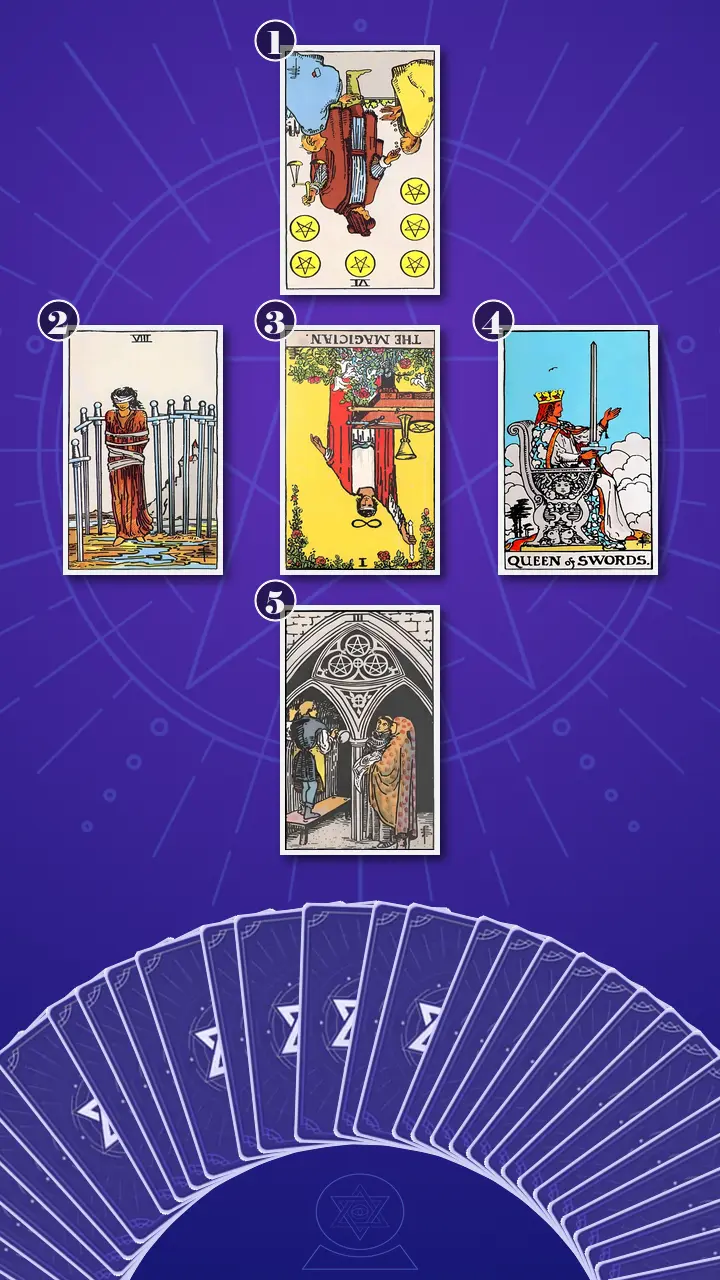
I chose The Shadow Spread, a five-card cross tarot spread designed for inner excavation. I use it when someone consciously knows one thing, such as “I can perform this work,” but repeatedly behaves as though the opposite were true. It is especially useful for examining self-undervaluing because it keeps five layers separate instead of compressing them into a single accusation about confidence.
For anyone wondering how tarot works in a career negotiation reading, I treat the spread as a structured set of reflective positions. The cards do not predict whether a recruiter will accept a counteroffer. They help me distinguish observable behaviour, the thought that triggers it, the belief underneath it, the resource that can interrupt it, and the practice that can make the change repeatable. Card meanings in context become prompts for evidence and choice, not declarations of fate.
I placed the third card at the centre as the hidden manifestation gap. The first sat above it, showing how the shadow appeared in Maya’s behaviour. The second went to the left as the trigger that narrowed her options. The fourth opened the right side of the cross as the recoverable resource, and the fifth formed the foundation below as the integration practice. The arrangement looked less like a warning and more like a drafting compass: pressure above, restriction to the left, a hinge in the centre, movement to the right, and a practical base underneath.
“We’ll begin with what is already visible,” I said. “Then we’ll trace it back to the mechanism beneath it. The final two cards will show us what you can recover and how you can use it. You remain the person making every decision.”
When Someone Else Holds the Scales
Position One: The Exchange That Keeps Expanding
The first card I turned over represented the observable shadow behaviour: accepting a low offer quickly and compensating through extra labour after the agreement. It was the Six of Pentacles, reversed.
I pointed to the scales held by the standing figure and the coins distributed to the two kneeling recipients. Reversed, the card showed balance becoming distorted. The exchange was not merely generous or ungenerous; decision-making power, labour, and compensation were no longer being measured by the same standard. Maya had unconsciously treated the person controlling the budget as though they also controlled the truth about her value.
“This is your 6:40 p.m. email,” I said. “You see an offer below the lowest figure in your saved range and answer, ‘That works for me,’ before asking how the number reflects the workload. A week later, the client asks for extra flows, another revision round, or evening availability. The fee remains fixed while your labour expands.”
The reversed energy appeared here as both blockage and excess: the fair scope-to-rate conversation was blocked, while Maya’s giving became excessive. Her private logic was painfully efficient: they have the budget, so they must know the real value; I can make the imbalance temporary by being excellent. But extra work did not correct the original exchange. It enlarged it.
“Overdelivery is not a retroactive counteroffer,” I said. “It cannot travel backwards and renegotiate the fee. It only teaches the present arrangement that more labour may be available at no additional cost.”
Maya gave one short laugh, but no amusement reached her eyes. Her fingers froze against the phone case; her gaze drifted toward a memory I could not see; then she exhaled through her nose and said, “That is so accurate it’s kind of brutal.”
I did not rush to soften the recognition. “Accurate does not mean shameful,” I said. “Securing income can be a sensible choice. The question is whether you are choosing the trade-off consciously or agreeing before you have enough information to know what the trade-off is.”
I asked her to think about the last low offer she had accepted. “What did you agree to before asking about deliverables, revision rounds, availability, or how the figure was calculated?”
“Honestly? All of it,” she said. “Then the first ‘tiny tweak’ became another user flow and a Monday handoff.”
The scales had made the external pattern visible without turning financial urgency into a moral failure. That distinction mattered. Maya did not need to be blamed for reaching for security. She needed a way to keep security from silently becoming unlimited access to her time.
Position Two: The Route the Mind Hides
The second card I turned over represented the trigger that activated the pattern: interpreting a compensation conversation as proof that there were too few safe options to risk a counteroffer. It was the Eight of Swords, upright.
The blindfolded figure stood inside an incomplete enclosure of swords. The bindings were loose, and open ground remained visible, but her attention had narrowed around the threat. Upright, the card carried an excess of restrictive Air: imagined consequences occupied so much mental space that the available movement could no longer be felt.
I connected it to one of Maya’s recruiter calls. Her researched range had been open in another browser tab. The recruiter named a lower figure and paused. Maya’s breathing became shallow, and her mind produced only two outcomes: accept immediately or lose the role entirely. Nothing had yet confirmed that a respectful counteroffer would end the conversation, but the feared refusal had already acquired the weight of a fact.
“It’s like Google Maps showing one stressful route full-screen until you forget the alternate-routes button still exists,” I said. “The pause, the clarifying question, and the single counteroffer are still on the map. The Eight of Swords explains why you temporarily stop seeing them.”
Her shoulders drew forward. “The silence is the worst part,” she said. “I hear one second of silence and start filling it for them. I say I’m flexible before they’ve even explained the range.”
“You negotiate with yourself before the other person has to,” I said.
Her lips parted, but she did not answer immediately. First her breath caught. Then her eyes moved towards the turned-over Six of Pentacles as if she were replaying several calls at once. Finally, she nodded once and pressed both palms flat against her thighs.
I asked which feared outcome arrived first during those calls. Maya did not say, “They might refuse my number.” She said, “They might realise I’m not as good as I think I am.” That was the deeper charge. A budget conversation had become an identity test. The card did not claim every option was safe or that every employer would negotiate. It showed that Maya was treating an untested possibility as a completed rejection.
The Four Open Tabs That Could Not Speak
Position Three: The Reversed Magician at the Centre
The third card I turned over represented the hidden belief sustaining the pattern: private knowledge of competence had not been organised into evidence, pricing language, and deliberate action. At the centre of the cross sat The Magician, reversed.
All four suit tools were already on the Magician’s table. Reversal did not remove them. It disrupted the channel between possession and use, between “I know this” and “Here is the relevant evidence, clearly stated.” I read the energy as blockage rather than deficiency. Maya did not lack every necessary tool. The tools were scattered, difficult to retrieve under pressure, and disconnected from one another.
Her professional life reproduced the image almost perfectly. Positive feedback existed in Slack. Completed work existed in Figma. Market research existed in Notes. A reasonable counteroffer existed in Google Docs. When compensation came up, those resources remained separate tabs rather than becoming one claim she could communicate. She responded with flexibility, then started another course or revised another portfolio interaction, treating additional preparation as a substitute for organising what was already present.
“Your Figma work, market research, client feedback, and unsent draft are the Magician’s four tools,” I told her. “The problem is not that the table is empty. The problem is that, under pressure, nothing on the table has a label.”
It had a familiar Severance quality. The version of Maya inside the work could explain why a flow failed, defend a design decision, and produce a strong revision. The version answering a compensation question felt cut off from that knowledge, as though her competence belonged to another floor of the building and could not pass through the elevator.
I watched her eyes settle on the four objects in the card. Her thumb moved as though she were scrolling through invisible tabs. “I have all of that,” she said quietly. “I just can’t summarise it when someone is waiting.”
“And because you cannot summarise it in that moment, you assume it does not count yet,” I replied. “Missing translation is not the same as missing ability.”
After a decade of working with cycles and planetary symbolism, I often think about visibility differently from absence. An eclipse can conceal a planet without removing it from the sky. Looking at the reversed Magician, I had the same professional association: Maya’s skill had not vanished. It had passed behind an unpractised communication structure at the exact moment she needed it to be visible.
That did not mean private confidence alone should determine her rate. The card challenged both extremes. She did not need to declare herself unquestionably brilliant, but she also did not need to wait for an authority to hand her a certificate of worth. Like the journey in The Wizard of Oz, the useful shift was not magical external confirmation. It was making an existing capacity legible through action, evidence, and judgment.
“Private capability becomes leverage only when the relevant part is made visible,” I said. “Not your whole personality. Not every project. Just the evidence that matches this scope.”
Maya looked down at the table and swallowed. The recognition carried some sadness. She had spent months trying to become more qualified for a conversation that might actually require ten minutes of organisation and one practised sentence.
When the Queen’s Sword Separated Data from Fear
Position Four: The Boundary That Leaves a Hand Open
The fourth card I turned over represented the recoverable resource: evidence-based discernment and direct boundaries that could turn capability into a clear compensation conversation. It was the Queen of Swords, upright, the key card of the reading.
The room seemed to become quieter around it. A cloud moved past the window, and a narrow strip of late light crossed the Queen’s vertical blade. Far below, a streetcar bell sounded once through the wet traffic. The environment appeared to underline the card’s central distinction: clarity did not need to arrive as aggression.
I showed Maya the upright sword in the Queen’s right hand and the open left hand extended towards whoever approached. The sword separated what was factual from what was feared. The open hand allowed genuine dialogue. Upright, this was balanced Air: precise without being cruel, independent without becoming closed, and direct without pretending that the other party had no constraints.
In Maya’s life, the Queen looked like a 24-hour pause. The proposed scope sat on one side of the screen, and three relevant project outcomes sat on the other. Maya then sent one concise response: the responsibilities aligned with a higher range, her evidence supported that range, and she was open to discussing compensation or adjusting the scope. She did not apologise, inflate her claims, or send a second message lowering the number while she waited.
This was where I used my Career Cycle Phase Identification, a diagnostic lens I apply when someone cannot tell whether a bottleneck is personal or systemic. I asked Maya to separate four variables: the proposed scope, her relevant evidence, current market conditions, and her personal worth. Then I tested the first three without allowing the fourth to contaminate the analysis.
A lower budget might reflect an industry-wide contraction, a company’s funding stage, an internal salary band, a client’s purchasing limit, or a genuine gap between the role and Maya’s current evidence. Those possibilities called for different responses. None could be diagnosed from one number alone, and none logically measured her worth as a person. A repeated pattern of reduced junior-design budgets across several organisations would be a macro signal. Specific, consistent feedback about a missing skill would be an individual development signal. A client requesting senior scope at a junior rate would be an exchange problem. The Queen’s sword kept those categories from collapsing into one wound.
“This number may tell you something about their budget,” I said. “It does not get to collapse every other fact into a judgment of you. A career cycle can be in low tide without your ability disappearing beneath the water.”
I asked Maya to replay the setup that had become automatic: at 6:40 p.m., the offer landed on her phone. Her market-rate note was already open, but her jaw tightened. She deleted the counteroffer, typed “That works for me,” and promised herself that the next project would make asking easier.
“You do not need to prove your whole career before asking for fairer terms,” I told her. “You need relevant evidence, a clear boundary, and enough space for the other person to answer.”
Accepting less does not prove your competence; name your evidence, state your boundary, and let the Queen of Swords' upright blade separate fair terms from fear.
For a beat, Maya stopped breathing. Her fingers remained suspended above the edge of the card, and her pupils widened as though the room had moved a fraction farther away. Then her gaze lost focus. I could see several memories passing behind it: the deleted draft, the recruiter’s silence, the Slack message that began with “tiny tweak,” the blue light from portfolio revisions after midnight. Her jaw shifted, and a flash of anger crossed her face. “But doesn’t that mean I’ve been wrong this whole time?” she asked, her voice suddenly sharper. “Like I did all that extra work for nothing?” I kept my tone steady. “It means the strategy protected access to work, but it charged you more than you realised. Recognising the cost is not the same as condemning the person who needed security.” Her eyes reddened. Her fists loosened one finger at a time, her shoulders dropped, and a long breath left her with a faint tremor. The release did not look triumphant. It looked slightly dizzy, as though clarity had returned responsibility to her hands before she felt fully ready to hold it.
“Now, with this new perspective, think back: was there a moment last week when this insight might have made you feel different?” I asked.
Maya thought about the Friday Slack request for “one quick tweak” that had added another flow and a Monday handoff. “I might have seen it as a scope change instead of a test of whether I was easy to work with,” she said. “I could have asked what was moving out of the original scope.”
That was the breakthrough I wanted to protect. It was not instant confidence. It was one small movement from contracted self-doubt and urgent self-protection towards evidence-based self-trust, steadiness, and grounded self-respect regardless of the response. Maya was beginning to distinguish evaluation from annihilation. A counteroffer could receive a yes, a no, or a revised scope. None of those outcomes erased the evidence she had named.
I modelled the Queen’s language for her: “Based on the scope and my experience delivering these outcomes, I’d be comfortable at this range. Is there room to discuss the compensation or adjust the scope?”
Maya repeated it once. Her first attempt rose at the end like an apology. On the second, she kept the range audible and left the final question genuinely open.
“I can keep my range visible and still remain open to conversation,” she said.
“Exactly,” I replied. “A boundary is not an ultimatum. The sword stays upright, and the hand stays open.”
The Plan Beneath the Stone Arch
Position Five: Craft That Can Be Inspected
The fifth card I turned over represented the integration practice: making competence visible through documented outcomes, shared standards, peer feedback, and prepared negotiation language. It was the Three of Pentacles, upright.
I pointed to the artisan standing on the raised bench, the architectural plan held by the other figures, and the pentacles integrated into the structure. Upright, the card offered balanced Earth. Skill became stable because it could be seen, discussed, and evaluated through shared criteria. The card did not ask Maya to feel worthy in isolation. It asked her to make a relevant piece of her work inspectable before terms were set.
In practical life, the stone plan became a one-page value brief. Before her next offer conversation, Maya would choose one completed project and write three lines: the problem she handled, her exact contribution, and one result another person could observe. She would review the page with two trusted designers and ask which sentence made her contribution clearest and which still sounded vague.
Instead of writing, “Helped improve the onboarding experience,” she might write, “Redesigned the mobile onboarding flow after identifying a repeated navigation failure in usability sessions, reducing the path from seven screens to four before developer handoff.” If confidential metrics were unavailable, she could name an observable process or product change without disclosing private client information.
“Your work does not have to speak for itself after you are hired,” I said. “You can make the relevant part visible before the fee and scope are fixed.”
Maya’s expression softened, although she still looked tired. She named a recent checkout-flow project and two former classmates whose critique she trusted. Then she hesitated. “What if they think my contribution isn’t strong enough?”
“Their feedback is calibration, not permission,” I replied. “You are not asking them to certify your worth. You are asking whether the sentence is specific enough for another professional to understand. You can revise the evidence without turning the revision into a verdict on yourself.”
She nodded slowly. First her hand moved towards her phone as if to open a new note. Then she stopped and looked back at the Three of Pentacles. Finally, she smiled with a trace of embarrassment. “I have a Notion dashboard with about twelve polished project trackers,” she said. “The page called ‘Rate and negotiation script’ is basically empty.”
“Then we know where ten useful minutes can go,” I said.
The final card grounded the reading in visible craft instead of heroic overdelivery. Maya did not need another whole career. She needed an architectural plan for the work she had already done: contribution, outcome, relevance, and a sentence connecting those facts to the proposed scope.
Drawing a New Orbit Between Skill and Terms
When I read the spread as a single story, the mechanism became clear. The Six of Pentacles showed the visible imbalance: Maya allowed the opening number to define the exchange and tried to correct it later with free labour. The Eight of Swords showed the trigger: possible rejection became so vivid that ordinary negotiation routes disappeared. The reversed Magician exposed the root: confidence, evidence, pricing language, and action existed, but they had not been connected into one usable value proposition. The Queen of Swords recovered her capacity to separate scope, proof, market conditions, and personal worth. The Three of Pentacles gave that clarity a durable form through documented work and professional calibration.
The core metaphor I offered Maya was a full toolbox with no labels or price tags. The tools were real. The hidden belief was that, because she could not identify the right one quickly under pressure, she must need more tools. That belief kept her polishing, studying, and overdelivering while postponing the smaller but more exposing task of naming what she had already built.
Her cognitive blind spot was not simply “I lack confidence.” It was the assumption that difficulty communicating competence proved an absence of competence, and that the first offer carried more objective authority than her evidence. Once that assumption was visible, the transformation direction became practical: pause, match proof to scope, and counter once.
I also introduced my Micro-Orbit Observation, a 30-day way of tracking small organisational shifts before they become a vague feeling of danger or opportunity. I call constructive signals “blueshifts”: transparent budgets, a sponsor naming Maya’s contribution, responsibility expanding alongside a rate discussion, or a client agreeing to adjust scope. I call risk signals “redshifts”: repeated “quick tweaks,” cancelled projects, compressed timelines, vague ownership, or senior expectations attached to junior compensation. One signal proves little. A month of repeated signals can help distinguish a temporary low tide, a company-level contraction, and an exchange that repeatedly asks Maya to absorb the cost.
I reduced the reading to three next steps. Each was small enough to begin without manufacturing perfect confidence.
- The 24-Hour Offer Buffer Save this line in your phone today: “Thanks for sending this through. I’d like to review the scope and compensation together; I’ll respond by tomorrow at 3 p.m.” Before the next recruiter or client call, place a note beside your screen that says, “Ask for the range and response deadline; do not answer the number live.” Use the sentence once, then set a calendar reminder. If the deadline is genuinely shorter, ask what flexibility exists. The pause creates decision space; it does not obligate you to counter, reject, or disclose personal financial details.
- The Ten-Minute Visible Craft Brief Choose one completed project in Notion or Google Docs. Set a ten-minute timer and write three lines: “The problem I handled,” “My specific contribution,” and “The result someone else could observe.” Add one sentence connecting those facts to the next role or contract. Send the one-page version to two trusted design peers and ask, “Which sentence makes my contribution clearest, and what still sounds vague?” Stop after one line if three feels overwhelming. Keep confidential details general. Peer feedback is calibration, not permission, and the page does not need a redesign.
- The Micro-Orbit Scope Check and One Counter For the next 30 days, give every offer or new client request one row in a private tracker. Record deliverables, revision rounds, availability, timeline, fee, and any blueshift or redshift you notice. Before replying, compare that scope with two relevant evidence points and use: “Based on the scope and my experience delivering [evidence], I’d be comfortable at [range]. Is there room to discuss the compensation or adjust the scope?” If the budget cannot move, identify one deliverable, revision round, or availability expectation that would need to change. After sending a counter, start a 30-minute no-edit window so you do not discount yourself in a second message.
I reminded Maya that none of these steps guaranteed a higher number. A counteroffer could reveal that the budget was fixed. A scope check could reveal that a contract did not fit her current financial needs. The purpose was not to force a dramatic refusal or turn every recruiter into an opponent. It was to let acceptance, negotiation, or refusal become a practical decision rather than a referendum on her competence.
The cards had not granted Maya value. They had made a self-reinforcing system visible. She was still the person who would decide whether to accept, counter, reduce the scope, or walk away. That ownership, not certainty, was the clarity available now.

Six Days Later: The Quiet Proof
Six days later, Maya sent one counter. The client could not raise the fee but removed an extra flow and one revision round. She slept through the night; her first morning thought was still, “What if I was wrong?” This time, she smiled and opened her value brief.
Her message to me was brief: “They said no to the number, but they didn’t reject me. We changed the work. I didn’t send a second message apologising.”
I read that sentence twice. The outcome was modest, and that was precisely why it mattered. Maya had not solved her entire career in a week. She had interrupted the orbit at the point where fear usually became automatic agreement. The offer remained information. Her evidence remained hers. Her boundary had changed the structure of the exchange even when the budget itself did not move.
For me, that was the real Journey to Clarity: not a prediction that every future offer would be fair, but a movement from contracted self-doubt towards evidence-based self-trust and grounded self-respect. Tarot had provided the map. Maya had created the proof by pausing, naming what was true, and allowing another person to respond.
If a low number appears and your jaw tightens, it may still feel safer to shrink the ask and prove yourself later than to risk hearing no. I hope Maya’s reading leaves one gentler fact beside that fear: noticing the lowball-offer freeze means you are already capable of creating a different pause.
If your next offer were information rather than a verdict, what would you place beside it before answering: one observable result, one clear scope boundary, or the Queen’s open-handed sentence that lets the other person respond?