One Warm Coworker Message, One Deleted Invite, One Measured Step

The Deleted Message on Line 1
Jordan was the dependable 29-year-old project coordinator on a close Toronto tech team. She could keep five moving deadlines from colliding, but one warm Slack message from a coworker had left her drafting a coffee invitation on the TTC and deleting it before the next stop.
At 6:18 p.m. on a northbound Line 1 train, she had typed, “Want to grab a drink sometime, just us?” The carriage smelled faintly of wet coats. The phone was warm against her palm, and the brakes shrieked as the train pulled into Bloor-Yonge. Her chest tightened. She deleted the invitation and opened the project channel instead.
“I replaced it with a question about Thursday’s deliverable,” she told me, turning her coffee cup slowly between both hands. “For ten minutes, I felt responsible. Then I spent the rest of the ride wondering what their last emoji meant.”
She wanted to find out whether this connection could become emotionally fulfilling, but the moment she pictured the next stand-up, team gossip, or a strained shared project, her stomach seemed to tighten around a fistful of tangled charging cables. So she chose task-only communication and carried the unsent question into every ordinary interaction.
“I want to know what this could be,” she said, “but I do not want to turn every workday into a test. If I cannot keep it simple, maybe I should not start it.”
I understood why she had been calling the deleted message good judgment. Silence had given her a brief sensation of control. It had not, however, made work feel simpler. The deleted message did not disappear; it came to tomorrow’s meeting as tension.
“I’m not going to tell you whether to date your coworker,” I said. “And the cards cannot predict their feelings or guarantee that nobody will ever feel awkward. What we can do is tidy up the reality: what you want, what work genuinely requires, and what your mind has added because it wants certainty. Let’s draw a map through this fog.”
The question I placed between us was simple: was the deleted message protecting professional stability, or making every normal interaction carry more meaning?

Choosing a Map for the Coworker Crossroads
I asked Jordan to place both feet on the floor, take one unforced breath, and hold the question without trying to answer it. I shuffled slowly. I use this pause as a change of mental gear, not as a performance of mystery; it helps separate the noise accumulated around a problem from the problem itself.
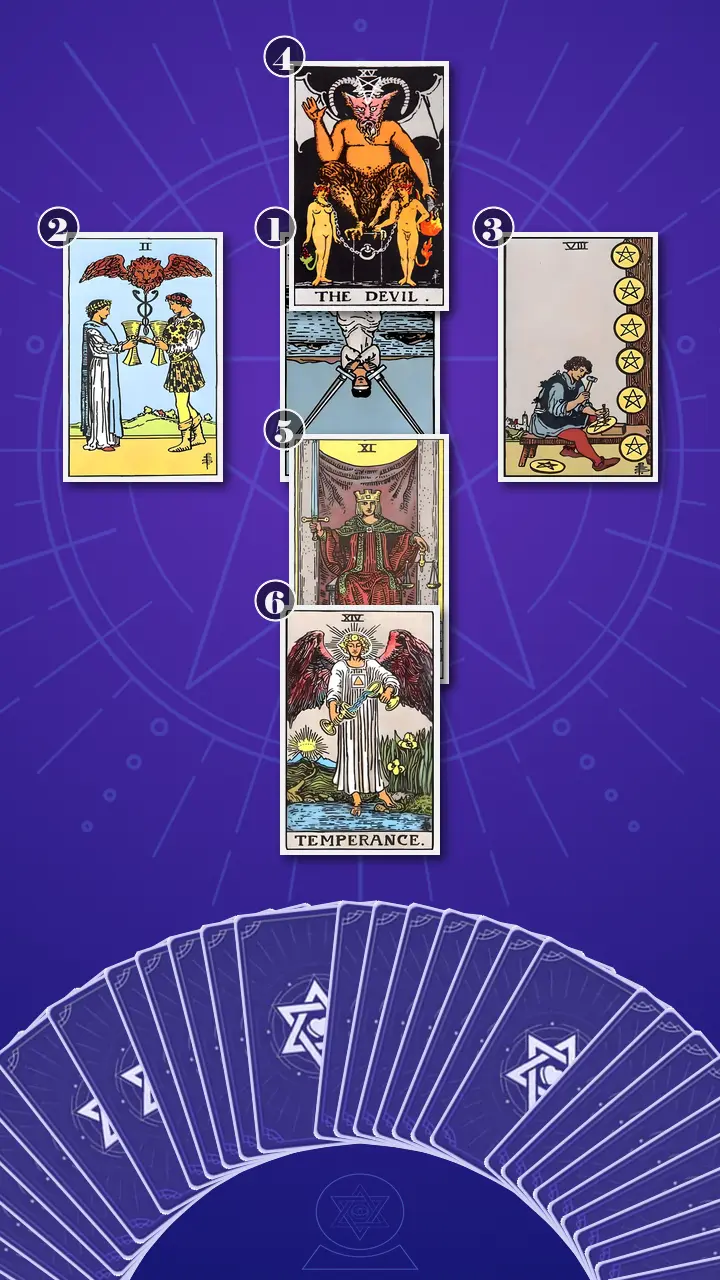
I chose the Decision Cross · Context Edition, a six-card tarot spread designed for a genuine trade-off. Jordan was not merely asking what an office crush meant. She was comparing two values: the possible fulfillment of direct connection and the predictability of keeping work uncomplicated.
This is how tarot works best in a decision like this: not as a machine that announces a romantic outcome, but as a structured way to examine card meanings in context. The spread could give both options a fair hearing, reveal the hidden fear making them look mutually destructive, and identify the conditions needed for a self-authored next step.
I placed the first card at the centre for Jordan’s observable stasis. The cards to its left and right would compare dating the coworker with keeping work simple. Above the centre, I would look for the hidden influence enlarging the conflict. Below it, one card would define the necessary boundary, and the final card would show how emotional honesty and professional responsibility might be integrated without forcing a verdict.
The arrangement looked like a signpost crossed by a narrow path. Two directions extended sideways, while the deeper route ran through fear, boundaries, and finally clarity.
Where the Stalemate Started Making Noise
Position 1: The Invitation and the Project Update
I turned the card representing Jordan’s present crossroads and observable stasis: the repeated drafting and deleting, the return to task-only messages, and the tension that remained unresolved. It was the Two of Swords, reversed.
I pointed to the blindfolded figure, the swords crossed over her chest, and the still water behind her. The scene looked calm, but it was a defended calm. Reversed, the card showed blocked Air energy turning inward. Thought and communication were not absent; they were circulating without release.
“At 6:18, you typed a clear invitation, deleted it, and sent a project question instead,” I said. “You got a short burst of control. Then you reopened the chat, rehearsed tomorrow’s meeting, and tried to read risk from punctuation. The pause stopped being neutral the moment it began generating more emotional noise than action would have.”
The Two of Swords did not accuse Jordan of cowardice. It showed the mechanics of workplace attraction analysis paralysis: if she sent the invitation, tomorrow might change; if she deleted it, she could pretend tomorrow remained under control. Yet no decision was already shaping the workday.
“What single fact or boundary would help you decide your next step?” I asked. “Not whether this becomes a relationship. Just what you would need before one respectful invitation could even be considered.”
Jordan gave a brief laugh, but there was bitterness under it. “That is too accurate. Almost cruelly accurate. I keep calling this professionalism, but I’m still checking the chat and planning how normal to act.”
I let the laugh settle. “Then we do not need to shame the pause. We need to find out whether it is serving the purpose you assigned to it. Caution is useful when it identifies a boundary. It becomes exhausting when it only repeats a threat.”
Position 2: The Cup That Does Not Promise an Answer
I turned the card representing dating the coworker as an emotional option: possible fulfillment, reciprocity, vulnerability, and direct communication, without any prediction of the coworker’s response. It was the Two of Cups, upright.
The two figures faced each other. Each held a cup. Their posture mattered because it contrasted so sharply with Jordan’s indirect signalling and private interpretation. The card’s Water energy was balanced: it offered openness and mutual recognition, but only where both people were allowed a clear position and a free response.
I gave the image contemporary language. “This is not the card saying they secretly like you. It is the possibility of you saying, once and without pressure, ‘I’ve enjoyed talking with you. Would you be up for coffee outside work sometime? No pressure if you’d rather keep it work-only.’ Its value is not a guaranteed yes. Its value is that you stop trying to infer an answer from warmth, response times, or where somebody sits at team drinks.”
I asked what part of her interest she would finally be acknowledging if the coworker remained completely free to decline.
Jordan looked down at the two figures. “That I actually want one honest exchange. Not a dramatic confession. Not an office situationship. Just one real answer that did not come from me analysing Slack.”
I nodded. The Two of Cups gave longing a legitimate place at the table, but it did not elevate romance above responsibility. Emotional fulfillment was a value Jordan could name. It was not a command she had to obey.
Position 3: Productivity as Emotional Airplane Mode
I turned the card representing keeping work simple as a practical option: predictability, professionalism, focus, and protection, while testing whether routine had become avoidance. It was the Eight of Pentacles, upright.
The craftsperson bent over the bench, surrounded by repeated evidence of careful work. I could immediately see why the image felt familiar to Jordan. Project plans, completed tickets, clean documentation, and a tidy task board gave her feedback she could trust. Competence was not a defence by definition. It was a real value and an important part of how she moved through the world.
But Jordan had described opening the project board after a warm personal exchange and volunteering to refine a document that was not due until Friday. The visible task gave her a success metric. It did not answer the personal question occupying her evening.
“This Earth energy is balanced when work is something you consciously protect,” I said. “It moves into excess when productivity becomes emotional airplane mode. You can silence the notification, but the underlying message remains unread.”
I placed the Two of Cups and Eight of Pentacles side by side. I asked Jordan to picture two scenes: a face-to-face moment at team drinks in which she wanted one honest exchange, and the next morning’s tidy task board in which she wanted Monday’s stand-up to remain completely ordinary.
“Neither desire is less mature,” I told her. “Connection protects your hope for a fuller personal life. Routine protects trust, focus, and ease at work. The problem begins only when you assume one value must destroy the other.”
Jordan’s fingers stopped circling the cup. She studied both cards, then said, “I’ve been trying to prove I have good judgment by acting as if I do not want anything.”
“And professionalism does not require emotional disappearance,” I replied. “It requires consistent conduct.”
The Chain Made of Future Meetings
Position 4: The Recurring Calendar Event Nobody Scheduled
I turned the card representing the hidden fear and reinforcing mechanism: Jordan’s belief that dating a coworker could create an inescapable professional entanglement and threaten her sense of control. It was The Devil, upright.
I watched Jordan’s shoulders rise before I spoke. I immediately clarified that this card was not a verdict about the coworker, and it did not label attraction as dangerous. I focused on the loose chains around the two figures. The card was showing perceived loss of agency, not the actual disappearance of choice.
Jordan’s mind had created a recurring calendar event called “What if this ruins everything?” One optional invitation expanded into every future meeting, every Slack reply, every shared deadline, and every team social. Like the divided identities in Severance, she wished her work self and dating self could remain in perfectly separate rooms. Because the same person existed in both, she treated silence as the only available lock.
The energy here was an excess of fear-based attachment. Her caution had attached itself to a totalising story: if this went awkward once, it would be awkward forever. That story made a loose situation feel inescapable before either person had chosen anything.
“A possibility is not an entanglement, and an invitation is not a contract,” I said. “There may be real constraints here. A reporting relationship, influence over pay or evaluation, a restrictive policy, or any concern about pressure would matter. But those are specific facts. They are not the same thing as mentally living through six months of awkward meetings before one coffee has even been suggested.”
This was where I used what I call Analysis Paralysis Deconstruction. I asked Jordan to strip the forecast back until only grounded reality remained. Had an invitation been sent? No. Had the coworker expressed discomfort? No. Did Jordan know the relevant policy? Not yet. Did either person influence the other’s schedule, evaluation, workload, pay, or advancement? She believed not, but had not checked carefully.
When the abstract what-ifs were removed, I could see the fear lose some of its theatrical scale. It did not vanish, and I did not need it to. It became a set of questions that could be investigated.
Jordan inhaled, held the breath, and looked past the cards as though replaying the patio conversation. Her thumb pressed hard against the cup handle. Then her grip loosened.
“I made one possible awkward answer into a permanent workplace trap,” she said quietly. “But I also do not want to use that insight to talk myself out of taking real risks seriously.”
“Good,” I said. “That distinction is the work. We do not minimise real workplace risk, and we do not let imagined permanence impersonate a policy.”
Position 5: When Justice Replaced Emojis with Evidence
I turned the card representing the boundary and communication condition: explicit professional limits, respectful wording, consent, discretion, and the information Jordan needed before choosing any next step. It was Justice, upright.
The level scales offered proportion. The upright sword offered a direct sentence. The symmetrical pillars held a structure in which desire and responsibility could both remain visible.
I translated the card into Jordan’s actual life. She could check the workplace relationship or conflict-of-interest policy, confirm whether either person held formal or informal power over the other, and write two professional non-negotiables. Only after that could she consider a one-time invitation with an easy path to decline.
Justice brought balanced Air where the reversed Two of Swords had shown blocked Air. The spread contained no Wands, so initiative was not arriving as a burst of impulsive courage. It had to be chosen deliberately after the context was understood.
Looking at the scales, I thought of the hundreds of complicated stories I have watched become more manageable over coffee. Most people do not need a grand theory. They need facts and fears to stop sharing the same cup.
“Good judgment does not require mind-reading,” I told Jordan. “It requires boundaries that survive either answer.”
I used my Complexity Reduction lens to identify the first clean choice. It was not “date or do not date.” It was this: can a genuinely free and professionally responsible choice exist in the actual context?
If policy, power, or reasonable concern about pressure made the answer no, Jordan would not extend the invitation. She could seek confidential policy guidance or decide that keeping it work-only was the boundary. If the answer was yes, she would still need clear wording, one invitation rather than repeated pursuit, and an ordinary professional baseline that did not depend on receiving the response she wanted.
I asked her to open a phone note with three headings: Facts, Fears, and Boundary. Under Facts, she wrote that they appeared to be peers and regularly had warm conversations, but she had not checked the policy. Under Fears, she wrote that every future meeting would become uncomfortable. Under Boundary, she wrote: “I will ask once, accept a no or an unclear answer, and keep my work communication friendly and task-appropriate.”
Jordan exhaled as she finished. Her face had not become carefree; it had become more precise.
“That feels almost boring,” she said.
“Useful clarity often is,” I replied. “It gives the nervous system less theatre and the adult self more information.”
When Temperance Poured a Third Option
Position 6: One Honest Sentence, One Clear Boundary
The room became unusually quiet as I reached the final card. Outside, rain threaded down the window in two narrow streams before meeting at the sill. The last drops of coffee passed through the filter behind me, measured and unhurried.
I turned the card representing self-authored clarity and integration: a proportionate, reversible action that could honour emotional fulfillment and professional simplicity without forecasting which path would win. It was Temperance, upright.
The angel poured carefully between two cups, with one foot on water and one on land. I read one cup as Jordan’s honest personal sentence and the other as her explicit workplace boundary. The pour between them was not a dramatic confession or an immediate relationship. It was one low-pressure, consent-aware conversation, considered only after the policy and power check.
Temperance was balanced energy in its clearest form. It did not ask Jordan to suppress attraction, nor did it suggest that courage meant ignoring professional reality. It offered a third position between total distance and total involvement: patient integration through a limited, reversible step.
I returned us to 6:18 p.m. on Line 1. Jordan had been trying to settle the whole future before the train reached the next station. Her chest tightened because one sentence had been forced to carry a relationship, a rejection, Monday’s meeting, team gossip, and her entire identity as a dependable colleague.
Stop treating total distance as the only way to keep work simple; let Temperance's careful pour model a measured conversation in which emotional honesty and professional boundaries can coexist without forcing an immediate final answer.
I stopped speaking. The rain tapped once against the glass, and the sentence seemed to remain between the two cups.
For one beat, Jordan did not move. Her breath paused halfway in, and her fingers hovered above the phone note as if the next line had disappeared. Then her gaze slipped out of focus. I could almost see the memories passing across her face: the deleted TTC invitation, the clipped reply in the glass meeting room, the unnecessary document she had polished while takeout cooled. Her eyebrows drew together, and a flush climbed into her cheeks.
“But doesn’t that mean I’ve been wrong this whole time?” she asked. The words came out sharper than anything she had said before. “I have spent weeks trying to be responsible.”
I did not rush to turn the anger into relief. “No. It means your strategy was intelligent enough to give you short-term control, but not well matched to the result you wanted. You were protecting something real. Now you can protect it more accurately.”
Her jaw tightened once, then released. Her shoulders dropped a fraction. She gave a small, unsteady exhale that sounded less like triumph than the dizziness of setting down something heavy and realising she would now have to choose how to walk without it.
“Now, using this new perspective, think back to last week,” I said. “Was there a moment when this insight might have changed how the situation felt?”
Jordan remembered the office kitchenette. The microwave had beeped while her coworker asked about her weekend, and she had redirected immediately to a deadline. “I thought the only professional response was to remove all warmth,” she said. “I could have answered normally. I could have let one human conversation be one human conversation.”
I nodded. “Exactly. Work stays simple through clear boundaries, not through endless guessing. You do not need a verdict on the whole connection to ask one respectful, reversible question. You can learn one thing without deciding everything.”
That was the pivotal movement of the reading: not from single to partnered, and not from caution to reckless optimism. It was a small but decisive step from contracted coworker-dating ambivalence and imagined entanglement toward grounded, self-authored clarity about desire and professional limits.
The Coffee Bean Filter for Finding Clarity
I gathered the six cards into one story. The reversed Two of Swords showed Jordan’s present loop: thought and communication cancelling each other while the workday absorbed the tension. The Two of Cups named the legitimate desire for direct connection. The Eight of Pentacles honoured her equally legitimate need for dependable work. The Devil revealed the hidden equation beneath the stalemate: attraction equals permanent entanglement, while silence equals control. Justice replaced that vague equation with facts, consent, policy, and boundaries. Temperance showed how one measured action could gather information without deciding the entire future.
Jordan’s blind spot was not that she cared too much about professionalism. It was that she had been treating emotional disappearance as the only proof of professionalism. Her mind was running two browser tabs, “possible connection” and “protect the routine,” and refreshing both without allowing any new information onto the screen.
The transformation was therefore practical: replace the demand for a permanent either-or answer with one explicit boundary and, only where the context allowed it, one low-pressure conversation. I gave her two actionable next steps.
- The 24-Hour Coffee Bean FilterOn one lunch break, Jordan would spend 10 minutes writing each decision variable on a separate slip or phone-note line. She would sort them into two filters: “Absolute Must-Haves” and “Emotional Noise.” Must-haves included policy compliance, no reporting or evaluation power, an easy no, no repeated invitation, discretion, and the ability to maintain normal collaboration. Predictions such as “every meeting will be awkward forever” went into Emotional Noise unless evidence supported them. She would leave the list untouched for 24 hours, then review it once.Keep each filter to three lines. Check the actual policy for 10 minutes rather than imagining an HR meeting. If power, policy, or pressure makes free consent doubtful, the filter has already produced a valid answer: do not ask, or seek confidential guidance before doing anything.
- The One-Ask, Easy-No Temperance StepOnly if the policy-and-power check allowed it, Jordan would draft one or two sentences in Notes: “I’ve enjoyed talking with you. Would you be up for coffee outside work sometime? No pressure at all if you’d rather keep things work-only.” She would leave it unsent for 24 hours, choose a context outside active tasks where the coworker could comfortably decline, and decide the exit condition in advance: ask once, treat hesitation or ambiguity as a no, and return to the same friendly professional baseline.Do not perfect the wording into a confession. The minimum version is simply to write the line and decide that “not now” is allowed. A boundary cannot guarantee zero awkwardness; it defines how Jordan will behave respectfully whatever the answer is.
I reminded Jordan that tarot had not selected a romantic outcome for her. The cards had done something more useful: they had turned a cloud of imagined futures into visible choices, constraints, and responsibilities. The authority remained with her.

A Week Later, Monday Was Still Monday
Six days later, I received a message from Jordan. She had completed the Coffee Bean Filter, checked the policy, and confirmed that neither person had influence over the other’s evaluation, workload, pay, or advancement. She kept two professional non-negotiables and removed seven hypothetical disasters from the decision.
She had also sent the short invitation. Her coworker replied that coffee sounded good.
“I’m pleased,” Jordan wrote, “but the strangest part is that Monday’s stand-up was just Monday. We discussed the launch timeline. Nobody stared. I did not monitor every pause. I think I made the future much bigger than the actual moment.”
The yes was not proof that tarot had predicted anything. It was not proof that the connection would become a relationship, or that navigating it would always be easy. The quieter proof was that Jordan had checked reality, named her limits, allowed another person a free answer, and remained capable of doing her job afterward. A no would have called for the same steadiness.
That night, she slept through until morning. Her first thought was still, “What if this gets messy?” This time, she smiled, reread her two boundaries, and got ready for work.
I think of that as the real Journey to Clarity. Clarity was not certainty about another person. It was Jordan meeting her own desire without surrendering proportion, and protecting her professional life without disappearing from her personal one.
When one warm message tightens your chest before tomorrow’s meeting, the hardest part is not only wanting someone. It is fearing that wanting them means you can no longer trust yourself to keep work steady. Merely separating that fear from the facts means you are no longer standing at the original crossroads.
If you did not have to settle the whole future today, what small boundary, or what one honest sentence, might you be curious to pour into Temperance’s second cup?