When Submit Felt Like the Whole Cliff: Returning It to One Click

When the Career You Want Feels Like an Irreversible Risk
Jordan (name changed for privacy) was 28, competent in a stable hybrid product-marketing role, and their sharpest career pivot anxiety arrived only when an application for the work they actually wanted was almost ready to submit.
When I asked Jordan to describe the most recent episode, they took me to 11:40 on a Sunday night in their shared London flat. A creative-strategy application sat beside a spreadsheet comparing salary, commute, skills, pension, and hypothetical exit routes. The laptop fan whined into the small bedroom; forgotten tea tasted cold and metallic. Jordan rewrote the opening paragraph for the sixth time, saved version seven, and opened LinkedIn.
A former classmate's polished career-change announcement glowed on the warm phone in their hand. Jordan's fingers jumped between tabs while their breathing shortened. The feeling was like a luggage strap tightening across their ribs each time a private preference moved one inch closer to becoming a visible action.
“I know which option I want,” Jordan told me. “That's exactly why it scares me. If I can't guarantee it's sensible, I'd rather leave it as a possibility.”
I let that contradiction sit between us without trying to brighten it. Protecting rent, income, and a reliable way back made sense. So did the longing for work with more creative ownership. The problem was not that Jordan lacked ambition or courage. Their mind had started treating uncertainty itself as evidence of danger.
“You are not waiting for information anymore,” I said gently. “You are waiting for uncertainty to stop feeling like uncertainty. Let's give the fear its proper scale and draw a map through it. The goal isn't to make tarot choose for you. It's to help you see what is already shaping the choice, so you can decide what happens next.”

Choosing a Compass at the Crossroads
I asked Jordan to place both feet on the floor, take one slower breath, and hold the question in plain language: “Why does the unknown option I actually want feel so dangerous?” I shuffled at an unhurried pace. The pause was not a mystical performance; it was a transition from reacting to observing.
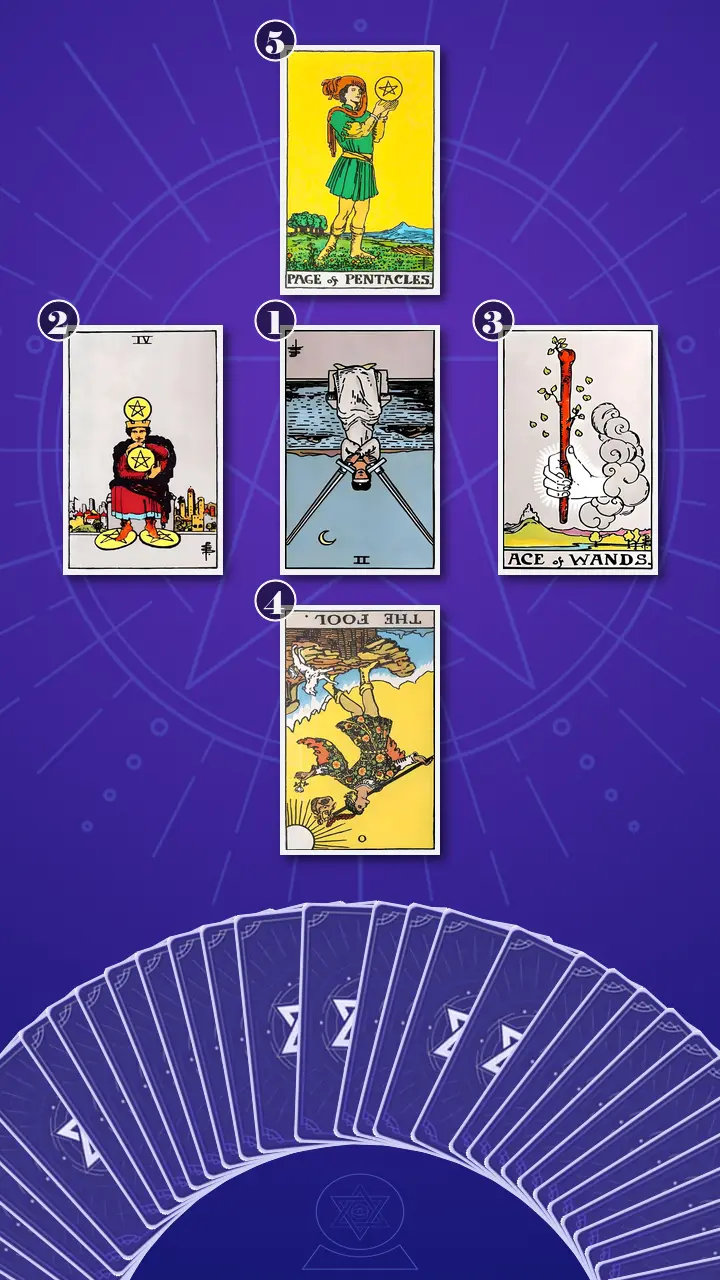
I chose a five-card Choice Spread. For anyone wondering how tarot works in a career decision, this spread is useful because it does not predict which job someone is destined to take. It separates the parts of the decision that have become tangled together.
The centre card would show Jordan's current pattern of researching, drafting, and withdrawing. The cards to the left and right would compare what the familiar path protects with what genuinely draws them toward the unknown one. The lower card would expose the hidden fear enlarging the threshold. The upper card would offer integration and practical next steps, not a promised destination.
I placed the cards in a cross that resembled a compass. It was compact enough to keep the reading focused on security, desire, fear, and agency, without turning one career application into a ten-year prophecy.
When Research Stops Changing the Answer
Position 1: Two Crossed Arguments
I turned over the card representing the current manifestation gap: the observable pattern of researching, drafting, and withdrawing while Jordan's thoughts held the desired choice in suspension. It was the Two of Swords, reversed.
I pointed to the blindfold and the two swords crossed defensively over the figure's chest. Upright, the image can hold a tense stalemate. Reversed, its Air energy had become Blockage through overload. Jordan was not missing a preference. They were keeping two polished arguments in permanent combat: “This could be the work I actually want” and “A responsible person would know more first.”
The modern card meaning was already open on Jordan's laptop at 11:40 p.m. The application contained enough information for the limited act of submitting, yet the spreadsheet kept growing. “Once I know the salary range, I can act” became “Once I understand the promotion path.” When that was answered, the reporting line became essential. Then the exit route. The missing fact changed whenever the previous one stopped providing delay.
I told Jordan that their decision algorithm was behaving like a Notion database that created a new property every time one option began to lead. It was no longer designed to choose. It was designed to keep the project permanently “in review.”
“Not choosing feels neutral,” I said, “but it still decides what gets no chance to become real.”
Jordan gave one short, bitter laugh. Their fingers stopped rubbing the edge of the table, then curled around their cold water glass. “That's too accurate. It's almost cruel.”
“I hear the sting,” I replied. “The card isn't accusing you of being indecisive. It's showing us what the research has been hired to do. It gives you temporary relief from being accountable for wanting something. That worked for a while. It just isn't producing new evidence anymore.”
Position 2: The Salary That Became a Lock
I turned over the card representing what the familiar option protected and what that protection cost: predictability, material continuity, and the risk that control could become immobility. The Four of Pentacles appeared upright.
The figure pressed one coin to the chest and pinned two beneath both feet. I saw healthy Earth energy at the centre of this card: preserve what matters, respect practical limits, and do not gamble with resources you need. Jordan's current salary covered a room in a shared flat and kept the monthly machinery of London life moving. That protection was real.
Jordan described Monday at 9:04 a.m., when the kettle clicked off and a Monzo notification confirmed the rent transfer. By the time Slack opened, the question “Could I attend one workshop?” had expanded into “Could I survive a failed career change?” The Four's balanced conservation had tipped into Excess. A stable job had become a reason not to book one conversation, test one brief, or submit one application, even though none of those actions required surrendering the job.
“A real boundary protects your rent,” I said. “An impossible guarantee protects you from being seen wanting something.”
Jordan's shoulders lowered on a long exhale. I watched recognition arrive with a trace of grief. They were not being asked to mock the safe path or throw away a functioning life. They were seeing how a necessary handrail had gradually become a locked door.
The Spark Before the Spreadsheet
Position 3: The Work That Keeps Waking You Up
I turned over the card representing what genuinely drew Jordan toward the unknown option: the motivation, creative potential, and lived value that persisted beneath fear. It was the Ace of Wands, upright.
A hand emerged from a cloud holding a living wand, fresh leaves breaking from it before the distant landscape had supplied a complete route. This was emerging Fire in a healthy, available form. It did not guarantee that every creative-strategy role would fit Jordan, or that enthusiasm could replace financial planning. It showed that the recurring spark itself was information.
I asked Jordan what happened before they opened the salary spreadsheet. They described leaning toward creative-strategy listings, sketching campaign ideas without being told, and leaving a Saturday workshop with new thoughts still arriving on the bus home. For a few minutes, effort felt different. Then the mind intervened: “I keep coming back to this, but interest isn't enough to bet my life on.”
“Agreed,” I said. “You don't have to bet your life on it. But you also don't have to debate genuine interest out of existence. The Ace is not a command or a promise. It is a reason to investigate.”
Jordan leaned closer to the card. Their mouth softened at one corner, not quite a smile. No Cups had appeared in the spread, and I mentioned the absence carefully: Jordan had become fluent in analysing and controlling the choice, but less practised at saying the simplest emotional truth aloud. They wanted to know what this work felt like from the inside.
The First Click Was Not the Whole Cliff
Position 4: The Leap Hidden Inside Submit
I turned over the card representing the hidden fear maintaining the conflict: the belief that one exploratory step could become an irreversible leap and expose defective judgment. The Fool appeared reversed.
The traveler's cliff became Jordan's final Submit screen at 11:58 p.m. The small bundle suggested the limited resources required for a beginning, while the white dog resembled an internal alarm that might invite a boundary check. Reversed, the Fool's beginning energy was Blocked. Every unknown detail was being interpreted as an instruction to stop.
Jordan gave me the sequence exactly as it happened: “If I apply, they might interview me. If they interview me, I might accept. If I accept, I might resign. If I resign, I might fail, lose money, and have to explain that I got it wrong.” One reversible submission had absorbed an interview, an offer, a resignation, a financial crisis, and a permanent identity verdict.
“The first click is not the whole cliff,” I said.
I thought of the rough cuts I make as an artist. A single frame can look like a fall if I pretend every later edit has already been fixed in place. Jordan's mind was doing the same thing, collapsing an entire unmade film into one frightening still.
I call this pattern Safe-Choice Sabotage Recognition. The safe option is not automatically false, timid, or wrong. The sabotage begins when valid safety arguments are assigned to actions that do not actually threaten safety. Protecting income is a boundary. Refusing a free conversation because it might reveal desire is a defence mechanism. Those are different decisions and deserve different evidence.
Jordan's palm pressed briefly against their sternum. Their gaze moved from the reversed Fool to the Page still face-down above it. “I've been reading Submit as 'resign, relocate, and reinvent yourself now,' haven't I?”
“Yes,” I said. “And noticing that scale distortion gives you the power to resize the action.”
When the Page Held One Real Thing
Position 5: A Learnable First Step
The room had grown quiet enough for me to hear rain easing against the window. I turned over the card representing the integration point that could close Jordan's manifestation gap: a reversible, time-boxed experiment that produced evidence without demanding a final life decision. The key card was the Page of Pentacles, upright.
The Page held one pentacle at eye level. The distant mountains still existed, but the Page was not trying to survey the entire range at once. This was adaptive Earth in Balance: focused study, practical curiosity, and respect for limits without gripping the familiar so tightly that learning became impossible.
In Jordan's life, the card looked like a seven-day career experiment instead of a five-year verdict: twenty minutes on a creative-strategy brief, one informational call, or one application that met two prewritten non-negotiables. The action would be real enough to create evidence and bounded enough to stop carrying Jordan's entire future.
I used my Narrative Fork Analysis and drew two competing plotlines in my notebook. In the first, Jordan remained in the current role and kept gathering forecasts, which preserved continuity but taught them nothing new about the desired work. In the frightening version of the second, Jordan submitted one application and somehow woke up inside an irreversible reinvention. The Page revealed the missing plotline: Jordan could keep the present job while giving the authentic direction one contained scene in which to become observable.
I brought Jordan back to 11:40 p.m.: the application ready, the salary spreadsheet open, their finger near Submit. They knew which option they wanted. What they did not have was a guarantee that wanting it would still look sensible from the other side.
“Certainty is not the bridge between wanting and knowing. One bounded experiment is: small enough to reverse, real enough to teach you something.”
You do not have to make a flawless leap; take a learnable first step and hold it as the Page holds the pentacle, close enough to study without making it carry your entire future.
Jordan's breath stopped first. Their fingers hovered a centimetre above the table, as if even touching the card might make the idea real. Then their gaze lost focus; I could see them replaying the Sunday draft, the unopened booking page, and the workshop ideas typed on the bus. Their pupils widened, their jaw released, and both shoulders dropped on a breath that sounded as though it had been waiting behind their ribs for months. Relief arrived, but it did not arrive alone. For one beat, Jordan looked almost dizzy at the responsibility that came with a smaller, clearer choice. Their eyes reddened. “But doesn't that mean I was wrong to wait?” they asked, their voice sharper before it softened into a tremor.
“No,” I said. “It means your old strategy protected you from a scale of risk your mind had imagined. You don't need to punish yourself for using it. You can simply decide whether it still fits the action in front of you.”
I invited them back into direct experience. “Now, using this new perspective, think about last week. Was there a moment when this insight could have made you feel different?”
“The booking page for that twenty-minute call,” Jordan said. “I could have treated it as one conversation. I made it into an announcement that I was leaving my field.”
I set a ten-minute timer and asked Jordan to write one action that could be reversed within seven days, followed by three boundaries: maximum time, maximum cost, and the point at which they would review what happened. They chose a private twenty-minute portfolio exercise, with no spending and no obligation to publish or submit it. The minimum version was five minutes and two rough ideas.
That was the pivotal movement from anxiety-driven certainty seeking to grounded curiosity, practical self-trust, and evidence-based clarity. Jordan did not suddenly know the correct career path. They had recognised that direct experience could answer a question prediction could not.
A Seven-Day Plot, Not a Five-Year Verdict
I gathered the five cards into one storyline: blocked Air kept Jordan debating; rigid Earth turned genuine material security into immobility; the Ace introduced creative Fire that kept returning; the reversed Fool exposed the fear beneath the threshold; and the Page offered flexible Earth, a container in which desire could meet evidence. Jordan's blind spot was treating non-decision as neutral and exploration as commitment. The shift was not from caution to recklessness. It was from demanding certainty before choosing to running one reversible experiment before forming a verdict.
“But one experiment won't tell me whether I should change careers,” Jordan said.
“Correct,” I replied. “It only needs to produce one observation that another hour of forecasting cannot. Actionable advice is useful here precisely because it stays small enough to respect your income, privacy, and right to change your mind.”
- The Protagonist Pivot ActionWithin the next 24 hours, choose one creative-strategy role and spend exactly 20 minutes making a rough response to one portfolio prompt in a private document. Stop when the timer ends, even if the work is unfinished. Do not publish, resign, or make the exercise carry any decision beyond those 20 minutes.If resistance spikes, do the five-minute version. Afterwards, write three lines: what energised me, what drained me, and what I still need to know.
- The Two-Fact Stop RuleBefore researching the next opportunity, write down only two facts required for its smallest reversible next step. Set a 30-minute browser timer and place every other question under “Later, if this advances.” When both facts are answered, choose to act, decline, or schedule one clearly defined missing fact.Ask no more than one person, and ask for relevant factual experience rather than approval of the whole career direction.
- The 20-Minute Conversation TestBy Wednesday evening, send one creative strategist a short LinkedIn message requesting a 20-minute informational call. Include two specific questions and no request for a referral. Keep the cost at zero and review what you learned immediately after the call.Draft the message in ten minutes. Sending it creates an option; it does not commit you to accepting anything that might follow.
I asked Jordan to regard these actions as production notes for the next scene, not a contract for the entire film. Their current job, rent boundary, and permission to stop remained intact. The authentic plotline simply received twenty-four hours in which to exist outside a saved folder.
A Week Later: One Message, One Quiet Morning
Six days later, I received a message from Jordan. They had completed the twenty-minute brief, stopped when the timer rang, and sent the informational-call request before opening another comparison tab. The creative strategist replied with two available times.
“I expected taking action to make me certain,” Jordan wrote. “It didn't. It made me interested. That feels much easier to work with.”
That night, Jordan slept through until morning. Their first thought was still, “What if I am wrong?” This time, they smiled at the familiar line, opened the seven-day experiment note, and left the question unanswered.
I did not see tarot make Jordan's career decision. I saw a five-card Choice Spread separate a real financial boundary from a catastrophic forecast, then return the pen to the person whose life was still in production. The proof of finding clarity was not certainty. It was one chosen action, taken with limits, curiosity, and a route back.
When the option you want tightens your chest, it can feel safer to hold the familiar life with both hands than to risk being seen wanting something else. But noticing where a first click becomes an imaginary cliff already means the old storyline is no longer running unseen.
If your next click did not have to carry the whole cliff, what one piece of the unknown could you hold at eye level for seven days, close enough to study and small enough to put down?