Study-Group Exclusion Still Hurt, Yet They Answered Question One

The Closed Chat at the Open Desk: Rejection-Triggered Academic Procrastination After Study-Group Exclusion
I was sitting opposite Jordan (name changed for privacy), a Toronto undergraduate who could build a polished Notion catch-up plan in ten minutes, yet could not answer the first practice question after seeing evidence of an invite-only study session. I recognised the pattern as rejection-triggered academic procrastination: the exclusion happened once, then returned every time the coursework reopened.
Jordan reconstructed the previous Tuesday for me. At 8:30 p.m., beneath the fluorescent buzz of an upper-floor campus library, they had opened the week's lecture slides beside a paper cup of cold coffee. A message appeared in the course chat: “Thanks for last night's session.” Their phone grew warm from repeated checking while their shoulders folded towards the desk.
“I came there to answer one question,” Jordan said. “Then I checked the thread, looked at everyone's Stories, opened a new timetable template, and told myself it was too late to do anything useful. Every time I open the notes, I remember they met without me.”
I heard the central conflict immediately. Jordan wanted to protect their academic progress, but beginning the work felt like making direct contact with the fear that the group had excluded them because they did not belong. The hurt seemed to sit beneath the sternum like a denied security pass: one small red light at a closed door, somehow making the whole building feel inaccessible.
“Not studying hurts me,” Jordan added, rubbing the tight place below their collarbone. “But starting feels like admitting they got to me.”
“They did get to you,” I said. “That is not a moral failure. Being excluded from useful academic support can hurt, and I am not going to turn that hurt into a productivity lecture. I also will not ask the cards to predict whether this group changes or to invent motives for them. I want us to map what happens between the notification and the blank answer, then find the smallest point where your choice becomes available again.”

Choosing the Switchback Map
I invited Jordan to place both feet on the floor, take one unforced breath, and hold a single question in mind: “Why do I keep delaying study after being left out of the group?” I shuffled slowly, using the few quiet seconds as a transition from replaying the chat to observing the pattern.
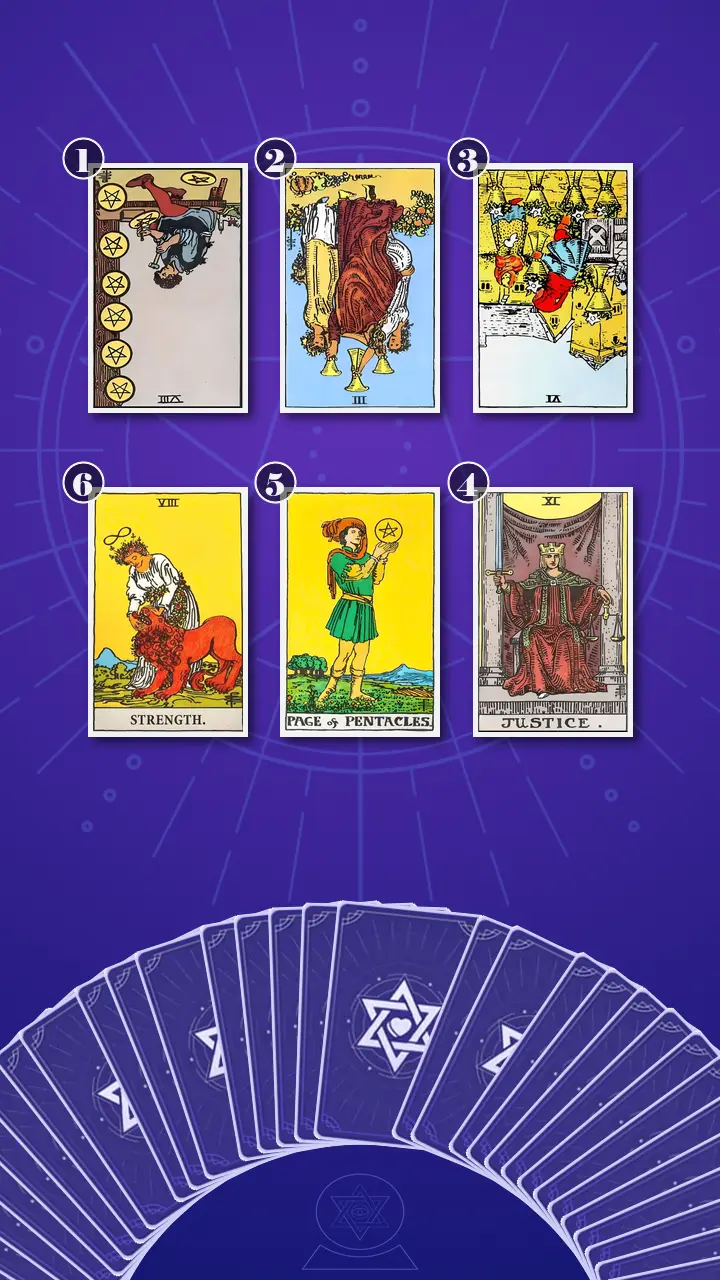
I chose the Transformation Path Grid · Context Edition, a six-card spread arranged as a two-row switchback. For anyone wondering how tarot works in a situation like this, I use the cards as a structured reflective instrument. They do not prove what another person thinks or forecast reconciliation. Their images help me separate an event, the meaning attached to it, the behaviour that follows, and the choices still available.
This spread suited Jordan's question because a purely relational layout would have centred the group, while the practical problem was a self-reinforcing loop: exclusion triggered checking and delay; delay produced unfinished work and guilt; falling behind then made access to the group feel even more essential. Six positions were enough to examine that loop without turning it into a verdict about Jordan's personality.
I placed the first three cards across the upper row. They would show the visible delay, the immediate social blockage, and the familiar story sustaining it. I set the fourth card directly below the third as the catalytic hinge. The final two cards would move back across the lower row, translating clarity into a bounded study action and then into the capacity to act while hurt remained present. The layout resembled a path reaching the edge of an old cycle, turning, and returning with a different response.
The Workbench and the Closed Circle
Position One: The Workbench Jordan Kept Leaving
“The card I am turning now represents the visible presenting problem,” I said, “opening study material after an exclusion cue, then replacing completion with planning, checking, and delay.” I revealed the Eight of Pentacles, in the reversed position.
I pointed to the artisan seated at the workbench and the pentacle still under construction. Upright, this card carries the balanced Earth energy of practice, repetition, and skill built through visible work. Reversed here, that energy was blocked. Jordan's academic ability had not vanished; their relationship with the workbench kept being interrupted whenever studying activated the social wound.
I brought the image directly back to the library. Jordan had opened a practice set, noticed the private-session message, renamed folders, colour-coded a catch-up timetable, checked classmates' posts, and restarted a timer. The first answer had remained blank. The excess was not effort but protective preparation: every surrounding task became polished enough to feel responsible while the vulnerable act of attempting one answer stayed untouched.
“The sequence sounds like this,” I said. “I will start once I have organised this properly. Then: I should check what I missed first. Then: it is too late to do a useful session now. A perfect catch-up plan can still be a form of not starting.”
Jordan gave a short laugh, but there was no amusement in it. Their mouth tightened before they said, “That's so accurate it is almost cruel.”
“Then let us be accurate without being cruel,” I replied. “This card is not calling you lazy or incapable. It is showing that planning has become a temporary shelter from the moment hurt meets the work. The useful question is not, ‘Why am I so undisciplined?’ It is, ‘What visible output did I originally come here to make?’”
Jordan glanced at the cards and then at their phone. “One practice answer,” they said. “It was literally just one answer.”
Position Two: The Course Behind a Locked Channel
“The card I am turning now represents the immediate blockage attached to the study task,” I said. “It identifies the gatekept group dynamic and the rupture in belonging that follows it.” I revealed the Three of Cups, in the reversed position.
I traced the inward-facing circle of figures and the three cups raised above them. In Jordan's daily life, those cups had become names clustered inside a private Discord, WhatsApp, or Messenger thread. The gathered harvest had become pooled notes, encouragement, and session resources circulating in a channel Jordan could see only after the fact.
I described the modern scene plainly: Jordan saw an after-session photo, a thank-you message, and a shared notes link from a meeting they had never been told about. The lecture material immediately began to feel as though it belonged to the closed circle, so Jordan closed the deck and monitored the chat instead. Reversed Water was blocked here through clique dynamics, disconnection, and hurt that could not move cleanly through the practical task.
“It is not only, ‘I missed the session,’” I said. “It becomes, ‘The course is happening in a room I cannot enter.’ That feeling makes sense. But a locked Discord channel describes the permissions of that channel. It does not make your entire course directory read-only.”
Jordan's chest rose sharply. They pressed a thumb against the edge of the table and stared at the three figures. “It really does feel like the notes belong to them,” they said. “Even when the slides are available to everyone.”
“That distinction matters,” I replied. “This card can name the group's closed behaviour without declaring that all academic connection is closed to you. The desire for collaboration is not the problem. The problem is allowing one group's gatekeeping to become the login screen for learning that never required their credentials.”
Position Three: The Notification with an Archive Inside
“The card I am turning now represents the underlying root,” I said. “It shows the familiar non-belonging script that sustains the loop and makes procrastination feel protective for a little while.” I revealed the Six of Cups, in the reversed position.
I drew Jordan's attention to the child offering a flower-filled cup, the other cups already occupying the courtyard, and the guarded buildings around the scene. Upright, the Water of this card can hold memory, familiarity, and earlier emotional exchanges. Reversed, its energy had become overextended into the present: one current message was recruiting the emotional weight of other times Jordan had felt outside a circle.
I recalled the scene Jordan had described from the TTC the following morning. They had opened a follow-up post containing pooled notes from the private session. Before reading the document, their stomach had dropped and the sentence “This always happens because people can tell I do not belong” had appeared. The facts on the screen had not expanded, but the emotional meaning had loaded like a message thread importing years of history at once.
“This happened today,” I said, “but your body may be answering every time it has felt similar. I am not claiming the past fully explains the present. I am asking whether a familiar story is adding weight to the current event before you have a chance to examine it.”
Jordan's breathing paused. Their fingers stopped moving against the phone case; then their gaze drifted beyond the table as though replaying several scenes without selecting one. Finally, they released a low breath and let both hands rest open. “It does feel older,” they said. “I do not even know which memory it belongs to. I just go straight to, ‘Of course this happened again.’”
“That response once offered protection by helping you anticipate exclusion,” I said. “Now it is withholding study so that you do not have to touch the whole emotional archive. The protection is understandable. Its current cost is that the group excludes you from one session, and the familiar story then excludes you from the work again.”
When Justice Entered the Dig
Position Four: Scales for Facts, Story, and Choice
The room became unusually still as I moved to the lower row. Even the faint mechanical hum beyond the window seemed to recede. “The card I am turning now represents the catalytic distinction,” I said, “between the group's observable behaviour, the meaning placed on it, and the academic action that remains under your control.” I revealed Justice, upright.
I looked at the evenly held scales, the vertical sword, and the frontal figure seated between two pillars. This was balanced energy: clear discernment without denial, accountability without self-prosecution, and cause and effect without exaggeration. Justice did not ask Jordan to minimise the gatekeeping. It asked them to stop entering their entire academic identity as evidence in a case that concerned one group's conduct.
I returned us to the moment at 8:30 p.m.: the lecture deck open under fluorescent light, proof of the missed session on the warm phone, and a cursor blinking beside question one. Jordan had arrived to produce one answer, but the page had suddenly felt like evidence about whether they belonged.
At that point, an old professional instinct surfaced in me. Years at Cambridge and on archaeological digs had taught me that a genuine object from one layer must be recorded accurately, but it cannot be promoted into the bedrock of an entire site. I call this Academic Stratigraphy: facts, interpretations, and enduring capacities belong in distinct layers so that intellectual debris does not bury the structure that still holds.
I imagined one of my old trench sheets and translated it into three headings on Jordan's phone: What happened, What I inferred, and What remains mine. The first layer read, “The group met and I was not invited.” The second read, “I am academically unwanted and cannot keep up.” The third read, “I can answer question one for ten minutes.” The first statement named a real exclusion. The second was a global conclusion, not an established fact. The third did not excuse anyone; it recovered a choice.
“Their gatekeeping is evidence about their behaviour, not a verdict on your ability,” I said. “Their gatekeeping is data about their behaviour, not a grade on your worth.”
You do not have to repeat their exclusion by excluding yourself from your own work; let Justice's scales separate what they did from the next study action you can choose.
I let the sentence remain between us. Jordan's inhale stopped halfway. Their fingers hovered above the phone, then curled tightly around it; their eyes lost focus as if the library scene were replaying in a sharper resolution. Their pupils widened, their jaw shifted, and a trace of colour rose beneath their eyes. When the words finally reached the emotional layer, their grip loosened one finger at a time. Their shoulders dropped, but relief did not arrive cleanly. It came with a flash of anger.
“But does that mean I have been doing this to myself?” Jordan asked, their voice low and unsteady. “Does it mean I was wrong to be this affected?”
“No,” I said. “The group made a choice that hurt you. Your checking and withdrawal were attempts to protect yourself from renewed contact with that hurt. Justice is not retroactive blame. It is present-tense leverage: the place where a protective response has begun costing you something can also become the place where a new choice starts.” Jordan exhaled with a faint tremor. Their shoulders stayed lower, yet their expression held the brief, almost dizzy blankness that can follow the setting down of a familiar burden.
Then I asked, “Now, with this new perspective, can you remember a moment last week when this insight might have made you feel different?”
Jordan looked towards the window. “Thursday night,” they said. “I spent forty minutes drafting a message to the group. I could have let the message wait and done question one. Not because the exclusion did not matter, but because the question was still mine.”
I nodded. This was the reading's decisive movement: from hurt-driven checking and protective withdrawal from coursework to fair-minded self-respect and cautious study engagement while hurt remained present. It was not a promise of calm, changed classmates, or instant confidence. It was the first separation of one painful layer from the enduring ground beneath it.
One Question Held at Eye Level
Position Five: The Apprentice's One Visible Output
“The card I am turning now represents the practical response,” I said. “It translates the insight into one bounded solo study task and one low-pressure route towards support outside the gatekept circle.” I revealed the Page of Pentacles, upright.
I pointed to the Page holding a single pentacle at eye level while the cultivated field and distant mountains remained present but secondary. Here, Earth energy had returned to balance. The backlog, the unresolved group situation, and the wider course still existed, but the Page did not attempt to hold all of them at once. Attention rested on one object that could be studied, handled, and completed.
I translated the card into Jordan's actual evening: choose one named practice question, place it in full-screen mode, activate a twenty-minute Focus setting, and write one answer before opening the timetable or chat. Afterwards, if support would help, Jordan could ask a different classmate, a tutor, or an office-hour instructor to compare that single answer. The social need and the study task could be addressed separately rather than forcing one to wait for the other.
“The Page is not asking you to prove that you need nobody,” I said. “It is restoring your learner role without requiring perfect confidence, group approval, or resolution of the entire friendship situation. Think of the answer as an academic minimum viable product. One completed response gives you more usable evidence than an immaculate dashboard with nothing moved to Done.”
Jordan turned their phone face down. “Twenty minutes still sounds possible,” they said. “An entire catch-up night does not.”
“Then the smaller unit is the honest one,” I replied. “A small task is not symbolic consolation. It is direct contact with the subject, and it begins rebuilding evidence that you can follow through.”
Position Six: Hurt Can Ride Along Without Driving
“The final card represents integration,” I said. “It shows the capacity to acknowledge exclusion-related hurt without allowing it to decide whether studying begins.” I revealed Strength, upright.
I asked Jordan to notice the woman's gentle hands near the lion's mouth. There was no image of forceful domination. The card's balanced, fire-like courage came through steadiness, patience, and compassionate self-command. Strength did not require Jordan to become indifferent, forgive anyone, suppress resentment, or stay in a social setting that felt hostile.
I offered the scene the card suggested. A new notification appears while Jordan is studying. Their chest contracts. They say quietly, “That hurt is here again,” take three slow breaths, place the phone face down, and return to the selected question for seven minutes. The notification remains real. The feeling remains real. Neither receives automatic control of the next action.
“So the goal is not to stop caring?” Jordan asked.
“Exactly,” I said. “Strength is using Focus mode while the difficult message still exists. It is carrying an unresolved notification without letting it become the operating system for the evening. You can be hurt and still keep one question open for yourself.”
Jordan looked back across the spread: three reversed cards showing interrupted work, a closed circle, and an old script; then three upright cards showing evidence, one practical task, and gentle regulation. Their fingertips rested beside Justice rather than on the phone. I watched recognition settle without pretending it had become certainty.
The Thesis Beneath the Clutter
I gathered the six cards into one account. A real act of gatekeeping had disrupted Jordan's sense of belonging. That hurt attached itself to the course material and recruited a familiar expectation of being academically unwanted. Planning, checking, and scrolling then protected Jordan from immediate contact with the wound, but the unfinished work created guilt and greater dependence on the same group. The classroom door had been shut by others; in response, Jordan had begun locking their own desk drawer.
The cognitive blind spot was not that Jordan had mistakenly perceived everything or cared too much about connection. The blind spot was treating social repair or emotional calm as a prerequisite for academic access. One group could be unavailable, unfair, or unhelpful without becoming the whole support system, and its behaviour could be evaluated separately from Jordan's academic worth.
The transformation direction was therefore precise: Jordan would stop waiting to feel accepted before studying, complete one defined solo task first, and address the legitimate need for healthier support as a separate decision. Justice supplied the distinction, the Page supplied the scale, and Strength allowed the action to coexist with discomfort.
To keep the actionable advice from becoming another elaborate system, I adapted my Thesis Stratigraphy Framework. In an essay, I use it to make the central argument pierce through layers of intellectual clutter. Here, the load-bearing claim was simpler: “My access to learning is not contingent on this chat.” Facts about the group, feelings about belonging, the selected academic output, and future support decisions could then occupy separate layers instead of collapsing into one impossible task.
I converted our six-card Transformation Path Grid tarot reflection for rejection-triggered study procrastination into two bounded experiments:
- The Nine-Minute Justice-to-Page Check Before one study block this week, open a phone note titled Facts / Story / Next Move. Spend two minutes writing one sentence under each heading, then spend seven minutes producing the first visible piece of one named practice answer. Keep the group chat closed for those nine minutes; no confrontation or friendship decision is required that night. Tip: If the exercise feels too activating, stop. The minimum version is one factual sentence and one question chosen for later: “Their choice was theirs; my next ten minutes are mine.”
- The One-Output Study Block On one library evening, put a single practice question in full-screen mode, activate Focus for twenty minutes, and answer it without opening a timetable template. After the timer, choose whether to send one low-pressure request outside the closed group, such as “Want to compare answers to question three this week? No worries if not,” or take that question to a tutor or office hour. Tip: Define success as one visible output, not a calm mood, perfect answer, or complete catch-up. On a difficult day, use a ten-minute version and stop when the timer ends if that better respects your energy.
I reminded Jordan that these were experiments, not tests of worth. They were free to reduce the time, stop, rest, seek institutional or personal support, or decide that contact with the original group was not appropriate. Tarot could make the pattern visible and help organise the evidence; Jordan retained authority over every boundary and next step.

Four Days Later: The Desk Reopens
Four days later, Jordan sent me a screenshot: one answer saved at 8:49 p.m. A new group notification had tightened their chest; they left it unopened, finished the paragraph, then sat alone with their cold coffee, relieved and sad. The desk was open again.
The message beneath the screenshot read, “Still hurt. Still not sure what I want to do about them. But I did question one before I decided anything else.”
I did not mistake that small proof for a solved life. Jordan had not become immune to group-chat FOMO, repaired the social rupture, or completed an entire backlog. They had done something more credible: they had named the exclusion without converting it into a total self-verdict, then kept one piece of learning available to themselves.
I never credit the cards with taking that action. The spread offered a map, and my role was to help distinguish its layers. Jordan chose to press Start. That is where tarot's practical value rests for me: not in making fate sound certain, but in returning authorship to the person whose life is being considered.
I know that when a private-chat notification tightens your chest above an open lecture deck, beginning can feel like walking back into the fear that the course has already decided you do not belong. If that is where you are tonight, noticing that the group's locked channel and your own open desk are two different layers already means you are no longer standing at the exact beginning of the loop.
If acceptance did not have to arrive first, which single piece of learning would you keep open tonight, and what seven-minute first layer would let you reclaim it without asking the locked chat for permission?