Finding Clarity in the Sunday-Night Screen Time Verdict
You’re a late-20s hybrid-office person in a big city, and Apple’s Screen Time summary hits like a weekly performance review—hello, productivity guilt.
Jordan said that to me with a half-laugh that didn’t quite land. We were on a Sunday-night Zoom call—me at a hotel desk in Toronto for a lecture, them in their condo bedroom near King West. Their face was lit from below by that familiar phone glow, and a streetlight leaked through the blinds in thin, pale stripes like prison bars nobody asked for.
“It popped up at 9:52,” they told me, thumb already hovering over the screen like it had its own gravity. “Weekly summary. I didn’t even think. I tapped it. Then I did the math and it was like… that’s basically a part-time job.”
I watched their shoulders inch up as if bracing for impact. Their stomach dropped—Jordan actually pressed a palm to their abdomen while they spoke—and their chest looked tight, as though the number had a hand around it. The room was quiet, but their body was loud: fidgety energy in the fingers, the jaw set, the eyes too bright for bedtime.
“I want to unwind,” they said, voice flattening. “I want to stay connected. But when I see the report, it feels like proof I’m wasting time and falling behind.”
That contradiction—the need for relief versus the fear that relief is a moral failure—was sitting between us like a third participant. And guilt was doing what guilt does best: turning a tool into a courtroom.
“I hear how heavy that notification feels,” I said. “Not abstractly—physically. Let’s try something different tonight. Not to ‘fix’ you. To map what’s happening, so you can stop getting ambushed by it and start choosing what’s next with a bit more respect for yourself.”
Choosing the Compass: How the Celtic Cross Spread Works for a Habit Loop
I asked Jordan to put their phone face down for one minute—just long enough to let their nervous system realize the room wasn’t on trial. “One slow inhale,” I said. “One slow exhale. We’re not summoning anything. We’re just changing gears—from reaction to reflection.”
I shuffled my well-worn Rider-Waite-Smith deck the way I used to brush soil off a coin at a dig site: patiently, not because the object was sacred, but because attention makes meaning visible.
“Tonight, we’ll use the Celtic Cross spread,” I told them. “It’s a classic for a reason. Your question isn’t about predicting an event. It’s about tracing a repeating trigger-response loop back to the belief underneath it—and then integrating a sustainable next step.”
For you reading this: that’s why the Celtic Cross is such a fit for productivity guilt and phone habits. It naturally separates the immediate trigger (what happens when the alert hits), the crossing tension (what makes it sticky), the unconscious root (why it feels personal), and the practical path forward (what changes when you stop punishing yourself and start experimenting). In other words: it’s built for finding clarity without oversimplifying the emotional messiness.
“The first card will show the immediate moment—what your Screen Time alert is actually doing to your mood and behavior,” I said. “The crossing card will show the tension that turns neutral data into guilt. And the outcome card will show what ‘what’s next’ looks like if you shift the stance you’re holding yourself with.”
Reading the Map: Card Meanings in Context, Not in Theory
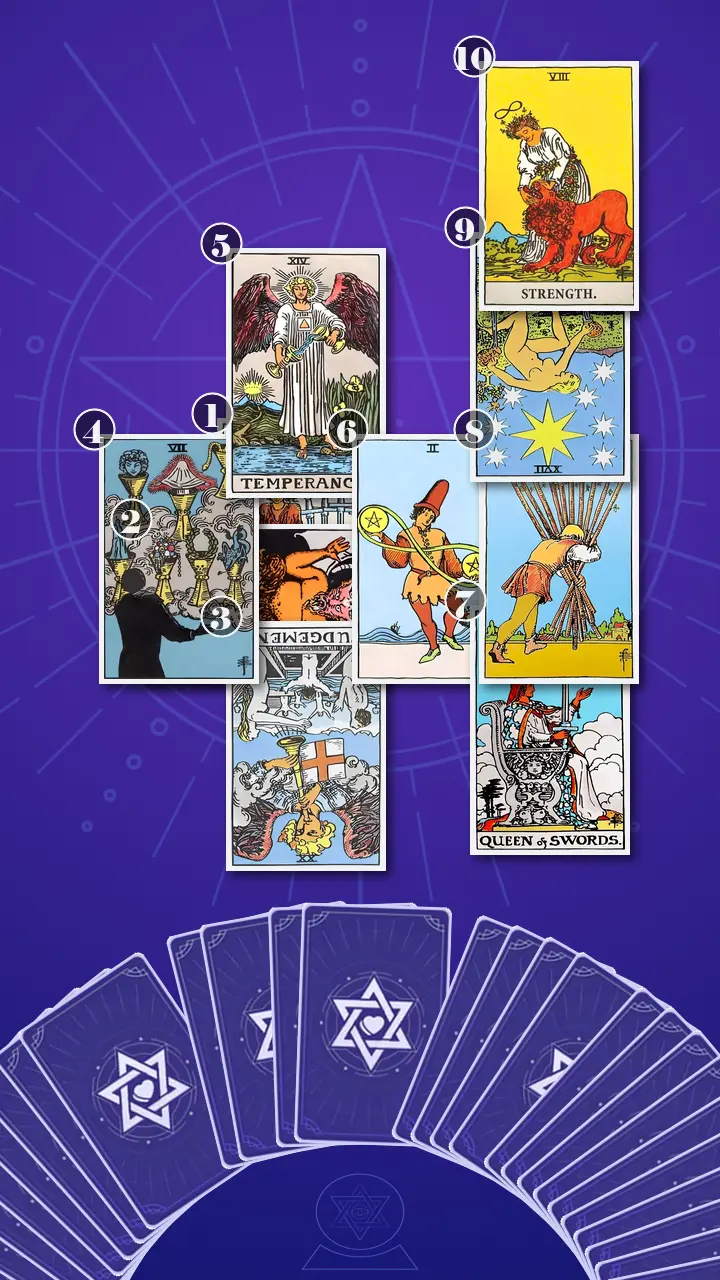
Position 1: The immediate moment — Eight of Swords (upright)
Now we turn over the card representing The immediate moment: what your Screen Time alert is actually showing you in behavior and mood.
Eight of Swords, upright.
I said it plainly, because this card doesn’t need theatrics. “You see the Screen Time alert, and it’s like your brain gets blindfolded: you stop seeing options and only see ‘I’m trapped / I’m failing.’ You open the report and freeze in self-auditing mode, even though the ‘bindings’ (your choices) aren’t actually locked—you could respond with curiosity, rest, or one workable boundary instead of a crackdown.”
The energy here isn’t that you lack discipline. It’s blockage: mental movement stops, and the only available action feels like self-correction. The blindfold on the figure in the card is the moment your body reacts before your mind has a say—the sinking stomach, the tight chest. You’re not choosing yet; you’re bracing.
Jordan gave a short, bitter laugh. “That’s… too accurate. Like, kind of brutal.” Their eyes flicked away from the screen, as if the card had looked back at them.
“It’s accurate,” I said gently, “but it’s not a sentence. The Eight of Swords is famous for one detail: the bindings are loose. The cage looks complete until you notice it isn’t. Screen Time is feedback, not a character assessment.”
Position 2: The main tension — The Devil (upright)
Now we turn over the card representing The main tension: what complicates your relationship with screen time and turns data into guilt.
The Devil, upright.
I didn’t flinch, and neither did Jordan—which told me they’d been expecting this one. “Your phone is the fastest relief button after stress—until it becomes a loop. You tell yourself ‘just one thing,’ and the feed hands you novelty on a conveyor belt. Then guilt tightens the chain: you try to control harder, which makes the urge feel stronger, which makes the rebound worse.”
The Devil’s energy is excess: too much pull, too little pause. Not because you’re weak, but because the system is built like a casino floor—autoplay, infinite scroll, the little ‘next hit’ of novelty. Your brain didn’t invent this. It got recruited by it.
“The urge isn’t the enemy; the shame spiral is,” I said. “The chains in this card are rarely locked tight. The pull feels fated, but it’s often just unexamined discomfort plus a very well-designed app.”
Jordan nodded once, sharply, like someone recognizing an old enemy in better lighting.
Position 3: The root driver — Judgement (reversed)
Now we turn over the card representing The root driver: the deeper belief that makes the notification feel personal and moral.
Judgement, reversed.
I felt the room change—not mystically, simply psychologically. The way it does when you finally name the real thing. “The Screen Time notification functions like a trumpet blast that calls you to ‘accountability’—but reversed, it becomes condemnation. You run a mental court case: tally hours, replay what you ‘should’ve’ done, and keep checking the dashboard like it’ll grant absolution. The root issue isn’t time; it’s self-worth fused to the metric.”
And because I’m who I am—a professor who has spent decades reading inscriptions that were literally meant to outlast a lifetime—I added my own frame. “In archaeology, numbers are evidence, not morality. A layer of ash doesn’t mean a city was ‘bad.’ It means something happened. When you treat data like a verdict, you stop learning from it.”
I leaned into the echo technique that always lands here: the courtroom. “In your mental courtroom,” I told Jordan, “the Screen Time report is Exhibit A. You reopen it like you’re refreshing analytics, waiting for a different verdict. Your inner voice plays prosecutor: ‘You should’ve read instead. You should’ve worked out. You should’ve meal-prepped. You should’ve…’”
Jordan’s breath caught—just for a beat. Then their gaze unfocused, as if they were watching the replay. Finally, a small exhale left their chest like something unhooking. “Oh,” they said quietly. “That’s exactly it.”
Judgement reversed is distortion of inner authority: review turns into punishment. The invitation isn’t to stop noticing the data; it’s to repair the voice interpreting it.
Position 4: What led here — Seven of Cups (upright)
Now we turn over the card representing What led here: the recent habit loop or context that intensified the pattern.
Seven of Cups, upright.
“Recent context: your phone became an endless menu—news, short videos, messages, productivity tips—so you never fully choose, you just reach. Time disappears because overstimulation makes ‘one more scroll’ feel like a solution, even when it leaves you emptier.”
This card’s energy is diffusion: attention scattered across a buffet of half-choices. It’s decision fatigue dressed up as freedom. And later, when the number arrives, it feels like you’ve been caught doing something you didn’t even enjoy.
Jordan rubbed their eyes. “That ‘candy for dinner’ thing,” they said. “Yes. That.”
Position 5: What you think you should do — Temperance (upright)
Now we turn over the card representing What you think you should do: your conscious goal or ideal that shapes the guilt narrative.
Temperance, upright.
I smiled a little, because this is the card people secretly want when they say they want control. “What you consciously want (even if guilt talks louder): a sustainable mix. Not ‘zero screen time,’ but a rhythm where decompression, connection, and focus can all exist. You’re trying to pour between cups—adjusting the blend—so your habits fit your actual life instead of an idealized routine.”
Temperance is balance energy, but not the Pinterest version. It’s the ordinary, repeatable kind: one foot on land, one in water, adjusting in motion. It’s the opposite of the Sunday-night crackdown.
“I want balance,” Jordan said, almost annoyed at how vulnerable it sounded. “Not another rule I’ll break.”
Position 6: The next developmental step — Two of Pentacles (upright)
Now we turn over the card representing The next developmental step: what changes when you stop punishing yourself and start experimenting.
Two of Pentacles, upright.
“The next step looks like real-life juggling, not a dramatic reset. You pick one boundary with high impact (morning or bedtime), keep everything else flexible, and treat the week like budgeting: review, adjust, repeat. The goal is stability inside a busy life, not perfection outside of it.”
This card is adaptation—and it’s the first breath of relief in the spread. The infinity loop around the pentacles is the point: iteration. Not one grand, morally purifying ‘life reset.’
I used the montage the card demanded. “Line 1 in the morning. Back-to-back meetings. Grocery run. The PATH at rush hour. Late-night wired-tired brain. Your week is already moving like waves behind that juggler in the card,” I said. “So we don’t design a plan that only works on your best Saturday. We design a plan that holds on your messiest Wednesday.”
Jordan’s shoulders dropped a fraction. Their hands stopped fiddling with the charger cable. “Okay,” they said, surprised at their own voice. “I can try one thing without turning it into a whole personality test.”
Position 7: Your role — Queen of Swords (upright)
Now we turn over the card representing Your role: how you’re currently holding yourself and what inner stance is available.
Queen of Swords, upright.
“Your strongest stance isn’t guilt—it’s clarity. You can tell the truth without cruelty: ‘This app ramps me up,’ ‘This is how I cope when I’m overloaded,’ ‘My attention matters.’ You set one clean boundary and you don’t need to insult yourself to enforce it.”
The Queen’s energy is precision. Not harshness—precision. She doesn’t need to shout to be firm.
I offered Jordan a line they could borrow, the way I’ve seen students borrow a clean thesis statement when their draft turns into a panic spiral. “If the notification hits,” I said, “try: ‘This is information, and I decide what it means.’ And remember: If you can’t say, “I’m choosing this,” you’re probably coping—so pause first.”
Position 8: External pressures — Ten of Wands (upright)
Now we turn over the card representing External pressures: the environment that keeps the phone loop alive (workload, social comparison, expectations).
Ten of Wands, upright.
“The environment isn’t neutral: you’re carrying a lot—meetings, messages, commuting, expectations—so the phone becomes the quickest escape hatch. Then Screen Time reports the escape as if it happened in a vacuum, which feeds the guilt loop. The ‘solution’ includes offloading a small piece of the burden, not just restricting the coping tool.”
This is overload energy—too much carried, too little seen. The figure’s view is blocked by the wands, and that’s exactly what happens in a week packed with context-switching: perspective narrows until the fastest off-switch looks inevitable.
Jordan’s eyes softened. “It’s not even when I’m lazy,” they said. “It’s when I’m done.”
“Exactly,” I said. “Your worst doomscrolling isn’t a character flaw. It’s a pressure valve.”
Position 9: The guilt knot — The Star (reversed)
Now we turn over the card representing The guilt knot: what you secretly hope will be true, and what you fear the data means about you.
The Star, reversed.
“Under the guilt is a quieter fear: ‘What if I can’t change?’ You want the report to prove you’re improving so you can finally feel hopeful. When it doesn’t, you chase ‘life reset’ content or stricter plans, then feel more discouraged. Hope returns when you track one gentle, behavior-based boundary—not your total hours.”
Reversed Star is deficiency of hope—not drama, just dimness. The kind where you save a Huberman Lab episode about habits and never finish it, and then somehow feel guilty about that too. The way you can scroll “Sunday reset” TikToks like penance and still feel empty.
Jordan swallowed. “I keep wanting the number to make me feel… redeemed.”
“And it can’t,” I said softly. “Because redemption isn’t a metric. It’s a relationship—with yourself.”
When Strength Spoke: Calm Courage, Not Harsher Control
Position 10: Integration — Strength (upright)
The room felt suddenly quieter, the way a lecture hall goes quiet when the real question finally appears. On Jordan’s side of the call, I heard a faint street sound—maybe a passing streetcar bell—thin and bright against the night.
Now we turn over the card representing Integration: what ‘what’s next’ looks like as a mindset shift and a sustainable relationship to limits.
Strength, upright.
“Integration looks like holding your urges the way you’d hold a strong animal: steady, calm, not violent. You feel the pull to scroll, you name the need (relief/connection/numbing), and you choose a kind limit you can keep even on a hard day. The number stops being a moral grade because you’re practicing self-respect in real time.”
Here, the energy is balanced power. Not deficiency. Not excess. Not blockage. Power expressed as kindness.
And I could feel Jordan’s old reflex rising—the one that wants to slam the door, delete the app, set five limits, prove seriousness immediately. It’s a reflex I’ve seen in excavation teams too: when the trench gets messy, someone wants to scrape hard and fast, as if force creates clarity. It doesn’t. It destroys context.
So I set the key message down like an artifact on clean paper.
Stop treating the number like a verdict; start holding your habits with calm courage—like Strength closing the lion’s jaws without violence.
Jordan went still in a three-step sequence I’ve come to trust as the body’s truth arriving.
First: a freeze. Their breath paused, and their thumb—mid-hover over the phone—stopped as if the air itself had thickened.
Second: the mind letting the idea through. Their eyes lost focus, not in zoning out, but in searching—like replaying the last time the Screen Time alert hit and watching their own reaction from a distance for the first time.
Third: the release. Their shoulders sank, slowly, as if they’d been wearing a backpack they forgot was there. Their mouth opened on a quiet, shaky exhale. “But… if I’m not harsh,” they said, and there was a flash of anger under it, “doesn’t that mean I was wrong? Like I bullied myself for nothing?”
That was the moment I wanted to answer as both historian and human. “In every era,” I said, “people confuse cruelty with authority. It’s a very old mistake. Being harsh never proved you were serious. It only proved you were scared.”
I kept my voice steady—firm boundary, soft tone. “Strength isn’t ‘letting yourself off the hook.’ It’s choosing leadership over punishment. It’s the calm bouncer, not the cop.”
I let the silence work for a second, then invited the question that turns insight into something you can actually use. “Now,” I said, “with this new lens—calm courage instead of a verdict—think back over the last week. Was there a moment when the alert hit, and this could’ve changed how you felt in your body in the first ten seconds?”
Jordan blinked, eyes wet but not falling apart. “Tuesday,” they said. “Between meetings. I checked the dashboard like it was a KPI. If I’d done… this… I think my chest wouldn’t have locked up. I could’ve taken a real break instead of trying to ‘fix’ the feeling by changing settings.”
That’s the shift the whole spread was aiming at: from contracted self-auditing to steadier self-trust. Not perfection. Not a cure. A move from guilt-as-control to curiosity-as-guidance.
The One-Week Experiment: Actionable Advice Without the Shame Spiral
I gathered the spread into a single story for Jordan, because integration is where tarot stops being interesting and starts being useful.
“Here’s what I see,” I said. “The Eight of Swords shows the moment you get mentally trapped by the notification. The Devil shows the attention-hook loop that makes willpower-only rules backfire. Judgement reversed is the engine—your inner court turning a number into identity. But Temperance tells me your real goal isn’t punishment; it’s balance. Two of Pentacles says the path is iterative, like budgeting in a messy week. The Queen of Swords gives you a clean, non-dramatic voice. Ten of Wands validates the context—you’re overloaded. Star reversed admits the fear: ‘What if I can’t change?’ And Strength answers: you don’t need to bully yourself into better habits. You need steady, self-respecting boundaries.”
The cognitive blind spot was clear: Jordan had been using the data to punish themselves, then wondering why their body rebelled. The transformation direction was equally clear: from verdict to experiment. Don’t punish the data—run a one-week experiment.
I offered next steps that were small enough to start, and specific enough to work in real life.
- The 60-Second “Neutral Data” PauseNext time the Screen Time notification hits, do one slow inhale and one slow exhale. Then say (out loud or in your head): “This is information, not a grade.” Only after that do you decide whether to open the report.If you feel the urge to tighten limits immediately, postpone any settings changes for 10 minutes. Tiny delay = choice restored. (This is my “Clay Disc” calibration: a small, grounding pause that stops you from acting like you’re in a crisis.)
- One Boundary, One Week (Not Five)Pick a single boundary for seven days: “Phone-free first 15 minutes after waking.” Track it with one daily checkmark (Notes app or a sticky note). For one week, ignore total hours.Choose a boundary that still works on your worst weekday, not your best Saturday. Think “Celestial Tracking”: one North Star you can actually orient to, even in clouds.
- Offload One Wand for 72 HoursMute one non-essential notification stream (one group chat, one promo email, or one app’s push notifications) and keep it muted for 72 hours as an experiment.Treat it like an archaeological test trench: small, controlled, informative. You’re not deleting your social life—you’re seeing what changes when one pressure source stops poking you all day.
Before we ended, I gave Jordan one “Inscription Affirmation”—not because I like slogans, but because carved words change how you move through a space. “Write this on a sticky note and put it by your charger,” I said. “Not as motivation. As an instruction from your calmer self: Firm boundary. Soft tone.”

A Week Later: The Quiet Proof of Self-Trust
Six days later, I got a message from Jordan while I was back home, grading essays with the same mug of tea I’d had on that Sunday call.
“Okay,” they wrote. “I did the phone-free 15 minutes. Not every day. Four out of six. But—here’s the weird part—I didn’t do the Sunday-night crackdown. I saw the summary and I literally heard you saying ‘neutral data.’ My stomach still dipped, but it didn’t take over my whole chest. I went to sleep.”
It was exactly the kind of change I trust: small, specific, and real. Not a transformed life. A different first ten seconds.
That’s what this journey to clarity is, more often than not. Not deleting the lion. Not pretending you don’t want relief. Just learning to hold your habits with steadier hands—so a number can go back to being a number.
When a notification makes your stomach drop, it’s not because you’re ‘bad at discipline’—it’s because a neutral number just got forced to carry your whole fear of falling behind and not being someone you can respect.
If you treated your next Screen Time alert as a cue to try one small, kind boundary—just for a week—what would you want that boundary to protect in your life?

Every reading at AceTarot is a journey to connect with inner wisdom and empower the path ahead. This reading shared here is a psychological mirror, not a private record—crafted to reflect universal emotional loops and help restore personal clarity. Please note that these insights do not replace professional psychological, medical, legal, or financial advice, and should not serve as the sole basis for major life decisions.
Learn more about our Journey to Clarity.
How did this insight land for you?
🫂 This Resonates Deeply
🌀 Living This Story
✨ Now I See Clearly
🌱 Seeing New Possibilities
🧰 Useful Framework
🔮 The Confirmation I Needed
💪 Feeling Empowered
🚀 Ready for My Next Step
Author Profile
AI Hilary Cromwell
911 readings | 529 reviews
“Having spent a lifetime at Cambridge and on archaeological digs, I’ve witnessed the rise and fall of countless civilizations. Please know that your current struggles are not a permanent fate, but merely a necessary fracture before rebuilding. I won't lecture you; instead, I invite you to sit with me in the ruins, using a patient, historical perspective to gently dust off the true, enduring value hidden beneath your temporary doubts.”
In this Personal Growth Tarot Reading :
Core Expertise
- Cognitive Paradigm Excavation: Treating your current growth bottleneck as the necessary collapse of an obsolete intellectual era.
- Core Philosophy Stratigraphy: Identifying which foundational beliefs must be carried forward to your next life stage and which must be left in the past.
Service Features
- The Paradigm Shift Manifesto: A rigorous intellectual exercise to definitively articulate the new governing laws and core values of your next life chapter.
Also specializes in :
Explore Related Patterns:
Boundary DiscernmentJordan's next step is not a dramatic reset; it is one clean boundary that can survive a messy week. Phone-free first 15 minutes after waking gives the habit a clear edge without turning the whole phone into a forbidden object. Boundary Discernment fits because the story separates what needs a limit from what needs compassion. You do not have to reject decompression, connection, or technology altogether; you only need a boundary precise enough to protect your attention without becoming another self-punishment ritual. The six-day follow-up proves the difference. Four out of six days is not perfect, but it is stable enough to stop the Sunday-night crackdown, which means the boundary is working as a container rather than a verdict.
Emotional RegulationJordan starts by putting the phone face down for one minute and taking one slow inhale and one slow exhale. That tiny action matters because the guilt response is happening in the body first: stomach drop, tight chest, braced shoulders, fidgety fingers. Emotional Regulation fits because the story does not ask Jordan to think their way out of the trigger while their nervous system is already on trial. It gives the body a cue of safety before the mind decides what the number means. The follow-up shows the pattern taking root. The stomach still dips when the summary appears, but it does not take over the whole chest, and Jordan goes to sleep. That is regulation: not the absence of a trigger, but a different first ten seconds.
Guilt ConditioningThe Screen Time summary popping up at 9:52 changes Jordan's body before any real decision happens: the thumb hovers, the stomach drops, the chest tightens, and the shoulders brace. That is the key signal of Guilt Conditioning: a neutral notification has been paired with self-criticism so many times that the cue itself starts to feel like evidence against you. The guilt is not coming from the number alone. It comes from the learned interpretation that the number means you wasted time, fell behind, or failed to be disciplined enough. Once the alert becomes a moral alarm, your nervous system reacts as if you have been caught, even when the dashboard is only giving information. The next move in the story directly interrupts that conditioning: phone face down, one breath, then the phrase, This is information, not a grade. That pause gives you a few seconds of choice before the old guilt script takes over.
Self-Judgment LoopJordan's dashboard becomes Exhibit A in a mental courtroom: tally the hours, replay the missed alternatives, and wait for the report to somehow grant absolution. The repeated should statements give the loop its structure, because the mind is not just reviewing behavior; it is prosecuting the self. Self-Judgment Loop fits because the same data gets reopened, reinterpreted, and used as a verdict. The behavior looks like accountability from the outside, but internally it keeps you trapped in a cycle of accusation, defense, and renewed guilt. The story loosens the loop by changing the role of the inner voice. Instead of using the number to punish yourself into better habits, you practice reading it as feedback that can guide one small experiment.
Explore Related Struggles:
Ease-Productivity SplitJordan says they want to unwind and stay connected, but the report makes that same relief feel like proof of wasting time. The phone is both the fastest pressure valve after meetings, messages, and commuting, and the object that later presents the escape as if it happened without context. You are not only negotiating screen habits here. You are negotiating whether ease is allowed to exist without proving its productivity value first. That is why the guilt lands so quickly: relief is being pulled into a courtroom where focus, discipline, and self-respect are treated as the only acceptable currencies. Ease-Productivity Split captures the inner tug between needing recovery and fearing that recovery makes you less serious. A small, kind boundary works because it protects what the break is for, instead of making total hours the only thing that matters.
Habit-Identity FusionJordan wants the number to prove improvement, almost as if a better report could offer redemption. That is why the notification does not feel neutral: it lands on the part of the self that is asking whether this habit says something final about discipline, respectability, and the ability to change. You are not just reviewing a behavior when the hours appear. You are watching a habit get fused to identity, so any messy week starts to feel like a personality test and any boundary failure feels like a verdict on who you are. Habit-Identity Fusion makes change feel heavier than it has to be. A one-week experiment matters because it restores proportion: you can adjust a pattern without turning the pattern into your whole self.
Inner Tribunal LockJordan describes the report like evidence in a trial: tally the hours, replay the alternatives, reopen the case against the self. The inner voice does not just notice what happened; it prosecutes every unused possibility, from reading to working out to meal-prepping. You get trapped because the review process has stopped being a way to learn. It has become an internal court where the same dashboard is refreshed for a different verdict, while the body braces as if judgment has already been passed. Inner Tribunal Lock names the point where self-reflection turns punitive and keeps choice out of reach. What comes next is a change in inner authority: firm enough to set a boundary, soft enough to stop mistaking punishment for accountability.
Metric-Compass FusionJordan checks the dashboard like a KPI, then waits for the number to explain what the week was worth. Screen Time is no longer a measurement tool in that moment; it becomes the compass that decides whether the last seven days point toward improvement or failure. You lose choice when the metric starts carrying moral authority. A number can show pattern, frequency, and direction, but it cannot tell you whether your need for relief was valid, whether your workload was heavy, or whether you are someone you can respect. Metric-Compass Fusion is the lock that forms when data stops informing your judgment and starts replacing it. The practical shift is to let one chosen boundary guide the next week, while total hours return to being evidence rather than a verdict.
Productivity Shame BindJordan opens the Screen Time summary and immediately starts doing the math, translating the hours into something that looks like a part-time job. Their body tightens before there is any real decision to make: shoulders rising, stomach dropping, chest locking around a number that was supposed to be informational. You get caught because the need to unwind and stay connected is being judged through productivity logic. The notification does not simply say how much time was spent; it starts asking whether the week was used well enough, whether rest was deserved, and whether falling behind has already happened. Productivity Shame Bind names that pressure point. The next move is not a harsher audit of your time, but a cleaner separation between useful data and the shame script that turns every break into evidence against you.
Explore Related Emotions:
Backslide AnxietyYou want balance but immediately clarify that you do not want another rule you will break. Beneath the wish for change sits the expectation that a promising plan may collapse, and that the next report will erase whatever progress seemed possible. Backslide Anxiety makes an imperfect week feel predictive rather than ordinary. When the total is expected to certify lasting change, any repetition of the old habit can seem like a return to the beginning, even though four mornings out of six already show that progress can be partial and real.
Clarity ReliefYour hands stop working the charger cable and your shoulders lower when the notification, bodily reaction, inner prosecution, and urge to overcorrect are finally separated. The exhale arrives before the habit is solved, showing that accurate understanding itself changes the physical weight of the moment. Clarity Relief comes from discovering that the number and the verdict are not the same event. Once you can see the interpretation being added, the report loses some of its authority and your next action no longer has to begin with punishment.
Grounded AgencyYou put the phone face down, delay any settings change, and choose one morning boundary that can survive a difficult weekday. Six days later, four checkmarks are enough to show that action can be meaningful without becoming a total reset. Grounded Agency is the felt return of authorship in a situation that previously seemed to dictate both your mood and your response. Saying that the report is information and that you decide what it means does not deny the habit; it places interpretation and the next small choice back within your reach.
Hope FatigueYou keep wanting the number to prove that you are improving, then turn toward stricter plans or reset content when it does not. Each attempt promises a clean beginning, yet the unfinished habit material and repeated disappointment leave hope dimmer rather than stronger. Hope Fatigue is not the absence of wanting change. It is the exhaustion of repeatedly asking a metric or a new system to create reassurance that it cannot reliably provide, until believing in another attempt begins to feel like work in itself.
Permission AnxietyYou ask whether being less harsh would mean you were wrong, or that you had bullied yourself for nothing. Even the possibility of a gentler boundary raises concern that you may be abandoning accountability rather than changing how you practice it. Permission Anxiety lives in that unstable moment when kindness feels risky. Allowing yourself to rest, experiment, or accept four successful days out of six may expose how closely seriousness has been tied to punishment, so freedom initially brings unease alongside possibility.
Productivity GuiltThe weekly summary appears at 9:52 p.m. and lands like a performance review: your shoulders rise, your stomach drops, and a number about phone use immediately becomes evidence that you wasted time. The thought of falling behind then pulls the report beyond habit data and into an assessment of whether your week was productive enough. When productivity is made responsible for self-respect, time spent unwinding can feel morally charged even when you were already overloaded. Productivity Guilt names that specific inner weight: the sense that an ordinary coping choice has reduced your worth or put you further away from the person you should be.
Rest GuiltYou say plainly that you want to unwind and stay connected, yet the report makes those needs look like proof that you failed to use your time correctly. The phone may have been the quickest available pause after meetings, messages, and commuting, but the total erases that context. Rest Guilt develops when restoration seems permissible only after every productive demand has been satisfied. Instead of allowing tiredness to count as information, you feel pushed to defend the break or repay it through stricter control, making rest carry the very tension it was meant to release.
Self-Audit AnxietyYou tap the summary almost automatically, freeze over the report, and begin tallying what the hours could have contained instead. Your body braces while the dashboard becomes Exhibit A in an internal review, leaving little room for context, curiosity, or proportion. The anxiety comes from being both examiner and accused. Self-Audit Anxiety captures the feeling of monitoring yourself under an unforgiving standard, where information cannot simply be noticed because it seems to demand an immediate defense, correction, or confession.
Self-Improvement ShameYour inner prosecutor does not stop at saying you used the phone longer than intended. It lists the reading, exercise, meal preparation, and better habits that should have occupied those hours, then treats the gap between reality and the ideal routine as a character statement. Once the metric is fused with self-worth, improvement is no longer a practical adjustment; it becomes a demand to prove that you are serious, disciplined, and redeemable. Self-Improvement Shame names the painful sense that your unfinished growth makes you less respectable, even though the report can only describe behavior.
Accountability DreadThe notification has not yet explained anything when your shoulders begin to lift and your thumb moves toward the report. You already know the ritual that may follow: count the hours, revisit every better use of time, and prepare to hear that you were not disciplined enough. That anticipation makes accountability feel less like honest review and more like an approaching sentence. Accountability Dread is the contraction that arrives before the evidence has been considered, because being asked to look at your behavior has become inseparable from expecting condemnation.
Cautious HopeSix days later, you report four phone-free mornings rather than a perfect week, and the next summary still produces a small physical dip. The meaningful change is narrower and more durable: the reaction does not consume your chest, trigger a crackdown, or prevent sleep. Cautious Hope fits because the evidence supports possibility without demanding certainty. You are beginning to trust that the first ten seconds can change while remaining honest that the old response may still appear, allowing progress to be encouraging without turning it into another test.
Hard-Won ComposureThe next summary still makes your stomach dip, but it does not take over your whole chest. You hear the neutral-data reminder, avoid the familiar Sunday-night crackdown, and go to sleep without trying to erase the discomfort through immediate settings changes. Hard-Won Composure describes steadiness that includes the trigger rather than pretending it has vanished. You hold enough internal space to feel the first reaction and still choose what happens after it, which makes the calm credible rather than performative.
Chronic OverwhelmYour week contains back-to-back meetings, commuting, messages, expectations, and repeated context switching before the heaviest scrolling begins. You describe reaching for the phone when you are done, which places the habit inside accumulated strain rather than simple unwillingness to act. Chronic Overwhelm is the sustained sense that too much is arriving for your available capacity. When the phone becomes the fastest pressure valve, restricting it without recognizing the underlying load can feel like losing the only immediate exit while still being expected to carry everything else.
Explore Related Contexts:
Attention Economy TrapJordan describes the phone as the fastest relief button after stress, then names the mechanics around it: autoplay, infinite scroll, novelty, and one more thing. The pull is not floating in the air; it is engineered into the environment that meets you when you are already tired. Attention Economy Trap fits because the external system turns relief and connection into prolonged capture. The feed keeps offering tiny decisions that feel like freedom while quietly removing the pause where a real choice could happen. The path forward is not a willpower contest with an industrial-strength design system. You get more agency by adding friction, protecting one vulnerable time window, and treating the urge to scroll as a cue to ask what kind of relief you actually need.
Notification GuiltThe Screen Time summary lands on Sunday night, and Jordan opens it at 9:52 before really choosing to. Once the total is converted into the equivalent of a part-time job, a device report starts acting like a weekly performance review. That is the structure of Notification Guilt: the alert does not just deliver information, it triggers a private audit where every hour has to defend itself. You are watching a neutral metric get loaded with productivity culture, adult-status pressure, and the fear of falling behind. The useful next move is to separate data from verdict. When the number becomes information again, you can ask what one boundary should protect instead of trying to prove your worth by reacting harder.
Zero-Sum Self-Improvement CultureJordan says they want to unwind and stay connected, but the report makes that feel like proof of wasting time and falling behind. The mental replay immediately becomes a list of should-have activities: reading, workouts, meal prep, and a more optimized version of the week. Zero-Sum Self-Improvement Culture is the outside script pressing on this moment. It treats every unproductive hour as a loss and turns rest into something you have to justify, so the Screen Time number becomes a scorecard for whether you are improving fast enough. What changes next is the accounting system. You can protect attention without making every break compete against a fantasy routine, and you can build one concrete boundary without turning the whole week into a moral audit.
Routine Reset TrialSix days later, Jordan has tried the phone-free first 15 minutes on four days and skipped the Sunday-night crackdown. The change is small, but it is specific: the alert still lands, the stomach still dips, and the first ten seconds no longer take over the whole night. Routine Reset Trial fits the answer to what comes next because the story points away from a dramatic reset and toward one repeatable boundary. You are not being asked to rebuild your life around a perfect screen rule; you are testing a structure that can survive a messy weekday. That makes the Screen Time report usable again. The week becomes review, adjust, repeat, and the goal becomes protecting one part of your life rather than winning a total-hours contest.
Work Life Boundary CreepThe week around Jordan is packed with meetings, messages, commuting, expectations, and late-night wired-tired recovery. By the time the phone becomes the quickest escape hatch, the Screen Time report is measuring the pressure valve without measuring the pressure. Work Life Boundary Creep shows up because the same device carries work signals, social connection, distraction, and decompression. In a hybrid-office city schedule, the boundary between being available, being productive, and trying to recover gets blurred until the bedroom becomes another place where the week reviews you. The next step needs to offload one piece of the burden, not just restrict the coping tool. Muting one nonessential stream or protecting the first 15 minutes of the morning gives you a boundary that responds to the environment instead of blaming you for needing relief.
Algorithmic Self-Help SpiralJordan does not just scroll entertainment; they also scroll the promise of a better routine. The story names Sunday reset videos, saved habit advice, stricter plans, and the strange extra guilt of not finishing the self-help content meant to fix the guilt. Algorithmic Self-Help Spiral fits because the feed sells improvement as an endless next input. Every tip looks like a route out, but the volume of advice keeps you in review mode and makes a simple habit boundary feel too small to count. The clean break is to stop using content consumption as proof of change. You get more traction from one behavior-based experiment than from another optimized plan that keeps your attention inside the same loop.