The Sunday Scaries Slot Machine
If you delete a post and feel relief first—then shame for caring at all—welcome to the metric-bound self-worth loop.
Maya showed up to my studio session in a black puffer coat that still held the cold from outside, even though the room was warm. She sat down like she was trying not to take up space, phone already in her hand, screen brightness turned down like it was something private and slightly embarrassing.
“It’s so stupid,” she said, and laughed once—dry, almost annoyed with herself. “I post a selfie, and then I… spiral. Like, immediate spiral. And if it doesn’t hit fast, I delete it. Sometimes within fifteen minutes.”
In her words I could hear the whole loop: post → refresh → zoom → reread caption → mind-read strangers → delete. But what I noticed first was her body. The way her shoulders climbed toward her ears as she talked. The way her stomach tightened under a big inhale she didn’t seem to finish. The way her cheeks flushed when she said, “delete,” like her nervous system already remembered the heat.
She described a scene so specific it could’ve been a short film: Sunday night, duvet pulled up, TV on low, thumb flicking to the notifications tab like a reflex. “It’s like a slot machine,” she admitted. “I keep pulling. I keep waiting for the tiny vibration that means I’m safe.”
Her shame wasn’t abstract. It had a texture—like trying to hold a glass of water steady on a subway platform while people brush past you. One jolt, one weird look, one quiet stretch of no likes, and the water goes everywhere. Except the water is your self-worth.
“I want to post and feel… normal,” she said. “Proud, even. But the second I’m not getting reassurance, it feels like a test I’m failing.”
I nodded and let that land without trying to talk her out of it. “You’re not ‘too much’ for caring—your nervous system is just treating a selfie like a belonging test,” I said. “And if we’re honest, the internet is really good at turning tiny moments into verdicts.”
I leaned forward, keeping my voice soft but steady—radio-host calm, the kind you use when a caller is about to cry on air. “Let’s not make this about ‘stop caring.’ Let’s make it about finding clarity: what wound gets poked when you hit post… and what would it look like to be seen without bargaining for your worth?”
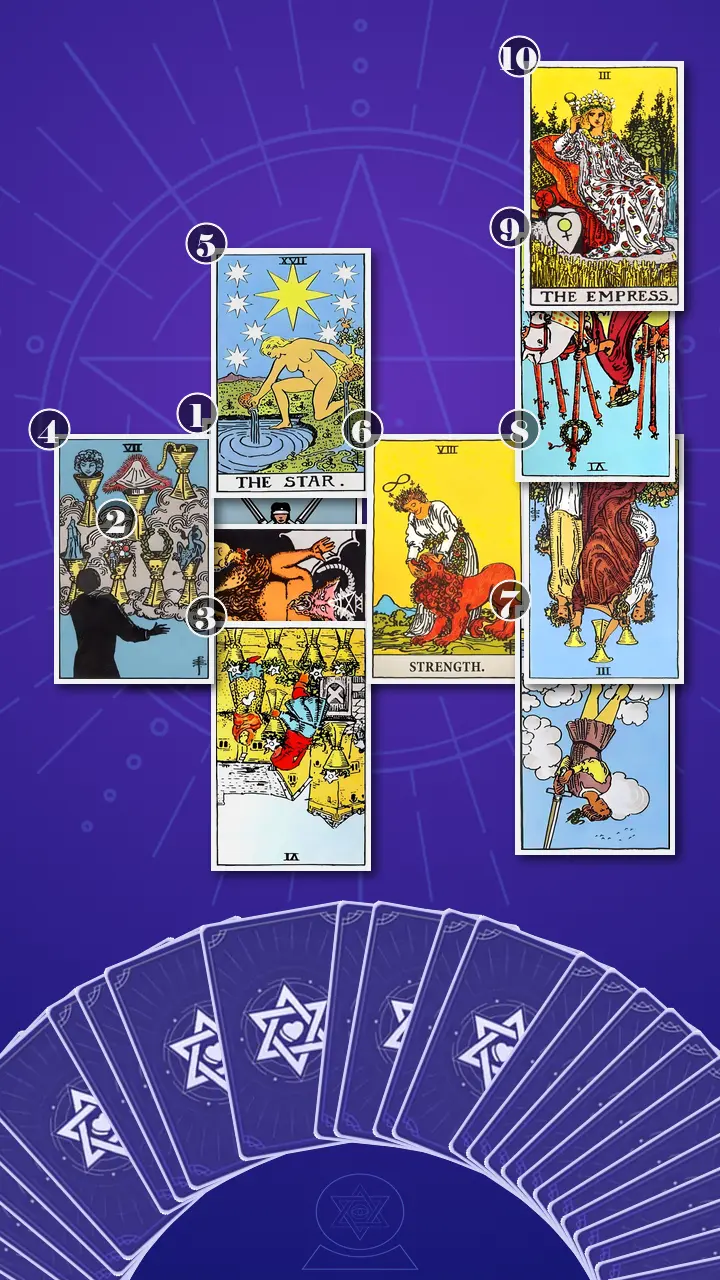
Choosing the Compass: The Celtic Cross · Context Edition
I asked Maya to place her phone face-down for a minute. Not as a dramatic ritual—just a nervous-system reset. “One breath in,” I said, “and on the exhale, let your shoulders drop even one millimeter.”
While she breathed, I shuffled slowly. I always do it this way—not because the cards need theatre, but because people do. The slow rhythm gives your brain a bridge from panic to curiosity.
“For this,” I told her, “I want to use a spread called the Celtic Cross · Context Edition. It’s basically the classic Celtic Cross, but with two positions adjusted for modern life—how you see yourself online, and how your social media environment amplifies things.”
And for anyone reading this who’s ever Googled how tarot works at 1 a.m.: this is why I love the Celtic Cross for loops like Maya’s. It builds a chain—surface behavior → deeper root → internal shift → integration—without turning the reading into a prediction. The point isn’t “what will happen on Instagram.” The point is “what is happening in you, and what’s the next grounded move?”
“We’ll start with what’s happening right now—the immediate post-check-delete loop,” I said. “Then we’ll look at what crosses you: the exact pressure point that makes leaving the selfie up feel unsafe. After that, we go underneath—what wound is driving the intensity. And we’ll pay close attention to one card in the near-future position, because that tends to show the first tiny inner move that changes everything.”
Reading the Map: When a Selfie Becomes a Trial
Position 1 — The Immediate Loop: Two of Swords (upright)
“Now we’re looking at what’s happening right now: the immediate behavior loop around posting, checking, and deleting,” I said as I turned the first card. “Two of Swords, upright.”
In the picture, the figure is blindfolded, arms crossed, swords held close like a barricade. “This is like hitting ‘share’ and then freezing—like you’ve put your heart on the table but your mind throws a blindfold over your feelings,” I said. “You keep your phone close, refreshing ‘casually,’ pretending it’s neutral… but you’re bracing for impact.”
Energy-wise, this is a blockage: not a lack of intelligence, but an interruption between feeling and choosing. The Two of Swords doesn’t scream. It goes quiet. It says, if I don’t fully feel this, maybe I won’t get hurt.
“It’s literally me,” Maya said, and then she did something I love because it’s so human: she laughed, but her eyes didn’t. “That’s… kind of brutal.”
“Brutal, but not blaming,” I said. “It’s self-protection.”
Then I pulled the ‘mini-trial’ frame into the room, the way you bring in a mic stand—cleanly, without drama. “Here’s what I’m hearing: your brain turns the post into a courtroom.”
I took a pen and drew two columns on my notepad:
What happened: “I posted. It’s been ten minutes. Some people saw it.”
What my mind says happened: “They saw it and kept scrolling. That means something about me.”
Maya’s jaw tightened at the second column. She didn’t look away from it; she just went very still, like she was watching a scene she already knew by heart.
Position 2 — The Pressure Point: The Devil (upright)
“Now we’re looking at what crosses you: the pressure point that makes the selfie feel unsafe to leave up,” I said. “The Devil, upright.”
“Ugh,” Maya breathed, like she’d just seen her iPhone Screen Time report pop up at the worst possible moment.
“Yeah,” I said gently. “Not ‘you’re bad.’ More like: this is sticky.”
“The pressure isn’t the photo,” I explained, “it’s the grip of metrics. You tell yourself you’ll check once, but it becomes the whole evening—views, likes, who watched your story, who didn’t. Deleting becomes the quick exit that relieves the panic, even though it keeps the bargain alive: I’m only safe if I’m approved.”
This card is excess energy—attachment turned up too loud. It’s like the volume knob got stuck on “monitoring.”
I tapped the loose chains in the image. “This is important: the chains are loose. That doesn’t mean it’s easy. It means agency exists in small increments.”
Maya stared at the card and swallowed. “It feels like I have to delete,” she said, voice low. “Like if I leave it up, I’m letting people… decide something about me.”
“That’s the bargain,” I said. “And the bargain always charges interest.”
Position 3 — The Root Driver: Six of Cups (reversed)
“Now we’re looking at the root driver: the deeper validation wound and the belief underneath the behavior,” I said. “Six of Cups, reversed.”
My voice softened because this is where the room usually changes temperature. “This is the card that says: the selfie is carrying extra weight. It’s not only, ‘Do I look good?’ It’s, ‘Am I welcomed?’”
In modern life, it looks like this: you scroll old photos, not because you miss your eyeliner from 2019, but because you miss the version of belonging you felt back then. “A slow response doesn’t just disappoint you,” I said. “It reactivates an older template of feeling overlooked. And then today’s engagement numbers land like that old sting all over again.”
Energy-wise, reversed Six of Cups is a blockage between past and present—memory running the current moment. And here’s the line I watched Maya react to: “This isn’t vanity,” I said, “it’s a receipt.”
Her reaction came in a three-step chain I’ve heard a thousand times on the radio when someone finally names the real thing: 1) her breath paused; 2) her gaze unfocused, like she was replaying a private clip; 3) she exhaled through her nose and her shoulders dropped a fraction.
“Oh,” she said, almost to herself. “That’s why it feels so personal.”
Position 4 — The Recent Past: Seven of Cups (upright)
“Now we’re looking at the recent past: what’s been shaping your relationship with visibility and comparison lately,” I said. “Seven of Cups, upright.”
“Lately,” I translated, “posting has felt like choosing from a scrollable menu of ‘acceptable versions’ of you. Multiple edits, multiple caption drafts in Notes, multiple imagined outcomes—and the more possibilities you hold, the less you trust any of them.”
This is excess imagination: your brain trying to pre-solve every possible reaction like it’s a marketing campaign and you’re the product. It’s the same energy as rewriting a Slack message three times because you can hear an imaginary coworker reading it in a judgmental tone.
Maya let out a small groan. “I hate how accurate that is.”
“It’s not because you don’t know what you want,” I said. “It’s because you’re terrified of being misread.”
Position 5 — The Conscious Aim: The Star (upright)
“Now we’re looking at the conscious aim: what you think you want from posting,” I said. “The Star, upright.”
The Star always clears the air in a reading. It’s open sky after a cramped bathroom mirror.
“What you think you want is likes,” I said. “What you actually want is to feel clean and okay in your own skin—like you can post because it’s you, not because it will perform. You want visibility that restores you, not visibility that turns you into a product.”
This card is balance: hope that doesn’t demand instant proof. A selfie can be self-expression, or it can be a referendum. The difference is where you put the metric.
Maya nodded fast, like she recognized herself underneath the loop. “Yes,” she said. “I just want to feel normal about being seen.”
When Strength Took the Phone Out of Her Hand
Position 6 — The Near Future (Key Card): Strength (upright)
I slowed down before I turned the next card. The room got quieter—not mystical quiet, just the kind that happens when someone can sense you’re approaching the core of the thing.
“Now we’re looking at the near future: the next inner move available if you choose self-trust over metrics,” I said. “And this is the bridge card of your whole reading.”
“Strength, upright.”
In the image, the lion isn’t defeated. It’s soothed. “Right after you post,” I said, “the urge spikes: check, adjust, delete. Strength here looks like doing something almost boringly kind—breathe, hand on chest, put the phone down, let the discomfort crest and pass. You don’t need to stop caring. You need to stop letting the urge steer the car.”
I watched Maya’s face change like a dimmer switch. She was still tense, but she was listening differently—like the part of her that’s exhausted finally heard a plan that didn’t require becoming a new person overnight.
Setup (the moment you know): You know that moment—phone warm in your hand, face a little hot, stomach tight—when you’re refreshing like you can force reassurance to appear. You’re scanning the crowd for applause before you finish your first line, and the quiet feels like danger.
Delivery (the sentence that cuts through):
Stop treating likes as a verdict and start practicing steady courage—hold your inner lion with Strength, not your phone.
I let it sit in the air for a beat. No extra commentary. Just space.
Reinforcement (what it does to the body): Maya’s reaction didn’t arrive as instant relief. First, her posture stiffened—like she’d been challenged. Her mouth tightened, and her eyes flashed with something that looked like anger. “But if I stop checking,” she said, “doesn’t that mean I’m… pretending I don’t care? Like I’m lying to myself?”
I nodded because that’s a real fear, and I didn’t want to outrun it. “No,” I said. “Strength isn’t pretending. Strength is staying present. It’s you saying, ‘I care—and I’m not going to negotiate my worth with an algorithm tonight.’”
And then the three-step chain happened again, slower this time: 1) she held her breath like she was about to hit ‘delete’; 2) her eyes went slightly unfocused, like she was picturing herself in bed with the notifications tab open; 3) she exhaled, long and shaky, and her shoulders dropped as if someone had taken a heavy bag off them.
Her face was still warm, but her expression softened. “Okay,” she whispered. “So it’s not discipline. It’s… choosing not to abandon myself.”
That was the pivot—from tight self-consciousness to the first hint of grounded self-trust. Not certainty. Not a perfect relationship with Instagram. Just a new internal metric.
“Exactly,” I said. “This isn’t about winning the room. It’s about finishing your line anyway.”
Then I brought in my own lens—my signature approach—because Strength isn’t just a concept to me. It’s a rhythm.
“Maya, can I do a quick Music Pulse Diagnosis with you?” I asked. “What have you been playing lately when you’re spiraling?”
She blinked. “Honestly? A lot of… jittery stuff. Up-tempo pop. And sometimes I put on The Daily or whatever podcast, like background noise, but it’s not relaxing.”
“Right,” I said, thinking of my years in radio—how a track at the wrong tempo can make a studio feel frantic even if everyone is ‘fine.’ “Your nervous system is already running fast. Then you introduce a high-stakes moment—being seen. And you try to regulate with more stimulation: refresh, refresh, refresh.”
“Strength is a Breath Soundtrack,” I continued. “Not a lecture. Not a personality trait. A tempo shift. We’re going to slow your internal BPM on purpose, so your brain can’t turn silence into a siren.”
Position 7 — You in the Pattern: Page of Swords (reversed)
“Now we’re looking at you in the pattern: how your self-talk, attention, and identity show up in the moment you hit delete,” I said. “Page of Swords, reversed.”
“In the moment you want to delete,” I translated, “your mind turns into a live comment section. You imagine specific people judging you, reread your caption for ‘cringe,’ and treat silence like a verdict.”
This is excess Air: hypervigilance. Mental sharpness turned inward like a blade. It’s like your brain is running its own Reddit thread about you before anyone else has commented.
“What you ‘know’ is a view count,” I said. “What you’re ‘guessing’ is a verdict.”
Maya pressed her lips together and nodded once—small, decisive. Like she’d just heard something she could actually use at 12:41 a.m. when the city noise is humming and she’s about to delete again.
Position 8 — Your Environment: Three of Cups (reversed)
“Now we’re looking at your environment: the social-media context and peer cues that amplify the wound,” I said. “Three of Cups, reversed.”
“Your environment is loud with comparison,” I said. “Friends posting, group chats reacting fast, the subtle social math of who likes what. Even real community can start to feel conditional when it’s filtered through public taps.”
This card is a blockage of belonging. Not because you don’t have people—but because you’re measuring closeness through public signals. And public signals are a messy instrument.
Maya looked down at her hands. “I hate that I notice,” she said. “Like—who liked her post immediately. Who didn’t like mine. It’s disgusting.”
“It’s not disgusting,” I said. “It’s your nervous system trying to predict safety.”
Position 9 — Hopes and Fears: Six of Wands (reversed)
“Now we’re looking at hopes and fears: what you secretly want validation to prove, and what you fear it will confirm,” I said. “Six of Wands, reversed.”
“Part of you wants the selfie to land like a crown,” I said. “Instant recognition that means, ‘I’m acceptable.’ And part of you is terrified of being overlooked, because ‘average’ feels like failure.”
This is a deficiency of internal recognition. When the crown doesn’t come fast, the old story tries to fill the gap: see, you’re not chosen.
Maya’s eyes glossed, just slightly. “That’s the part I don’t want to admit,” she said. “Because it sounds so… pathetic.”
“It sounds human,” I corrected. “And it makes sense with your root card. The ache isn’t about attention. It’s about belonging.”
Position 10 — Integration Direction: The Empress (upright)
“Now we’re looking at the integration direction: the most grounded way to relate to visibility so you don’t have to disappear,” I said. “The Empress, upright.”
Her whole face softened at the image—lush, warm, steady. “The Empress is the opposite of negotiating your value,” I said. “It’s embodied self-worth. It’s nourishment. It’s the baseline where you already feel okay—fed, rested, in your body, connected—so posting becomes optional.”
This is balance in Earth energy: worth grown internally, not granted externally. “Grow your worth like a baseline, not like a post-performance score,” I said, and I meant it as a practice, not a slogan.
Maya let out a small breath that sounded like relief mixed with grief—like she could see how long she’d been trying to live off applause instead of food and sleep.
From Insight to Action: The No-Check Window (and a Soundtrack That Holds You)
I leaned back and stitched the spread together for her, the way I’d stitch a segment outline before going live.
“Here’s the story your cards are telling,” I said. “Right now, you’re in a stalemate (Two of Swords): part of you wants to express yourself, part of you braces for impact. That stalemate gets crossed by a compulsive attachment to numbers (the Devil), so the moment becomes high-stakes. Underneath, there’s an older ‘am I welcomed?’ ache (Six of Cups reversed), and lately you’ve been trying to pre-solve every reaction by curating endlessly (Seven of Cups). But your conscious aim is actually healing and honest visibility (the Star). Strength shows the first inner shift—regulating the urge without obeying it—and the Empress is the destination: a self-nourished baseline where being seen isn’t survival.”
“Your cognitive blind spot,” I added, “is thinking the only choices are monitor or disappear. The transformation direction is different: practice being seen with self-compassion and boundaries around metrics.”
Then I got practical—because clarity that can’t be used isn’t clarity, it’s just a pretty thought.
- The 7-Minute No-Check WindowOnce this week, after you post (or even after you save the post as a draft), set a 7-minute timer. Put your phone in a different room. When the urge spikes, place one hand on your chest and take 3 slow breaths.Expect the first 2–3 minutes to feel weird—like leaving the stove on. If 7 feels impossible, do 90 seconds. This is practice, not a test.
- The “Know vs Guess” Notes CheckThe moment you want to delete, open Notes and write two mini lists: “What I actually know is…” (3 facts) and “What I’m guessing is…” (3 guesses). Then decide whether you’re deleting the photo… or deleting the possibility of mixed feedback.Treat specific mind-reading (“That one coworker definitely thinks…”) as a guess, not a fact. You’re allowed to pause and come back later.
- Alison’s BGM Prescription (3 Tracks)Before you post at night, play one of these for 8–10 minutes to shift out of the “trial” state:
1) a brown noise track (for city-brain overstimulation),
2) a 432 Hz or 528 Hz calming tone track (if you like steady frequencies),
3) a “soft-focus” instrumental playlist (search: Deep Focus / Lo-Fi Calm) at low volume.This isn’t about being spiritual enough. It’s about giving your nervous system a container so Strength is easier to access. If tones annoy you, skip them—use brown noise + instrumental instead.
“And just so we say it out loud,” I told her, “turning off Instagram notifications for the evening isn’t avoidance. It’s choosing the conditions under which you can stay regulated.”

A Week Later: The Quiet Proof
Six days later, Maya texted me a screenshot—not of her likes, but of her timer. 7:00, completed. Under it she wrote: “I posted to Close Friends. Put my phone in the bathroom. I felt shaky and kind of lonely for a minute… then I made tea. I didn’t delete.”
It wasn’t a fireworks moment. It was a small, stubborn kind of courage—the kind that doesn’t need an audience. Clarity, in her case, didn’t mean never caring again. It meant noticing the heat in her face and the tightness in her stomach, and choosing not to treat that sensation like an emergency order from the algorithm.
When you delete the selfie and feel that split-second relief, it’s often because you’re trying to avoid the ache of “maybe I’m not chosen” landing in your body—hot face, tight stomach, the whole thing.
If you let “being seen” be practice instead of proof, what’s one tiny boundary you’d want around metrics the next time you post?
This story is adapted from psychological research, written so that those in a similar struggle can see their own pattern in it — and find their next step clearly.These insights are not a substitute for professional psychological, medical, legal, or financial advice.
Learn more about our Journey to Clarity.
How did this insight land for you?
🫂 This Resonates Deeply
🌀 Living This Story
✨ Now I See Clearly
🌱 Seeing New Possibilities
🧰 Useful Framework
🔮 The Confirmation I Needed
💪 Feeling Empowered
🚀 Ready for My Next Step
Author Profile
 AI
AI“Through ten years of sound energy research, I’ve found that when we struggle, it's usually just our internal rhythm falling out of sync under pressure. I know firsthand the frustrating helplessness of wanting to move forward but feeling paralyzed. Without overwhelming theories, I want to be the soothing background track that helps you recalibrate, turning your heavy burdens back into a light, effortless, and harmonious melody.”
In this Introspection Tarot Reading :
Core Expertise
- Mental Noise Cancellation: Diagnosing severe internal friction not as a moral failing, but as a chaotic overlapping of incompatible psychological frequencies.
- Resonance Healing Calibration: Identifying the 'dissonant baseline' of your chronic anxiety and calculating the specific acoustic or rhythmic input needed to soothe it.
Service Features
- The Frequency Reset Pause: A customized rhythmic breathing or acoustic grounding technique to forcefully lower your brainwave state from a frantic beta frequency to a restorative alpha state.
Also specializes in :
Explore Related Patterns:
External ValidationMaya waiting for the tiny vibration that means she is safe shows the selfie has stopped being just an image and has become a live measurement of belonging. The post, refresh, zoom, reread, delete sequence gives her nervous system a temporary answer to a deeper question: am I acceptable right now? When the answer is outsourced to likes and views, deleting the post becomes a fast way to end the exposure. You are not simply wanting attention; you are trying to soothe the wound of worth that only feels stable when the outside world responds quickly enough.
Rejection SensitivityTen quiet minutes after Maya posts are read as evidence that people saw her and kept scrolling, and the old line see, you are not chosen rushes in before anyone has actually said anything. Her body reacts as if delayed engagement were exclusion, with a hot face, tight stomach, and held breath. The pattern is the nervous system treating ambiguity as rejection because an older template of being overlooked is running the present moment. You are trying to soothe the sting of maybe I do not belong, so silence becomes a threat instead of simply a gap in feedback.
Visibility AvoidanceMaya deletes the selfie when reassurance does not arrive fast enough, even though she says she wants to post and feel normal, even proud. The deletion is not a clean preference change; it is a quick exit from the exposed feeling of being evaluated. This is visibility becoming unsafe the moment it is not instantly confirmed. You are trying to soothe the wound by disappearing before mixed feedback can touch you, but the disappearing also teaches the body that being seen was the danger.
Mind ReadingMaya knows only that some people saw the post, but her mind writes the second column: they saw it, kept scrolling, and that means something about me. Rereading the caption for cringe and imagining specific judges turns silence into a private trial. The protective intention is to predict rejection before it lands, but the cost is that guesses start acting like facts. You end up trying to soothe a wound created by an imagined verdict, not by clear evidence in the room.
Comparison TrapMaya tracks friends posting, group chats reacting quickly, who liked someone else's post immediately, and who did not like hers. Public taps start functioning like social math, even when the relationships themselves may be more complex than the platform can show. The trap is that belonging gets measured through comparative signals rather than lived connection. You are trying to soothe the fear of being less chosen by checking where you stand, but every comparison gives the wound another scoreboard.
Intermittent ReinforcementMaya calling the notification tab a slot machine is precise: the reward is unpredictable, so every refresh could be the one that makes her safe. The vibration briefly settles the system, which teaches the checking ritual to happen again. This variable reward loop turns reassurance into something you chase rather than something you receive and release. You are not failing at willpower; your attention has been trained to believe the next metric might finally close the wound.
Secure VisibilityMaya's seven-minute timer, the phone in the bathroom, the tea, and the decision not to delete show a different relationship with being seen. The post stays up while her body feels shaky, which means visibility is no longer being handled by panic alone. This pattern grows when you separate expression from instant proof. You still care, but you practice staying with yourself while feedback remains incomplete, which gives the validation wound a steadier place to land.
Shame BindingMaya laughs dryly, calls it stupid, hides the screen brightness, and later says noticing who liked what feels disgusting. The shame arrives after the relief, so the loop is no longer only about the selfie; it is also about judging herself for needing reassurance. That self-judgment binds the wound tighter because it makes the need for belonging feel like a flaw. You are trying to soothe pain with deletion, then punishing yourself for needing soothing at all, which keeps the whole experience private and hotter.
Explore Related Struggles:
Approval-Safety FusionMaya posts, refreshes, zooms, rereads, and deletes when reassurance does not arrive quickly enough. You can feel the bind in the way a tiny vibration becomes proof of safety and a quiet stretch of no likes becomes a failed test. The deletion is not just about removing a photo. It is a fast attempt to get steadiness back after visibility starts feeling like exposure to judgment. You are trying to stand in public view while the body asks for proof that the room will not turn against you, so approval becomes less like feedback and more like permission to feel safe.
Inner Tribunal LockMaya can separate what happened from what her mind says happened. The facts are small and ordinary, but the interpretation becomes a courtroom where silence, scrolling, and delayed reactions are treated as evidence against her. You are not just overthinking a selfie in that moment. You are standing inside an internal hearing where every imagined viewer becomes a witness and every pause becomes a verdict. Deleting the post ends the trial quickly, but it also keeps the court in session for the next time you try to be seen.
Metric-Compass FusionMaya does not stop at posting. She tracks views, likes, story watchers, who reacted, who did not, and how quickly the room seems to answer. You are watching a metric board become the place where meaning gets assigned. The problem is that numbers are too thin to answer the question underneath. A count can tell you what happened on an app, but it cannot tell you whether you are welcome, valued, or safe to be seen. When metrics become the compass, you start outsourcing your inner direction to signals that were never built to carry your worth.
Visibility-Connection SplitMaya wants to post and feel normal, even proud. The moment the response slows down, visibility stops feeling like self-expression and starts feeling like a test she can fail in front of everyone. You are caught between the wish to be seen and the fear that being seen will not translate into connection. Public taps can make community look available while still leaving the deeper need untouched. Deleting becomes a way to step out of the exposed space, but the real longing is not to disappear; it is to be visible without having to turn visibility into proof.
Chosen-Worth BindMaya names the part she does not want to admit, the part that wants the selfie to land like a crown. You are not simply hoping for attention in that moment; you are hoping the public response will prove you are acceptable, selected, and not quietly passed over. That is why an average response can feel harsher than it logically should. The wound is not about one post performing badly, but about worth getting tied to the sensation of being chosen. When recognition does not arrive fast enough, the old conclusion rushes in to fill the space before you can choose a kinder interpretation.
Nostalgic Belonging LockMaya's selfie carries more than the question of whether the photo looks good. The slow response pokes an older template of feeling overlooked, and today's engagement starts landing with the heat of an old memory. You are trying to soothe a belonging wound that did not begin with this post. The present moment gets crowded by a past version of you that still wants to know whether there is a place for her. When that older ache runs the current moment, the app stops feeling like an app and starts feeling like a receipt for whether you were ever welcomed.
Curated Belonging TrapMaya describes the recent past as multiple edits, caption drafts, imagined outcomes, and a scrollable menu of acceptable versions of herself. You are watching self-expression get filtered through an imagined audience before it even reaches the post. The curation is an attempt to prevent misreading, but it creates a different trap. The more versions you generate for possible approval, the harder it becomes to trust the version that is simply yours. The wound being soothed here is the fear that belonging depends on presenting the exact right self at the exact right angle.
Explore Related Emotions:
Approval AnxietyMaya posts the selfie and then moves straight into the loop: refresh, zoom, reread the caption, imagine strangers' reactions, delete. Her body joins the loop too, with shoulders climbing, stomach tightening, and her face heating when she says the word delete. That sequence turns a small act of visibility into a live test of whether she is acceptable. The notification tab becomes a temporary regulator, and the tiny vibration matters because it gives her a momentary feeling of safety. Approval Anxiety fits because the emotional charge is not just wanting people to like the photo. It is the feeling that her worth has been placed outside her body and must be returned quickly through public signals, or the whole system starts to shake.
Belonging ShameThe selfie is named in the story as carrying extra weight: not only Do I look good? but Am I welcomed? A slow response does not simply disappoint Maya; it lands like an old sting of being overlooked returning through today's engagement numbers. That is why the quiet stretch after posting feels so personal. The lack of immediate recognition gets translated into a belonging verdict, and average starts to feel like failure because it touches the fear of not being chosen. Belonging Shame names the exposed ache underneath the metrics. Maya wants reassurance that she has a place, but needing that reassurance makes her feel small, so the desire for welcome gets wrapped in embarrassment before it can be held with any gentleness.
Exposure DreadMaya hits share and then freezes, phone close, body braced as if impact might arrive through the screen. The story describes the post as putting her heart on the table while her mind throws a blindfold over her feelings. Being visible stops feeling like a simple choice and starts feeling like a trial. The selfie becomes a place where other people might decide something about her before she has enough inner steadiness to stay with herself. Exposure Dread names the charged moment after she lets herself be seen. The fear is not just that the photo will be disliked; it is that visibility itself will strip away control and leave her waiting for a verdict from the room.
Rejection ChillA quiet stretch of no likes lands in Maya's body as more than empty time. The story gives it a sharp texture: one jolt, one weird look, one pause in response, and the water of her self-worth spills everywhere. Public signals become a messy instrument for measuring closeness. When they do not arrive fast enough, the gap gets filled by an old sentence: maybe she is not chosen. Rejection Chill fits the cold drop that follows the missing response. It is the feeling of social warmth suddenly being withdrawn, even when nothing explicit has happened, because silence has been loaded with the power to confirm or deny belonging.
Self-Betrayal AcheMaya realizes that the no-check window is not about discipline; it is about choosing not to abandon herself. That line matters because deleting has been offering relief while also keeping the bargain alive: she is only safe if she is approved. Each deletion removes the post, but it also removes her from the discomfort of being visible. The ache comes from sensing that she has been protecting herself by disappearing before anyone else can decide. Self-Betrayal Ache fits because the wound is partly relational and partly inward. The story shows Maya beginning to feel the cost of negotiating her worth with an algorithm, and the first repair is staying with herself long enough not to vanish on cue.
Shame SpiralMaya deletes the post and feels relief first, then shame for caring at all. Even before the deeper wound is named, she tries to shrink the experience with a dry laugh and calls it stupid, as if judging herself might get ahead of anyone else's judgment. The shame has a physical trail in the story: flushed cheeks, a tightened jaw, a body trying not to take up space, and the word delete carrying heat. She is not only embarrassed by the post; she is embarrassed by the need the post reveals. Shame Spiral captures that second layer of pain. The selfie triggers the fear of being judged, and then the fact that she cares becomes another thing to judge, creating a loop where disappearing briefly soothes her while also confirming that her desire to be seen feels unsafe.
Cautious HopeMaya does not move from panic to confidence in one clean leap. First her shoulders drop a fraction, then later she completes the seven-minute timer, puts her phone in the bathroom, feels shaky and lonely for a minute, makes tea, and does not delete. The hope in the story is small enough to be believable. She still cares, still feels the heat in her face and the tightness in her stomach, but she begins to see that caring does not have to mean surrendering her self-worth to the metrics. Cautious Hope fits because the change is tender and unfinished. You can feel a new possibility forming: being seen may become practice rather than proof, one tiny boundary at a time.
Grounded AgencyMaya places the phone face-down for a minute, breathes, and later puts it in the bathroom while the timer runs. These are small physical choices, but they change the center of control in the scene. The point is not to stop wanting reassurance. The shift is that she creates conditions where the urge can rise without automatically becoming a command. Grounded Agency fits because Maya starts reclaiming the space between sensation and action. Her power shows up as phone down, breath slower, boundary set, and one completed window where the algorithm does not get to make the final decision for her.
Hard-Won ComposureRight after posting, Maya's urge spikes: check, adjust, delete. The story does not erase the discomfort; it keeps the phone warm in her hand, her face hot, her stomach tight, and the silence feeling almost dangerous. Then a different rhythm appears. She breathes, puts the phone down, lets the first minutes feel weird, and gives the discomfort enough room to crest without obeying it. Hard-Won Composure names that difficult steadiness. It is not effortless calm or polished confidence; it is the earned capacity to stay present while the old alarm is still ringing.
Hypervigilant AnxietyMaya lies under the duvet on Sunday night with the TV low, thumb flicking to the notifications tab like a reflex. The motion is small, but the attention behind it is intense: who saw it, who liked it, who did not, what the silence might mean. Her mind becomes a live comment section before anyone has actually commented. View counts turn into evidence, guesses start posing as facts, and the quiet after posting is read as danger. Hypervigilant Anxiety fits because the story shows a nervous system scanning for social threat inside tiny digital signals. You are watching a body try to predict rejection fast enough to avoid feeling it, even when the available data is only a handful of taps and pauses.
Comparative JealousyMaya notices the social math: friends posting, group chats reacting fast, who liked someone else's photo immediately, who did not like hers. The environment around her is not silent; it is loud with comparison cues. That comparison does not stay outside her. It turns community into a scoreboard, and then she attacks herself for even noticing the scoreboard, calling the reaction disgusting. Comparative Jealousy names the sting of watching validation appear easily for someone else while your own visibility feels uncertain. In this story, the feeling is not shallow envy; it is a relational ache sharpened by public signals that make closeness look countable.
Visibility ReliefMaya says she wants to post and feel normal, even proud. The story frames that wish as visibility that restores her rather than visibility that turns her into a product. Relief enters when being seen no longer has to carry the whole question of whether she is acceptable. A selfie can become expression again when it is not forced to deliver proof of worth. Visibility Relief fits the softer emotional direction of the story. It names the exhale that becomes possible when Maya can appear without bargaining for approval, even if that freedom is still new and fragile.
Explore Related Contexts:
Approval BottleneckMaya can leave the selfie up only until reassurance fails to arrive. If the likes, views, or tiny vibrations do not show up fast enough, deletion becomes the quick exit that makes the pressure drop for a moment. That makes approval the gatekeeper of action. You have already expressed yourself, but the post is not allowed to remain visible unless the outside world clears it quickly enough, which gives strangers and peers too much authority over your next move. Approval Bottleneck fits because the external signal is blocking the natural completion of the act: post, leave it, move on. The useful boundary is to stop treating delayed feedback as a stop sign and create a time container where the photo does not need immediate permission to exist.
Attention Economy TrapMaya describes Sunday night with the duvet pulled up, the TV low, and her thumb flicking to the notifications tab like a reflex. She calls it a slot machine because the next tiny vibration can suddenly change the meaning of the whole moment. That is the platform layer of the wound: metrics arrive in uneven bursts, and the waiting itself becomes part of the pressure. You are placed inside a system where attention is counted, delayed, ranked, and made public enough to feel meaningful without ever being clear enough to trust. Attention Economy Trap names the external design that keeps the loop sticky. The issue is not a lack of willpower; it is that the environment is built to turn checking into a repeated pull for reassurance, so a boundary around the notification stream becomes a way to reclaim agency.
Social Performance LoopMaya posts a selfie, then moves almost immediately into refreshing, zooming, rereading the caption, imagining how strangers are reading her, and deleting if the post does not land quickly enough. The post is no longer just a photo; it becomes a public performance with a shrinking response window. The external structure is the online visibility economy, where every tap, view, and quiet minute appears measurable but remains socially ambiguous. You are not simply deciding whether you like the selfie; you are being asked to keep a version of yourself onstage while the audience may or may not respond. Social Performance Loop fits because the story keeps returning to the same staged sequence: express, monitor, interpret, retreat. The useful leverage point is not to pretend you do not care, but to separate self-expression from the platform's instant scoring system before the loop converts visibility into a trial.
Algorithmic Comparison LoopMaya does not only watch her own post; she notices who liked someone else's post immediately, who did not like hers, and how quickly group chats react. The environment is loud with comparison because social response is visible enough to invite ranking. The structure is not simple jealousy or vanity. You are inside a platform where closeness, attention, and timing are displayed as trackable signals, even though those signals are too messy to carry the meaning being placed on them. Algorithmic Comparison Loop fits because the wound is amplified by a system that constantly supplies other people's metrics as context for your own. The practical question becomes where to interrupt comparison before the platform turns community into a scoreboard.