Finding Clarity in the Monday-Morning WhatsApp Scroll
You had a genuinely sweet weekend, and then 24–48 hours later you’re hit with post-date whiplash—rewatching every moment like you’re looking for a reason to distrust it.
Taylor arrived looking put-together in that specific London way—clean coat, hair pinned like she’d made a decision about it—but her attention kept snapping back to her phone like it had a magnet in it.
She described it exactly as I’ve heard it a hundred times, but never quite the same twice: 8:41 AM on a Monday, shoulder-to-shoulder on the Central line at Oxford Circus, phone screen bright against the grey. The carriage rattling. Someone’s headphones leaking tinny bass. Her thumb opening the WhatsApp thread just to reread it—then closing it—then opening it again, as if repetition could turn a feeling into a fact.
“It was… genuinely sweet,” she said, and I watched her throat tighten on the word sweet, like it had teeth. “So why do I suddenly feel turned off?”
There it was: the core contradiction in its most modern outfit—torn between naming the ick as fear of intimacy and treating it as a real mismatch.
As she spoke, I noticed the precise tells she probably didn’t: the swallow she couldn’t quite finish; the small, involuntary wince when she imagined a second date; the way her shoulders lifted a fraction, as if bracing for impact from a question as ordinary as, “So… what are you looking for?”
Her unease wasn’t an abstract emotion. It was a physical stomach-drop, like stepping off the Tube and realising you’ve walked onto the wrong platform—followed by a tight-throat pressure that made honesty feel like it might get stuck halfway out.
“I don’t want to lead them on,” she added, faster now, the words bumping into each other. “But I also don’t want to self-sabotage. If I can’t explain the ick logically, I don’t trust it.”
I nodded. “That makes sense. Your mind is trying to protect you by building a case. But we can do something kinder than a courtroom today.” I let the silence sit for half a beat. “Let’s try to map the fog—so you can find clarity without forcing certainty.”
Choosing the Compass: The Decision Cross · Context Edition
I don’t treat tarot like a theatrical ritual; I treat it like a structured conversation with your attention. I asked Taylor to take one slow breath—slower than her instinct wanted—and to hold the question in her mind: Is this ick fear of intimacy, or a real mismatch?
As I shuffled, the sound of the cards was dry and ordinary—like turning pages in a paperback on a rainy commute. That’s the point. It’s a psychological threshold: from spiralling privately into looking at something together, in daylight.
“We’re going to use a spread called the Decision Cross · Context Edition,” I said. “It’s built for exactly this: separating two competing interpretations of the same experience—the post-weekend ick as protection versus the ick as incompatibility—without pretending we can get a perfect verdict from one sitting.”
For you reading this: this is how tarot works when it’s done well. Not prophecy—pattern recognition. A shape that helps the mind stop spinning in circles.
This spread is simple and ruthless in the best way: one card for the immediate reality (what’s actually happening in your thoughts, body, behaviour), two cards for the competing lenses (fear of intimacy vs mismatch), one card as a clarifier (what to ask/notice/communicate), and one card for integration (a grounded next step that builds self-trust).
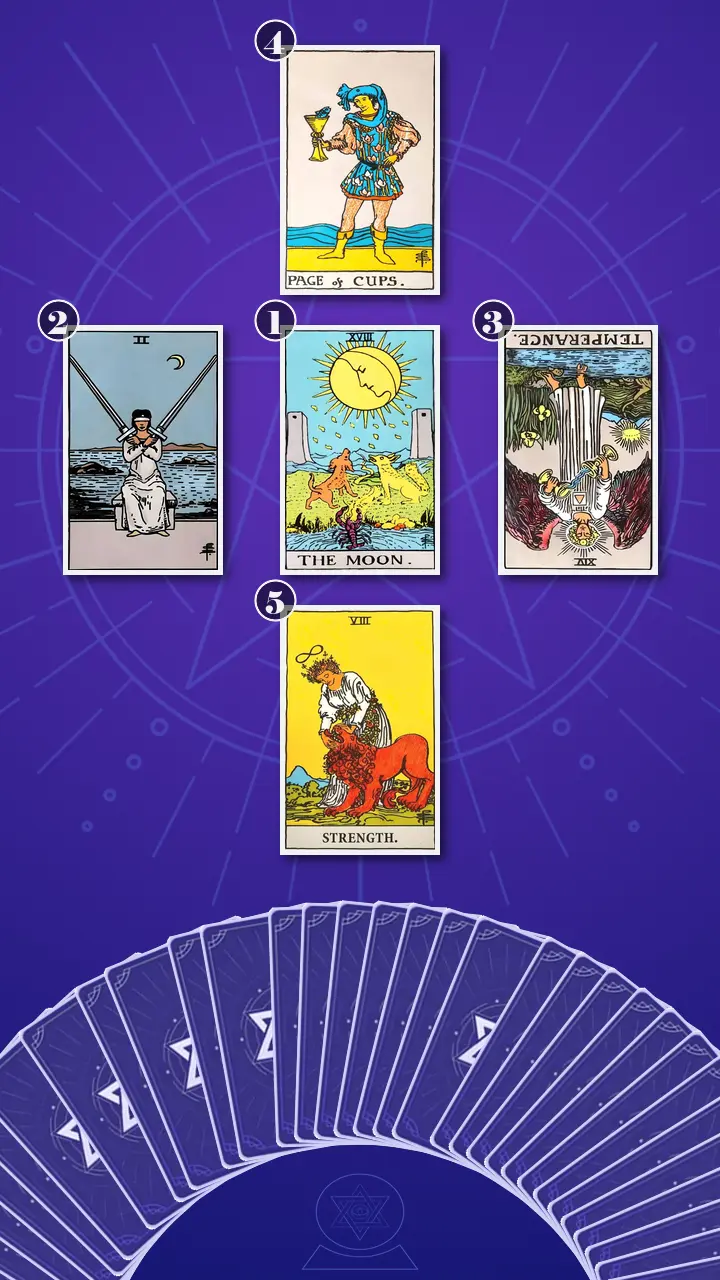
I pointed to the space where the cards would land. “Card 1 will name what the ick is doing right now. Cards 2 and 3 will show the two stories you’re torn between. Card 4 will give you the clean question—the clarifier. And Card 5 will be the practical next step. Not a prediction. A direction you can test.”
Reading the Map: Fear of Intimacy vs Real Mismatch
Position 1 — The immediate reality: what the ick is doing right now
“Now we turn over the card that represents the immediate reality: what the ick is doing in your thoughts, body, and behaviour right after the sweet weekend.”
The Moon, upright.
The image is all low visibility: a winding path disappearing into dim light, creatures rising from water, and two animals—one tame, one wild—howling at the same moon. In my experience, The Moon doesn’t mean “something is wrong.” It means “you’re trying to make a decision in bad lighting.”
I said, “This is like the night after the sweet weekend—you’re lying in bed, scrolling back through messages, and one tiny comment replays in a harsher tone than it had in the moment. Nothing objectively happened, but your stomach drops anyway. Your brain starts imagining the next date as awkward before it even exists.”
Her eyes flicked up—caught—and then down again to the table, as if she’d been seen doing something slightly embarrassing.
“Energy-wise,” I continued, “this is low-visibility Water. Not wrong, not right—just fog. In fog, the nervous system does something very human: it grabs for certainty. It tries to lock onto one detail as proof you should end it, because uncertainty feels unbearable.”
Then I offered her a clean tool, not a lecture. “The Moon asks for a split-screen: three observable facts from the weekend—what was said and done—and three interpretations—the story your mind is telling. Facts and stories often get fused after closeness. Unfusing them is the first rung of clarity.”
Position 2 — Lens A: if the ick is primarily fear of intimacy
“Now we turn over the card that represents Lens A: what it looks like if the ick is primarily fear of intimacy—your protective pattern when closeness increases.”
Two of Swords, upright.
Blindfold. Crossed swords right across the heart. Calm water behind her that she can’t fully see. This is the card of emotional input blocked so the mind can stay in control.
“Here’s the modern version,” I said. “You tell yourself you’re just busy, but you’re using delay as armour. Waiting longer to reply. Avoiding making the next plan. Keeping the conversation light so you don’t have to find out what you actually feel. You’re not rejecting them—you’re freezing the whole situation so you can’t be ‘wrong’ about it.”
I used an analogy Taylor’s face told me she’d understand immediately. “It’s like your phone is locked, but you keep waking the screen—checking the notification preview without opening the message. That little hit of control without the risk of being real.”
“Distance lowers the pressure,” I added, “but it also lowers the data.”
Taylor made a sound that was half-laugh, half-wince. “That’s… painfully accurate,” she said. “If I don’t choose, I can’t be wrong. But then I’m also… stuck.”
“Exactly,” I replied, keeping my tone steady. “This isn’t shameful. It’s logical self-protection. The question is the cost: the longer you stay blindfolded, the more The Moon-fog grows. Less contact, less information, more imagination.”
Position 3 — Lens B: if the ick is primarily a real mismatch
“Now we turn over the card that represents Lens B: what it looks like if the ick is primarily a real mismatch—genuine lack of fit, pacing, or values.”
Temperance, reversed.
Temperance is usually the art of blending—water pouring between two cups, one foot on land, one in water. Reversed, that blend doesn’t settle. The rhythm stays off.
“This card doesn’t villainise anyone,” I said. “It simply says: the mix may not be stabilising in real life.”
I translated it into her week. “The weekend felt easy in a curated bubble. But weekday reality doesn’t blend: texting pace feels too much or too little, planning style feels chaotic or rigid, emotional tone slightly off. And then you start compensating—editing yourself to make the mix work—saying yes when you mean maybe, laughing when you feel irritated.”
Her mouth tightened, and she nodded once, very small.
“Temperance reversed is often the moment someone realises,” I said, “‘If you’re doing all the blending, that’s not being chill—that’s self-editing.’ And self-editing fatigue can show up as an ick spike.”
As an archaeologist, I can’t help thinking in layers. “In a dig, if one layer keeps showing the same imbalance—same kind of pottery, same burn marks—you don’t call it a one-off. You call it a pattern. Temperance reversed asks: where are you consistently adjusting your natural pace to keep things smooth?”
Position 4 — The clarifier: what you need to ask, notice, or communicate
“Now we turn over the card that represents the clarifier: what you need to ask, notice, or communicate to tell fear from incompatibility without rushing to a verdict.”
Page of Cups, upright.
The Page stands relaxed, holding out a cup with a fish peeking out—an odd little messenger. This is my favourite kind of guidance card because it’s not dramatic. It’s curious.
“This is the ‘weird feeling as a notification’ card,” I said. “Not ‘abort mission.’ More like: look here.”
I leaned slightly forward. “A gentle truth beats a perfect theory. The Page asks you to make one small clarity move—one kind, direct question or one pacing preference—so you get new information instead of reassurance.”
Then I offered a micro-script, keeping it simple on purpose—my own version of what I call Pictogram Dialogue: if conflict is a whole essay in your head, communicate with the equivalent of street signs. Clear. Minimal. Impossible to misread.
“Something like,” I said, “‘I had such a nice time. I’m noticing I can get in my head after closeness—can we keep it slow and do something low-key this week?’”
Her thumb unconsciously mimed hovering over a Send button. And I saw it—tiny, but real: her throat unclenched a millimetre at the idea that honesty didn’t have to be a twelve-paragraph confession.
“That message isn’t asking them to fix your feelings,” I added. “It’s inviting real data.”
When Strength Stayed Gentle
Position 5 — Integration and next step: a grounded move that builds self-trust
I took a breath before turning the last card. The room felt quieter—not mystical, simply focused, the way a library does when someone finally finds the book they’ve been searching for.
“Now we turn over the card that represents integration and next step: the most grounded way to move forward this week that supports self-trust.”
Strength, upright.
Strength is not about overpowering anything. It’s a calm figure with gentle hands on a lion—instinct, intensity, urge—held with steadiness rather than force.
Setup (what you know if you’ve lived it): it’s that 24–48 hour window after a genuinely sweet weekend—your commute starts, you open the chat thread, and suddenly your stomach drops like you’ve missed some obvious red flag everyone else can see. Your mind panics and tries to choose between two harsh stories: “I’m self-sabotaging” or “This is doomed.”
Delivery (and I said it slowly, letting it land):
Stop treating the ick as a verdict and start treating it as a sensation you can hold with steady courage—like Strength, you tame the impulse to bolt by staying gentle and present.
There was a pause where Taylor didn’t move at all.
Reinforcement: I watched the reaction travel through her in three steps. First, a physiological freeze—her breath caught, and her fingers went still on the edge of her sleeve. Then cognition seeped in: her eyes unfocused, as if she were replaying the exact moment she’d felt the stomach-drop on the Tube, hearing that metallic screech and mistaking it for danger. And then the release: a long, careful exhale that sounded like she was putting something heavy down without making a noise.
“But if I don’t listen to it…” she began, and her voice tightened with a sudden edge—brief anger, almost—“doesn’t that mean I’ve been wrong before? Like I’ve ignored red flags?”
I didn’t contradict her. I widened the frame. “This is where my work often becomes what I call Emotional Historiography—reading feelings through time, not through one dramatic moment. In archaeology, a single shard can be important, but you don’t declare an entire civilisation from one broken cup. You date it. You place it in a layer. You compare it to other finds.”
“Strength isn’t ‘ignore it,’” I said. “Strength is ‘stay in the room with it long enough to learn what it is.’ You don’t have to obey the impulse to bolt to prove you’re discerning. You also don’t have to shame the impulse to bolt to prove you’re mature.”
Then I asked her the question that turns insight into usable clarity. “Now, with this new lens—just for a moment—think back to last week. Was there a point where you felt the stomach drop and immediately reached for distance? If you’d treated that sensation as information, not a sentence, what would you have done differently for five minutes?”
Taylor blinked hard, then gave the smallest nod. “I would’ve… replied normally,” she said. “Or at least not rewritten the reply six times. I would’ve asked one question instead of disappearing.”
And there it was: not certainty, but self-trust beginning—shifting from post-date unease and evidence-hunting for proof to calm curiosity that treats the ick as workable information.
The One Clean Next Step: Actionable Advice for the Next 48 Hours
I gathered the spread into a single story, because scattered insights don’t help when you’re back on the Central line with your phone in your hand.
“Here’s the pattern the cards describe,” I told her. “The Moon says you’re in low visibility after closeness—your nervous system is loud, and your mind wants certainty. Two of Swords shows your control move: you freeze, you slow-reply, you delay plans so you can’t be wrong. Temperance reversed admits a second truth: sometimes the blend really is off, and you’ve been mixing yourself down to keep it smooth. Page of Cups gives you the ethical method: one gentle, curious message instead of a disappearing act. Strength makes it practical: calm courage, one grounded next step, no verdict required.”
Her cognitive blind spot, I named plainly: “You’re treating the ick as if it must be either a truth you obey or a flaw you eradicate. That binary keeps you stuck.”
And the transformation direction: “We move from interpretation to experimentation. From proving to learning. From ‘I need certainty before I act’ to ‘I need one clean next step so I can get real information.’”
Then I offered the smallest possible actions—because courage in dating is rarely a grand speech. It’s usually a three-sentence text and a boundary you actually keep.
- The 3 Facts vs 3 Stories Note (Moon antidote)On your commute today, open Notes and write: 3 observable facts from the weekend (what was said/done) and 3 interpretations you’re tempted to make. Circle only what you can verify.Keep it time-limited: one stop per bullet. If you catch yourself building a 30-line “case,” stop—your nervous system wants safety, not more evidence.
- Send the Page-of-Cups Text (curious, not courtroom)Send one warm, low-pressure message: “I had a really nice time. I’m noticing I get a bit in my head after closeness—could we keep it slow and do something low-key this week?”If it feels cringe, make it smaller. Write it, leave it in Drafts for 10 minutes, reread once, then send. You’re not confessing your life story—you’re stating a pacing preference.
- The Pacing Non‑Negotiable (Temperance reversed test)Choose one domain for 7 days—texting rhythm or frequency of dates or physical pace—and stop “mixing yourself down.” Example: “I’m not great at all-day texting during workdays—can we do a call later this week instead?”This is my Amphora Balance rule: two people carry equal weight. If the connection only works when you do all the adjusting, that’s data—not a personal failing.
Finally, I reframed commitment the way I do in my own work—what I call Covenant Evolution: “You’re not signing a lifetime contract by planning one low-key date. You’re making a small, historically normal move: gathering evidence over time, with boundaries.”

A Week Later: Relief, and a Little Curiosity
A week later, Taylor messaged me—not a paragraph, just a screenshot and two lines. She’d sent the Page-of-Cups text. She’d expected it to feel like handing someone a lever. Instead, the reply was simple: “Totally get that. Low-key sounds perfect. Want to do a walk and a pub on Wednesday?”
She wrote: “My stomach still did the drop. But I didn’t vanish. I did the 3 facts vs 3 stories thing on the Overground and realised half my ‘proof’ was… literally a story.”
Her clarity wasn’t a fireworks moment. It was a quieter proof: she was gathering real information without punishing herself for having a nervous system.
It wasn’t perfect, either—the kind of progress that actually happens in real life. She told me she slept properly that night, then woke up and her first thought was, What if I’m wrong? Only this time, she noticed the thought, breathed, and didn’t treat it like an emergency.
That’s the Journey to Clarity, as I see it: not certainty, but ownership. Not a verdict, but a method.
When something sweet gets real, your body tightens like it’s bracing for a future you can’t undo—and your mind tries to regain control by turning one tiny “off” moment into the whole verdict.
If you didn’t have to obey the ick or shame it—what’s one small, honest next step you’d be willing to try just to get real information?
This story is adapted from psychological research, written so that those in a similar struggle can see their own pattern in it — and find their next step clearly.These insights are not a substitute for professional psychological, medical, legal, or financial advice.
Learn more about our Journey to Clarity.
How did this insight land for you?
🫂 This Resonates Deeply
🌀 Living This Story
✨ Now I See Clearly
🌱 Seeing New Possibilities
🧰 Useful Framework
🔮 The Confirmation I Needed
💪 Feeling Empowered
🚀 Ready for My Next Step
Author Profile
 AI
AI“Having spent a lifetime at Cambridge and on archaeological digs, I’ve witnessed the rise and fall of countless civilizations. Please know that your current struggles are not a permanent fate, but merely a necessary fracture before rebuilding. I won't lecture you; instead, I invite you to sit with me in the ruins, using a patient, historical perspective to gently dust off the true, enduring value hidden beneath your temporary doubts.”
In this Love Tarot Reading :
Core Expertise
Service Features
Also specializes in :
Explore Related Patterns:
Avoidant AttachmentAfter the genuinely sweet weekend, the second date becomes imaginable and Taylor's body braces as if an ordinary next step carries too much exposure. The pattern is visible in the small relational withdrawals: waiting longer to reply, avoiding the next plan, keeping the conversation light, and freezing the situation so she cannot be wrong. That distance works as emotional regulation. It lowers the pressure of closeness, but it also lowers the data, which means imagination has more room to fill the gap. The line "If I don't choose, I can't be wrong" captures the defense perfectly: safety is created by not moving, even when not moving keeps her stuck. For you, Avoidant Attachment is not a verdict that the connection is fake or that your feelings are broken. It is a pattern to audit when the urge to bolt appears specifically after warmth, availability, or a possible next step, and when a small honest message would give you more truth than disappearing ever could.
Certainty SeekingTaylor's 8:41 AM WhatsApp loop is the clearest behavioral anchor: she opens the thread, rereads it, closes it, and opens it again as if enough repetition could make the feeling settle into a fact. The sweet weekend gives her one set of data, but the Monday-morning body drop pushes her mind into evidence-hunting mode. The protective move is not clarity itself; it is the demand for certainty before any small relational action is allowed. When she says she cannot trust the ick unless she can explain it logically, the mind turns into a courtroom, trying to prove either fear of intimacy or real mismatch before the connection has been tested in ordinary daylight. For you, Certainty Seeking shows up when the need to know becomes stronger than the willingness to learn. The shift is not to ignore the ick, but to stop treating certainty as the entry fee for action and use one clean next step to gather real information.
Black-and-White ThinkingTaylor's question lands as a strict either-or: the ick is fear of intimacy, or it is a real mismatch. That split feels useful because it promises a clean answer, but it also pressures one interpretation to explain the whole experience before the evidence is complete. Black-and-White Thinking is the cognitive trap underneath the post-date spiral. The ick becomes either a truth to obey or a flaw to eradicate, and the connection becomes either self-sabotage or doomed. That binary creates urgency while blocking the slower middle ground where a feeling can be real, protective, exaggerated, and still worth testing. For you, the psychological shift is from verdict to experiment. You do not have to decide whether the ick is completely valid or completely false before you send one honest message, name one pacing preference, or gather one more piece of real-world data.
Emotional ReasoningTaylor's stomach drop and tight throat arrive before she has a clean explanation. Her body reacts to the thought of a second date, and then the mind looks backward through the weekend for something that could justify the intensity of that sensation. Emotional Reasoning takes that body-level intensity and lets it masquerade as evidence. A tiny comment replays in a harsher tone, a neutral message starts to feel loaded, and the physical drop becomes easy to mistake for a red flag rather than a signal that needs context. For you, the work is not to shame the body for reacting. The useful audit is whether the sensation is being treated as information you can hold, date, and compare against facts, or as a final sentence you must obey immediately.
Boundary DiscernmentTaylor's Page-of-Cups text is the turning point because it does not ask for a verdict. It names the post-closeness reaction, keeps the tone warm, and asks for a slower, low-key next step that can be tested in real life. Boundary Discernment separates a boundary from a shutdown. Instead of disappearing to regulate anxiety or overexplaining to earn permission, the pattern becomes a small, clean statement of pace. That gives the other person a fair chance to respond while protecting Taylor from mixing herself down to keep things smooth. For you, this is the grounded middle path between obeying the ick and shaming it. When Taylor sends the message, still feels the stomach drop, and does not vanish, self-trust starts to come from evidence gathered with boundaries rather than certainty forced in isolation.
Self-SilencingThe Temperance reversed section gives the mismatch lens its strongest behavioral evidence: Taylor may be saying yes when she means maybe, laughing when she feels irritated, and editing herself to make the blend feel smoother than it actually is. The ick may not come from the other person being wrong; it may come from the cost of muting herself. Self-Silencing turns relational friction into private strain. Instead of naming pace, preference, or irritation while it is still small, the self gets trimmed down to preserve the mood. Over time, that quiet adjustment can make the body revolt through an ick spike because direct honesty has been delayed. For you, this pattern matters because real mismatch becomes visible only when you stop doing all the blending. A pacing preference is not a dramatic confrontation; it is a data test that shows whether the connection can hold your real rhythm, not just your most agreeable version.
Explore Related Struggles:
Binary Choice LockTaylor names the weekend as genuinely sweet, then immediately gets pulled into the question of whether the ick is fear of intimacy or a real mismatch. The issue is not that either possibility is fake. The pressure comes from forcing the whole experience into two harsh stories before there is enough lived data to tell what is actually happening. You can feel the lock in the way the ick becomes either a truth to obey or a flaw to eradicate. Once the body signal has to choose a legal category, curiosity disappears. The connection stops being something you can test at human speed and becomes a case you have to win inside your own head. The struggle here is the need to pick the correct interpretation before you are allowed to act kindly. Clarity starts to return when the question shifts from which story is final to what small piece of information can be gathered without abandoning yourself or the other person.
Certainty-Safety FusionOn the Central line, Taylor opens the WhatsApp thread, closes it, and opens it again as if the same messages might finally harden into proof. The repetition is not random scrolling. It is a way of trying to make the uncertainty feel physically safer by turning a sensation into something she can prosecute, explain, and control. You see the fusion when she says she does not trust the ick unless she can explain it logically. Logic becomes less like a tool and more like a locked door she cannot move through until every feeling has been verified. That makes sense as self-protection, but it also keeps her inside the fog because no amount of rereading can replace new relational data. The core strain is the belief that certainty has to arrive before action. The story loosens that bind by giving her a smaller standard of safety, where one warm text, one pacing preference, and one low-key plan can test reality without demanding a final verdict.
Distance-Intimacy SplitAfter a sweet weekend, Taylor's body reacts to the idea of a second date as if closeness itself has raised the stakes. The wincing, the bracing, the delayed replies, and the urge to keep the conversation light all point to the same split. Part of her wants enough contact to know what is real, while another part tries to lower the pressure by stepping back. You can hear the tension in her worry about not leading them on and not self-sabotaging. Distance feels ethical because it avoids giving the wrong signal, but distance also removes the information she needs to know whether the connection is safe, mutual, or misaligned. The retreat protects her from being wrong, while also keeping her stuck without fresh evidence. The struggle is not solved by forcing yourself closer or disappearing faster. It begins to shift when distance is no longer the only way to manage pressure, and intimacy no longer has to mean immediate exposure. A slow, honest next step gives the connection a chance to show itself without making your whole body carry the verdict at once.
Inner Tribunal LockTaylor does not simply feel uncertain after the weekend. She starts assembling a case. One comment gets replayed in a harsher tone, the chat thread becomes evidence, and the body signal gets treated like it has to testify for either fear of intimacy or real incompatibility. You can feel how exhausting that inner courtroom becomes. Every sensation has to prove its legitimacy, every possible next step is judged for whether it will make her wrong, and even a gentle message starts to feel like handing someone a lever. The trial offers control, but it also keeps her from meeting the actual person in front of her. The struggle is the conversion of self-protection into self-interrogation. Clarity becomes possible when the ick is allowed to be information rather than a sentence. That shift gives you a way to stay discerning without putting your whole dating life on trial every time closeness makes your body loud.
Relational Pacing StrainThe weekend works inside its own curated bubble, but the weekday version of the connection starts to reveal friction. Texting rhythm, planning style, emotional tone, and the pace of seeing each other do not blend as cleanly once real life returns. That is where Taylor starts editing herself, saying yes when she means maybe and smoothing over irritation before it can become useful information. You can feel the strain because the possible mismatch is not about one dramatic red flag. It is about whether the relationship can hold her actual rhythm. If the mix only stabilizes when she does all the adjusting, the ick may be pointing to an imbalance in pace rather than a flaw in her capacity for intimacy. The important move is not to overexplain the whole connection. It is to name one concrete pacing preference and watch what happens next. A bond that can adapt to a real boundary gives you different data from a bond that only works when you shrink your timing, tone, or needs to keep things smooth.
Explore Related Emotions:
Cautious Self-TrustA week later, Taylor still feels the stomach-drop, but she does not vanish. She sends the text, checks her facts against her stories, and notices the what if I am wrong thought without treating it like an emergency. Cautious Self-Trust is not a sudden glow of confidence. It is the quieter capacity to stay with an uncomfortable signal long enough to learn from it, while still keeping your agency intact. The story earns this emotion because progress does not arrive as certainty. It arrives as ownership: a body that still reacts, a mind that still questions, and a self that can take one clean next step anyway.
False Alignment UneaseTaylor notices that the weekend felt easy in a curated bubble, while weekday reality may not blend: texting pace, planning style, and emotional tone all start to matter. The sharper detail is that she may be compensating, saying yes when she means maybe and laughing when irritation is actually present. False Alignment Unease lives in that small self-editing. The connection may look smooth from the outside because one person is quietly sanding down their natural pace to keep it working. This label keeps the mismatch possibility alive without turning anyone into a problem. It names the inner discomfort that appears when harmony depends on you doing too much of the blending.
Grounded AgencyTaylor is invited to take one slower breath, separate facts from interpretations, and send one gentle pacing message instead of disappearing. The emotional movement is small, but it changes the whole frame from private spiralling to shared reality-testing. Grounded Agency appears when the ick stops being a command and becomes workable information. You do not need to solve the entire relationship in one sitting; you need one honest action that creates cleaner data. This is why the story lands on experimentation rather than certainty. The inner weather becomes steadier when you can act without forcing a verdict, protect your pace without vanishing, and stay close enough to learn what is actually true.
Intimacy ClaustrophobiaTaylor’s throat tightens on the word sweet, and her shoulders lift when she imagines a second date. Nothing in the story shows an obvious rupture, yet the body responds as if ordinary closeness has narrowed the room. You can see Intimacy Claustrophobia in the way a simple next step starts to feel like impact. The pressure is not only about liking or not liking someone; it is about the feeling that being known, asked, or expected to continue might remove your ability to move freely. That is why the ick carries such charge. It may be pointing to real pacing data, but it is also wrapped in a bodily squeeze that makes closeness feel urgent before it has actually become unsafe.
Intuitive Self-DoubtTaylor almost disappears instead of asking one direct question, and later realizes that half her proof was actually a story. The date is not the only thing under suspicion; her own internal signal becomes something she feels she has to verify from the outside. Intuitive Self-Doubt shows up when the body speaks but the mind does not know whether to trust the language. The stomach-drop might be useful information, but it might also be old protection, and that uncertainty makes her doubt her capacity to read herself. The story’s practical shift matters because self-trust is rebuilt through small tests, not forced certainty. She learns that she can listen to the sensation without handing it total authority.
Relational FogTaylor keeps opening and closing the WhatsApp thread on the Central line, trying to reread a feeling until it turns into a fact. The weekend was genuinely sweet, but the Monday-morning replay makes each memory look slightly different under pressure, as if the connection has moved into low visibility. You are not dealing with a clean yes or no signal here. The body reacts first, the mind rushes in afterward, and the story starts fusing observable facts with interpretations. That creates Relational Fog: the suspended inner weather of wanting clarity while every attempt to force clarity makes the emotional atmosphere harder to read. This label fits because the central question is not whether one detail proves intimacy fear or mismatch. It is the disorienting state of trying to make a romantic decision while your internal lighting is poor, your body is loud, and your mind keeps mistaking repetition for evidence.
Self-Audit AnxietyTaylor says she cannot trust the ick unless she can explain it logically, then keeps searching the weekend for proof. The emotional scene becomes less like remembering a date and more like prosecuting her own reaction. You are watching Self-Audit Anxiety take over when a sensation refuses to become a clean argument. Instead of letting the stomach-drop be one piece of information, the mind demands a complete case file before allowing any move at all. This matters because the question she brings is already split in two: fear of intimacy or real mismatch. The anxiety comes from believing she must audit herself perfectly before she is allowed to respond honestly.
Verdict DreadTaylor’s mind turns one off feeling into a forced ruling: either the ick is true and she must leave, or it is a flaw and she must correct herself. Even the memory of past red flags enters the room, making the present sensation feel heavier than the actual evidence in front of her. You can feel Verdict Dread in that binary pressure. The body has a reaction, and suddenly the reaction seems to demand a final answer about the whole connection, her judgment, and what kind of dater she is. The story keeps pushing against that false courtroom. The more the ick is treated as a sentence, the less room there is to ask what it actually contains: fear, mismatch, pacing needs, irritation, or simple uncertainty.
Tenderness OverwhelmTaylor calls the weekend genuinely sweet, but the word catches in her throat like it has teeth. The warmth is not fake, yet her body receives it with a stomach-drop, as if sweetness has arrived carrying expectations she has not consented to yet. Tenderness Overwhelm is the pressure that can follow a good moment when it suddenly feels consequential. The issue is not that care is unwanted; it is that care can feel like it requires an immediate level of openness, certainty, or future commitment. That makes the ick more complex than simple attraction loss. Part of the turned-off feeling may be the nervous system trying to shrink a tender experience back down to a size it can hold.
Explore Related Contexts:
Digital Intimacy Boundary ConfusionTaylor’s uncertainty does not stay abstract; it moves through WhatsApp, reply timing, draft messages, and the repeated opening and closing of the chat thread. The phone becomes the place where closeness is negotiated without either person being fully in the room. Digital contact gives her just enough connection to keep monitoring the situation, but not enough direct information to resolve it. Delayed replies, light conversation, and hesitation around making the next plan create a dating environment where distance feels controlled while the actual relational data gets thinner. You can see the context clearly in the proposed Page-of-Cups text. The issue is not whether a message is perfect; it is whether digital contact can become a clean boundary and a real question, rather than a private courtroom where every notification becomes evidence.
Readiness Mismatch CycleThe weekend feels easy in its own bubble, but the weekday version of the connection brings in texting rhythm, planning style, emotional tone, and the question of pace. Taylor is not evaluating a fantasy; she is watching whether the connection can function outside a curated stretch of time. The mismatch becomes visible when she starts compensating. Saying yes when she means maybe, laughing through irritation, or mixing herself down to keep the atmosphere smooth suggests that the relationship may only feel workable when her natural pace is edited out. You do not need a dramatic dealbreaker for this context to matter. Readiness can fail quietly through rhythm, timing, and uneven adjustment, which is why the story asks her to test one pacing preference instead of forcing a verdict from the first spike of ick.
Relationship Hypervigilance LoopTaylor leaves a sweet weekend and immediately starts scanning the evidence: the chat thread, the memory of a comment, the imagined second date, the body’s stomach-drop. The dating context turns into a monitoring field where ordinary ambiguity starts to feel like something that must be solved before she can move. The loop is social as much as personal. Early dating offers limited data but high interpretive pressure, so the mind tries to make a verdict out of fragments: one message tone, one physical reaction, one moment of irritation, one imagined future conversation. You are dealing with a context where the search for certainty can become louder than the connection itself. The story’s practical shift is to stop treating every signal as final proof and start gathering new information through proportionate contact, pacing, and direct communication.
Direct Communication TrialTaylor does not want to lead the other person on, and she also does not want to disappear because she cannot explain the ick logically. That puts the external task in plain view: she needs a communication move that is honest enough to create data and gentle enough not to overstate certainty. The trial is small but socially meaningful. A three-sentence pacing message asks whether the other person can meet her in a slower rhythm, and it turns private interpretation into an observable exchange. You are not solving the whole relationship through one text. You are testing whether clarity can come from direct contact rather than from another round of rereading, delaying, and building a case in your head.
Strategic Dating BoundaryTaylor’s clearest move is not a confession or a verdict; it is a pacing preference. She names that she gets in her head after closeness and asks for something slow and low-key, which turns the ick into a boundary test rather than a disappearance act. That boundary creates social information. The other person’s simple acceptance of a walk and pub plan shows whether the connection can hold a real limit without pressure, punishment, or overexplanation. You regain agency here by making the dating environment testable. Instead of adjusting yourself until the connection feels smooth, you set one condition and watch how reality responds.