The 8:47 p.m. Draft That Turned Into a Trial
“You can say I’m not ready out loud,” I told Jordan, “and then you spend the next hour rewriting the text to sound ‘mature,’ with full-on Sunday Scaries energy.”
Jordan—28, non-binary, mid-level office job, Toronto—let out a small breath that was half laugh, half flinch. “Okay, wow. That’s… grossly accurate.”
They’d booked me for a late-evening session, the kind where the city outside is still running but your body is already negotiating with exhaustion. Jordan sat on their condo couch with their work laptop still open to Outlook, phone in hand, rereading the same two-line iMessage thread like it was a document that could change their life.
The overhead LED light felt a little too bright. Their phone was warm against their palm. Their shoulders kept creeping up toward their ears, like their body was trying to make itself smaller.
“I sent it,” they said, voice careful. “Just… ‘I’m not ready to define this yet.’ And the second it left my thumbs, my chest went tight and my stomach dropped. Like I’d just failed some invisible test.”
I’ve hosted radio for years—music therapy segments, call-ins from people who don’t know how to name what they’re feeling but can name the song they keep looping. Jordan’s shame had that same quality: not loud, not dramatic—more like an irritating high-frequency tone you can’t un-hear once you notice it.
“So your question is: after ‘I’m not ready,’ why does it hit your self-worth?” I said. “Because right now, it’s landing in your body like I’m not enough. Wanting to honor your own timing versus fearing that needing time proves you’re not lovable or capable.”
Jordan nodded, but their eyes stayed on the phone like it might start grading them. The silence from the other person wasn’t just silence—it was a blank screen they were treating like a verdict.
“We’re not here to make you ready,” I added gently. “We’re here to find clarity—so ‘not ready’ stops sounding like a confession and starts sounding like honest information you’re allowed to act on.”

Choosing the Compass: The Celtic Cross · Context Edition
I asked Jordan to take one slow breath in, one longer breath out—nothing mystical, just a nervous-system handrail. Then I shuffled, the cards making that soft paper hiss I’ve always loved, like a brush across a snare drum.
“Today we’ll use the Celtic Cross · Context Edition,” I said. “It’s the classic Celtic Cross, but with position roles tuned to your exact moment—what happens right after you say the boundary, what hooks it into shame, what the deeper root is, and what the next internal pivot can be.”
If you’ve ever wondered how tarot works when you’re not asking for fate or prediction, this is the kind of spread I reach for. Not because it tells you what someone else will do, but because it maps the chain reaction: the visible behavior (the phone-checking, the overexplaining) → the hidden fear underneath → the inner critic and social pressure that keep it going → the leverage point where everything can shift.
“Think of it like an audio session,” I said, tapping the deck once on the table. “We’re not judging the song. We’re isolating tracks. What’s the lead vocal? What’s the static? Where’s the feedback loop?”
I pointed to the layout as I placed the first cards. “Card 1 is the immediate ‘after’ moment. Card 2 crosses it—the force that turns pacing into a self-worth hit. Card 3 is the root fear. And Card 6, on the right, is the near-future pivot—the internal switch that can change the whole experience.”
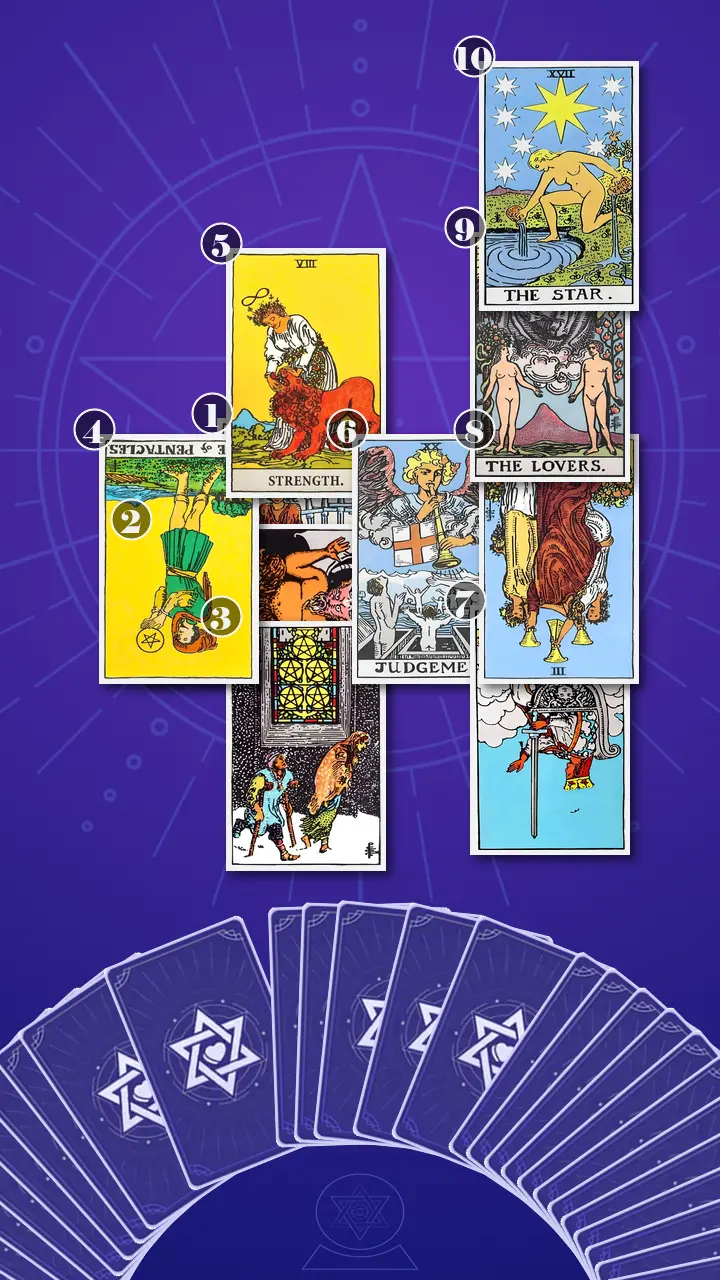
Reading the Map: Card Meanings in Context
Position 1 — The Aftermath Loop
“Now we’re turning over the card that represents the observable ‘after’ moment: what happens in your mind and behavior right after you say ‘I’m not ready.’”
Eight of Swords, upright.
I watched Jordan’s eyes tighten—like they recognized the picture before they recognized themselves in it.
“This is like when Jordan says one honest sentence, then spends the next day trapped inside their own commentary track, treating uncertainty as evidence of personal failure.”
In energy terms, the Eight of Swords is blockage—not because you’re truly trapped, but because your perception narrows until there’s only one question left: How did they take it? The blindfold isn’t fate; it’s focus gone too tight. And the bindings? They’re loose. The prison is maintained by what you say to yourself after you speak.
I let the image land, then added, “Micro-montage: laptop open with a half-finished doc, phone warm from scrolling, thumb hovering over delete, shoulders creeping up. Your brain calls it ‘being responsible.’ Your body calls it ‘brace for impact.’”
Jordan gave a short, bitter little laugh. “This is my exact after-text spiral,” they said, and the way they said it—like it was both validating and kind of unfair—told me we’d hit the recognition point.
Position 2 — The Force That Turns Pace Into Worth
“Now we’re turning over the card that represents the main internal force that turns a pacing boundary into a self-worth hit.”
The Devil, upright.
Jordan’s face did that immediate wince people do when a card doesn’t feel symbolic—it feels like a screenshot.
“This is like when Jordan feels they must keep someone happy in order to stay safe, and they mistake that pressure for love.”
The Devil’s energy is excess—too much attachment to one outcome, too much bargaining, too much “please don’t leave” hidden inside “I’m just being considerate.” It’s the approval tether. It’s refreshing iMessage/WhatsApp like it’s a live score—up if they respond warmly, down if they take time.
“Here’s the sound of it,” I said, because sound is how I name things. “It’s like handing someone your self-worth like a receipt to be stamped. You’re not just waiting to hear back. You’re waiting to breathe.”
Jordan swallowed. Their thumb pressed the edge of their phone case—hard—then released. “That’s… yeah,” they said quietly. “I don’t even want the answer. I want proof I’m still wanted.”
“Exactly,” I said. “And that’s why it hits self-worth. The boundary isn’t the problem—the chain is.”
I paused, then gave them a sentence I keep on my own mental soundboard: A boundary isn’t a confession.
Position 3 — The Root Fear Under the Words
“Now we’re turning over the card that represents the underlying fear about worth, belonging, or safety that makes this feel so charged.”
Five of Pentacles, upright.
“This is like when Jordan interprets a normal human pace as proof they’ll be shut out of connection, so they try to earn warmth instead of asking for it.”
The Five of Pentacles is deficiency energy—an old scarcity story. Not ‘I need time,’ but ‘I don’t get to need time.’ The image is cold street, lit window. It’s that TTC moment Jordan described—earbuds in, reflection in the dark window—thinking, Warmth is for people who have it together.
Jordan’s gaze went soft and far away, like a quick internal flashback was playing. Their shoulders didn’t rise this time. They dropped. “I hate that I need time,” they said. “Like time is a character flaw.”
“That sentence,” I said, “is the root. Not the relationship. Not the text.”
Position 4 — The Recent Conditioning Pattern
“Now we’re turning over the card that represents what has recently conditioned this response pattern.”
Page of Pentacles, reversed.
“This is like when Jordan treats emotional readiness the way they’d treat a resume—something to polish privately until it’s flawless—rather than something clarified through honest, imperfect contact.”
Reversed, this Page shows blockage through performance pressure: readiness measured like a deliverable, love handled like a project plan. The overcorrection risk is turning intimacy into productivity—researching, scripting, perfecting—until your heart feels like it’s being managed in Notion.
I glanced at Jordan’s laptop, still open. “Your brain is trying to make your feelings ‘presentable.’ Like a cover letter. And it makes sense—you’re competent at work. Reliability is rewarded. But relationships aren’t quarterly reviews.”
Jordan’s mouth twitched. “I literally draft messages like legal documents,” they admitted. “I’m trying to sound reasonable.”
“Right,” I said. “And that’s how a one-sentence boundary becomes a multi-page defense brief.”
Position 5 — The Conscious Ideal: Who You’re Trying to Be
“Now we’re turning over the card that represents what you’re trying to do ‘right’ here—your conscious ideal.”
Strength, upright.
Jordan’s expression changed—relief mixed with suspicion, like they didn’t fully trust kindness yet.
“This is like when Jordan can stay present in an uncomfortable conversation—breathing, speaking plainly, and refusing to turn discomfort into a story about being unworthy.”
Strength is balance—regulated courage, not perfect confidence. It’s clean edges with soft delivery. It says you don’t need to win an argument for your own pace. You need to stay with yourself while the discomfort rises and falls.
As a radio host, I’ve sat behind a mixing board watching a singer try to force a high note—jaw clenched, throat tight—and the take always gets worse the harder they push. Then we do one thing: we relax the grip, we breathe, we let the note arrive. Strength is that moment. Not louder. Truer.
When Judgement Spoke: The Metric Swap That Changed Everything
Position 6 — The Pivot: The Next Internal Switch
I let the room go a little quieter before I turned the next card. Even the city noise outside—an elevator hum, a distant siren—felt like it stepped back.
“Now we’re turning over the card that represents the next pivot: the insight or internal shift that can change how you relate to ‘not ready.’ This is the hinge.”
Judgement, upright.
“This is like when Jordan stops asking, ‘Did they approve?’ and starts asking, ‘Was I truthful, and did I treat myself with respect in that moment?’”
Setup. I nodded toward Jordan’s phone. “This is the exact moment you described: you hit send on ‘I’m not ready,’ then immediately reread it like it’s evidence. Your chest goes tight, your stomach drops, and suddenly you’re drafting a whole closing argument—just in case their silence means you’re unlovable.”
Delivery.
Stop putting yourself on trial for needing time; answer the trumpet call of truth, and let your boundary be a clean awakening instead of a confession.
I didn’t rush past the sentence. I let it sit in the air the way a final chord hangs for a beat before the crowd claps.
Reinforcement. Jordan’s reaction came in layers—a small, human chain I’ve learned to respect. First: a freeze. Their breath caught, and their fingers went still around the phone. Second: the mental shift. Their eyes unfocused, like they were replaying every “reasonable” paragraph they’d ever typed, every moment they’d tried to earn permission to have a pace. Third: the release. A long exhale slid out of them, slow and shaky, and their shoulders lowered like someone had finally set down a heavy bag.
“But if I don’t explain,” Jordan said, and their voice carried a flash of anger—surprising, bright, protective—“doesn’t that mean I’ve been doing it wrong? Like I’ve been… manipulating it?”
I shook my head. “No. It means you’ve been trying to get safe the only way your nervous system knows: by controlling the narrative. That’s not manipulation. That’s protection. We’re just updating the method.”
This is where I brought in my Melodic Mirror—my signature way of diagnosing emotional patterns through personal playlists. “Tell me the truth,” I said. “After you sent that text, what did you put on? Or what song got stuck in your head?”
Jordan blinked, startled by the question, then laughed once—more real this time. “I played the same sad track three times,” they admitted. “The chorus is basically, ‘Please don’t leave.’”
“That’s Judgement,” I said gently. “Not as punishment— as a wake-up call. Your playlist is telling you the metric you’re using: If they approve → I’m safe. Judgement asks for a metric swap: If I’m truthful → I’m aligned. Same situation. Different KPI.”
I leaned forward slightly. “Now—use this new lens and look back at last week. Was there a moment when you set a boundary and then punished yourself for it? A moment where this could’ve let you feel different?”
Jordan stared at the tabletop, then nodded once. “Tuesday,” they said. “I kept checking my phone between meetings like it was a heart monitor.”
“Good,” I said. “That’s the exact point where we practice.”
Climbing the Staff: Self, Environment, Hopes, Integration
Position 7 — You in This Moment: The Inner Voice
“Now we’re turning over the card that represents your self-concept in this moment: the inner voice you bring into the aftermath.”
Queen of Swords, reversed.
“This is like when Jordan can explain everyone else’s boundaries with empathy, but when it’s their turn, they act like a prosecutor who must win the case.”
Reversed, the Queen’s clarity becomes excess harshness—discernment pointed inward like a blade. I could almost hear it: the crisp, cutting voice that calls itself “realistic” while it’s quietly being cruel.
“Let’s do it live,” I said. “Give me the first line your inner critic said after you sent the text.”
Jordan’s face tightened. “Prosecutor voice: ‘You sounded needy. You’re confusing. You’re hard to love.’”
“Okay,” I said, keeping my tone neutral, steady. “Now Witness voice—facts and values, not insults.”
I rewrote it out loud as if I were editing lyrics, not a human being. “Witness voice: ‘Right now, I’m not ready to define the relationship. I care about honesty and consent, and I don’t want to promise what I can’t sustain.’”
Jordan whispered, “Ouch.” But it wasn’t spiraling. It was recognition—clean and sharp, the way truth can be when it isn’t weaponized.
Position 8 — Environment: The Invisible Audience
“Now we’re turning over the card that represents external context and social pressure: what you’re absorbing that amplifies comparison or urgency.”
Three of Cups, reversed.
“This is like when Jordan hears other people’s timelines so loudly that their own inner clock gets drowned out, and then they confuse being different with being wrong.”
This card is blockage through noise—group chats, Instagram soft launches, engagement posts with “when you know, you know.” Not because your friends are doing anything wrong, but because when you’re tender, milestone culture becomes an amplifier. It turns your private pace into a public performance review.
Jordan’s eyes flicked toward their phone again, guilty. “I scroll,” they admitted. “And I don’t even enjoy it. It’s like I’m checking a scoreboard.”
“Exactly,” I said. “Comparison fatigue isn’t a personality flaw. It’s an input problem.”
Position 9 — Hopes and Fears: The Double-Bind
“Now we’re turning over the card that represents the emotional double-bind: what you hope is true, and what you fear honesty will cost you.”
The Lovers, upright.
“This is like when Jordan tries to decide whether honesty will ‘cost’ them love, instead of asking whether any love that requires self-betrayal is sustainable.”
The Lovers isn’t just romance. It’s alignment. Its energy is balance—choice guided by values, not panic. You want to stay connected, and you also want to stay true. The fear is that choosing yourself means losing love.
“Here’s the reframe,” I said. “Alignment is a higher standard than approval. Approval can be temporary. Alignment is structural.”
Jordan’s throat bobbed as they swallowed. “I’m scared if I say less, I’ll sound cold,” they said.
“That’s such an honest fear,” I replied. “And it’s workable. Clean edges. Soft delivery. No self-betrayal.”
Position 10 — Integration: The Humane Direction
“Now we’re turning over the card that represents integration and direction: how to rebuild self-worth while keeping your boundary clean and humane.”
The Star, upright.
“This is like when Jordan stops chasing immediate reassurance and instead builds a consistent inner refuge—so ‘not ready’ feels like self-respect, not danger.”
The Star is balance that takes time—steady pouring, not one perfect conversation. The outcome here isn’t “you never feel activated again.” It’s that your nervous system learns a new association: honesty doesn’t equal exile. A boundary doesn’t equal punishment.
“If there’s one thing I know from sound research,” I said, “it’s that your system entrains. It learns rhythm. If the rhythm after a boundary is ‘send → spiral → seek verdict,’ your body will keep playing that track. The Star asks for a new chorus: ‘send → replenish → return to self.’”
From Insight to Action: Clean Edges, Soft Delivery
I pulled the whole spread together for Jordan in one clean narrative—the way I would summarize a song after isolating each stem.
“Here’s why this happens,” I said. “The Eight of Swords shows the immediate mental trap: your perspective narrows to their reaction. The Devil shows the tether—your self-worth chained to being wanted, chosen, ‘easy.’ The Five of Pentacles shows the root scarcity story: needing time means being left outside of warmth. The Page reversed shows how you try to solve it like work—prep until perfect. Strength is your conscious aim: regulated courage. Judgement is the pivot: swapping the metric from performance review to values check. And The Star is the direction: consistent repair and replenishment so your worth doesn’t rise and fall with a typing bubble.”
“Your cognitive blind spot,” I added, “is that you’re treating readiness like a measure of worth. That’s the trap. The transformation direction is the opposite: treat readiness as data you’re allowed to act on—without apologizing.”
Then I got practical—because clarity without next steps can become another form of spiraling.
- Minimum Viable Boundary TextOnce this week, send: “I’m not ready to define this yet. I’ll check in with myself again on [date].” Stop there—no backstory, no reassurance paragraph.If your body begs for a disclaimer, paste the extra into a Notes doc titled “Defense Brief” and do not send it for 24 hours.
- 20-Minute Phone-Free Timer (Post-Boundary)Right after you send the boundary, put your phone on Focus mode and set a 20-minute timer. Use the time to do one tiny “Star” action: shower, tea, or a 10-minute walk around the block—no scrolling.Tell yourself it’s temporary. You’re not “being chill.” You’re retraining the loop.
- Inner Witness Rewrite (Fact + Value)The moment shame spikes, write two lines only: “Right now, I…” (a plain fact) + “I care about…” (a value). Read it once out loud, then stop.If self-compassion feels cringe, go neutral. You’re practicing fairness, not hype.
I also offered one of my favorite tools from my studio life—my Emotional BPM strategy. “When you feel the urge to check your phone,” I said, “that urge has a tempo. Your body is speeding up, trying to outrun uncertainty.”
“So pick a song at roughly 60–80 BPM—something steady, not dramatic—and let it be your metronome for the 20 minutes. You’re telling your system: we can stay here without performing.”
Jordan nodded slowly. “That feels… doable,” they said, and their voice sounded less like a defendant and more like a person.

A Week Later: The Quiet Proof
Six days later, Jordan texted me a screenshot—cropped to protect privacy, but the shape of it was unmistakable. One sentence. A date. No paragraph underneath trying to soften it into acceptability.
Under it they wrote: “I did the 20-minute Focus timer. I hated the first five minutes. Then I made tea and… my chest unclenched.”
The bittersweet part was small and honest: they said they slept a full night, but woke up and their first thought was still, What if I was wrong? Then—this mattered—they added, “I heard your voice saying, ‘Readiness is data, not a verdict,’ and I didn’t reach for my phone like it was oxygen.”
That’s what a Journey to Clarity looks like in real life. Not fireworks. A quieter nervous system. Clean edges. Soft delivery. No self-betrayal.
I want you to remember this, too: When you say “I’m not ready” and your chest tightens like you’ve just confessed something unforgivable, it’s not because your pace is wrong—it’s because you’re trying to prove you’re still worthy while honoring it.
If you didn’t need anyone to grade your timing, what would a one-sentence, clean-edged “not ready” sound like for you this week?
This story is adapted from psychological research, written so that those in a similar struggle can see their own pattern in it — and find their next step clearly.These insights are not a substitute for professional psychological, medical, legal, or financial advice.
Learn more about our Journey to Clarity.
How did this insight land for you?
🫂 This Resonates Deeply
🌀 Living This Story
✨ Now I See Clearly
🌱 Seeing New Possibilities
🧰 Useful Framework
🔮 The Confirmation I Needed
💪 Feeling Empowered
🚀 Ready for My Next Step
Author Profile
 AI
AI“Through ten years of sound energy research, I’ve found that when we struggle, it's usually just our internal rhythm falling out of sync under pressure. I know firsthand the frustrating helplessness of wanting to move forward but feeling paralyzed. Without overwhelming theories, I want to be the soothing background track that helps you recalibrate, turning your heavy burdens back into a light, effortless, and harmonious melody.”
In this Love Tarot Reading :
Core Expertise
- Communication Dissonance Audit: Diagnosing arguments not by the words spoken, but by the fundamental mismatch in emotional tempo and frequency.
- Reactive De-escalation Mapping: Identifying the specific 'high notes' of defensive anger that shatter the emotional safety of the connection.
Service Features
- The Syncopation Pause: A 3-second acoustic grounding technique to interrupt an escalating argument, lowering the emotional BPM before permanent damage is done.
Also specializes in :
Explore Related Patterns:
Anxious AttachmentJordan's sad track looping 'Please don't leave,' their need for proof they are still wanted, and their fear that honesty will cost love all place the boundary inside an attachment alarm. The sentence 'I'm not ready' does not stay neutral; it becomes a possible trigger for being left out of warmth. The mind is not simply asking whether the relationship is defined; it is asking whether needing time will lead to emotional exile. Anxious Attachment fits because the body treats distance, silence, and uncertainty as threats to connection, then searches for reassurance before self-trust can return.
External ValidationJordan's blank-screen vigil after sending 'I'm not ready' turns a two-line iMessage thread into a grading system. The body response, chest tight and stomach dropping, is not just about the text; it shows self-worth being regulated through another person's reaction. When you wait for a warm reply before you can breathe, approval becomes the metric for safety. External Validation fits because the story repeatedly shows worth being outsourced to a typing bubble, a silence, or proof that you are still wanted.
Relationship Performance AnxietyJordan treats emotional readiness like a resume, a quarterly review, or evidence in a trial. The moment after sending 'I'm not ready' becomes less about relational honesty and more about whether they performed maturity correctly. Relationship Performance Anxiety fits because the story makes intimacy feel like an evaluation setting. You are not only hoping to be understood; you are trying to pass as reasonable, easy, and lovable, which turns a human pace into a self-worth exam.
Timing PerfectionismJordan measures readiness like a deliverable, polishing their feelings until they sound mature enough to be acceptable. The need for more time becomes something to fix privately instead of information to share cleanly. Timing Perfectionism fits because the story shows pace being forced into a standard of flawlessness. When you believe you should only speak once you are perfectly ready, any unfinished feeling starts to look like failure rather than honest internal data.
Shame BindingJordan's line 'I hate that I need time, like time is a character flaw' makes the pacing boundary collapse into a judgment of character. Their chest tightens as if 'not ready' were a confession rather than honest information. Shame Binding fits because the story shows a neutral need becoming glued to defectiveness: confusing, needy, hard to love. The psychological work is separating the fact of needing time from the verdict that this need makes you less worthy.
Boundary DiscernmentJordan's one-sentence screenshot, a date, and no reassurance paragraph shows the healthier edge of the same story. The boundary becomes specific, humane, and limited, without turning into a courtroom defense. Boundary Discernment fits because the pivot is not to become colder or more certain. It is to recognize where your responsibility ends: you can be honest, respectful, and clear without handing someone else the authority to grade whether your timing is allowed.
Defensive OverexplainingJordan drafts messages like legal documents and turns one sentence into a multi-page defense brief. The extra wording is not just communication; it is an attempt to control how the other person will read the boundary. Defensive Overexplaining fits because the story shows narrative control being used as protection. When you fear that a clean boundary will be judged as cold or confusing, explanation becomes a safety behavior, even when it quietly moves you away from the truth you already stated.
Compulsive CheckingJordan rereads the same iMessage thread, checks their phone between meetings like a heart monitor, and treats the blank screen as if it could update their worth in real time. The behavior keeps attention locked on the possible reply. Compulsive Checking fits because the checking is functioning as reassurance regulation. Each refresh promises certainty, but it also trains the nervous system to treat silence as emergency data, keeping the boundary aftermath stuck in the same loop.
Explore Related Struggles:
Approval-Safety FusionJordan sends one honest sentence, then their body reacts like the connection has entered a danger zone. Their chest tightens, their stomach drops, and their eyes stay fixed on the phone as if the reply will decide whether the boundary was allowed to exist. You can see the pressure clearly when Jordan says they do not even want the answer; they want proof they are still wanted. Approval has stopped being simple reassurance and has become the signal their body uses to decide whether they are safe in the relationship. That is why "I'm not ready" hits self-worth so hard. The boundary should return agency to you, but this structure hands the safety verdict to someone else's response. The repair begins when you can separate being approved from being safe enough to tell the truth.
Metric-Compass FusionJudgement changes the key question from "Did they approve?" to "Was I truthful, and did I treat myself with respect?" That shift matters because Jordan has been using response speed, warmth, social timelines, and sounding mature as the scoreboard for whether their boundary was valid. You can see how the compass gets hijacked. The private question of readiness is measured by external metrics: the reply, the typing bubble, the group-chat timeline, the Instagram soft launch, the invisible performance review. When those metrics lead, your inner direction gets outsourced. Metric-Compass Fusion names that collapse between what can be measured and what should guide you. The pivot is not to win a better score from the outside. It is to let truth, respect, and consent become the instruments you use to locate yourself after the boundary is spoken.
Perfect Readiness TrapJordan does not just send a boundary; they rewrite it until it sounds mature, reasonable, and legally defensible. Their work laptop stays open, the message gets polished like a cover letter, and emotional readiness is treated like something that must be privately perfected before it can be shown. You are watching a real boundary get dragged into a performance system. The more Jordan tries to make "I'm not ready" sound flawless, the more the sentence starts to carry the burden of proving that they are thoughtful, lovable, and not too much. Perfect Readiness Trap captures the bind where readiness becomes a standard you must meet before you are allowed to be honest about not meeting it. The clearer move is not to become perfectly ready on command; it is to let readiness be information you can share without turning your whole self into a defense brief.
Read Receipt Worth LockJordan keeps rereading the same two-line iMessage thread as if the blank space could suddenly reveal who they are allowed to be. The silence is not experienced as ordinary delay; it becomes a screen where their worth is being projected back at them. You can feel the lock in the details: checking between meetings like the phone is a heart monitor, refreshing messages like a live score, reaching for the device as if it were oxygen. The object is small, but the meaning placed on it is enormous. Read Receipt Worth Lock names the moment a response pattern becomes a worth verdict. When this structure is active, every pause can feel like rejection evidence, even when the only confirmed fact is that someone has not replied yet. The way out starts with making the phone a communication tool again, not the place where your value gets graded.
Truth-Connection SplitJordan's sentence holds two needs at once: they want to stay connected, and they also want to stay truthful about not being ready. The fear is not only that the other person may dislike the boundary; it is that honesty itself might be what costs them love. You can hear the split when Jordan worries that saying less will sound cold. Connection starts demanding extra explanation, while truth asks for a cleaner edge. The result is a boundary that keeps trying to become a reassurance paragraph so the bond will not feel threatened. Truth-Connection Split names the double-bind where being honest and being loved feel like competing outcomes. The work is not to choose coldness over care. It is to build a form of connection where your truth does not have to be diluted to stay acceptable.
Inner Tribunal LockThe whole aftermath is staged like a trial: one sentence goes out, and suddenly Jordan is preparing a closing argument. The story names the invisible test, the prosecutor voice, and the brutal charge sheet: needy, confusing, hard to love. You can see the self-worth hit forming before the other person has even answered. The external silence matters, but the harsher verdict is already being rehearsed inside, where a normal pacing boundary is cross-examined until it sounds like a character flaw. Inner Tribunal Lock names that internal courtroom. It does not mean your concerns are fake; it means the method of evaluation has turned against you. The shift is to move from prosecution to witness: facts, values, and consent, without insults dressed up as realism.
Scarcity-Timing BindJordan says the root sentence out loud: they hate that they need time, as if time itself were a character flaw. The image around that fear is cold street, lit window, and the belief that warmth belongs to people who have it together. You are not seeing simple indecision here. You are seeing timing get attached to scarcity, where needing more space feels like proof that belonging might be withdrawn. A normal human pace becomes loaded with the fear of being left outside connection. Scarcity-Timing Bind is why "not ready" can feel bigger than the relationship moment itself. It makes your own rhythm feel unaffordable, like asking for time might cost you warmth. Naming the bind gives you a cleaner frame: needing time is data, not evidence that you have fallen below the threshold for love.
Explore Related Emotions:
Alignment ReliefJordan is invited to stop asking, "Did they approve?" and start asking, "Was I truthful, and did I treat myself with respect in that moment?" That swap changes the emotional center of the whole story. You can feel the relief because the new metric belongs to Jordan. Their boundary no longer has to win a performance review; it only has to carry accurate information with clean edges and humane delivery. Alignment Relief fits the upright movement in the case. The pressure eases when Jordan's worth is measured by truth and self-respect rather than by the warmth, speed, or certainty of someone else's response.
Approval AnxietyJordan keeps looking at the phone like the other person might start grading them. A reply is no longer just a reply; it becomes the stamp that says whether their boundary was acceptable and whether they are still wanted after saying it. You can feel the approval tether in the line, "I don't even want the answer. I want proof I'm still wanted." That is why the self-worth hit is so sharp: the response is being used as a live score for lovability. Approval Anxiety belongs here because Jordan's body is waiting for permission to breathe. Their worth rises and falls with the imagined reaction on the other side of the screen, even though their timing is still valid before anyone responds.
Boundary GuiltJordan says "I'm not ready to define this yet," and the sentence immediately stops feeling like neutral information. Their body treats it like a confession, as if needing time has to be paid for with careful wording, emotional labor, and proof that they are still a good person to love. You are watching guilt attach itself to a boundary before anyone else has rejected it. The problem is not the boundary's content; it is the inner demand that the boundary be made harmless, mature, reasonable, and impossible to dislike. Boundary Guilt is the cleanest name for the pressure inside this moment. It captures the way Jordan's pace becomes something they feel responsible for justifying, even when the boundary itself is honest, humane, and allowed.
Cautious Self-TrustJordan sends one sentence, uses the phone-free timer, makes tea, and notices their chest unclench. The old thought still appears in the morning, but they do not reach for the phone like it is oxygen. You can see self-trust forming in a very practical shape. It is not instant confidence or a dramatic emotional reset; it is the ability to let discomfort pass through the body without handing the whole verdict back to the screen. Cautious Self-Trust belongs because the story ends with a small but meaningful transfer of authority. Jordan's worth is not fully untethered yet, but their system has started learning that honesty does not equal exile.
Dependency ShameJordan admits they do not even want the answer as much as they want proof they are still wanted. That admission lands with a raw edge because it exposes how much of their steadiness has been outsourced to another person's reaction. You can hear the shame in the need to make the boundary sound mature, reasonable, and emotionally low-maintenance. Wanting reassurance becomes another thing to judge themselves for, which doubles the pressure instead of soothing it. Dependency Shame names the exposed feeling beneath the phone checking. Jordan is not wrong for wanting care, but the story shows how painful it becomes when needing reassurance is treated as evidence that they are too much.
Scarcity AnxietyJordan looks at their own need for time and hears an older scarcity story underneath it: "I don't get to need time." The image that lands is cold street, lit window, and the belief that warmth belongs to people who already have themselves together. You can feel how quickly a normal relationship pace becomes a threat of exclusion. If there is only so much warmth available, then any hesitation seems like it could cost Jordan their place inside it. Scarcity Anxiety fits because the self-worth hit comes from treating love as limited, conditional, and easy to lose. Jordan is not only waiting for a response; they are bracing for the possibility that needing time has moved them outside the circle of care.
Self-Betrayal AcheJordan drafts messages like legal documents, trying to make one honest sentence sound reasonable enough to survive another person's reaction. Their real pace is there, but it gets padded, polished, and softened until the boundary starts serving approval more than truth. You can feel the ache in the split between wanting connection and wanting to stay intact. Every extra paragraph is an attempt to keep love close, but it also asks Jordan to make their own timing smaller and more defensible. Self-Betrayal Ache fits because the pain is not only fear of rejection. It is the quiet hurt of recognizing that staying acceptable has sometimes meant abandoning the cleanest version of what they know is true.
Shame SpiralJordan sends one plain sentence, then their chest tightens, their stomach drops, and the phone becomes something to reread like evidence. The body reacts before the conversation has even moved forward, turning a pacing statement into the sensation of having done something privately unforgivable. You can see the spiral in the way one boundary recruits a whole courtroom inside them. Their thumb hovers, the wording gets inspected, and the silence on the screen starts to feel like proof that they are needy, confusing, or hard to love. Shame Spiral fits because the emotional pain is not only about waiting for a reply. It is the rapid collapse from "I need time" into "something about me is wrong," with each reread tightening the case against their own worth.
Timing Dependence AnxietyJordan's question turns on one painful equation: if they are not ready, they worry that their timing proves something defective about their worth. Readiness stops being personal data and starts acting like a pass-fail metric for being lovable. You can see this dependence in the way they try to control the narrative after sending the text. The perfect explanation is supposed to make their pace acceptable, as if the timing only becomes real once another person approves it. Timing Dependence Anxiety names the specific inner weather of this story. The fear is not simply that the relationship may move slowly; it is that Jordan's own pace does not feel safe unless it is validated from the outside.
Explore Related Contexts:
Approval BottleneckJordan does not say they want a specific answer from the other person; they say they want proof they are still wanted. The phone becomes a live score, the reply becomes permission to breathe, and the metric in the room shifts into 'If they approve, I'm safe.' You are not simply waiting for communication. The other person's response has been given gatekeeping power over your sense of acceptability, which turns an ordinary delay into a high-stakes approval checkpoint. Approval Bottleneck fits because the external stage is a narrow gate where one person's reaction appears to decide whether your boundary was allowed. Naming the bottleneck gives you a way to separate useful feedback from the larger question of whether your pace is legitimate.
Readiness Mismatch CycleJordan says they are not ready to define the relationship, but the sentence immediately gets measured against whether they are lovable, capable, or moving at the right speed. The story keeps returning to timing as a test: needing time becomes a supposed flaw, other people's timelines get louder, and the check-in date becomes a way to hold pace without pretending certainty. You are inside a timing conflict that is bigger than one text. One part of the connection needs honest pacing, while the surrounding dating script treats readiness as proof of value and commitment as a deadline. Readiness Mismatch Cycle fits because the pain is not only that you are unsure. The external pressure is that uncertainty is being evaluated like a failure, so your own timing starts to look like evidence against you instead of information you can act on.
Situationship AmbiguityJordan's message is specifically about not defining the connection yet, and the silence afterward becomes a blank screen they read like a verdict. The relationship has enough meaning to make the reply matter, but not enough shared structure to make the pause easy to interpret. You are in the unstable middle ground where every small digital signal carries too much weight. Without a defined container, the other person's timing, tone, and silence can start acting like unofficial status updates. Situationship Ambiguity fits because the story is built around an undefined relational stage where clarity, pace, and belonging are all being negotiated at once. The self-worth hit comes from trying to locate yourself in a connection that has not yet named its rules.
Relationship Boundary NegotiationJordan sends 'I'm not ready to define this yet,' then the whole room of the story gathers around what that sentence is allowed to mean: a boundary, a timing signal, or a defense brief. The later one-sentence text with a check-in date shows the same action becoming a cleaner piece of relational information rather than a paragraph built to manage someone else's reaction. You are not dealing with a lack of care; you are dealing with the social difficulty of stating a limit inside a connection that still matters. The pressure comes from having to preserve warmth while also preserving consent, pace, and honesty. That is why this maps to Relationship Boundary Negotiation. The outer stage is the moment where your pace has to become visible to another person, and the work is to keep that boundary humane without making your self-worth depend on how gracefully they receive it.
Silent Evaluation PeriodAfter Jordan sends the boundary, their eyes stay on the phone, the iMessage thread gets reread like a document that could change their life, and Tuesday becomes another example of checking between meetings like the phone is a heart monitor. The silence is not empty in the story; it is treated as an active evaluation. You are caught in the waiting room after a vulnerable message, where the absence of a reply starts producing its own narrative. The digital delay becomes a social pressure field because nothing has been confirmed, corrected, or softened yet. Silent Evaluation Period fits because the pain point is the externally visible pause after disclosure. The work is not to force an instant reply, but to stop letting a blank screen become the authority that grades your timing.
Dating Performance LoopJordan rewrites the text to sound mature, drafts messages like legal documents, and treats emotional readiness like something to polish privately until it is flawless. A one-sentence boundary turns into a closing argument, as if dating requires the same presentability as a resume or quarterly review. You are navigating a dating environment where being reasonable, low-maintenance, and easy to understand can start to feel like the price of staying wanted. That pressure makes honest communication performative before it ever reaches the other person. Dating Performance Loop fits because the external script around modern intimacy is pushing Jordan to manage optics instead of simply share information. The self-worth hit intensifies when the message is judged not by truthfulness, but by whether it sounds impressive enough to keep connection secure.
Social Clock PressureJordan names the group chats, Instagram soft launches, engagement posts, and 'when you know, you know' messages that make everyone else's timeline feel louder than their own. Scrolling becomes a scoreboard, even when it does not provide comfort or clarity. You are absorbing a milestone culture that turns private pacing into a public comparison problem. The pressure is not coming from one person alone; it is amplified by a social environment where being undecided can look like falling behind. Social Clock Pressure fits because the story shows a broader stage around the relationship: timelines, announcements, and social proof are crowding the decision. Once that pressure is visible, 'I'm not ready' can be understood as a legitimate pace rather than a failed performance against someone else's schedule.