Replaying the Perfect Connection After Ghosting at 8:47 p.m.
When I met Jordan, they were twenty-eight, leaving a Toronto creative-agency shift with Slack still lighting up their phone. The moment the work notifications stopped, they reopened the old chat to investigate the silence after intimacy.
At 8:47 p.m. on the northbound TTC Line 1, Jordan scrolled through the old iMessage thread while fluorescent lights buzzed overhead and the carriage smelled faintly of wet coats. Their phone felt warm in their hand. Their shoulders lifted toward their ears as they reread the kindest message, telling themself that the perfect conversation must contain the clue that explained everything.
After a warm date and an unusually honest conversation, several quiet days had passed. At home, Jordan checked the person's Instagram profile, drafted an explanation in Notes, and wondered whether one overlooked sentence had changed the entire connection. Their question was simple and painfully familiar: Why do I replay the perfect connection after they ghost me?
Longing moved through their body like a song stuck on one beautiful chorus, playing loudly enough to drown out the silence between tracks. Jordan wanted to accept that the connection had ended, but feared that accepting the ghosting would mean the intimacy had never been real, or that they had not been chosen for lasting belonging.
I told them I understood the helplessness of wanting to move forward while the mind keeps reopening the same file. I have spent ten years researching sound energy, and I often see this kind of struggle as an internal rhythm falling out of sync under pressure. We did not need to force an answer about the other person's motives. We could begin by drawing a map toward clarity.

Choosing the Compass for an Unfinished Ending
I invited Jordan to take three slow breaths and hold the question in a practical way: what keeps happening inside them after intimacy is followed by silence? I shuffled slowly, treating the movement as a change of focus rather than a supernatural performance. The cards would give us images to examine, not a verdict to obey.
For this reading, I used the Transformation Path Grid (6) - Context Edition. For anyone wondering how tarot works in a situation like ghosting after emotional intimacy, this six-card spread is useful because it traces a repeating system instead of pretending the problem is a straight line from past to future. It shows the current replay, the ambiguity that blocks movement, the attachment bargain underneath, the turning point, one practical action, and the form of hope that can grow afterward.
I laid the cards in a two-by-three grid. The upper row would show the visible loop from memory into uncertainty and attachment. The lower route would turn through the key transformation, move into action, and arrive at integration. The structure was intentionally small: enough to show why the pattern repeats, focused enough to keep the power of change with Jordan.
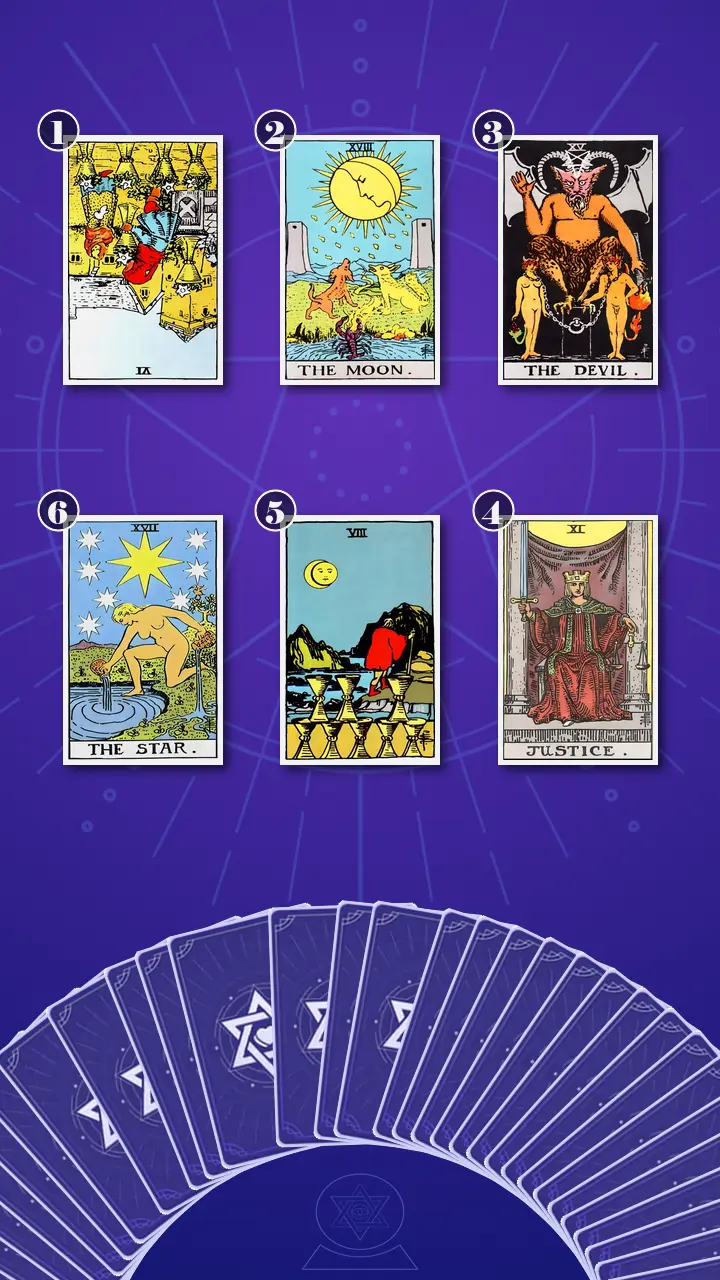
Reading the Map: Where Memory Edits the Record
The Flower-Filled Cup and the Quiet House
Now I turned over the card representing the current pattern: the observable replay that follows intimacy and ghosting, including selective memory and idealization. It was the Six of Cups, in reversed position.
In the Rider-Waite-Smith image, a child offers a flower-filled cup while a quiet village house rests behind the figures. I asked Jordan to notice the contrast: tenderness in the foreground, absence in the background. That was exactly what happened after work. They opened the old chat, reread the warmest message, and let that single exchange stand in for the entire bond while the unanswered follow-up slipped outside the frame.
The reversed energy showed an excess of backward-looking tenderness and a shortage of attention for the complete record. It did not mean the intimacy was fake. It meant memory had become selective and sticky, giving the peak moment more authority than the pattern that followed. A highlight reel can prove intensity; only a whole pattern can show consistency.
Jordan did not nod. They gave a small, bitter laugh and looked down at their hands. “That is almost rude,” they said. “I keep doing exactly that.”
I let the recognition land without turning it into shame. “The card is not accusing you of being foolish,” I said. “It is showing the strategy your mind found for keeping closeness available. We can respect what the message meant to you without letting it report the whole relationship.” Their thumb stopped moving across the phone, though their fingers still held it tightly.
The Moonlit Branching Path
Now I turned over the card representing the blockage: how ambiguity and imagined explanations keep grief from registering and make the replay feel necessary. It was The Moon, in upright position.
The moonlit path between two towers, the dog and wolf facing the sky, and the crayfish emerging only partly from the water gave us a visual map of incomplete information. When Jordan noticed a changed profile photo, a delayed reply, or another quiet evening, their mind generated several possible explanations: maybe the timing had been wrong, maybe the other person had become scared, maybe one sentence had caused the shift. Each theory briefly made the silence feel solvable, but none created new evidence.
I described the process as a recommendation algorithm trying to infer an entire story from three clicks, one profile change, and a blank notification screen. The more possibilities it generated, the more compelling the uncertainty became. The Moon's energy was blocked by the demand for certainty: Jordan kept treating unknown information as a clue that could eventually restore the connection.
I asked, “What does the silence directly tell you, and what are you supplying so that it feels less final?” Jordan's gaze followed the winding path on the card, and their shoulders lowered by a fraction. The question did not make the unknown comfortable, but it made the difference between fact and projection visible.
The Loose Chain That Renews Itself
Now I turned over the card representing the root: the attachment bargain that keeps the imagined relationship alive to protect belonging and self-worth. It was The Devil, in upright position.
The figures in the Rider-Waite-Smith image wear loose chains. I emphasized the word loose. The card was not a prediction of permanent captivity, and it was not a character judgment. It showed a repeated bargain that could be observed. At 10:32 p.m. in Jordan's rented apartment, they would lie on the sofa, reread the warmest message, feel a brief drop in loneliness, then check the person's profile again and feel more unsettled afterward.
I asked Jordan to listen for the two-part inner monologue beneath the action: “If I find the clue, I can get closeness back” beside “If I stop looking, I may have to feel the ending.” The replay offered a small, controllable dose of intimacy in exchange for the rest of the evening's attention. It postponed grief and temporarily protected them from the sharper thought that being ghosted might mean they were not chosen.
Jordan's hand moved toward their phone, stopped, and rested flat on their knee. The urge was still present, but now it had a shape. I said, “This is not the same as saying you chose the ghosting. It is noticing what the replay does for you in the next five minutes, and what it costs you afterward.” They breathed out slowly, with recognition and a thin line of sadness in their expression.
When Justice Separated the Song from the Silence
The Upright Sword Between Feeling and Evidence
By the fourth position, the room grew unusually quiet. Rain tapped the window in a steady pattern, and a stripe of streetlight lay across the table like a path out of the blue-grey water of the first three cards. I turned over the card representing the key transformation: the clarity move of separating emotional intensity from mutual consistency and treating observable behavior as information. It was Justice, in upright position.
The upright sword and balanced scales asked for proportion. I invited Jordan to imagine the old connection as an incomplete content brief: one high-performing excerpt cannot represent the whole campaign. Beside the card, I wrote three lines: What I felt, What they repeatedly offered, and What the gap communicates. The exercise did not require Jordan to call the intimacy fake or condemn the person who disappeared. It required a fairer record.
This was the moment I used my Communication Dissonance Audit. I developed it to diagnose arguments not by the words spoken, but by the mismatch in emotional tempo and frequency underneath them. Here, the connection had reached a fast, beautiful emotional high note, while the rhythm of follow-through afterward had gone silent. That dissonance did not erase the high note. It told us that intensity and sustained availability were not the same signal.
In my mind, I saw the sword as a clean edit, not an eraser. It removed the unsupported conclusion that a perfect moment had to equal a consistent relationship, while leaving the true feeling in the document. I said, “The feeling can be real, but the relationship can still be non-reciprocal. Silence is information, not a verdict on your worth.”
Before I explained the card further, I asked Jordan to stay with the most difficult part. It was 8:47 p.m. on the TTC's Line 1: their phone was warm, the carriage lights buzzed, and the quiet apartment ahead felt more final than the memory. They were not only missing the person; they were trying to solve the ending.
The feeling was real, but real feeling is not the same as mutual consistency. You do not have to erase the intimacy to let the silence count as information, or keep the highlight reel alive to prove that it mattered.
You do not need to keep the perfect connection alive to prove it mattered; use Justice's upright sword and scales to separate what was felt from what was consistently offered, then let that balanced view shape one self-respecting boundary.
For one suspended beat, Jordan froze. Their breath paused, their thumb hovered above the phone, and their jaw tightened. Then their eyes went unfocused as the warm message, the unanswered follow-up, and the imagined explanations seemed to replay in sequence. Their brow drew together. “But if I let the silence count,” they said, “doesn't that mean I was wrong about us?” I waited without rushing to soften the question. Finally, a long exhale moved through their chest. Their closed hand opened one finger at a time, their shoulders dropped, and their eyes shone. The release was not pure relief; a small blankness followed, the dizzy space left when there was no puzzle to solve. Then Jordan whispered, “That moment mattered to me, and it still wasn't consistent.” I asked, “Now, use this new perspective to recall last week: was there a moment when the silence might have felt different if you had let the feeling matter and the gap count as information?”
This was a first crossing from longing-driven replay and selective nostalgia toward grief-informed perspective, self-trust, and clearer relational boundaries. Justice did not hand Jordan an explanation for another person's behavior. It returned the measuring instrument to their own hands.
The Eight of Cups and the Ten-Minute Doorway
Now I turned over the card representing the action: the practical behavior that makes the central insight usable in daily life. It was the Eight of Cups, in upright position.
The cloaked figure walking away from the uneven stack of cups did not look dramatic to me. They were not destroying the cups or declaring that the journey had meant nothing. They were choosing not to keep feeding an incomplete arrangement. For Jordan, that could mean recording what was known, muting the profile for one evening, and walking to the corner shop for tea instead of using the old chat as the only available route back to closeness.
Jordan pushed back gently. “Seven days sounds like erasing them. What if they message? What if I miss the chance to respond?”
“Then we make the boundary chosen and adjustable,” I said. “Mute or archive; do not delete unless that genuinely serves you. The pause is about your attention, not about controlling what they do. You do not have to call it meaningless to let it be over.”
I taught Jordan my Syncopation Pause, a three-second acoustic grounding technique adapted for the moment before an automatic check. When the urge rose, they would stop, listen for one nearby sound, feel both feet, and let three silent beats pass before deciding. On the first beat they could name the feeling, on the second the unknown, and on the third one present-life action. The point was to lower the emotional BPM before the old story took over.
Jordan rubbed the edge of the card, then placed their phone face down. The gesture was small, but it was the first movement in the reading that did not orbit the absent person.
The Star After the Notification Stops
Now I turned over the card representing integration: the perspective Jordan could cultivate after practicing the central shift. It was The Star, in upright position.
The large eight-pointed star hung above a figure pouring water onto both land and pool. I read that image as emotional circulation. Hope did not need to wait for one particular notification to restore the battery. It could return to friendship, work, music, the body, and the self-directed present.
The Star's energy was balanced renewal rather than a promise that the ghosted connection would return. It allowed Jordan to keep the memory beautiful without reopening it as evidence of an ongoing relationship. Future intimacy could be evaluated through ordinary actions: making plans, following through, communicating when availability changed, and making room for mutual adjustment. Peak chemistry could remain meaningful without becoming the standard every new date had to recreate.
Jordan looked at the card for a long moment. Their expression held grief, but it was no longer trying to bargain with it. I could see cautious hope arriving as something quieter than excitement: not a prediction, just enough self-trust to notice what steadiness might feel like.
From the Highlight Reel to a Whole Pattern
When I gathered the six cards together, they told one coherent story. The reversed Six of Cups showed memory turning one flower-filled message into a complete relationship record. The Moon showed why the silence became a branching puzzle. The Devil revealed the bargain beneath the checking: a few minutes of closeness in exchange for postponed grief. Justice supplied the hinge, asking Jordan to weigh felt intensity beside words, follow-through, and silence. The Eight of Cups turned that appraisal into a pause, and The Star let the remaining feeling move back into a wider life.
The grid's visual path matched Jordan's internal rhythm. The top row formed a closed circuit of memory, uncertainty, and attachment. The lower route opened through discernment, a deliberate behavioral boundary, and grounded hope. The problem was not that Jordan had cared too much, and the answer was not to erase the tender parts. The loop continued because the perfect explanation had become the price of closure.
I named the cognitive blind spot plainly: Jordan had been treating intensity as evidence of reciprocity and explanation as the condition for relief. They were trying to make the absent person's motive settle a question about their own worth. The transformation direction was more honest and more practical: separate what happened from what was imagined, let silence count as information without turning it into a verdict, and use consistent action rather than peak chemistry to understand future intimacy.
This is what finding clarity looked like in the room. Not certainty about why someone vanished. Not a prediction about whether they would come back. It was a fairer record that could hold two truths at once: the connection mattered to Jordan, and it was not consistently mutual. The power to decide what counted, what boundary followed, and where attention went next belonged to Jordan.
Small Next Steps for a Self-Respecting Boundary
I gave Jordan two pieces of actionable advice. Both were deliberately small. Neither required permanent deletion, emotional numbness, or pretending that the ending was easy.
- Whole-Pattern Reality CheckOnce this week, when the urge to reopen the old chat appears after work or during a quiet evening, open a Notes page titled Whole Pattern Check instead. Write three short lines: what they said or did, what you inferred it meant, and what repeated reciprocity would have looked like. Read the lines once, then spend five minutes on a present-life task such as making tea, showering, or walking to the corner store. Finish with one sentence describing a boundary you want in future dating, such as needing plans followed through and changes communicated.Keep each line under one sentence and use observable behaviour only. The minimum version is warm message / imagined meaning / consistent follow-through. If the exercise feels too activating, pause and switch to a neutral task; this is observation, not a case against yourself.
- The Syncopation PauseFor seven days, during the hours when you usually check, such as 9:00 p.m. to midnight, mute the person's Instagram Stories and archive the old chat. Before any decision to reopen it, put the phone across the room, notice one nearby sound, feel both feet, and take three seconds of deliberate space. Then set a ten-minute timer and complete one neutral action before deciding freely whether to continue the pause.A seven-day pause is not emotional erasure. Mute or archive rather than delete if that feels more self-directed, and do not ask friends or another account to monitor the person. The boundary is about your attention, and you can revise it without treating either choice as a pass or fail.

A Week Later, the Quiet Proof
Six days later, I received a message from Jordan. “I used the Whole Pattern Check last night. I still miss them, but I didn't reopen the thread. I made tea and texted a friend about literally anything else.” It was not a triumphant ending. It was evidence that the old sequence could be interrupted.
That night, Jordan slept through the night. At breakfast, the first thought was still, “What if I am wrong?” They smiled at the thought, not because uncertainty had vanished, but because it no longer held the phone.
I told Jordan that this was the real Journey to Clarity: not a card deciding what the connection meant, but a person learning to let memory, grief, evidence, and hope occupy their proper places. The tarot offered images and questions. Jordan chose what to do with them.
When your phone goes quiet after something tender, your chest may tighten and your hands may reach for the old thread. Keeping the best moments alive can feel safer than admitting that a real feeling ended without choosing you back. You do not have to call it meaningless to let it be over.
If you could let the good memory remain a real, flower-filled cup without asking it to prove an ongoing bond, what small, ordinary part of your present life might you notice again?
This story is adapted from psychological research, written so that those in a similar struggle can see their own pattern in it — and find their next step clearly.These insights are not a substitute for professional psychological, medical, legal, or financial advice.
Learn more about our Journey to Clarity.
How did this insight land for you?
🫂 This Resonates Deeply
🌀 Living This Story
✨ Now I See Clearly
🌱 Seeing New Possibilities
🧰 Useful Framework
🔮 The Confirmation I Needed
💪 Feeling Empowered
🚀 Ready for My Next Step
Author Profile
 AI
AI“Through ten years of sound energy research, I’ve found that when we struggle, it's usually just our internal rhythm falling out of sync under pressure. I know firsthand the frustrating helplessness of wanting to move forward but feeling paralyzed. Without overwhelming theories, I want to be the soothing background track that helps you recalibrate, turning your heavy burdens back into a light, effortless, and harmonious melody.”
In this Love Tarot Reading :
Core Expertise
- Communication Dissonance Audit: Diagnosing arguments not by the words spoken, but by the fundamental mismatch in emotional tempo and frequency.
- Reactive De-escalation Mapping: Identifying the specific 'high notes' of defensive anger that shatter the emotional safety of the connection.
Service Features
- The Syncopation Pause: A 3-second acoustic grounding technique to interrupt an escalating argument, lowering the emotional BPM before permanent damage is done.
Also specializes in :
Explore Related Patterns:
Closure ChasingChecking the changed profile photo, revisiting delayed replies, and drafting explanations in Notes make the ghosting feel like a solvable investigation. Each theory offers a short burst of control, yet none adds evidence or completes the ending. When you make the other person's motive the missing key to relief, closure stays permanently one clue away. Closure Chasing names this loop because the search for a perfect explanation postpones acceptance and keeps your attention tied to someone who is no longer participating in the conversation.
Nostalgia LoopAt 8:47 p.m. on Line 1, reopening the kindest message turns one emotionally vivid exchange into the main evidence for the whole bond, while the unanswered follow-up recedes. Repeating that mental edit keeps closeness available, but it also directs attention back to the peak moment whenever the silence begins to feel final. When you replay the highlight rather than the full sequence, memory is doing more than remembering. It is protecting the connection from completion. Nostalgia Loop fits because the same beautiful fragment is repeatedly used to soften loss, even though each return renews the gap it was meant to relieve.
Post-Intimacy Reassurance LoopAfter the warm date and unusually honest conversation, every period of silence sends Jordan back to the thread, the profile, or a drafted explanation. Rereading the warmest message briefly recreates the felt closeness, but checking again exposes the same absence and restores the unease. When you use the record of intimacy to reassure yourself that the bond is still available, the relief depends on repeating the behavior. Post-Intimacy Reassurance Loop captures this sequence because the digital trace becomes a temporary substitute for present reciprocity, soothing the attachment alarm for minutes while keeping the unanswered relationship psychologically active.
Emotional ReasoningThe unusually honest conversation felt so vivid that Jordan initially treated its emotional force as evidence of a continuing mutual connection. Letting the later silence carry equal weight then felt like denying the original intimacy or admitting that the entire perception of the bond had been wrong. When you move from "this felt deeply real" to "therefore this relationship was equally real, mutual, and sustainable," feeling begins to perform the job of evidence. Emotional Reasoning fits because the intensity was genuine, but it could not establish the other person's capacity or willingness to follow through.
Rejection SensitivityJordan does not only fear that the connection ended. They fear that accepting the ending will prove they were not chosen for lasting belonging, which gives every blank notification and imagined explanation implications far beyond the other person's availability. When silence begins answering questions about your worth, replaying the connection can feel like a way to challenge or postpone that verdict. Rejection Sensitivity fits because the mind treats ambiguous withdrawal as personally defining, even though the available evidence can only describe the other person's lack of consistent participation, not your value.
Boundary DiscernmentPlacing the phone face down, muting the profile, and archiving rather than deleting create a boundary around Jordan's attention without pretending the connection meant nothing. Refusing to monitor through friends or another account also keeps the decision focused on Jordan's behavior rather than on controlling or anticipating the absent person. When you understand that a pause can be chosen, adjustable, and self-directed, a boundary stops looking like punishment or emotional erasure. Boundary Discernment fits because Jordan learns to protect present attention while allowing the memory, the grief, and the other person's independent choices to exist without constant surveillance.
Reality TestingThe three-line audit asks Jordan to place what they felt beside what the other person repeatedly offered and what the gap communicates. The later Whole Pattern Check reinforces the same move by separating observable behavior from inferred meaning and from the reciprocity Jordan would need in a sustainable connection. When you let the warm conversation and the unanswered follow-up occupy the same record, you no longer have to erase either one. Reality Testing becomes an adaptive pattern here because it protects the truth of your feeling without allowing that feeling to override contradictory behavioral evidence.
Uncertainty ToleranceSix days later, the thought "What if I am wrong?" still appears at breakfast, but it no longer sends Jordan back to the thread. Earlier, Jordan had also accepted that the moment mattered while the connection remained inconsistent, without obtaining a definitive explanation for the other person's behavior. When you can leave the motive unknown and still decide what the observed silence means for your participation, uncertainty loses its power to command another check. Uncertainty Tolerance fits because clarity comes from acting on the available record, not from forcing ambiguity to disappear before you reclaim your attention.
Explore Related Struggles:
Ambiguity-Promise FusionJordan notices a changed profile photo, another blank notification screen, or a delayed reply and generates several possible explanations. None of the theories creates new evidence, yet each one makes the silence feel temporarily solvable and keeps the possibility of restoration active. When you experience the unknown as a clue rather than a limit, uncertainty starts carrying the emotional force of a promise. Ambiguity-Promise Fusion keeps you attached to what might still be explained, corrected, or recovered, even when no mutual action is arriving. Separating direct information from supplied possibilities lets you stop requiring every unanswered question to remain an open door.
Closure-Authority SplitJordan searches the old thread, checks Instagram, and drafts an explanation in Notes as though the right reconstruction could finally reveal why the person disappeared. The investigation keeps closure tied to a missing motive, even though every available action works only with traces the absent person has already left behind. When relief depends on an answer that only someone else can provide, your authority to recognize an ending remains externally gated. Closure-Authority Split names the divide between the information you wish you had and the behavioral record you can already evaluate. You cannot manufacture another person's explanation, but you can decide that silence, non-response, and absent follow-through are relevant information for your own boundary.
Idealization-Reality SplitJordan rereads the kindest message until that single exchange begins to represent the entire bond, while the unanswered follow-up and quiet days slip outside the frame. The replay does not invent the tenderness, but it edits the amount of authority that tenderness receives when the connection is evaluated. When you keep returning to a peak moment, memory can become both evidence and refuge. Idealization-Reality Split describes the friction between what was vividly meaningful and what the complete pattern can actually support. Clarity does not require you to call the intimacy fake; it asks you to let consistency, silence, and follow-through occupy the record alongside the beautiful part.
Memory-Loyalty BindJordan resists a seven-day pause because muting the profile and archiving the chat sound like erasing the person. Keeping the warmest message close becomes a way to protect the truth that the intimacy mattered, even as repeated contact with the archive keeps the ending active in the present. You can become caught between honoring a memory and releasing the bond that memory represents. Memory-Loyalty Bind makes movement feel disloyal, as though allowing an ending would revise a meaningful experience into a mistake. The memory does not need to remain an active relationship record to stay real; you can carry its significance without repeatedly surrendering your present attention to it.
Chosen-Worth BindJordan fears that accepting the ghosting will mean they were not chosen for lasting belonging, and later wonders whether letting the silence count would prove they were wrong about the connection. The absent person's behavior is therefore asked to settle more than the status of one relationship; it is made to answer a question about Jordan's personal worth. When you bind worth to being selected by a particular person, their availability can begin functioning like a verdict rather than information about their capacity or choice. Chosen-Worth Bind keeps the replay emotionally urgent because finding the right explanation appears capable of reversing both the ending and its meaning about you. Returning those questions to separate categories allows another person's silence to matter without granting it authority over your eligibility for care and belonging.
Explore Related Emotions:
Ambiguity DreadAfter several quiet days, Jordan studies a changed profile photo, a delayed reply, and another blank notification screen, then generates several possible explanations. When you treat incomplete information as a puzzle that must contain a hidden answer, every unknown acquires emotional weight and the silence never gets to remain simply unknown. Ambiguity Dread is the suspended feeling created by that expanding field of possibilities. You remain braced for the clue that could settle the connection, even though each new theory deepens your involvement without giving you new evidence or dependable contact.
Borrowed Warmth AcheAt 10:32 p.m. in the apartment, Jordan rereads the warmest message, feels briefly less alone, and then checks the profile again only to become more unsettled. When you use an old exchange as the nearest available route back to closeness, the memory can still warm you, but it cannot provide the living response your body is reaching for. Borrowed Warmth Ache captures the tenderness and deprivation inside that cycle. You receive a short, controllable echo of intimacy from the thread, then feel the difference between remembered contact and present reciprocity more sharply once the screen remains unchanged.
Conditional Belonging FearJordan fears that accepting the ghosting would mean they had not been chosen for lasting belonging. When another person's silence becomes entangled with your eligibility for durable closeness, the unanswered message stops being information about one person's availability and begins to feel like a verdict on whether you are keepable. Conditional Belonging Fear is the inner weather beneath that verdict. You may search for the missed sentence because a correctable mistake feels less threatening than the possibility that closeness can be genuine, meaningful, and still not become the secure bond you wanted.
Counterfactual LongingJordan drafts an explanation in Notes and wonders whether one overlooked sentence changed the entire connection. When you keep reconstructing the moment before the silence, the mind creates alternate versions of the past in which a different phrase, better timing, or fuller understanding could still return you to the earlier closeness. Counterfactual Longing is directed toward more than the absent person. You are also yearning for the imagined timeline in which the connection remained recoverable, because that version protects you from an ending that cannot be revised through further analysis.
Grounded AcceptanceJordan states that the moment mattered to them and still was not consistent, then uses a record that separates what was felt, what was repeatedly offered, and what the gap communicates. When you allow all three forms of information into the same frame, you no longer have to choose between idealizing the connection and declaring the entire experience false. Grounded Acceptance is the steadiness of holding those two truths without forcing them into a cleaner ending. You can let the intimacy retain meaning, let the silence describe the available relationship, and make a boundary from the whole pattern rather than from either the highlight or the hurt alone.
Liminal GriefThe warm date and unusually honest conversation are followed by quiet days without a shared explanation or acknowledged goodbye. When you have a meaningful memory but no mutually completed ending, you can remain suspended between relating to the connection as something real and recognizing that no active relationship is being offered. Liminal Grief occupies that in-between space. You cannot fully move with the ending while the unknown is still being treated as solvable, so the old thread becomes a waiting room where the bond feels neither securely present nor completely released.
Nostalgia Loop AnxietyAt 8:47 p.m. on Line 1, Jordan rereads the kindest message and lets it carry more weight than the unanswered follow-up. When you revisit an emotional peak this way, memory offers immediate contact while the complete relationship record recedes, so the past becomes both soothing and electrically difficult to leave alone. Nostalgia Loop Anxiety names that combination of sweetness and pressure. You are not replaying because the moment meant nothing; you are replaying because keeping it vivid delays the harder task of letting a meaningful experience coexist with a nonresponsive present.
Retroactive Rejection DreadWhen Jordan is asked to let the silence count, their breath pauses and they ask whether that would mean they were wrong about the connection. When you experience a later rejection as evidence about an earlier intimate moment, the ending seems able to travel backward and strip credibility from what you felt. Retroactive Rejection Dread makes replay feel protective. You keep the best conversation active because stopping can seem like admitting that your perception, openness, or emotional response was mistaken, even though a real moment and an inconsistent relationship can coexist.
Bittersweet ReleaseJordan's closed hand opens one finger at a time after they recognize that the moment mattered and still was not consistently mutual. When you stop demanding that the memory prove an ongoing bond, the body can loosen without requiring you to dismiss the intimacy or pretend the ending does not hurt. Bittersweet Release holds both parts of that movement. You are letting go of the obligation to solve or preserve the connection while retaining the right to remember it as meaningful, so the softening contains both loss and regained room to choose.
Cautious HopeJordan places the phone face down, later makes tea, and texts a responsive friend about something unrelated to the ghosted connection. When your attention begins moving toward available people, ordinary activities, and the body, one absent notification stops carrying the entire burden of restoring closeness. Cautious Hope is quieter than expecting the person to return. You begin to sense that meaningful intimacy can exist again and that future connection can be recognized through steadiness, communication, and follow-through rather than through one perfect emotional high.
Cautious Self-TrustSix days later, Jordan still misses the person but does not reopen the thread; they make tea and text a friend instead. When you can notice the old question without automatically handing it your attention, your judgment begins to rest on your own observations and choices rather than on the absent person's possible explanation. Cautious Self-Trust grows through these modest acts rather than through absolute certainty. You are learning that you can honor what you felt, recognize what was not repeatedly offered, and adjust a boundary without needing the other person to validate your reading of the relationship first.
Clarity ShockFor one suspended beat, Jordan freezes as the warm message, unanswered follow-up, and imagined explanations replay in sequence. When you finally place emotional intensity beside observable consistency, the familiar puzzle can collapse quickly, leaving a dizzy blankness where constant interpretation used to organize your attention. Clarity Shock names that exposed first contact with a fairer record. You have not received an explanation from the absent person; you have seen that your feeling can remain valid without requiring their silence to become either a hidden promise or a judgment of your worth.
Explore Related Contexts:
Breakup Closure LimboAt 8:47 p.m. on the TTC, Jordan rereads the kindest message and searches it for the explanation the other person never provided. Several quiet days, a changed profile photo, and an unanswered follow-up leave the connection without a mutually stated ending, placing Jordan between remembered intimacy and an external pattern that has already stopped moving. You are dealing with a closure gap created by unilateral silence, not a puzzle with enough evidence to guarantee a solution. Breakup Closure Limbo makes explanation appear to be the price of moving forward because the other person retained control over the missing information. A clearer position becomes possible when you let the lack of follow-through define the present status while preserving your own account of what the intimate moment meant.
Ghosting After IntimacyAfter a warm date and an unusually honest conversation, Jordan receives several quiet days without a reply, explanation, or direct ending. The withdrawal happens after meaningful disclosure, so the external rupture is not simply a date that failed to progress. One person helped create intimacy and then unilaterally removed communication and follow-through. You can keep replaying the best exchange because the relationship record is structurally uneven: the intimate moment is detailed and available, while the ending contains almost no shared information. Naming Ghosting After Intimacy allows the silence to count as observable behavior without requiring you to declare the earlier connection fake or use another person's disappearance as a verdict on your worth.