An Old Flame Returned; One Direct Question Redefined Readiness

When an Old Flame's Return Feels Like Proof
After ten years of researching sound energy, I have learned to notice the moment an inner rhythm falls out of sync under pressure. I recognized that moment when Maya, a late-twenties hybrid product marketing professional in Toronto, settled into my chair and kept her phone face down as if it might interrupt her.
At 11:40 p.m. the previous Tuesday, she had received one message from an old flame: I've been thinking about you. The radiator in her small apartment had hissed beside the faint bell of a passing streetcar. Her phone felt warm in her restless hands as she reread the message, screenshot it for the group chat, and opened a restaurant page they had once discussed. Before a direct question could be asked, her mind had already turned one affectionate notification into a complete reunion.
Maya worked in product marketing, where she could challenge a vague KPI and ask for evidence without blinking. In her relationship, she told me, the same directness seemed to vanish. Why do I keep treating an old flame's return as proof we're ready? she asked. They came back, so that has to mean something changed. I know a message is not a plan, but it feels like more than nothing.
I could see the longing in the way her thumb hovered over the silent phone. It moved through her like a warm notification trapped beneath her sternum: each new buzz promised light, and every pause tightened the wire around her ribs. The warmth was real. So were the restless hands, the shallow breath, and the fear that asking for clarity might make the feeling of being chosen disappear.
I told her that I would not use the cards to declare whether the old flame was ready, selfish, destined, or incapable of change. I wanted to help her separate memory from present evidence, hope from assumption, and another person's choice from her worth. The hope is real; the evidence is still incomplete, I said. We can let both facts exist. Today, let us draw a map through the fog.
Choosing the Compass: The Shadow Spread
I asked Maya to place her phone on the table, take one slow breath, and name the question beneath the question: not Will we get back together? but Why does their return feel like proof before we have discussed what changed? I shuffled slowly while she focused on that distinction. The small ritual was a transition into attention, not a test of fate.
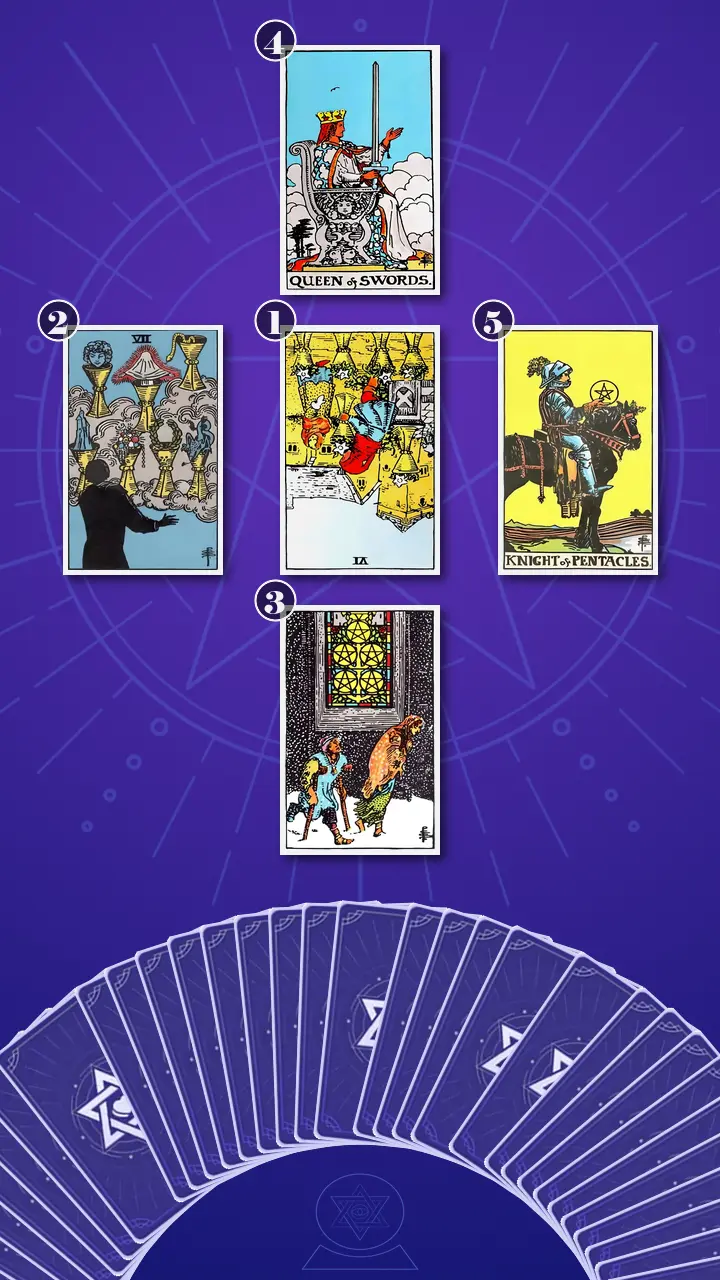
For this relationship clarity reading, I chose a five-card Shadow Spread. I explained that this is how tarot works in my practice: the images give us an objective structure for examining a pattern that emotion alone keeps blurring. The spread was designed for inner excavation, so it could show the visible behavior, the projection feeding it, the fear underneath, the truth that makes the pattern workable, and the grounded practice that follows. It was not there to predict a reunion or pronounce a verdict.
The first card would show the observable pattern: rereading messages and fast-forwarding into reunion planning. The second would reveal the cognitive blind spot that turns ambiguous contact into an idealized story of mutual readiness. The third would uncover the fear that not being chosen again might feel like evidence of insufficient worth. Above the center, the fourth card would offer the key transformation: direct questions, boundaries, and self-trusting discernment. The fifth would translate that clarity into an observation of ordinary behavior over time.
For anyone searching for the Six of Cups reversed and Seven of Cups meaning when an ex returns, the sequence matters. I would not isolate a card from Maya's life or treat a symbol as a fixed sentence. I would read the card meanings in context, then return every image to something she could notice, question, or choose in the present.
When Memory Starts Writing the Future
The Flower-Filled Archive: Six of Cups Reversed
Now I turned over the card representing Position 1, the observable pattern from the diagnosis: treating renewed contact as present-day proof by rereading messages and fast-forwarding into reunion planning. It was the Six of Cups, in reversed position.
In the Rider-Waite-Smith image, a child offers another child a cup filled with white flowers inside an enclosed stone courtyard. Even reversed, the tenderness is not false. It is the familiar gift, the old sweetness, the emotional fragrance carried by a remembered connection. But the reversal showed Water flowing backward and becoming blocked: the past was not simply remembered; it was being allowed to speak for the present.
I brought Maya back to her Toronto bedroom. She had received I've been thinking about you, opened years of archived messages, paused over an old heart emoji, and begun browsing the restaurant before asking what the sender wanted now. Familiarity can recognize a connection; it cannot verify a change. The earlier affection might have been genuine without proving that the conditions surrounding the breakup had changed.
I said the inner monologue aloud so she could hear its rhythm: This is familiar, so maybe it is safe; it feels sincere, so maybe the old problem is gone. The card was not asking her to delete the thread, deny the good memories, or punish herself for wanting another chance. Its invitation was smaller and more precise: let the memory remain meaningful, while asking it to stop pretending to be evidence.
Maya gave a short, bitter laugh. First, her thumb froze above the screen. Then her eyes lost focus, as if she were replaying the restaurant tab and the group-chat screenshots. Finally, she breathed out through her nose and said, That is too accurate. Almost cruel. I kept my voice gentle. It is not a criticism of nostalgia. It is a way to protect the truth that the affection mattered without making it carry a promise it never made.
I suggested that, for one week, she keep two brief columns after each interaction: What Happened and What Familiarity Made Me Infer. That would let the Six of Cups remain a cup of memory instead of letting it become a contract written by the past.
Seven Browser Tabs in the Clouds: Seven of Cups Upright
Now I turned over the card representing Position 2, the cognitive blind spot in the limiting cycle: turning ambiguous contact into an idealized story of mutual readiness. It was the Seven of Cups, in upright position.
The card showed a silhouetted figure facing seven cups floating in clouds. Each cup offered a different possibility: a castle, jewels, a laurel wreath, a dragon, a veiled figure. Nothing had been selected, touched, or confirmed. The Water here was in excess, expanding emotional possibility faster than verifiable information could keep up.
I compared it to opening seven browser tabs from one late-night check-in: apology, commitment, personal growth, reunion, closure, chemistry, and forever. Maya knew the feeling. They said, I miss what we had, and her mind moved to They regret leaving, then to They finally understand what went wrong, then to They are ready to build something stable with me now. Each step felt emotionally fluent, but none had been spoken by the other person.
The blockage was not that Maya had too much imagination. It was that imagination was being asked to perform the job of a direct answer. Hope briefly replaced the discomfort of not knowing, then the unanswered questions remained exactly where she had left them. The more certainty she manufactured from tone, punctuation, and reply speed, the harder it became to tolerate a simple conversation about intention.
I asked, Which parts of the reunion story have they actually named, and which parts are attractive possibilities your mind supplied? Maya's chest tightened. She silently counted the futures she had built from one message, then glanced toward the phone as if it might defend her. Her shoulders rose by a fraction before she let them fall. She did not need to choose rejection or reunion in that moment. She only needed to stop calling every open tab a fact.
The Lit Window on a Cold Toronto Night: Five of Pentacles Upright
Now I turned over the card representing Position 3, the underlying fear that not being chosen again would be interpreted as evidence of insufficient worth. It was the Five of Pentacles, in upright position.
The Rider-Waite-Smith image showed two figures moving through snow beneath a stained-glass window lit by five pentacles. I asked Maya to imagine seeing that warm apartment window from a Toronto sidewalk after a cold evening. When the old flame's attention arrived, it could feel like an invitation back inside. When six hours of silence followed, the same attention could feel like the door had closed again.
Maya told me what happened in her body after a warm exchange: her chest lifted, then dropped; her stomach hollowed; her plans with friends suddenly seemed less important than remaining available for the next message. If they choose me now, the earlier leaving did not mean I was lacking. If they do not, maybe it did, she said. I heard the fear without turning it into a diagnosis or a fact.
The Five of Pentacles was constricted Earth, a scarcity image beneath the Cups. The temporary warmth of the old flame's attention had begun to look like the only available source of belonging, even though Maya had friends, work, routines, and a life that did not disappear when one person went quiet. The card did not predict rejection. It showed how the fear of exclusion could narrow her attention until being chosen by one person seemed to determine whether she possessed worth.
Maya grew quiet. Her fingers curled against her palm, and I saw her gaze settle on the five pentacles in the window. Then she said, I think I have been trying to make their return prove I am still worth choosing. I told her that wanting reassurance was human, but another person's availability could never be a reliable measuring device for her value. The useful question was not how to extract a guarantee from the return. It was what she needed in order to participate without abandoning herself in the waiting.
When the Queen's Sword Asked for Facts
When I placed the fourth card above the center, the room seemed to quiet around the radiator. This was the catalyst and the antidote in the spread. I turned the card slowly, giving Maya time to notice her first reaction before I named mine.
The Question That Leaves the Group Chat: Queen of Swords Upright
Now I turned over the card representing Position 4, the key transformation: replacing confirmation-seeking interpretation with direct questions, boundaries, and self-trusting discernment. It was the Queen of Swords, in upright position.
The Queen held one upright sword while her other hand remained open. Her sword separated what had been said from what hope had supplied. Her open hand did not shut out an honest answer. Together, the two symbols offered Maya a way to stay receptive without surrendering judgment. She could ask, What has changed for you since we ended, and what are you hoping for now? without using the question to force a reunion or provoke a confession.
This was where I reached for my signature Communication Dissonance Audit. I diagnose arguments not by the words spoken, but by the fundamental mismatch in emotional tempo and frequency. No argument had happened yet, so I was not labeling the old flame or claiming access to their intentions. I was diagnosing the gap Maya could actually observe: one warm message had pushed her emotional tempo toward a full reunion, while the relationship's present terms, accountability, and boundaries were still unnamed.
In sound terms, she had heard a bright opening note and filled in the rest of the song. The Queen's sword asked us to listen for the missing measures. What had changed? What did each person want now? How would they understand the earlier ending? What would respectful pacing look like? I told Maya that direct communication could reveal a mismatch, but that was information, not punishment. Clarity does not ruin what is ready; it reveals what is available.
The Sentence That Changed the Tempo
At 11:40 p.m., the room is quiet except for the radiator and one warm message on your screen. Your chest lifts, your thumb opens the old thread, and before you reply, your mind is already choosing a restaurant for the reunion. The urge to decode feels safer than risking an answer you cannot control.
Familiarity is not evidence of readiness; ask what has changed, and let the Queen's upright sword separate hope from observable fact.
She did not exhale at once. Her breath paused high in her chest, and her fingers held the phone as if movement might disturb the sentence. Then her eyes went soft and unfocused, replaying the group-chat screenshots, the deleted question, and the restaurant tab. A flush rose beneath her eyes. Her jaw tightened, and for one sharp second the new clarity felt like an accusation. But doesn't that mean I was wrong before? she asked, her voice thin with anger and grief. I kept my voice level. It means hope was asked to do the job of evidence. The affection can have been real, and you can still need more information now. Her fists opened against her knees. Her shoulders dropped, not into certainty but into room to breathe. A long, shaky exhale left her, followed by a small laugh. I can be open without deciding in advance. I nodded. Now, use this new perspective to think back: was there a moment last week when asking one clear question would have felt different?
That was the first movement from confirmation-seeking reunion fantasies toward clear-eyed curiosity. It was not a promise that the answer would be comforting. It was a return of authorship. Maya could ask, listen, assess, and decide what access she wanted to offer. The cards had not taken the choice from her; they had helped her hear her own question underneath the noise.
The Still Horse and the Seven-Day Pattern: Knight of Pentacles Upright
Now I turned over the card representing Position 5, the actionable practice: defining evidence of readiness and observing consistency over time without forcing an outcome. It was the Knight of Pentacles, in upright position.
The Knight sat on a still dark horse and held one pentacle carefully in front of him. Behind him were cultivated fields, not a dramatic battlefield or a burst of flame. His stillness was deliberate evaluation rather than passivity. I told Maya that readiness was closer to service uptime than a launch-day announcement: reliability became visible across ordinary days, not because one exciting return had made a perfect entrance.
After a direct conversation, she could notice whether plans were proposed clearly, confirmed, and kept. She could observe whether the earlier rupture could be discussed without deflection, whether her pace was respected, and whether accountability remained present after the emotionally intense exchange ended. She did not need to track online status, test the other person, or collect evidence forever. One week of ordinary observation would be enough to replace the demand for a verdict tonight with a manageable question: What repeats?
The energy had moved from Water's backward pull and clouded projection, through the constricted Earth of the Five of Pentacles, into the clarifying Air of the Queen and back into steady Earth. The spread contained no Wands. That absence mattered. The spark of renewed contact could be meaningful, but intensity alone was not action. Maya's shoulders lowered as she imagined letting trust respond to a pattern rather than sprinting ahead of it. I do not need a verdict tonight; I can notice what repeats, she said.
The One-Page Return-Is-Data Reset
I gathered the five cards into one story. The reversed Six of Cups showed how a tender memory became present-day proof. The Seven of Cups multiplied one affectionate message into several possible futures, allowing imagined certainty to cover the discomfort of not knowing. The Five of Pentacles revealed why that certainty felt necessary: another departure threatened to become a verdict on worth. The Queen of Swords restored the missing language, and the Knight of Pentacles offered a pace for testing that language against behavior.
I returned to the image I had given Maya at the beginning: a knock at the door is not an inspection certificate proving the whole house has been rebuilt. A reopened connection can be an opportunity for information. It does not have to be treated as a promise, and it does not have to be rejected simply because the past was painful. Maya could open the door a little, ask who was there, and decide what she wanted to do with the answer.
The cognitive blind spot was not merely romantic optimism. It was the belief that asking for clarity might destroy something real, while decoding every message would protect it. The transformation direction was more practical: move from treating renewed contact as proof to asking one direct question about what has changed, then assess the answer alongside consistent present-day behavior. Hope could stay in the room, but it no longer got to sit in the evidence chair.
I gave Maya three small next steps. They were designed to reduce the emotional BPM without turning discernment into surveillance or a secret test.
- The Facts-and-Familiarity SplitAfter the next message from the old flame, Maya will open the Notes app at home for two minutes and write the exact words, timing, and action under What Happened. Under What Familiarity Made Me Infer, she will record the reunion story her mind supplied, then add one body fact such as my chest warmed, then tightened while I waited.Keep it to one interaction. Close the old message archive afterward, and remember that writing down an inference does not require sending a reply or acting on it.
- The Queen's One-Question CheckBefore the next emotionally intimate exchange with the old flame, Maya will choose one sentence in daylight: What has changed for you since we ended?, What are you looking for now?, or What would be different this time? If she wants to send it, she will send only the question and let the answer belong to the other person.I taught her my Syncopation Pause: put the phone face down, listen to one nearby sound, and release a quiet hum over three seconds before replying. This acoustic grounding technique does not erase longing; it lowers the emotional BPM enough to choose rather than react.
- The Slow-Trust Observation WindowFor seven days after the clarity conversation, Maya will keep one short note with four headings: Plans, Communication, Accountability, and Boundaries. She will record only observable behavior, such as whether a proposed plan is confirmed and kept, whether the past can be discussed, and whether a stated pace is respected.Use the minimum version if needed: record one agreement that was kept or missed. Do not monitor location, online status, or private activity. At the end of the week, ask What pattern is present? rather than How hopeful do I feel tonight?
I also reminded her that a boundary was information about the conditions under which she could participate, not a tool for forcing an answer. She could slow down, decline intimacy, pause the exchange, or leave if contact became coercive or repeatedly disrespectful. No card, question, or seven-day note could obligate her to continue. The point of this five-card Shadow Spread tarot reading was not to produce a relationship outcome. It was to return choice to the person living the relationship.

A Week Later, the Quiet Proof
Four days later, I received a message from Maya. She had asked the Queen's question in the afternoon rather than at midnight. The old flame had answered with specific words about what they now understood from the earlier breakup and what they were hoping to explore. It was not a cinematic promise, and Maya did not treat it as one. She told me she had agreed to a Saturday coffee so they could speak in person, with no assumption that the meeting meant they were back together.
She had also started the seven-day note. One plan had been confirmed and kept. One difficult question had been answered without her having to soften it into a joke. She was still watching for whether those actions would repeat, but her mood was no longer rising and falling with every reply. The old flame's return had become information she could evaluate, not a verdict she had to accept.
That evening, after the plan was clear, Maya slept through the night. At breakfast, the thought What if I am wrong? arrived first; she smiled into her coffee, because it was a question now, not a command.
I told her that this was the first quiet proof of our Journey to Clarity. The cards had not changed the other person, guaranteed reconciliation, or erased the ache of the earlier ending. They had helped Maya move from romantic fast-forwarding to clear-eyed curiosity, from imagined certainty to grounded observation, and from needing to be chosen to trusting herself to choose.
Maya, not the cards, remained the author of what happened next. She could welcome the connection, ask for more information, notice what repeated, and decide how much trust to extend. That is the kind of clarity I want tarot to offer: a steady background track that helps a person hear their own judgment without turning hope into a trap.
When their name lights up your phone and your chest warms before your stomach tightens, it can feel safer to turn the return into proof than to risk an answer that uncertainty might twist into a verdict on your worth.
If you let this return be information rather than proof, what one clear question or ordinary pattern in your own seven-day note would you feel curious to notice next?