Ghosting After Intimacy in the 7:12 a.m. Blue Light
Jordan was 28, good at finding the right words for clients, and still spending their hybrid-work breaks decoding one unanswered text because post-intimacy ghosting had made their own memory feel unreliable.
They joined my video call from a shared apartment bedroom near Toronto's west end at 7:12 on a Wednesday morning. Their feet had not touched the floor. Blue phone light washed over the duvet, the radiator clicked behind them, and their thumb kept reopening the same intimate thread on a screen warm from being held too long.
"I can handle the silence if I know what it means," Jordan said. They had already drafted the calm check-in, the honest request for clarity, and the six-paragraph message that tried to explain everything. They had deleted all three. The conflict was painfully simple: they wanted to know what the intimacy meant, while the silence refused to supply a stable answer.
Longing seemed to sit inside them like a stalled lift between floors. Their chest stayed compressed, their stomach dropped whenever the notification bar was empty, and their hands kept reaching for the phone as if movement alone could open the doors.
"You are not only missing them," I said. "You are trying to recover trust in your own reading of what happened. You keep calling it closure, but part of you is still asking for proof that you were not foolish to believe the intimacy mattered."
I told Jordan I would not use tarot to invent the absent person's motives or predict whether they would return. That would only add another unprovable story. I wanted us to find a different kind of clarity: one that could honour the intimate moment, recognise the present silence, and return the next decision to Jordan.
"Let's draw a map through the fog," I said, "and see whether their explanation is truly required before your experience and your boundary can both be valid."

Choosing a Map for the Unanswered Connection
I asked Jordan to place the phone face down and take three slow breaths while holding one question: After intimacy and silence, what story am I still clinging to? I shuffled slowly. The pause was not a mystical performance; it was a deliberate transition from reacting to a notification stream toward examining a chosen question.
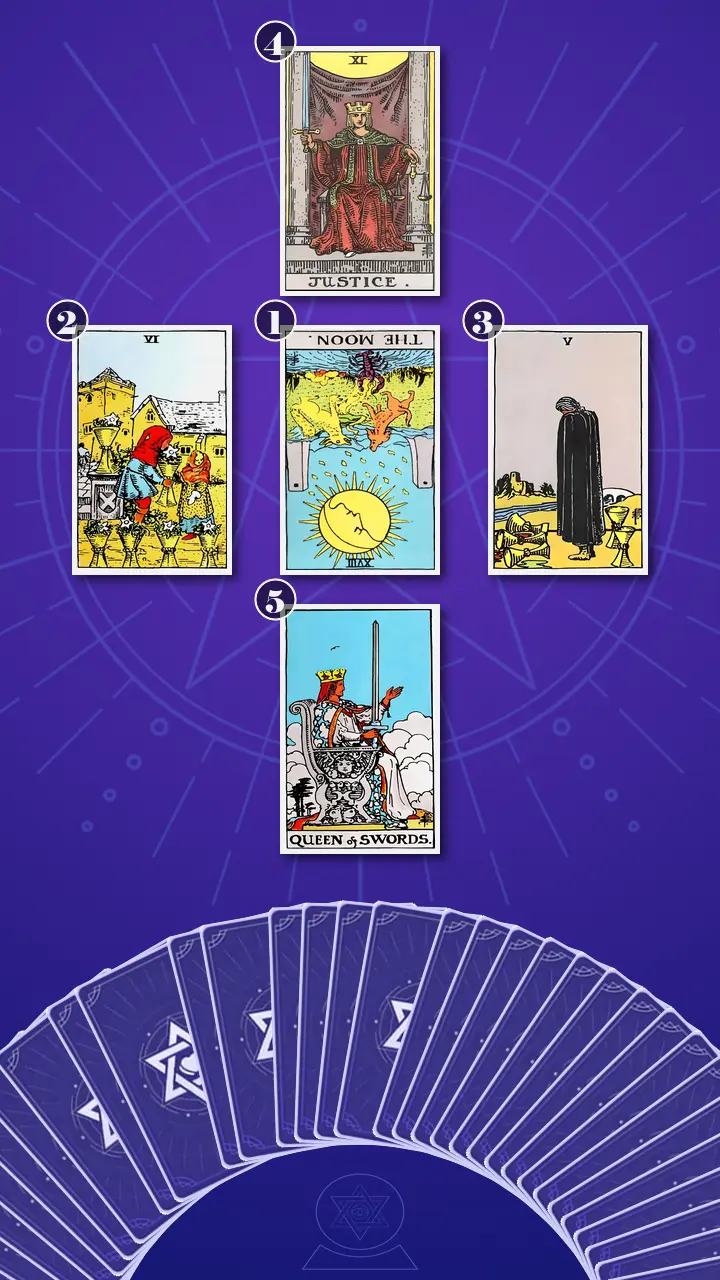
I selected the Relationship Spread · Context Edition, a compact five-card relationship tarot spread arranged as a cross. For anyone wondering how tarot works after ghosting or mixed signals, I use this structure because it separates five things that easily become fused: present behaviour, remembered intimacy, the impact of silence, the story that needs questioning, and the self-directed next step.
The centre card would show the lens keeping Jordan engaged with the silence. The left-to-right axis would contrast the tenderness they experienced with the grief created by communication stopping. Above and below that emotional axis, the final two cards would offer a reframe and turn it into a boundary grounded in observable consistency.
I positioned the camera over the table. "The cards cannot tell us what is happening inside someone else's mind," I said. "They can help us notice what your mind is doing with the missing information, and what choices remain yours."
The Moon in the Notification Bar
Position One: The Clue-Seeking Lens
"The card I am turning now represents your present lens: the checking, rereading, and searching that keep the silence psychologically active," I said. I revealed The Moon, in reversed position.
I pointed to the winding path between two distant towers. Under uncertain moonlight, the dog and wolf react differently to the same stimulus. I saw Jordan's digital loop in that image: one changed profile photo could produce three incompatible explanations, yet each explanation arrived with the emotional force of evidence.
At 7:12 that morning, Jordan had seen no new message and noticed the person's profile photo had changed. Their mind immediately began generating routes through the missing stations: perhaps the person was overwhelmed; perhaps they were dating someone else; perhaps the intimacy had meant nothing. The same signal could support every story, which meant it could verify none of them.
"The inner monologue sounds like this," I said. "If the change means they are scared, then opening up was safe. If it means they lost interest, then I was foolish. But the profile photo cannot answer either question."
The Moon reversed showed a blockage beginning to loosen. Uncertainty was still present, but Jordan had started to see projection as projection. I also warned them about overcorrection: a long message sent in panic or an abrupt block used to force a clean ending would still let urgency make the decision.
Jordan gave a short, bitter laugh. Their thumb moved toward the phone, stopped, and curled back into their palm. "That is so accurate it is almost cruel," they said.
"Then let the accuracy reduce the cruelty," I replied. "The checking is an attempt to create safety. It is not evidence that you are weak, and it is not producing the information it promises."
The Tender Scene That Would Not Stop Replaying
Position Two: What the Intimacy Genuinely Held
"The next card represents the felt meaning of the intimacy for you, without claiming access to the other person's intentions," I said. I turned over the Six of Cups, upright.
The card showed a flower-filled cup being offered in a protected garden. Jordan told me about a saved voice note they had replayed on the Line 1 train: the softness in the other person's voice, a private joke, the rain-darkened coats around them, and the warmth that rose behind their ribs before the present silence returned.
I asked Jordan to finish one sentence without predicting the future: "It felt real because I genuinely felt..."
"Safe," they answered. "Unedited. Like I did not have to perform being chill."
I watched their shoulders drop as they spoke. That tenderness did not need to be dismissed as fake simply because the connection later became inconsistent. The Six of Cups held a balanced capacity for emotional memory, but that energy moved into excess when one sincere moment was asked to function as a contract for future reciprocity.
"A real moment is not the same thing as a guaranteed continuation," I said. "You can keep the truth of what you experienced without asking the memory to promise what was never discussed."
Jordan looked away from the phone and back at the flower-filled cup. Their expression softened, then tightened with a quieter grief. "So I do not have to call it fake to let it end?"
"No," I said. "Honouring your experience and evaluating their current behaviour are separate acts."
Grief at Maximum Zoom
Position Three: When Silence Becomes a Total Verdict
"The card I am opening now represents silence's impact: the point where missing communication becomes a story about both the connection and your worth," I said. The Five of Cups appeared upright.
I traced the three spilled cups with one finger. For Jordan, they resembled three linked losses: the unanswered contact, the imagined future, and the feeling of being chosen. The two upright cups behind the figure held what grief had cropped out of the frame: Jordan's capacity for intimacy and their right to expect reciprocity.
Jordan described seeing the person active online while their own message remained unanswered. Their hands had gone cold. Ordinary tasks blurred, and the thought arrived instantly: "If they disappeared, maybe everything I felt was embarrassing."
I did not try to brighten the card. There had been a real disappointment, and naming it mattered. The blockage came from grief being given a job it could not fairly perform. Grief could register the loss of contact; it could not reliably issue a verdict on whether the intimacy was real or whether Jordan was worthy of care.
"Grief can narrow the frame without telling the whole truth," I said.
Jordan's breathing paused. Their eyes fixed on the cloaked figure as if replaying the unanswered message, then moved slowly toward the two standing cups. A breath left their chest in a low, uneven stream. "I have been treating missing them and rejecting myself as the same feeling," they said.
"Yes," I replied. "Separating them will not erase the loss. It will stop the loss from being asked to define the entire landscape."
When Justice Took the Phone Off the Witness Stand
Position Four: The Story That Needed Questioning
The radiator clicked once and fell quiet. A pale strip of Toronto morning light reached the edge of Jordan's duvet as I turned the card above the emotional axis. "This position represents the story you must question before clarity can emerge," I said. "Justice, upright."
Justice held level scales in one hand and an upright sword in the other. I asked Jordan to open a blank note with two columns. Under Observable Facts, they wrote: "We shared something vulnerable and intimate" and "Communication has stopped." Under Assigned Meaning, they wrote: "I imagined it," "They never cared," and "I lost my only chance."
The card's energy was balance: not emotional coldness, and not a judgment against either person. Justice asked what was known, what was inferred, and what standard applied regardless of motive.
Here I used my Toxic Script Identification lens. In the private film Jordan had been editing each morning, they had cast themselves in two repeating roles: the Detective, gathering profile changes and timestamps, and the Defendant, forced to prove they had not been foolish or unworthy. The absent person did not need to be assigned a secret role for me to see how destructive Jordan's internal casting had become.
I also audited the sentence that restarted the loop: "I can handle the silence if I know what it means." Each repetition triggered the same dead-end sequence: check, theorise, self-prosecute, postpone the boundary. It was a dialogue loop even when only one person was speaking.
Jordan was still inside the 7:12 a.m. equation: if one overlooked sentence proved sincerity, opening up had been safe; if the silence proved rejection, they had been foolish. Their mind kept demanding a correct verdict before permitting a boundary.
The Sentence That Changed the Frame
You are not required to turn silence into a verdict about your worth; weigh the observable facts and choose a boundary that honors consistent reciprocity, like Justice holding her scales level and her sword upright.
I left a pause around the words before adding, "The intimacy can have been real in its moment, and the current silence can still be insufficient for continued access to you. A boundary does not need a verdict on their motives; it needs evidence about what continued participation costs you."
Jordan did not soften at first. Their breath stopped, two fingers stayed suspended above the phone, and their eyes lost focus as if the last week were replaying frame by frame. Then their mouth tightened. "But does that not mean I have been wrong this whole time?" they asked, sharper than before.
I let the anger have room. "It means the checking has been trying to protect you. It does not mean your tenderness was a mistake."
Their gaze returned to Justice. The tension in their jaw moved first, then their shoulders lowered by a fraction, then one hand opened flat on the duvet. Their eyes shone, but the exhale that followed sounded less like uncomplicated relief than the slight dizziness of setting down something heavy and realising they now had to choose where to stand.
"Oh," Jordan said quietly. "I can miss them without putting myself on trial."
"Now, with this new perspective, think back to last week," I said. "Was there a moment when this insight could have changed how you felt?"
Jordan named Sunday in the laundry room, when the washer thumped and the person's bar post appeared above an unanswered message. "I could have said that the fact was they were not communicating with me. I did not have to turn the post into a biography of why."
I named the shift I was witnessing: from attachment vigilance, longing, and silence-driven self-doubt toward fact-based discernment. It was not a complete transformation or a painless one. It was the first move toward self-respecting boundaries and steadier belonging rooted in consistent reciprocity.
The Sentence That Returned the Pen
Position Five: The Queen of Swords Participation Boundary
"The final card represents your self-respecting next step, based on current behaviour rather than a prediction about future contact," I said. I placed the Queen of Swords, upright, beneath the centre card.
Her sword was precise, but her other hand remained open. I read that image as discernment without punishment: emotional awareness paired with language that did not beg, diagnose, threaten, or pretend indifference.
Jordan showed me the beginning of their six-paragraph draft. Together, we reduced it to two sentences: "I enjoyed what we shared, and I need consistent communication to stay engaged. I am stepping back."
The Queen's Air energy was available in balance. She did not ask Jordan to suppress affection or perform detachment. She asked them to make their participation legible to themselves. Directness was not punishment. Openness did not require unlimited access.
"Do I have to send it?" Jordan asked.
"No," I said. "You may send it once, keep it as a private boundary, mute the thread, or choose no further contact. Tarot is not here to make that decision for you. A boundary needs a standard, not a solved motive."
The No-Verdict Boundary
I gathered the spread into one continuous story. The Moon showed how incomplete information had become clue-seeking. The Six of Cups preserved a tender experience that Jordan had begun treating as a promised continuation. The Five of Cups showed genuine grief narrowing into a total self-verdict. Justice separated evidence from interpretation, and the Queen of Swords returned that discernment to Jordan as language and choice.
As an artist, I often think of life as a film still in production. Jordan had bravely remained in a painful scene because they believed they needed the other actor to explain the final cut before they were allowed to leave the set. Their cognitive blind spot was the belief that postponing a boundary was neutral. In practice, waiting for a solved motive kept granting attention and emotional access to an unanswered connection.
The transformation was not from caring to not caring. It was from asking silence to explain the entire relationship toward separating facts from story, honouring what had been real for Jordan, and letting consistent behaviour determine continued participation.
The Next Five Minutes, Not the Rest of Your Life
- Run the five-minute Justice check. During the next urge to check the person's profile, open a private note titled Facts / Story / Standard first. Set a five-minute timer. Write no more than three camera-verifiable facts, one interpretation you keep returning to, and one standard you control, such as: "I only stay engaged where communication is consistent." Do not send, block, or investigate anything during the timer. If three facts feel overwhelming, write one. Stop if the note starts becoming another case file against either person.
- Rehearse the Pattern Interruption Script. When the trigger line appears, say aloud: "Cut. I am looking for reassurance, not new evidence. A boundary needs a standard, not a solved motive. I can care about what happened and still choose what I participate in now." Then draft a two-sentence participation boundary. Ask one trusted friend to check only whether it is concise and self-directed, and choose one seven-day option: send it once, mute the thread, or make no further contact. The minimum version is writing the sentence for yourself. Its purpose is to interrupt your default role, not to provoke a reply.
Jordan worried that even writing the boundary would make them obsess over whether to send it. I suggested leaving it unsent for one hour and placing the phone outside reach for two minutes if the checking urge intensified. The exercise was an experiment in choice, not a test of discipline.

A Week Later: The Quiet Proof
Six days later, Jordan wrote: "I muted the thread. I slept through the night. My first thought this morning was still, What if I got it wrong? But I laughed, checked the weather, and got out of bed."
They had not solved the other person's motive, erased the longing, or rewritten the intimate memory as meaningless. They had completed the Facts / Story / Standard note, kept the boundary draft private, and reclaimed the first minutes of their morning. That was enough to count as evidence that the story was changing.
I saw this Journey to Clarity as a movement from needing certainty about someone else toward trusting a standard within oneself. The cards did not rescue Jordan or decide the ending. They helped Jordan notice the script, interrupt the loop, and take the pen back.
When someone goes quiet after intimacy, I know how quickly a tight chest and restless hand can turn a tender memory into a referendum on worth. If that is happening to you, noticing the difference between the intimacy, the silence, and the story already means you are no longer standing at the exact beginning.
So I leave you with the question I left beside Justice's level scales: If you let consistent behaviour, rather than a solved motive, guide you for one small moment, what might you feel ready to stop offering or gently name for yourself?
This story is adapted from psychological research, written so that those in a similar struggle can see their own pattern in it — and find their next step clearly.These insights are not a substitute for professional psychological, medical, legal, or financial advice.
Learn more about our Journey to Clarity.
How did this insight land for you?
🫂 This Resonates Deeply
🌀 Living This Story
✨ Now I See Clearly
🌱 Seeing New Possibilities
🧰 Useful Framework
🔮 The Confirmation I Needed
💪 Feeling Empowered
🚀 Ready for My Next Step
Author Profile
 AI
AI“I’ve always felt our lives are films currently in production. As an artist, I know that when you feel stuck, it’s often because you’ve bravely stayed in a painful scene for just a little too long. I’m not here to coldly analyze you. I want to sit closely with you, look at those difficult moments with profound empathy, and gently hand you the pen so you have the courage to write your next beautiful act.”
In this Love Tarot Reading :
Core Expertise
- Toxic Script Identification: Recognizing the repetitive, destructive roles you both automatically play (e.g., the Savior and the Victim) during conflicts.
- Dialogue Loop Auditing: Analyzing the specific triggering phrases that consistently escalate your arguments into dead ends.
Service Features
- The Pattern Interruption Script: A creative role-play directive to consciously change your default response to a known trigger, forcing the relationship dynamic to shift.
Also specializes in :
Explore Related Patterns:
Boundary DiscernmentJordan reduced a six-paragraph explanation to two sentences naming what they valued, what they required, and where they would step back. They were also given permission to keep the statement private, mute the thread, or make no further contact, so the boundary remained a standard for Jordan's participation rather than a tactic for producing a reply. When you practise this form of discernment, affection and access no longer have to be identical. You can honour what felt real while deciding that present inconsistency is insufficient for continued engagement. The boundary does not punish the other person or diagnose their silence. It makes your own threshold for reciprocity legible and actionable.
Closure ChasingJordan said they could handle the silence if they knew what it meant, then drafted and deleted three different attempts to obtain clarity. The missing explanation became more than desired information. It became the condition Jordan believed had to be met before they could trust the intimate memory, stop investigating, or establish a boundary. When you chase closure this way, another person's account appears to hold the final permission to move. Waiting can feel neutral and responsible, yet it continues granting attention to an unanswered connection while your own standard remains suspended. The pattern loosens when closure becomes a decision grounded in observable consistency rather than a verdict extracted from someone else's motives.
Nostalgia LoopJordan kept replaying a saved voice note with its soft voice, private joke, and remembered feeling of being safe and unedited. The memory contained something genuinely meaningful, but repeated return to it began asking one sincere moment to guarantee a future that had never been discussed. When you use a tender memory as protection against present inconsistency, remembering becomes a form of emotional bargaining. You do not need to declare the moment fake in order to stop treating it as a contract. The memory can remain true as an experience while current behaviour determines whether the connection still receives your participation.
Post-Intimacy Reassurance LoopJordan's thumb kept reopening the same intimate thread, moving from an empty notification bar to profile changes, timestamps, and a saved voice note. After intimacy, each check offered a brief promise that one more clue might restore certainty and reassure them that trusting the moment was not foolish. When you enter this loop, the checking is doing more than looking for contact. It is trying to repair self-trust through the absent person's response, but every ambiguous signal generates another theory and keeps the silence psychologically active. Seeing the reassurance function makes it possible to interrupt the loop without shaming the longing that started it.
Reality TestingJordan divided a blank note into observable facts and assigned meanings, placing the shared intimacy and stopped communication apart from conclusions such as "I imagined it" or "They never cared." That physical separation exposed how much interpretation had been passing as evidence. When you test a story against observable reality, you do not have to suppress emotion or pretend the loss is simple. You give grief accurate limits by allowing it to register disappointment without letting it determine motive, history, or worth. The result is a clearer basis for action because your next step no longer depends on making an unverifiable story feel certain.
Romantic ProjectionJordan saw a changed profile photo and immediately generated three incompatible explanations, then used a later bar post to construct another account of why the person had gone quiet. None of these signals could reveal motive, but each imagined route arrived with the emotional force of evidence. When you project a romantic story into missing information, the mind turns ambiguity into a screen for both hope and self-accusation. A neutral digital detail can become proof that the person is frightened, involved elsewhere, or never cared, even though the detail verifies none of those conclusions. Naming the projection does not invalidate the intimacy. It prevents an invented motive from controlling your next decision.
Self-Judgment LoopJordan repeatedly occupied the roles of Detective and Defendant, first gathering profile changes and timestamps and then using the uncertainty to prosecute their own judgment. The question shifted from what the other person was doing to whether Jordan had been foolish, embarrassing, or unworthy for believing the intimacy mattered. When you put yourself on trial after someone goes silent, every clue becomes evidence in a case against your perception or value. The investigation cannot produce relief because the standard keeps changing from finding facts to proving that your tenderness was justified. Separating disappointment from self-evaluation allows you to recognise the loss without making your worth the accused party.
Uncertainty ToleranceSix days later, Jordan still had the thought that they might have interpreted the situation incorrectly, but they did not reopen the investigation. They muted the thread, checked the weather, and got out of bed without solving the other person's motive. When you tolerate uncertainty, unanswered questions can remain present without receiving control over your behaviour. You are not forcing yourself to stop caring or pretending that ambiguity feels comfortable. You are allowing a reliable standard to guide participation even while the mind continues producing doubts, which turns uncertainty from a command into information you can carry.
Internal ValidationJordan asked whether they had to call the intimacy fake in order to let the connection end, then recognised that they could miss the person without putting themselves on trial. This separated the validity of Jordan's felt experience from the absent person's willingness or ability to confirm it. When you validate your experience internally, you are not claiming certainty about the other person's intentions. You are recognising that your tenderness, openness, and perception do not become fraudulent because reciprocity later disappears. That distinction returns authority over your self-assessment to you while leaving room to evaluate current behaviour honestly.
Explore Related Struggles:
Affection-Workability SplitJordan says the intimacy felt safe and unedited, then faces a thread where communication has stopped. The friction begins when the truth of that tender moment is asked to prove that the connection can still work, even though present reciprocity is absent. You do not have to call the affection fake in order to assess the relationship as it exists now. This struggle is the effort of holding two valid facts together: the moment may have mattered, and continued access can still depend on consistency that is not being offered.
Ambiguity-Promise FusionJordan replays a voice note and asks one sincere intimate moment to carry the weight of a future agreement that was never discussed. Because the memory was real, the mind keeps treating it as evidence that continuation, explanation, or reciprocity must still be latent inside the silence. You can preserve what the moment meant without turning it into a promise. The struggle sits in that separation: ambiguity keeps hope attached to an implied contract, while current behaviour offers no stable confirmation that such a contract exists.
Closure-Authority SplitJordan says the silence would be manageable if its meaning were known, then drafts and deletes messages while waiting for the absent person to supply the decisive explanation. The boundary remains postponed because a correct account of their motive is treated as the permission required to step back. That arrangement places authority over your participation outside you. The struggle is not simply missing an answer; it is being unable to close, continue, or redefine the connection until someone who is not communicating authorizes your reading of it. A standard based on observable consistency returns that authority without inventing a motive.
Identity Verdict LockJordan sees an unanswered message beside visible online activity and immediately moves from missing contact to wondering whether the intimacy was embarrassing, imagined, or proof of being foolish. The internal roles of Detective and Defendant make every clue part of a case in which the self is also on trial. When silence is allowed to issue a verdict about your worth, uncertainty becomes personally prosecutorial rather than merely unresolved. You can separate the loss of contact from the value of your openness; that distinction prevents another person's nonresponse from becoming the final authority on who you were in the intimate moment.
Vulnerability Without ContainmentJordan shared something intimate, saved a soft voice note, and then had no ongoing exchange in which that openness could be acknowledged or carried forward. The vulnerable material stays psychologically present while the mutual channel around it has closed, so what was revealed has no shared place to land. You can respect the openness without making indefinite availability its price. The struggle comes from carrying a real exposure after the connection stops providing the consistency that would make further vulnerability sustainable.
Monitoring-Safety FusionJordan reopens the same thread, tracks a changed profile photo, and reads online activity for clues. Each check is meant to make the situation safer to understand, yet the same signal produces several incompatible explanations and leaves the next check feeling necessary. You regain decision space when monitoring is recognized as an action rather than new evidence. The lock is structural: stopping can feel like surrendering the last chance to know, while continuing cannot deliver the certainty it promises.
Explore Related Emotions:
Cautious Self-TrustJordan still wakes with the thought that they may have interpreted everything incorrectly, but six days later they can laugh, check the weather, and get out of bed without reopening the thread. The unanswered question remains present while their behaviour begins to rely on a standard they can observe and control. Cautious Self-Trust does not require you to become certain about another person's intentions. It grows when you allow your experience to have been real, recognise what their current behaviour provides, and make one small decision without demanding that every doubt disappear first.
Certainty HungerJordan reopens the same thread, studies a changed profile photo, and generates several incompatible explanations from a signal that can verify none of them. The missing information stays psychologically active because every new clue appears capable of finally stabilising what the intimacy meant. When you experience Certainty Hunger, an explanation begins to feel like the price of trusting your own memory and permitting yourself to act. The hunger is not simply curiosity about another person; it is the felt belief that uncertainty must be solved before your experience, worth, or boundary can be valid.
Intuitive Self-DoubtJordan can remember the softness of the voice note and the experience of feeling unedited, yet one changed profile photo is enough to make their reading of the entire encounter unstable. Several contradictory explanations arrive with equal force, and their own memory begins to feel less trustworthy than the missing answer. Intuitive Self-Doubt takes hold when you outsource confidence in your experience to someone who is no longer communicating. Without their confirmation, every perception becomes vulnerable to revision, so you keep searching for external evidence instead of allowing your felt experience and present observations to stand as separate, valid forms of information.
Liminal GriefJordan names three linked losses in the silence: the contact itself, the imagined future, and the feeling of being chosen. Communication has stopped without a mutual ending, so each loss remains present without a clear moment at which it can be recognised as complete. Liminal Grief is what you feel when something meaningful has become unavailable but has not been clearly concluded. You are mourning a relationship possibility and a version of yourself within it, while the absence of a shared ending keeps the loss suspended between what happened, what might have happened, and what can no longer be confirmed.
Retroactive Rejection DreadJordan sees the unanswered message and immediately wonders whether everything they felt was embarrassing, imagined, or meaningless. The present silence is being asked to travel backward and rewrite the intimate moment, as though later inconsistency could prove that the earlier experience never held truth for them. Retroactive Rejection Dread appears when you fear that a painful ending has the authority to invalidate your past perception. You are not only facing the loss of contact; you are bracing for a revised verdict in which trusting the moment becomes evidence that your judgment, openness, or worth was fundamentally mistaken.
Bittersweet ReleaseJordan asks whether they must call the intimacy fake in order to let it end, then gradually accepts that a sincere moment did not constitute a promise of continuation. Six days later, they have muted the thread and slept through the night even though the longing and the question of whether they got it wrong have not vanished. Bittersweet Release lets you loosen your hold without rewriting what mattered. The loss can still ache, but you no longer need to sacrifice the truth of your experience or keep offering attention to an unanswered connection in order to preserve the memory.
Quiet Self-RespectJordan reduces six paragraphs of explanation to a clear statement that they enjoyed what was shared and require consistent communication to remain engaged. They are also permitted to keep the statement private, mute the thread, or choose no further contact without turning any option into a performance aimed at provoking a reply. Quiet Self-Respect is the inward steadiness of making your participation legible to yourself. You can care, remain affected, and decline continued access at the same time, because your boundary rests on what consistent reciprocity requires rather than on proving blame or indifference.
Vulnerability HangoverJordan describes the intimacy as a rare moment in which they did not have to perform being chill, then spends the following silence drafting and deleting explanations. The openness that initially felt natural is revisited under harsher light once no reciprocal communication arrives. A Vulnerability Hangover leaves you feeling exposed after the moment of connection has passed. You begin reviewing what you revealed, questioning whether you offered too much, and searching for proof that the other person's withdrawal does not make your openness a mistake.
Clarity ShockJordan writes the shared intimacy and stopped communication under observable facts, then places imagined meaning, indifference, and lost opportunity in a separate column. When they hear that silence does not have to become a verdict on their worth, their breath stops and their body registers the disruption before their shoulders begin to lower. Clarity Shock arrives when a precise distinction breaks an emotional equation you have been living inside. You can suddenly see that missing someone and rejecting yourself are not the same feeling, but the insight initially brings dizziness because it returns a decision that uncertainty had allowed you to postpone.
Explore Related Contexts:
Chemistry to Consistency TestJordan could name what the intimate moment genuinely offered through safety, unedited presence, and tenderness. The current record also showed stopped communication, an unanswered message, and visible online activity without direct follow-through. This places you in a Chemistry to Consistency Test, where the question is whether a meaningful encounter is being matched by repeatable reciprocity. The point is not to downgrade the chemistry or infer hidden motives. It is to let ongoing behaviour determine whether the connection can support continued participation.
Ghosting After IntimacyJordan shared vulnerable intimacy, kept an intimate thread and voice note, and then received no reply while the other person remained visibly active online. That sequence leaves one person holding evidence of closeness and evidence of withdrawal at the same time, while the person who stopped communicating controls access to any explanation. When you are ghosted after intimacy, the external problem is not merely missing information. It is a unilateral collapse of reciprocity after access has already deepened, which can keep your attention tied to digital traces. Naming the stage allows you to treat the silence as current behaviour and decide what access remains available without turning the earlier intimacy into a mistake.
Mixed Signal LimboAt 7:12 a.m., no new message appeared, but the profile photo had changed. Later, a bar post surfaced above an unanswered message. Those platform signals confirm activity without clarifying relational intent, allowing several incompatible explanations to remain equally plausible. In Mixed Signal Limbo, you are left between a tender memory and present digital visibility that does not become direct communication. The structural issue is asymmetrical information. You can see enough to keep interpreting, but not enough to establish a shared reality. You can restore leverage by ranking direct, consistent behaviour above profile changes, timestamps, and posts.
Post-Ghosting Boundary TrialJordan reduced a six-paragraph draft to two sentences, kept the boundary private, muted the thread, and six days later had reclaimed the first minutes of the morning. The action did not depend on the absent person replying or on a definitive account of their motives. A Post-Ghosting Boundary Trial is the stage where you test whether your standard can govern participation while ambiguity remains. The boundary is still being established rather than fully settled, but it returns control over attention, contact, and access to observable choices you can make.